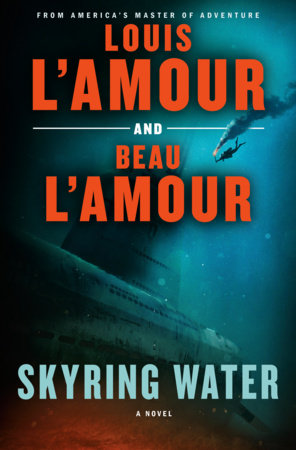
Download high-resolution image
Listen to a clip from the audiobook
audio pause button
0:00
0:00

Skyring Water

A Novel

Author Beau L'Amour On Tour, Louis L'Amour
Listen to a clip from the audiobook
audio pause button
0:00
0:00
Louis and Beau L’Amour present a collaboration across time, an epic novel of Cold War suspense, as a pair of unlikely heroes, a woman without a name, and the undefeated agents of the Third Reich find themselves locked in a deadly race to control the greatest secret of the 20th century.

1961. The world is on the brink of nuclear war. Walls are dividing East and West. Empires are crumbling. And in Barcelona, chaos is unleashed when a rogue officer of the East German STASI attempts to blackmail a pair of struggling arms dealers. The secret—30 tons of stolen gold hidden in an icebound wilderness at the end of the world.

Mike Fowler is a former Navy salvage diver and OSS assassin. Anton Voss is an expatriate German scientist whose past grows darker the closer anyone looks. Once they might have been enemies, yet the two share an inseparable bond; they have saved one another's lives. But all of that is put at risk when Mike discovers Anton standing over a midnight visitor with a gun in his hand. 

Now they're on the run, allied with gangsters, pursued by the CIA, Israeli intelligence, and a shadowy cabal bent on creating an invisible empire. The trail leads from the rain-soaked docks of Marseilles to the futuristic towers of Caracas and the ruins of a secret island laboratory in Argentine Patagonia. The only way for Mike Fowler to save his oldest friends, and the woman he loves, is to unlock a decades-old mystery buried in his partner’s Nazi past . . . before it destroys them all.

Includes a special postscript by Beau L'Amour detailing the history of the original unpublished manuscript and the process of collaborating with his father both before, and after, his passing.
CHAPTER 1

Spain, 1961 . . .

The rear end of the Lancia skidded sideways. Muddy gravel roared in the wheel wells and rattled off the undercarriage. Mike Fowler counter-steered, then held the accelerator steady, letting the torque of the six-cylinder engine do its job. As the tachometer hit five thousand rpm, he shifted into third gear.

Ahead of him the rugged peaks and ridgelines of the Pyrenees were obscured by low gray clouds. On one side the slope fell away with not much more than a slushy berm between his tires and the treetops; on the other rocks nearly clipped the sideview mirror. Watery wind-driven snow smeared under his wipers, blurring his view of the rutted road.

It didn't matter. In this machine, under these conditions, nothing could touch him. The car was a 1955 Aurelia B20. Though a few years old, it remained a wonder of Italian engineering. It was owned by Fowler's business partner, Anton Voss, a man who had an unerring instinct when it came to anything mechanical.

The fact that it was another man's car would not go over well if the Spanish police stopped him, and the situation was sure to go from bad to worse if they decided to search the trunk. But Mike Fowler had a considerably more serious problem than being pulled over by the Guardia Civil. And that was why he was tearing up a twisting mountain road headed into a storm that was sure to close the passes into France before morning.

Nearly thirty tons of gold bullion. Thirty tons lost to history, its existence the stuff of myth or the colorfully illustrated cover of a men's adventure magazine. A legendary treasure hidden in one of the most inaccessible places on the planet. Men were willing to kill to discover its location, and now some of them believed that Anton Voss knew where it could be found.

As the car roared past a stand of trees, Fowler saw what he was looking for: a long straight grade and, at the top, a tight curve disappearing behind a shoulder of the hill. He took it as fast as he dared while keeping an eye on the rearview mirror. There was no sign of pursuit.
He hit the brakes as he rounded the curve. The car slewed across the road, coming to a stop with its nose buried in the brush. Cutting the engine, he climbed out and, moving to the back of the Lancia, opened the boot.

Pulling away a greasy tarp, he removed a Sturmgewehr 44 assault rifle and a pair of pouches holding six curved magazines. Fowler dodged up the slope inside the elbow of the turn. Stopping at an outcrop of rain-slick rock he took cover behind the dead branches that had fallen from a small oak.

He spotted them a mile off. The driver of the black Mercedes was pushing it hard, fearing his quarry was escaping and desperate to catch up. Mike Fowler smiled grimly. He knew these mountains from long experience. He could outdrive his pursuers as long as he had petrol in his tank. But he couldn't allow them to know where he crossed the border. If they were as organized as he suspected, they could have a team waiting not long after he reached France.

What the men in the Mercedes didn't realize was that he hadn't been running, not since he'd left Barcelona. He had driven far and fast, but his plan had been to gain just enough distance to set a trap.

Adjusting the sights on the StG 44, he raised the gun. When the black car was about two hundred yards out, he fired. Once. Twice.

The first bullet went into the tank at the top of the radiator, the second lower down. The oil pan on the Mercedes was relatively well protected, and the 8mm Kurz cartridge would not penetrate like that of a full-power rifle, but he figured he'd try for it anyway.

Steam burst through the grill and the gaps around the hood. The tires locked up and the Mercedes slid to a halt, the vague form of the driver craning forward trying to see what had gone wrong.

The two men in the car didn't realize they were under fire.

Fowler squeezed the trigger again, putting a round through the windshield. Then he took out the left front tire and punched a pair of holes in the pontoonlike fender, searching for the distributor or fuel pump. The engine died.

There was a muffled shout of alarm. The front door on the far side of the Mercedes popped open and the men dove for cover below the edge of the road.

There was a flicker of movement just past the trunk lid and then pistol shots cracked up from below. He couldn't tell where the gunfire was aimed but it wasn't coming anywhere close.

Beyond the car, through a screen of wet, wilted grass he made out a black shape . . . the shoulder of a trench coat. Fowler fired a single shot. The man in the black coat twisted and cried out. Cursing in German, he crabbed sideways, painfully searching for better cover.

Fowler turned away from the road and bellowed, "On the slope! They're on the slope!" His voice echoed off the hill behind him, hopefully obscuring his location and confusing the men below as to how many attackers they were facing. It didn't work as well as he would have liked. One bullet and then another ricocheted off the rocks just to Fowler's left.
Mike decided he had played with them long enough. Thumbing the fire selector over, he loosed two three-round bursts. The bullets chewed up rock and weeds and mud. A ricochet whined off into the depths of the canyon. After that there was no more return fire, and he could no longer see either man.

Good. The plan had been to draw their pursuers' attention, giving Voss an opportunity to get away. Fowler wanted them to think that he and Anton were together, and he wanted them to report as much to their superiors. But if these men showed any more resistance, he would hunt them down and kill them. The shadowy group they worked for had destroyed everything he and Anton Voss had struggled to build over the last decade.

Fowler blasted a line of bullet holes down the side of the Mercedes. He shredded the left rear tire. He changed magazines and blew out the windshield and side windows. Take this as a warning, he thought. Don't make me come after you.

He changed magazines again and again, firing long undisciplined bursts. A pile of spent shells grew as he turned the grill into a pockmarked ruin and shot out the headlights, the mirrors, and then one of the door handles. When the stamped metal of the gun steamed and the foregrip scalded his hand even through his driving glove, Fowler stopped. Below him the almost new 1960 Mercedes 220 was a complete wreck. Only one patch of sheet metal remained bare, the driver's-side door.

He stood, a gesture of his contempt, challenging the men below to try something.

"You want to stop us?" he yelled. "Now's your chance!" His voice echoed off the hills and cliffs.

Nothing happened. He hoped they were listening but, if they were smart, they were halfway down the canyon. He slung the rifle and slid a handgun from his belt. It was a 9mm SIG 47/8, a gun their enemies knew was favored by Anton Voss.

Fowler found a position lower on the hill. He raised the pistol and fired, putting a tight group of bullets into the door and a few more into the rest of the body. He moved slightly, spreading out the pattern of ejected cartridges and smearing his footprints until they were hard to read. The gun locked open. Grabbing the heel release, he dropped the distinctive magazine on the ground, doing what he could to suggest there had been two shooters.

He didn't know how convincing the ruse was. But since he left Barcelona none of their enemies had come close enough to see inside the car. If he was lucky, they might not be aware that Anton owned a yacht or where, until just recently, it had been moored. He was risking his life and his freedom on what could very well be a fool's errand.

Deep in the mountains he pulled over at a wayside above a brush-choked ravine. Taking out the assault rifle, he removed the buttstock, recoil spring, and bolt carrier. He swung the barrel and receiver of the gun in an underhanded arc, sending it pinwheeling into the depths to his left. He tossed the remainder of the parts in the other direction. A moment later he had disposed of the SIG in a similar fashion.

Fowler opened a garment bag and a leather Gladstone. He changed out of his dirty clothes and into a three-piece suit of brown tweed. Then he replaced his muddy combat boots with a pair of handmade shoes. In the last light of day, he combed his hair in the reflection of the car window. He wasn't sure who he saw looking back: a nondescript forty-year-old man with a lean, disciplined body and a face that betrayed little. A man who had fought his way to the top of a profession that he could not discuss in polite company. And now he suspected he couldn't claim even that: his business was a smoking ruin that would probably be seized by the Spanish government. He was a wanted man. There was no way of going back.

He took a slow look around. Catalonia had been his home as long as anywhere on earth. If he ever returned, it was likely he would be arrested for murder. He slipped into the mud-streaked Lancia and fired up the motor. There was a storm coming, and he still had a long way to go.
“I bow and tip my hat to the amazing talents of Louis L’Amour and Beau L’Amour for Skyring Water. Not only did Louis L’Amour thoroughly entertain me while growing up, but he continues to do so with a wholly unexpected Cold War thriller.”—C. J. Box, #1 New York Times bestselling author of The Crossroads

“Louis and Beau L’Amour deliver a masterful Cold War adventure. What begins as a hunt for gold becomes a hunt for the truth. Skyring Water touches on the big themes—loyalty, history, and the costs of war. This novel delivers.”—Elliot Ackerman, author of Sheepdogs

“In the master storyteller’s new novel—brilliantly completed by his son Beau—Louis L’Amour unleashes a lightning-fast international thriller that roars far beyond the frontier. Raw, relentless, and packed with heart-stopping action, Skyring Water is classic adventure at its finest. Beau has done his father proud again.”—Ryan Pote, author of The Ghost City
© Chai Telan
Beau L’Amour is a writer, art director, and editor. He has written and produced several films, including USA Network’s The Diamond of Jeru. Since 1988 he has been the manager of the estate of his father, Louis L’Amour. View titles by Beau L'Amour
Our foremost storyteller of the American West, Louis L’Amour has thrilled a nation by chronicling the adventures of the brave men and woman who settled the frontier. There are more than three hundred million copies of his books in print around the world. View titles by Louis L'Amour

About

Louis and Beau L’Amour present a collaboration across time, an epic novel of Cold War suspense, as a pair of unlikely heroes, a woman without a name, and the undefeated agents of the Third Reich find themselves locked in a deadly race to control the greatest secret of the 20th century.

1961. The world is on the brink of nuclear war. Walls are dividing East and West. Empires are crumbling. And in Barcelona, chaos is unleashed when a rogue officer of the East German STASI attempts to blackmail a pair of struggling arms dealers. The secret—30 tons of stolen gold hidden in an icebound wilderness at the end of the world.

Mike Fowler is a former Navy salvage diver and OSS assassin. Anton Voss is an expatriate German scientist whose past grows darker the closer anyone looks. Once they might have been enemies, yet the two share an inseparable bond; they have saved one another's lives. But all of that is put at risk when Mike discovers Anton standing over a midnight visitor with a gun in his hand. 

Now they're on the run, allied with gangsters, pursued by the CIA, Israeli intelligence, and a shadowy cabal bent on creating an invisible empire. The trail leads from the rain-soaked docks of Marseilles to the futuristic towers of Caracas and the ruins of a secret island laboratory in Argentine Patagonia. The only way for Mike Fowler to save his oldest friends, and the woman he loves, is to unlock a decades-old mystery buried in his partner’s Nazi past . . . before it destroys them all.

Includes a special postscript by Beau L'Amour detailing the history of the original unpublished manuscript and the process of collaborating with his father both before, and after, his passing.

Excerpt

CHAPTER 1

Spain, 1961 . . .

The rear end of the Lancia skidded sideways. Muddy gravel roared in the wheel wells and rattled off the undercarriage. Mike Fowler counter-steered, then held the accelerator steady, letting the torque of the six-cylinder engine do its job. As the tachometer hit five thousand rpm, he shifted into third gear.

Ahead of him the rugged peaks and ridgelines of the Pyrenees were obscured by low gray clouds. On one side the slope fell away with not much more than a slushy berm between his tires and the treetops; on the other rocks nearly clipped the sideview mirror. Watery wind-driven snow smeared under his wipers, blurring his view of the rutted road.

It didn't matter. In this machine, under these conditions, nothing could touch him. The car was a 1955 Aurelia B20. Though a few years old, it remained a wonder of Italian engineering. It was owned by Fowler's business partner, Anton Voss, a man who had an unerring instinct when it came to anything mechanical.

The fact that it was another man's car would not go over well if the Spanish police stopped him, and the situation was sure to go from bad to worse if they decided to search the trunk. But Mike Fowler had a considerably more serious problem than being pulled over by the Guardia Civil. And that was why he was tearing up a twisting mountain road headed into a storm that was sure to close the passes into France before morning.

Nearly thirty tons of gold bullion. Thirty tons lost to history, its existence the stuff of myth or the colorfully illustrated cover of a men's adventure magazine. A legendary treasure hidden in one of the most inaccessible places on the planet. Men were willing to kill to discover its location, and now some of them believed that Anton Voss knew where it could be found.

As the car roared past a stand of trees, Fowler saw what he was looking for: a long straight grade and, at the top, a tight curve disappearing behind a shoulder of the hill. He took it as fast as he dared while keeping an eye on the rearview mirror. There was no sign of pursuit.

He hit the brakes as he rounded the curve. The car slewed across the road, coming to a stop with its nose buried in the brush. Cutting the engine, he climbed out and, moving to the back of the Lancia, opened the boot.

Pulling away a greasy tarp, he removed a Sturmgewehr 44 assault rifle and a pair of pouches holding six curved magazines. Fowler dodged up the slope inside the elbow of the turn. Stopping at an outcrop of rain-slick rock he took cover behind the dead branches that had fallen from a small oak.

He spotted them a mile off. The driver of the black Mercedes was pushing it hard, fearing his quarry was escaping and desperate to catch up. Mike Fowler smiled grimly. He knew these mountains from long experience. He could outdrive his pursuers as long as he had petrol in his tank. But he couldn't allow them to know where he crossed the border. If they were as organized as he suspected, they could have a team waiting not long after he reached France.

What the men in the Mercedes didn't realize was that he hadn't been running, not since he'd left Barcelona. He had driven far and fast, but his plan had been to gain just enough distance to set a trap.

Adjusting the sights on the StG 44, he raised the gun. When the black car was about two hundred yards out, he fired. Once. Twice.

The first bullet went into the tank at the top of the radiator, the second lower down. The oil pan on the Mercedes was relatively well protected, and the 8mm Kurz cartridge would not penetrate like that of a full-power rifle, but he figured he'd try for it anyway.

Steam burst through the grill and the gaps around the hood. The tires locked up and the Mercedes slid to a halt, the vague form of the driver craning forward trying to see what had gone wrong.

The two men in the car didn't realize they were under fire.

Fowler squeezed the trigger again, putting a round through the windshield. Then he took out the left front tire and punched a pair of holes in the pontoonlike fender, searching for the distributor or fuel pump. The engine died.

There was a muffled shout of alarm. The front door on the far side of the Mercedes popped open and the men dove for cover below the edge of the road.

There was a flicker of movement just past the trunk lid and then pistol shots cracked up from below. He couldn't tell where the gunfire was aimed but it wasn't coming anywhere close.

Beyond the car, through a screen of wet, wilted grass he made out a black shape . . . the shoulder of a trench coat. Fowler fired a single shot. The man in the black coat twisted and cried out. Cursing in German, he crabbed sideways, painfully searching for better cover.

Fowler turned away from the road and bellowed, "On the slope! They're on the slope!" His voice echoed off the hill behind him, hopefully obscuring his location and confusing the men below as to how many attackers they were facing. It didn't work as well as he would have liked. One bullet and then another ricocheted off the rocks just to Fowler's left.

Mike decided he had played with them long enough. Thumbing the fire selector over, he loosed two three-round bursts. The bullets chewed up rock and weeds and mud. A ricochet whined off into the depths of the canyon. After that there was no more return fire, and he could no longer see either man.

Good. The plan had been to draw their pursuers' attention, giving Voss an opportunity to get away. Fowler wanted them to think that he and Anton were together, and he wanted them to report as much to their superiors. But if these men showed any more resistance, he would hunt them down and kill them. The shadowy group they worked for had destroyed everything he and Anton Voss had struggled to build over the last decade.

Fowler blasted a line of bullet holes down the side of the Mercedes. He shredded the left rear tire. He changed magazines and blew out the windshield and side windows. Take this as a warning, he thought. Don't make me come after you.

He changed magazines again and again, firing long undisciplined bursts. A pile of spent shells grew as he turned the grill into a pockmarked ruin and shot out the headlights, the mirrors, and then one of the door handles. When the stamped metal of the gun steamed and the foregrip scalded his hand even through his driving glove, Fowler stopped. Below him the almost new 1960 Mercedes 220 was a complete wreck. Only one patch of sheet metal remained bare, the driver's-side door.

He stood, a gesture of his contempt, challenging the men below to try something.

"You want to stop us?" he yelled. "Now's your chance!" His voice echoed off the hills and cliffs.

Nothing happened. He hoped they were listening but, if they were smart, they were halfway down the canyon. He slung the rifle and slid a handgun from his belt. It was a 9mm SIG 47/8, a gun their enemies knew was favored by Anton Voss.

Fowler found a position lower on the hill. He raised the pistol and fired, putting a tight group of bullets into the door and a few more into the rest of the body. He moved slightly, spreading out the pattern of ejected cartridges and smearing his footprints until they were hard to read. The gun locked open. Grabbing the heel release, he dropped the distinctive magazine on the ground, doing what he could to suggest there had been two shooters.

He didn't know how convincing the ruse was. But since he left Barcelona none of their enemies had come close enough to see inside the car. If he was lucky, they might not be aware that Anton owned a yacht or where, until just recently, it had been moored. He was risking his life and his freedom on what could very well be a fool's errand.

Deep in the mountains he pulled over at a wayside above a brush-choked ravine. Taking out the assault rifle, he removed the buttstock, recoil spring, and bolt carrier. He swung the barrel and receiver of the gun in an underhanded arc, sending it pinwheeling into the depths to his left. He tossed the remainder of the parts in the other direction. A moment later he had disposed of the SIG in a similar fashion.

Fowler opened a garment bag and a leather Gladstone. He changed out of his dirty clothes and into a three-piece suit of brown tweed. Then he replaced his muddy combat boots with a pair of handmade shoes. In the last light of day, he combed his hair in the reflection of the car window. He wasn't sure who he saw looking back: a nondescript forty-year-old man with a lean, disciplined body and a face that betrayed little. A man who had fought his way to the top of a profession that he could not discuss in polite company. And now he suspected he couldn't claim even that: his business was a smoking ruin that would probably be seized by the Spanish government. He was a wanted man. There was no way of going back.

He took a slow look around. Catalonia had been his home as long as anywhere on earth. If he ever returned, it was likely he would be arrested for murder. He slipped into the mud-streaked Lancia and fired up the motor. There was a storm coming, and he still had a long way to go.

Reviews

“I bow and tip my hat to the amazing talents of Louis L’Amour and Beau L’Amour for Skyring Water. Not only did Louis L’Amour thoroughly entertain me while growing up, but he continues to do so with a wholly unexpected Cold War thriller.”—C. J. Box, #1 New York Times bestselling author of The Crossroads

“Louis and Beau L’Amour deliver a masterful Cold War adventure. What begins as a hunt for gold becomes a hunt for the truth. Skyring Water touches on the big themes—loyalty, history, and the costs of war. This novel delivers.”—Elliot Ackerman, author of Sheepdogs

“In the master storyteller’s new novel—brilliantly completed by his son Beau—Louis L’Amour unleashes a lightning-fast international thriller that roars far beyond the frontier. Raw, relentless, and packed with heart-stopping action, Skyring Water is classic adventure at its finest. Beau has done his father proud again.”—Ryan Pote, author of The Ghost City

Author

© Chai Telan
Beau L’Amour is a writer, art director, and editor. He has written and produced several films, including USA Network’s The Diamond of Jeru. Since 1988 he has been the manager of the estate of his father, Louis L’Amour. View titles by Beau L'Amour
Our foremost storyteller of the American West, Louis L’Amour has thrilled a nation by chronicling the adventures of the brave men and woman who settled the frontier. There are more than three hundred million copies of his books in print around the world. View titles by Louis L'Amour
  • More Websites from
    Penguin Random House
  • Common Reads
  • Library Marketing