Close Modal
Download high-resolution image Look inside
Listen to a clip from the audiobook
audio pause button
0:00
0:00

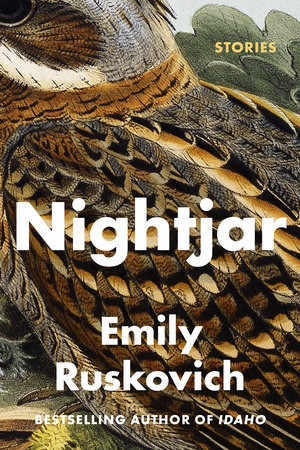
Nightjar

Stories

Look inside
Listen to a clip from the audiobook
audio pause button
0:00
0:00
Hardcover
$29.00 US
| $39.99 CAN
12 per carton
On sale Jul 07, 2026 | 272 Pages | 9780812994025
Grades 9-12 + AP/IB

See Additional Formats
From the award-winning author of the national bestseller Idaho comes a “stunning collection” (Harper’s Bazaar) of stories that explore how unexpected intuitions forever alter the lives of ordinary people.

“These are marvelous and unsettling stories.”—Kelly Link, author of The Book of Love

“In clear and distinctive prose, Emily Ruskovich evokes the epic scope of quiet lives.”—Paula Hawkins, author of A Slow Fire Burning

Five years after moving into the isolated house in rural Oregon where her husband lived as a child, the protagonist of “Victor’s Room” begins to doubt her husband’s account of his family’s past. In “Round Lake,” a young woman’s plans to meet a lover in Tokyo are upended when she learns a startling truth about her mother’s death. In “Owl,” winner of an O. Henry Award, a fur trapper reckons with the dreadful origins of his marriage after his wife is brutally injured by four adolescent boys.

Haunting and psychologically provocative, and set against the vivid backdrop of the Pacific Northwest, Nightjar illuminates the secret, instinctive knowledge that lies just under the surface of our awareness.
Victor’s Room


But the cherries were sour.

There at the northern corner of their land, her two children spat them out. They scratched at their tongues like little animals and looked at Rebecca as if she had done this on purpose, promising sweet cherries and delivering these awful ones instead.

“I didn’t know,” she said, not meaning to laugh, but laughing for reasons she would never be able to tell them. In apology for this laughter, she petted the sun-warmed cap of Madeline’s hair and then touched her fingertip to the deep dimple on Dotty’s chin, her usual gestures of comfort. Madeline was four, Dotty nearly two, and all three of them were hungry and sweaty and tired and tick-ridden from the hour spent trudging through brush and briar to get to this tree. Rebecca’s arms were aching from carrying Dotty. Madeline’s new dress was clotted with burrs.

Even so, it was worth it to have found the tree. It was Grant who had told her it was here, that he’d eaten these very cherries as a boy.

“We could take some cherries to Papa’s peacocks,” said Madeline. Though only four, she was adept at salvaging experiences. She hated nothing more than disappointment.

Dotty clapped her hands and said “Hiss,” her word for sister. What she meant was that Hiss’s idea was a good one.

So the three of them gathered the fallen cherries and tied them up in Madeline’s jacket; the sack they had brought for this purpose had been lost along the way. They started their journey back to the house, Dotty in Rebecca’s arms, and Madeline trailing a few steps behind.

They lived just outside the town of Mardell, in the Blue Mountains of Oregon. Their land was tucked away in the narrow valley between two mountains, on fifty acres cut through by a small creek on the west side. Grant did all the shopping in Walla Walla, where he worked as a professor, so there was little reason to go into the town of Mardell, which was nothing more than a fire station, a mercantile, and a church. There was not even a school; the children who lived in Mardell had to take a bus all the way to Gibbon, thirty-five miles away. One hundred twelve people lived here, if the sign on the highway could be believed, but in the four years since she’d arrived, Rebecca had hardly seen anyone at all.

As soon as their house was in view, Madeline, suddenly bursting with energy, ran as fast as she could to the garden. Dotty wiggled out of Rebecca’s arms and toddled behind her sister, yelling “Hiss!” until she was sobbing about being left behind and Rebecca had to pick her up. Carrying Dotty, she followed the fence line down to Madeline, who was standing by the garden gate. The garden was fenced in so that the peacocks would not have to be; the peacocks roamed free in the day and roosted in the rafters of the old open barn at night.

Madeline called for the birds by name—Fethy, Throaty, Ee-yaw, and Tail-Tail. The names varied by week and by bird; Madeline could not tell them apart and called for them though she knew that not one of them would come. The birds did not pay attention to the girls or Rebecca, only Grant, who had cared for them as chicks when Madeline was a newborn.

The only animal who came that afternoon when Madeline called was Chips, the fifteen-year-old potbellied pig who had come with the house. Chips hobbled up the hill and they met at the edge of the larger garden. The old pig, grunting rapidly, rooted for the cherries in the jacket Madeline had laid out for her. They all fell into a happy silence then. Chips eating the cherries, Madeline watching Chips, Dotty digging in the soil, and Rebecca looking at the scene with detached amazement.

She rolled a cherry in her fingertips and turned to look up the hill at the large white farmhouse with its covered porch and sage-colored gables. For most of the four years that she had lived here, she had resented the pretty house and its lonely acres, had felt adrift in a life not really hers, and had longed to leave it behind.

But now she looked upon the farmhouse with a desire that was so strong it felt more like rage than like love.

Though love was what it was.

Surely it was love.


Rebecca had met Grant on the first day of her first semester at Whitman College, in 1971. She was eighteen, attending on a partial scholarship, her double major as yet undeclared but long ago decided: education and religious studies. Both passions ran in her blood. Her mother, long dead, had been a fourth-grade teacher, and her father a mechanic whose one regret in life was that he did not finish seminary.

Her first class, art history, an elective, was taught by Dr. Larry Williams, one of the most respected and popular professors on campus. Rebecca felt lucky to have been given a seat in his class her freshman year. The class was held on the fourth floor of Reynolds Hall, and though Rebecca was not late on that first day, she was later than everyone except for the professor. She had expected a lecture hall, but this was a normal classroom with movable desks, seating only about thirty people. There was only one seat available in the crowded room. It jutted out in front of the first row. She pretended not to be fazed by this exposed position and she sat down.

She remembers her first glimpse of the professor. He came through that door and with his eyes was already making a joke of what looked like her eagerness—The front row not close enough for ya? Somehow, he made this joke without any words at all, and yet the whole room seemed primed to laugh with him at anything he chose.

Rebecca was surprised by his joking demeanor. Also, he was much younger than she’d imagined. He looked to be barely thirty and seemed scattered and self-conscious. Though he had no accent there was something faintly British about the way he spoke, an affectation of gentility. He had a jumpy way of speaking, as if he were ever surprised and pleasantly appalled by anything that anyone said to him. He was tall and slim, youthful and self-delighted. He had put effort into his appearance—khakis, corduroy blazer, red tie—and yet he looked ragged up there at the front of the room, as if he had worn this same professor costume all summer long.

After making small talk with the students he knew, he launched into a long summary of his professional life and interests, which seemed to have absolutely nothing to do with art history. Nobody but Rebecca seemed irritated by this. Here she was, in her first-ever college class, taught supposedly by Whitman’s greatest, feeling already impatient and bored. Nearly twenty minutes passed before the professor mentioned the name of the class, the History of Modern Psychiatry.

She nearly laughed—this was not her class. This was not the professor people held in high esteem.

Elated, she rose, smiled, mumbled an apology, and made her way to the door.

The professor, whose name had not been given, and who clearly had not prepared a lecture, this being the first day, a throwaway day, said, “Whoa, hold on there, now,” and smiled with amusement at the suddenness of her departure.

“Wrong class,” she said, moving past him.

“Well,” he said, with a teasing smile. “Maybe this isn’t the class you’re signed up for, but what makes you think it’s the wrong class? Isn’t it possible your subconscious brought you here for a reason?”

“I don’t think so.” She opened the door.

Then he said, “Stay.”

She remembers the way he said it. A change in the room. He was still smiling, but she sensed something behind that smile, an insistence hidden in humor. His “Stay” was a command barely masquerading as play.

She looked around at the other people in the room, but nobody was looking at her with anything other than mild amusement. She hesitated just long enough that a woman in the class spoke up. “I’m first on the wait list,” the woman said. “There are five of us waiting to get in if someone drops.” By this she meant that letting in one random girl who did not want to be there was at the expense of five who did.

The professor said to Rebecca, “You hear that? Five people want in, and you want out.”

He was still smiling. “Raise your hand if you are on the wait list,” he said to the class. Five hands went up. He looked at Rebecca. “I tell you what,” he said. “If you stay in this class, they stay. All five of them. And I never let people in over the cap.”

“I have a class with Dr. Williams,” she said.

“But it’s only a day,” he said. “What’s a day to you?”

This took her aback, the sudden reversal of terms. Clearly, just seconds before, he had meant that she would have to stay the whole semester, and now he was saying he meant only a day. It made her realize that he wanted to win this somehow, to keep her here for any length of time at all. She stared at him, wondering what was going on.

Then he said, in a jokey way, “Come on. You stay one day, they stay the whole term. You don’t want to rob these five of a riveting education, do you?” He sat down on the side of what had been her desk, and he patted it, as if to say, Come along, come here.

There was something happening here and she did not understand what it was. “So, tell me,” he said. “Is there some reason you must get to that other class, some reason you must be exactly who you said you would be?”
Praise for Nightjar

“Emily Ruskovich, who wrote the best-selling and award-winning 2017 novel Idaho, proves herself to be a master of short fiction with this stunning collection of five short stories set against the otherworldly backdrop of the wilderness of the Pacific Northwest. Whether the stories revolve around a young woman moving into her husband’s childhood home or an estranged father grieving the loss of his brother, all of them explore the flimsy intersection between secrets and innocence, truth and memory.”—Harper’s Bazaar

“To read Emily Ruskovich is to unwrap a gift: her stories are surprising, rewarding, beautiful. There are strange love affairs, hearts gently breaking, cherished childhood memories that turn out to be untrue; in clear and distinctive prose, she evokes the epic scope of quiet lives.”—Paula Hawkins, New York Times bestselling author of A Slow Fire Burning

“These are marvelous and unsettling stories. Ruskovich’s prose is lambent, the relationships between her characters are thorny, complex, and mesmerizing, and the shapes of her stories constantly surprise. I loved Nightjar.”—Kelly Link, bestselling author of The Book of Love

“These are exquisite short stories. They disturb, delight, and linger long after finishing.”—Louise Kennedy, author of Trespasses

“Ruskovich blends urgent pacing with lush wooded scenery and intimate psychological details. It’s a marvel.”Publishers Weekly, starred review

“In this exquisitely tailored collection of five stories, Ruskovich plumbs the depths of mystery, memory, and the quiet grief of intimacy. . . . Like Idaho, this book has a compelling slipperiness, both in time and reality. Ruskovich’s characters are often in two places in time at once, and she expertly weaves memory and observation to fuse the past and present together. . . . A portal to a haunting, liminal Pacific Northwest.”Kirkus Reviews, starred review


Praise for Emily Ruskovich


“You know you’re in masterly hands here. . . . Wrenching and beautiful.”—The New York Times Book Review

“Sensuous, exquisitely crafted.”The Wall Street Journal

“Riveting . . . exquisitely rendered with masterful language and imagery . . . powerful and deeply moving.”The Washington Post

“Shatteringly original . . . upturns everything you think you know about story. . . . You could read Idaho just for the sheer beauty of the prose, the expert way Ruskovich makes everything strange and yet absolutely familiar. . . . She startles with images so fresh, they make you see the world anew.”San Francisco Chronicle

“Ruskovich’s prose is immensely seductive.”The Boston Globe

“Haunting, propulsive and gorgeously written.”People
© Sam McPhee
Emily Ruskovich is the author of the bestselling novel Idaho, which won the International Dublin Literary Award, only the fourth American novel ever to do so. Ruskovich is also the recipient of the Pacific Northwest Book Award and an O. Henry Prize. Her writing has appeared in The New York Times, The Paris Review, The Guardian, One Story, Zoetrope, The Virginia Quarterly Review, and elsewhere. She grew up in the Idaho panhandle, and lives now in the mountains of western Montana with her husband and their three young children. Nightjar is her second book. View titles by Emily Ruskovich

About

From the award-winning author of the national bestseller Idaho comes a “stunning collection” (Harper’s Bazaar) of stories that explore how unexpected intuitions forever alter the lives of ordinary people.

“These are marvelous and unsettling stories.”—Kelly Link, author of The Book of Love

“In clear and distinctive prose, Emily Ruskovich evokes the epic scope of quiet lives.”—Paula Hawkins, author of A Slow Fire Burning

Five years after moving into the isolated house in rural Oregon where her husband lived as a child, the protagonist of “Victor’s Room” begins to doubt her husband’s account of his family’s past. In “Round Lake,” a young woman’s plans to meet a lover in Tokyo are upended when she learns a startling truth about her mother’s death. In “Owl,” winner of an O. Henry Award, a fur trapper reckons with the dreadful origins of his marriage after his wife is brutally injured by four adolescent boys.

Haunting and psychologically provocative, and set against the vivid backdrop of the Pacific Northwest, Nightjar illuminates the secret, instinctive knowledge that lies just under the surface of our awareness.

Excerpt

Victor’s Room


But the cherries were sour.

There at the northern corner of their land, her two children spat them out. They scratched at their tongues like little animals and looked at Rebecca as if she had done this on purpose, promising sweet cherries and delivering these awful ones instead.

“I didn’t know,” she said, not meaning to laugh, but laughing for reasons she would never be able to tell them. In apology for this laughter, she petted the sun-warmed cap of Madeline’s hair and then touched her fingertip to the deep dimple on Dotty’s chin, her usual gestures of comfort. Madeline was four, Dotty nearly two, and all three of them were hungry and sweaty and tired and tick-ridden from the hour spent trudging through brush and briar to get to this tree. Rebecca’s arms were aching from carrying Dotty. Madeline’s new dress was clotted with burrs.

Even so, it was worth it to have found the tree. It was Grant who had told her it was here, that he’d eaten these very cherries as a boy.

“We could take some cherries to Papa’s peacocks,” said Madeline. Though only four, she was adept at salvaging experiences. She hated nothing more than disappointment.

Dotty clapped her hands and said “Hiss,” her word for sister. What she meant was that Hiss’s idea was a good one.

So the three of them gathered the fallen cherries and tied them up in Madeline’s jacket; the sack they had brought for this purpose had been lost along the way. They started their journey back to the house, Dotty in Rebecca’s arms, and Madeline trailing a few steps behind.

They lived just outside the town of Mardell, in the Blue Mountains of Oregon. Their land was tucked away in the narrow valley between two mountains, on fifty acres cut through by a small creek on the west side. Grant did all the shopping in Walla Walla, where he worked as a professor, so there was little reason to go into the town of Mardell, which was nothing more than a fire station, a mercantile, and a church. There was not even a school; the children who lived in Mardell had to take a bus all the way to Gibbon, thirty-five miles away. One hundred twelve people lived here, if the sign on the highway could be believed, but in the four years since she’d arrived, Rebecca had hardly seen anyone at all.

As soon as their house was in view, Madeline, suddenly bursting with energy, ran as fast as she could to the garden. Dotty wiggled out of Rebecca’s arms and toddled behind her sister, yelling “Hiss!” until she was sobbing about being left behind and Rebecca had to pick her up. Carrying Dotty, she followed the fence line down to Madeline, who was standing by the garden gate. The garden was fenced in so that the peacocks would not have to be; the peacocks roamed free in the day and roosted in the rafters of the old open barn at night.

Madeline called for the birds by name—Fethy, Throaty, Ee-yaw, and Tail-Tail. The names varied by week and by bird; Madeline could not tell them apart and called for them though she knew that not one of them would come. The birds did not pay attention to the girls or Rebecca, only Grant, who had cared for them as chicks when Madeline was a newborn.

The only animal who came that afternoon when Madeline called was Chips, the fifteen-year-old potbellied pig who had come with the house. Chips hobbled up the hill and they met at the edge of the larger garden. The old pig, grunting rapidly, rooted for the cherries in the jacket Madeline had laid out for her. They all fell into a happy silence then. Chips eating the cherries, Madeline watching Chips, Dotty digging in the soil, and Rebecca looking at the scene with detached amazement.

She rolled a cherry in her fingertips and turned to look up the hill at the large white farmhouse with its covered porch and sage-colored gables. For most of the four years that she had lived here, she had resented the pretty house and its lonely acres, had felt adrift in a life not really hers, and had longed to leave it behind.

But now she looked upon the farmhouse with a desire that was so strong it felt more like rage than like love.

Though love was what it was.

Surely it was love.


Rebecca had met Grant on the first day of her first semester at Whitman College, in 1971. She was eighteen, attending on a partial scholarship, her double major as yet undeclared but long ago decided: education and religious studies. Both passions ran in her blood. Her mother, long dead, had been a fourth-grade teacher, and her father a mechanic whose one regret in life was that he did not finish seminary.

Her first class, art history, an elective, was taught by Dr. Larry Williams, one of the most respected and popular professors on campus. Rebecca felt lucky to have been given a seat in his class her freshman year. The class was held on the fourth floor of Reynolds Hall, and though Rebecca was not late on that first day, she was later than everyone except for the professor. She had expected a lecture hall, but this was a normal classroom with movable desks, seating only about thirty people. There was only one seat available in the crowded room. It jutted out in front of the first row. She pretended not to be fazed by this exposed position and she sat down.

She remembers her first glimpse of the professor. He came through that door and with his eyes was already making a joke of what looked like her eagerness—The front row not close enough for ya? Somehow, he made this joke without any words at all, and yet the whole room seemed primed to laugh with him at anything he chose.

Rebecca was surprised by his joking demeanor. Also, he was much younger than she’d imagined. He looked to be barely thirty and seemed scattered and self-conscious. Though he had no accent there was something faintly British about the way he spoke, an affectation of gentility. He had a jumpy way of speaking, as if he were ever surprised and pleasantly appalled by anything that anyone said to him. He was tall and slim, youthful and self-delighted. He had put effort into his appearance—khakis, corduroy blazer, red tie—and yet he looked ragged up there at the front of the room, as if he had worn this same professor costume all summer long.

After making small talk with the students he knew, he launched into a long summary of his professional life and interests, which seemed to have absolutely nothing to do with art history. Nobody but Rebecca seemed irritated by this. Here she was, in her first-ever college class, taught supposedly by Whitman’s greatest, feeling already impatient and bored. Nearly twenty minutes passed before the professor mentioned the name of the class, the History of Modern Psychiatry.

She nearly laughed—this was not her class. This was not the professor people held in high esteem.

Elated, she rose, smiled, mumbled an apology, and made her way to the door.

The professor, whose name had not been given, and who clearly had not prepared a lecture, this being the first day, a throwaway day, said, “Whoa, hold on there, now,” and smiled with amusement at the suddenness of her departure.

“Wrong class,” she said, moving past him.

“Well,” he said, with a teasing smile. “Maybe this isn’t the class you’re signed up for, but what makes you think it’s the wrong class? Isn’t it possible your subconscious brought you here for a reason?”

“I don’t think so.” She opened the door.

Then he said, “Stay.”

She remembers the way he said it. A change in the room. He was still smiling, but she sensed something behind that smile, an insistence hidden in humor. His “Stay” was a command barely masquerading as play.

She looked around at the other people in the room, but nobody was looking at her with anything other than mild amusement. She hesitated just long enough that a woman in the class spoke up. “I’m first on the wait list,” the woman said. “There are five of us waiting to get in if someone drops.” By this she meant that letting in one random girl who did not want to be there was at the expense of five who did.

The professor said to Rebecca, “You hear that? Five people want in, and you want out.”

He was still smiling. “Raise your hand if you are on the wait list,” he said to the class. Five hands went up. He looked at Rebecca. “I tell you what,” he said. “If you stay in this class, they stay. All five of them. And I never let people in over the cap.”

“I have a class with Dr. Williams,” she said.

“But it’s only a day,” he said. “What’s a day to you?”

This took her aback, the sudden reversal of terms. Clearly, just seconds before, he had meant that she would have to stay the whole semester, and now he was saying he meant only a day. It made her realize that he wanted to win this somehow, to keep her here for any length of time at all. She stared at him, wondering what was going on.

Then he said, in a jokey way, “Come on. You stay one day, they stay the whole term. You don’t want to rob these five of a riveting education, do you?” He sat down on the side of what had been her desk, and he patted it, as if to say, Come along, come here.

There was something happening here and she did not understand what it was. “So, tell me,” he said. “Is there some reason you must get to that other class, some reason you must be exactly who you said you would be?”

Reviews

Praise for Nightjar

“Emily Ruskovich, who wrote the best-selling and award-winning 2017 novel Idaho, proves herself to be a master of short fiction with this stunning collection of five short stories set against the otherworldly backdrop of the wilderness of the Pacific Northwest. Whether the stories revolve around a young woman moving into her husband’s childhood home or an estranged father grieving the loss of his brother, all of them explore the flimsy intersection between secrets and innocence, truth and memory.”—Harper’s Bazaar

“To read Emily Ruskovich is to unwrap a gift: her stories are surprising, rewarding, beautiful. There are strange love affairs, hearts gently breaking, cherished childhood memories that turn out to be untrue; in clear and distinctive prose, she evokes the epic scope of quiet lives.”—Paula Hawkins, New York Times bestselling author of A Slow Fire Burning

“These are marvelous and unsettling stories. Ruskovich’s prose is lambent, the relationships between her characters are thorny, complex, and mesmerizing, and the shapes of her stories constantly surprise. I loved Nightjar.”—Kelly Link, bestselling author of The Book of Love

“These are exquisite short stories. They disturb, delight, and linger long after finishing.”—Louise Kennedy, author of Trespasses

“Ruskovich blends urgent pacing with lush wooded scenery and intimate psychological details. It’s a marvel.”Publishers Weekly, starred review

“In this exquisitely tailored collection of five stories, Ruskovich plumbs the depths of mystery, memory, and the quiet grief of intimacy. . . . Like Idaho, this book has a compelling slipperiness, both in time and reality. Ruskovich’s characters are often in two places in time at once, and she expertly weaves memory and observation to fuse the past and present together. . . . A portal to a haunting, liminal Pacific Northwest.”Kirkus Reviews, starred review


Praise for Emily Ruskovich


“You know you’re in masterly hands here. . . . Wrenching and beautiful.”—The New York Times Book Review

“Sensuous, exquisitely crafted.”The Wall Street Journal

“Riveting . . . exquisitely rendered with masterful language and imagery . . . powerful and deeply moving.”The Washington Post

“Shatteringly original . . . upturns everything you think you know about story. . . . You could read Idaho just for the sheer beauty of the prose, the expert way Ruskovich makes everything strange and yet absolutely familiar. . . . She startles with images so fresh, they make you see the world anew.”San Francisco Chronicle

“Ruskovich’s prose is immensely seductive.”The Boston Globe

“Haunting, propulsive and gorgeously written.”People

Author

© Sam McPhee
Emily Ruskovich is the author of the bestselling novel Idaho, which won the International Dublin Literary Award, only the fourth American novel ever to do so. Ruskovich is also the recipient of the Pacific Northwest Book Award and an O. Henry Prize. Her writing has appeared in The New York Times, The Paris Review, The Guardian, One Story, Zoetrope, The Virginia Quarterly Review, and elsewhere. She grew up in the Idaho panhandle, and lives now in the mountains of western Montana with her husband and their three young children. Nightjar is her second book. View titles by Emily Ruskovich
  • More Websites from
    Penguin Random House
  • Common Reads
  • Library Marketing