Download high-resolution image Look inside
Listen to a clip from the audiobook
audio pause button
0:00
0:00

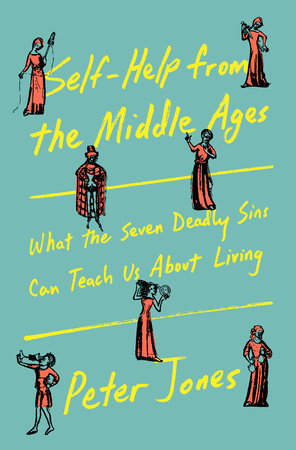
Self-Help from the Middle Ages

What the Seven Deadly Sins Can Teach Us About Living

Look inside
Listen to a clip from the audiobook
audio pause button
0:00
0:00
In this charming journey into the past, a historian reveals medieval wisdom that can still guide us today

"One of the most compelling medieval history books I have ever read."
–Ian Mortimer, author of The Time Traveler’s Guide to Medieval England


Peter Jones was teaching medieval history at a university in Siberia when his third icy winter there plunged him into a dark place. Luckily, he knew something few of us know-- that for all its reputation for darkness and superstition, the Middle Ages were the golden age of self-help. So he set out on a journey to explore the wisdom of medieval scholars, saints, and mystics, looking for an alternative path through the challenges of modern life.

Never in history, Jones marvels in Self-Help from the Middle Ages, has so much energy and talent gone into studying how the mind works as in the medieval centuries. Although today we think of the Seven Deadly Sins as a catalog of forbidden behavior, in the Middle Ages, at the height of their currency, they were a path to self-knowledge and self-forgiveness. Together, pride, envy, anger, sloth, greed, gluttony and lust were a psychological map that laid out seven basic patterns of thought, showing how our thinking can go astray and how we can find our way home.

In Self-Help from the Middle Ages, Jones explores each sin, searching the hellscapes of Hieronymous Bosch and Giotto, the intimate confessions of Dante and Margery Kempe, and the personal struggles of Francis of Assisi and Catherine of Siena. Along the way he discovers a treasure trove of lost truths about temptation, frustration, addiction, compulsion, burnout, rage, fear, anxiety, and grief that still pulse with life. With beautiful illustrations drawn from medieval art and literature, his book is a gift to all who love history and anyone who has ever sought wisdom from the past.
The Seven

I can’t think of the word. It’s not ‘distant’ or ‘obscure’, these are too cold. But it’s not ‘exotic’ either. What’s the word for this, the thing that horrifies you but then unlocks your heart?

In my hands is a book written on lambskin seven hundred years ago. It’s tall, like an oversized restaurant menu. The pages are yellow, the spine has the waxy feel of dead skin, and it smells of damp gardening gloves. It weighs roughly the same as a large fresh salmon. I’m sitting with it in the Vatican Library, and under the flash of the archivist’s spectacles I feel like the skinned lamb myself. Usually this book is kept in a concrete vault. You have to show your credentials at the front gate and surrender your passport to the Swiss Guards. Next you have to go through a brief interview, get your photo taken, sign several forms, and leave all your things in a digitally activated locker. Only then, after you’ve stripped off your modern identity, are you allowed to climb the stairs and get your hands on this, the world’s only copy of the Ark of Wisdom.1

Is it worth travelling to the Vatican City for? Opening up the 650- year-old manuscript, I find every combination of anxiety and desire. And although the ink is ancient, the ideas are as fresh as if they had been written this morning. Across the 300 pages there are ecstasies and passions, rages and fantasies, procrastinations and jealousies. So many of the thoughts I imagined were mine alone– thoughts exhilarating, petty, lonely or afraid – are here, exposed in brown Gothic handwriting. There are the telltale signs of hypocrisy; the ‘right’ and ‘wrong’ kinds of personal grooming; the best remedies for depression.2 The book pulses with energy, as if every word were written by somebody who already knew our world was coming.

I shouldn’t be surprised that this manuscript feels so alive. It was structured around a sixteen-hundred-year-old system that still works; a map that continues to function as a reliable guide to the human brain. Because the Ark of Wisdom is really a handbook for how to live with the Seven Deadly Sins.

For most of us in the twenty-first-century the Seven Deadly Sins are a bit of a joke. Not too long ago they inspired a range of ice creams, with a pink strawberry ‘Lust’ and a peanut-butter ‘Sloth’. Graphic novels have made them into villains, and video games have made them into end-of-level bosses. It’s still possible to stream Se7en (1995), the blockbuster movie starring Morgan Freeman and Brad Pitt, which features a serial killer who punishes people for each sin in turn (although in the wrong order).

But in the Middle Ages the Deadly Sins were more than a gimmick. They were psychological tools, keys for deciphering personality and decoding desire. They were a Periodic Table for the mind. As desert monks like John Cassian described them, the sins were a system for ordering and processing all thoughts. Every tempting idea and harmful act, in theory, could be traced back to some combination of these seven.3

What are their names? And what’s their ‘correct’ order?4 Listing them in their classic form
– and in their usual ranking, from most to least ‘deadly’ – the seven are:

1. Pride : Self- obsession, to the point of dismissing the lives of others. This usually grows out of your focus on yourself.
2. Envy : Craving for other people to fail, or for their successes to be crushed. This usually grows out of your focus on others.
3. Anger : Frenzy, rage and a loss of the power of reason. This usually grows out of your impatience with others, or with yourself.
4. Sloth : Despair, depression, or falling out of love with life. This usually grows out of a lack of focus.
5. Avarice : Questing for more and better possessions. This can also cover ‘wasteful’ generosity, or fixation on different objects. It usually grows out of a focus on material things.
6. Gluttony : Excessive desire for food, alcohol, or other consumables. This can also cover total abstinence from eating, or excessive connoisseurship. It usually grows out of a focus on necessity.
7. Lust : Fixation on sex, but also sensory pleasure. It usually grows out of a focus on bodies.

The Ark of Wisdom moves through each of these seven with the precision of a sniper and the compassion of a kidney donor. Written sometime in the late 1300s, it has rarely been cited or copied since. In fact, it remained more or less unknown beyond the monastery near Milan where it was first kept. So, reading it now, in the Vatican Library, is a moving experience. But really, the Ark of Wisdom is only the beginning. Out there in Europe’s archives are thousands of works just like this one: books that use the Seven Deadly Sins to explore temptation, frustration, fear, anxiety, grief and passion; guides for coping with rage and narcissism, and for embracing life’s positives. Obstacles keep these books out of our reach. Most are inaccessible, written in obscure languages and torturous handwriting. Also, they’re usually packaged under two labels – ‘medieval’ and ‘theology’ – that don’t always excite the average reader.

And this is an enormous loss. Because if these guides have a true home, it isn’t in the concrete vaults of a library building. And it’s not in a university research seminar, either. It’s in the hands of all of us, as we struggle through these labyrinths we get thrown into. The dark mazes of our lives.

A Pink Sky

A few years ago I fell into a trap that nearly swallowed me whole. It was a trench packed with unforgiving snow, and it was one I had dug all by myself.

I was teaching medieval history at a university in Siberia. Winter was approaching, and it was already bitterly cold. Below around minus 20ºC my eyelashes grew tiny icicles. Beyond minus 25ºC, if I stayed outside for longer than twenty minutes I could no longer feel my legs. I spent my afternoons in shopping malls, browsing leather bags and microfibre hats. I ate herring salads in cafés with pictures of the Eiffel Tower on the walls. Snow covered the pathways like fresh earth on a casket. Soon I found I no longer thought about the future. I stopped reading the news and I stopped contacting my friends. Then I stopped going outside at all. In my apartment I just stood by the window, pressed up against a radiator, watching as chimney stacks puffed smoke into a pink sky.

History can be an escape portal. It can transport you to a different life, a different heart. This was a lesson I began to learn when I was nine. One afternoon, early in the school holidays, my mother took me on the Piccadilly Line to the National Portrait Gallery in London. I stood in front of a picture of Richard III, the king who had been his mother’s twelfth child and who had died at the Battle of Bosworth Field in 1485. I looked at the faded lines of his black robe, his crooked fingers with their colourful rings, and his luminous, desperate face, and I felt something inside me spike. Part of it was horror. To live in a world so different. To be bludgeoned to death in a muddy field with a halberd axe. For this to be a plausible life outcome. But alongside this horror was another feeling. I found I was burning to lift the veil, to cross the abyss. I wanted to discover what life was really like for the people on the other side of this window of oil and wood.

Over the next three decades I chased that mystery I’d seen in the Middle Ages wherever it led me. It was a quest that took me around the world. For a while I lived in the basement of a second-hand bookshop, absorbing shelves of books with foxed endpapers and titles like Cistercian Monasticism. At university I became obsessed with medieval mystics, and wrote a musical comedy about the twelfth-century lovers Abelard and Heloïse. Moving to New York to do a PhD, I found my mentor, a French scholar who taught me to look for clues to medieval psychology in obscure Latin texts. I travelled between the archives of Paris and London, and I hunted through the margins of forgotten manuscripts. I published articles in academic journals, gave papers at conferences and found teaching jobs, first in Toronto and then in London, just a few hundred yards from the National Portrait Gallery. On quiet days I sometimes went back to visit King Richard, to thank him for all the glamour he had brought me.

And then, for reasons that are still opaque to me, I moved to the city of Tyumen in Siberia. Some of my motivations were fairly rational, in hindsight. My contract in London was ending and the job advert was enticing. The challenge of the climate and language appealed to me, and I was curious to see what medieval Europe might look like to people who had grown up under Vladimir Putin. When I sat explaining these reasons to my friends, it did occur to me that they didn’t amount to much, but I left these doubts behind when I arrived in my new home. At first I loved it. My days were filled with walks through silver birch forests. The snowflakes shone for me in the heavy air like diamonds. On the wall of my new apartment the landlord had hung a framed photograph of the cosmonaut Yuri Gagarin waving to a cheering crowd on a Moscow street. And most days I waved back.

But over time I stopped waving at Yuri. Over time the coldness in my life stretched beyond the hard fact of the weather. After days of heavy teaching, I would wake up with an ache that flowed from the stem of my brain into every capillary of my bloodstream. I was supposed to be researching and planning my lessons, to be getting on with my life. But I couldn’t bring myself to do anything at all. Standing by the window, my spirit disappearing with the smoke in the sky, I realised I had nothing to say. I didn’t want to give lectures. I didn’t want to read, and I didn’t want to look at any smiling cosmonauts. All I wanted to do was curl up and sleep for a thousand years.

A modern diagnosis of my condition would probably be straightforward. I was, I think, depressed. I was suffering from burnout, disillusionment, and the kind of deep melancholy that strikes around 20 per cent of the global population at some point in their lives. If I’d used my Siberian medical insurance, I would probably have been recommended either therapeutic or pharmaceutical solutions. I could have taken a CBT course, or gone through counselling sessions, or begun a regime of fluoxetine, citalopram, or sertraline, depending on how severe my doctor judged my case to be. Whatever the treatment, though, it might not have solved things for ever. According to psychiatric research, a substantial number of people who finish a course of antidepressants and do not receive further treatment relapse within twelve months. Experts on the culture of burnout have even suggested that a state of depression is knotted into my generation’s worldview in threads that can never be untangled.

I was still immersed in medieval thought, though. And as my nights got longer I kept turning over the same inevitable question. How would my condition have been treated in the Middle Ages? How did people get through a crisis of inertia or self-doubt seven hundred years ago, before Europe became ‘modern’? Although there would have been no drugs or clipboards, my depression would still have been considered a professional matter in the year 1300. In fact, an expert would have analysed how I thought, dreamed and moved through the world with an intensity that could make some modern therapy seem superficial. Because, as I discovered, the world that lay on the other side of the frame of King Richard’s portrait had a curious characteristic, a feature that makes it surprisingly close to our own. This was a civilisation geared towards understanding the human mind.

When I say this, I’m not talking about the entire European Middle Ages. Conventionally, the period spans the thousand years from the end of the Western Roman Empire (c.400s) to three major transformations in European history: the invention of the printing press (c.1450), which brought mass literacy and the rapid-fire circulation of ideas; the colonisation of the Americas (c.1492), which changed the economic and political landscape for ever; and the Reformation (c.1517), which fragmented the religious unity of much of Europe. Although ‘medieval’ can still be a useful label for this long time span, in practice the differences between society in the 600s and society in the 1400s are often so vast they cannot be put together in the same box. And so, when I say ‘medieval’, I’m really talking about the four centuries I fell in love with: the period we call the High and Later Middle Ages (c.1100–1500).

For the sake of getting to know them a little, these four centuries can be compared to four Beatles albums.

The 1100s are Revolver. Full of potential and uneasy tensions, with a creativity that was not yet self-conscious. This was an era of groundbreaking innovation: the first universities in Bologna and Paris; the first crusades; the first Gothic abbeys and cathedrals in Saint-Denis and Sens; and also the first Arthurian romances (a genre that, some have claimed, invented the modern idea of love). The writing from this period was looser, more experimental, and although often cynical it was also unpredictable and fun. From this point in time, anything seemed possible.

The 1200s are Sgt Pepper’s Lonely Hearts Club Band. More developed and sophisticated than what came before, with everything now in technicolour. The universities were in full flow, producing some of the biggest hits in the whole medieval canon. Eastern ideas exploded across the continent, with translations of the Quran and works of Arabic science, philosophy and medicine filling European libraries. The artwork was now more solid, more three-dimensional, and more emotionally expressive. But somehow everything was also becoming a parody of itself, with writers straining to hold all that creativity together without letting conflict and self-indulgence take over.

The 1300s are The Beatles (or the ‘White Album’). Sprawling and fragmented, with a surprising amount of violence and death tying things together (from the Peasants’ Revolt to the Great Plague). The major powers were now drifting apart, no longer uniting for joint crusades. And although some of the best writing of the Middle Ages survives from this period, including the Divine Comedy and the Canterbury Tales, these works somehow feel more isolated. Instead of being in the universal language of Latin, they were written in Tuscan and Middle English. And so, even though literature could now reach wider national audiences, the era of continent-wide literary hits was coming to an end.

And the 1400s are Abbey Road. All the powerful entities of Europe were now drifting apart, while a major conflict (the Hundred Years’ War) roared between the two protagonists of England and France. There were constant scraps about finances, and by the end of the century (with the start of transatlantic colonisation) the centre of economic gravity had shifted to America. But still, this was a time of great artists (like Jan van Eyck and Rogier van der Weyden) at the peak of their powers and producing technically perfect art.
“Self-Help from the Middle Ages is one of the most compelling medieval history books I have ever read. It does what I feel all good history books should do – it informs us about ourselves; it does not just tell us stories about the long-since dead. It will tantalise and delight those who think they know everything there is to know about the medieval mindset as well as those who cannot imagine that there were once different ways of thinking. I genuinely loved this book.”
Ian Mortimer, author of The Time Traveler’s Guide to Medieval England

“This book came as a wonderful surprise. Peter Jones, a learned historian, combines self-help, the middle ages, and autobiographical confessions and somehow weaves a tapestry that triumphantly relates all three. In particular, he highlights the subtlety and psychological insights in medieval writers, whose wise treatments of disorderly desires have helped him to navigate his own life, and could help any of us to do the same.”
Simon Blackburn, author of Think: A Compelling Introduction to Philosophy

"Peter Jones’ Self-Help from the Middle Ages is a treat for the history glutton. Funny, candid, and revelatory, it shows how medieval thinkers struggled with the same quirks of the human condition as we do. I loved following Jones on his quest to decode the medieval recipe for a contented life, whether it was to a classroom in Siberia, a library in London, or a Spanish cathedral claiming to house the Holy Grail. Jones makes the Middle Ages feel close enough to touch – and its lessons are needed now more than ever.
Irina Dumitrescu, writer and Professor of Medieval English, University of Bonn

“From Lucifer's iridescent footwear, to supermarket shopping in Vladimir Putin's Siberia, this is a unique and delightful book: part personal memoir, part investigation of the very idea of sin, part magical mystery tour through some of the world's greater medieval book collections. I can think of nothing else quite like it. Written by an acknowledged expert, yet with the thrill of a treasure hunt, it blows the cobwebs off centuries in which, however virtuous those in pursuit of goodness, the Devil always had the best tunes.”
Nick Vincent, Professor of Medieval History, University of East Anglia

“In the fine tradition of medieval confessional writing, Self-Help from the Middle Ages examines the ways in which voices from the past can help us navigate our present-day struggles, no matter what they may be. Combining thoughtful scholarship, timeless wisdom, and aching vulnerability, Peter Jones reminds us that the one constant in history is the beautiful complexity of the human heart.”
–Danièle Cybulskie, author and host of The Medieval Podcast

Self-Help from the Middle Ages manages to be two wondrous things at once: a dazzling tour of medieval moral theology and a riveting guide to that era's lessons for our contemporary lives. Beautifully written and brilliantly conceived, Jones' book will delight readers with its erudition, relevance, and wisdom.”
–Bruce Holsinger, author of Culpability and The Invention of Fire

“A thoughtful exploration of medieval ideas - and how they can illuminate a modern life. A lovely book in which personal reflections and historical insights from the Middle Ages are woven together to look at emotion, desire and self-understanding.”
Peter Frankopan, author of The Silk Roads and professor of Global History at Oxford University

“This book is brimming with exceptional insight into the lives and minds of medieval people, but it also offers a glimpse into the magic of a historian’s practice. Personal and deeply thoughtful, it is an ode to medieval history and its possibilities in the modern day.”
Helen Carr, author of Sceptred Isle

"Funny and profound. Offers help from across the ages to very modern concerns. A mind cleanse and an antidote to Instagram, it makes us feel relieved we’re all human after all. A great book."
–Xand van Tulleken

‘‘The history… is first- rate. Jones is a thoughtful, well- travelled scholar with a hugely impressive command of archival material across Europe. He is also an astute art historian and a good storyteller with an eye for a killer image."
Dan Jones, bestselling author of The Plantagenets and The Templars, in Sunday Times (UK)

“Historian Jones debuts with an illuminating and eclectic survey of how medieval thinkers grappled with perennial psychological challenges through the framework of the seven deadly sins. . . . This captivates.”
–Publishers Weekly
(starred review)

"A scholarly and forgiving rethinking of problematic behavior for a world sketched by psychology and secularism."
–Kirkus Reviews

© Jairo Vargas Martín
PETER JONES received his Ph.D. in medieval history from New York University. He taught at the School of Advanced Studies at the University of Tyumen in Siberia, where he was Chair of History. Today, he is a Marie Curie fellow at Complutense University of Madrid. View titles by Peter Jones

About

In this charming journey into the past, a historian reveals medieval wisdom that can still guide us today

"One of the most compelling medieval history books I have ever read."
–Ian Mortimer, author of The Time Traveler’s Guide to Medieval England


Peter Jones was teaching medieval history at a university in Siberia when his third icy winter there plunged him into a dark place. Luckily, he knew something few of us know-- that for all its reputation for darkness and superstition, the Middle Ages were the golden age of self-help. So he set out on a journey to explore the wisdom of medieval scholars, saints, and mystics, looking for an alternative path through the challenges of modern life.

Never in history, Jones marvels in Self-Help from the Middle Ages, has so much energy and talent gone into studying how the mind works as in the medieval centuries. Although today we think of the Seven Deadly Sins as a catalog of forbidden behavior, in the Middle Ages, at the height of their currency, they were a path to self-knowledge and self-forgiveness. Together, pride, envy, anger, sloth, greed, gluttony and lust were a psychological map that laid out seven basic patterns of thought, showing how our thinking can go astray and how we can find our way home.

In Self-Help from the Middle Ages, Jones explores each sin, searching the hellscapes of Hieronymous Bosch and Giotto, the intimate confessions of Dante and Margery Kempe, and the personal struggles of Francis of Assisi and Catherine of Siena. Along the way he discovers a treasure trove of lost truths about temptation, frustration, addiction, compulsion, burnout, rage, fear, anxiety, and grief that still pulse with life. With beautiful illustrations drawn from medieval art and literature, his book is a gift to all who love history and anyone who has ever sought wisdom from the past.

Excerpt

The Seven

I can’t think of the word. It’s not ‘distant’ or ‘obscure’, these are too cold. But it’s not ‘exotic’ either. What’s the word for this, the thing that horrifies you but then unlocks your heart?

In my hands is a book written on lambskin seven hundred years ago. It’s tall, like an oversized restaurant menu. The pages are yellow, the spine has the waxy feel of dead skin, and it smells of damp gardening gloves. It weighs roughly the same as a large fresh salmon. I’m sitting with it in the Vatican Library, and under the flash of the archivist’s spectacles I feel like the skinned lamb myself. Usually this book is kept in a concrete vault. You have to show your credentials at the front gate and surrender your passport to the Swiss Guards. Next you have to go through a brief interview, get your photo taken, sign several forms, and leave all your things in a digitally activated locker. Only then, after you’ve stripped off your modern identity, are you allowed to climb the stairs and get your hands on this, the world’s only copy of the Ark of Wisdom.1

Is it worth travelling to the Vatican City for? Opening up the 650- year-old manuscript, I find every combination of anxiety and desire. And although the ink is ancient, the ideas are as fresh as if they had been written this morning. Across the 300 pages there are ecstasies and passions, rages and fantasies, procrastinations and jealousies. So many of the thoughts I imagined were mine alone– thoughts exhilarating, petty, lonely or afraid – are here, exposed in brown Gothic handwriting. There are the telltale signs of hypocrisy; the ‘right’ and ‘wrong’ kinds of personal grooming; the best remedies for depression.2 The book pulses with energy, as if every word were written by somebody who already knew our world was coming.

I shouldn’t be surprised that this manuscript feels so alive. It was structured around a sixteen-hundred-year-old system that still works; a map that continues to function as a reliable guide to the human brain. Because the Ark of Wisdom is really a handbook for how to live with the Seven Deadly Sins.

For most of us in the twenty-first-century the Seven Deadly Sins are a bit of a joke. Not too long ago they inspired a range of ice creams, with a pink strawberry ‘Lust’ and a peanut-butter ‘Sloth’. Graphic novels have made them into villains, and video games have made them into end-of-level bosses. It’s still possible to stream Se7en (1995), the blockbuster movie starring Morgan Freeman and Brad Pitt, which features a serial killer who punishes people for each sin in turn (although in the wrong order).

But in the Middle Ages the Deadly Sins were more than a gimmick. They were psychological tools, keys for deciphering personality and decoding desire. They were a Periodic Table for the mind. As desert monks like John Cassian described them, the sins were a system for ordering and processing all thoughts. Every tempting idea and harmful act, in theory, could be traced back to some combination of these seven.3

What are their names? And what’s their ‘correct’ order?4 Listing them in their classic form
– and in their usual ranking, from most to least ‘deadly’ – the seven are:

1. Pride : Self- obsession, to the point of dismissing the lives of others. This usually grows out of your focus on yourself.
2. Envy : Craving for other people to fail, or for their successes to be crushed. This usually grows out of your focus on others.
3. Anger : Frenzy, rage and a loss of the power of reason. This usually grows out of your impatience with others, or with yourself.
4. Sloth : Despair, depression, or falling out of love with life. This usually grows out of a lack of focus.
5. Avarice : Questing for more and better possessions. This can also cover ‘wasteful’ generosity, or fixation on different objects. It usually grows out of a focus on material things.
6. Gluttony : Excessive desire for food, alcohol, or other consumables. This can also cover total abstinence from eating, or excessive connoisseurship. It usually grows out of a focus on necessity.
7. Lust : Fixation on sex, but also sensory pleasure. It usually grows out of a focus on bodies.

The Ark of Wisdom moves through each of these seven with the precision of a sniper and the compassion of a kidney donor. Written sometime in the late 1300s, it has rarely been cited or copied since. In fact, it remained more or less unknown beyond the monastery near Milan where it was first kept. So, reading it now, in the Vatican Library, is a moving experience. But really, the Ark of Wisdom is only the beginning. Out there in Europe’s archives are thousands of works just like this one: books that use the Seven Deadly Sins to explore temptation, frustration, fear, anxiety, grief and passion; guides for coping with rage and narcissism, and for embracing life’s positives. Obstacles keep these books out of our reach. Most are inaccessible, written in obscure languages and torturous handwriting. Also, they’re usually packaged under two labels – ‘medieval’ and ‘theology’ – that don’t always excite the average reader.

And this is an enormous loss. Because if these guides have a true home, it isn’t in the concrete vaults of a library building. And it’s not in a university research seminar, either. It’s in the hands of all of us, as we struggle through these labyrinths we get thrown into. The dark mazes of our lives.

A Pink Sky

A few years ago I fell into a trap that nearly swallowed me whole. It was a trench packed with unforgiving snow, and it was one I had dug all by myself.

I was teaching medieval history at a university in Siberia. Winter was approaching, and it was already bitterly cold. Below around minus 20ºC my eyelashes grew tiny icicles. Beyond minus 25ºC, if I stayed outside for longer than twenty minutes I could no longer feel my legs. I spent my afternoons in shopping malls, browsing leather bags and microfibre hats. I ate herring salads in cafés with pictures of the Eiffel Tower on the walls. Snow covered the pathways like fresh earth on a casket. Soon I found I no longer thought about the future. I stopped reading the news and I stopped contacting my friends. Then I stopped going outside at all. In my apartment I just stood by the window, pressed up against a radiator, watching as chimney stacks puffed smoke into a pink sky.

History can be an escape portal. It can transport you to a different life, a different heart. This was a lesson I began to learn when I was nine. One afternoon, early in the school holidays, my mother took me on the Piccadilly Line to the National Portrait Gallery in London. I stood in front of a picture of Richard III, the king who had been his mother’s twelfth child and who had died at the Battle of Bosworth Field in 1485. I looked at the faded lines of his black robe, his crooked fingers with their colourful rings, and his luminous, desperate face, and I felt something inside me spike. Part of it was horror. To live in a world so different. To be bludgeoned to death in a muddy field with a halberd axe. For this to be a plausible life outcome. But alongside this horror was another feeling. I found I was burning to lift the veil, to cross the abyss. I wanted to discover what life was really like for the people on the other side of this window of oil and wood.

Over the next three decades I chased that mystery I’d seen in the Middle Ages wherever it led me. It was a quest that took me around the world. For a while I lived in the basement of a second-hand bookshop, absorbing shelves of books with foxed endpapers and titles like Cistercian Monasticism. At university I became obsessed with medieval mystics, and wrote a musical comedy about the twelfth-century lovers Abelard and Heloïse. Moving to New York to do a PhD, I found my mentor, a French scholar who taught me to look for clues to medieval psychology in obscure Latin texts. I travelled between the archives of Paris and London, and I hunted through the margins of forgotten manuscripts. I published articles in academic journals, gave papers at conferences and found teaching jobs, first in Toronto and then in London, just a few hundred yards from the National Portrait Gallery. On quiet days I sometimes went back to visit King Richard, to thank him for all the glamour he had brought me.

And then, for reasons that are still opaque to me, I moved to the city of Tyumen in Siberia. Some of my motivations were fairly rational, in hindsight. My contract in London was ending and the job advert was enticing. The challenge of the climate and language appealed to me, and I was curious to see what medieval Europe might look like to people who had grown up under Vladimir Putin. When I sat explaining these reasons to my friends, it did occur to me that they didn’t amount to much, but I left these doubts behind when I arrived in my new home. At first I loved it. My days were filled with walks through silver birch forests. The snowflakes shone for me in the heavy air like diamonds. On the wall of my new apartment the landlord had hung a framed photograph of the cosmonaut Yuri Gagarin waving to a cheering crowd on a Moscow street. And most days I waved back.

But over time I stopped waving at Yuri. Over time the coldness in my life stretched beyond the hard fact of the weather. After days of heavy teaching, I would wake up with an ache that flowed from the stem of my brain into every capillary of my bloodstream. I was supposed to be researching and planning my lessons, to be getting on with my life. But I couldn’t bring myself to do anything at all. Standing by the window, my spirit disappearing with the smoke in the sky, I realised I had nothing to say. I didn’t want to give lectures. I didn’t want to read, and I didn’t want to look at any smiling cosmonauts. All I wanted to do was curl up and sleep for a thousand years.

A modern diagnosis of my condition would probably be straightforward. I was, I think, depressed. I was suffering from burnout, disillusionment, and the kind of deep melancholy that strikes around 20 per cent of the global population at some point in their lives. If I’d used my Siberian medical insurance, I would probably have been recommended either therapeutic or pharmaceutical solutions. I could have taken a CBT course, or gone through counselling sessions, or begun a regime of fluoxetine, citalopram, or sertraline, depending on how severe my doctor judged my case to be. Whatever the treatment, though, it might not have solved things for ever. According to psychiatric research, a substantial number of people who finish a course of antidepressants and do not receive further treatment relapse within twelve months. Experts on the culture of burnout have even suggested that a state of depression is knotted into my generation’s worldview in threads that can never be untangled.

I was still immersed in medieval thought, though. And as my nights got longer I kept turning over the same inevitable question. How would my condition have been treated in the Middle Ages? How did people get through a crisis of inertia or self-doubt seven hundred years ago, before Europe became ‘modern’? Although there would have been no drugs or clipboards, my depression would still have been considered a professional matter in the year 1300. In fact, an expert would have analysed how I thought, dreamed and moved through the world with an intensity that could make some modern therapy seem superficial. Because, as I discovered, the world that lay on the other side of the frame of King Richard’s portrait had a curious characteristic, a feature that makes it surprisingly close to our own. This was a civilisation geared towards understanding the human mind.

When I say this, I’m not talking about the entire European Middle Ages. Conventionally, the period spans the thousand years from the end of the Western Roman Empire (c.400s) to three major transformations in European history: the invention of the printing press (c.1450), which brought mass literacy and the rapid-fire circulation of ideas; the colonisation of the Americas (c.1492), which changed the economic and political landscape for ever; and the Reformation (c.1517), which fragmented the religious unity of much of Europe. Although ‘medieval’ can still be a useful label for this long time span, in practice the differences between society in the 600s and society in the 1400s are often so vast they cannot be put together in the same box. And so, when I say ‘medieval’, I’m really talking about the four centuries I fell in love with: the period we call the High and Later Middle Ages (c.1100–1500).

For the sake of getting to know them a little, these four centuries can be compared to four Beatles albums.

The 1100s are Revolver. Full of potential and uneasy tensions, with a creativity that was not yet self-conscious. This was an era of groundbreaking innovation: the first universities in Bologna and Paris; the first crusades; the first Gothic abbeys and cathedrals in Saint-Denis and Sens; and also the first Arthurian romances (a genre that, some have claimed, invented the modern idea of love). The writing from this period was looser, more experimental, and although often cynical it was also unpredictable and fun. From this point in time, anything seemed possible.

The 1200s are Sgt Pepper’s Lonely Hearts Club Band. More developed and sophisticated than what came before, with everything now in technicolour. The universities were in full flow, producing some of the biggest hits in the whole medieval canon. Eastern ideas exploded across the continent, with translations of the Quran and works of Arabic science, philosophy and medicine filling European libraries. The artwork was now more solid, more three-dimensional, and more emotionally expressive. But somehow everything was also becoming a parody of itself, with writers straining to hold all that creativity together without letting conflict and self-indulgence take over.

The 1300s are The Beatles (or the ‘White Album’). Sprawling and fragmented, with a surprising amount of violence and death tying things together (from the Peasants’ Revolt to the Great Plague). The major powers were now drifting apart, no longer uniting for joint crusades. And although some of the best writing of the Middle Ages survives from this period, including the Divine Comedy and the Canterbury Tales, these works somehow feel more isolated. Instead of being in the universal language of Latin, they were written in Tuscan and Middle English. And so, even though literature could now reach wider national audiences, the era of continent-wide literary hits was coming to an end.

And the 1400s are Abbey Road. All the powerful entities of Europe were now drifting apart, while a major conflict (the Hundred Years’ War) roared between the two protagonists of England and France. There were constant scraps about finances, and by the end of the century (with the start of transatlantic colonisation) the centre of economic gravity had shifted to America. But still, this was a time of great artists (like Jan van Eyck and Rogier van der Weyden) at the peak of their powers and producing technically perfect art.

Reviews

“Self-Help from the Middle Ages is one of the most compelling medieval history books I have ever read. It does what I feel all good history books should do – it informs us about ourselves; it does not just tell us stories about the long-since dead. It will tantalise and delight those who think they know everything there is to know about the medieval mindset as well as those who cannot imagine that there were once different ways of thinking. I genuinely loved this book.”
Ian Mortimer, author of The Time Traveler’s Guide to Medieval England

“This book came as a wonderful surprise. Peter Jones, a learned historian, combines self-help, the middle ages, and autobiographical confessions and somehow weaves a tapestry that triumphantly relates all three. In particular, he highlights the subtlety and psychological insights in medieval writers, whose wise treatments of disorderly desires have helped him to navigate his own life, and could help any of us to do the same.”
Simon Blackburn, author of Think: A Compelling Introduction to Philosophy

"Peter Jones’ Self-Help from the Middle Ages is a treat for the history glutton. Funny, candid, and revelatory, it shows how medieval thinkers struggled with the same quirks of the human condition as we do. I loved following Jones on his quest to decode the medieval recipe for a contented life, whether it was to a classroom in Siberia, a library in London, or a Spanish cathedral claiming to house the Holy Grail. Jones makes the Middle Ages feel close enough to touch – and its lessons are needed now more than ever.
Irina Dumitrescu, writer and Professor of Medieval English, University of Bonn

“From Lucifer's iridescent footwear, to supermarket shopping in Vladimir Putin's Siberia, this is a unique and delightful book: part personal memoir, part investigation of the very idea of sin, part magical mystery tour through some of the world's greater medieval book collections. I can think of nothing else quite like it. Written by an acknowledged expert, yet with the thrill of a treasure hunt, it blows the cobwebs off centuries in which, however virtuous those in pursuit of goodness, the Devil always had the best tunes.”
Nick Vincent, Professor of Medieval History, University of East Anglia

“In the fine tradition of medieval confessional writing, Self-Help from the Middle Ages examines the ways in which voices from the past can help us navigate our present-day struggles, no matter what they may be. Combining thoughtful scholarship, timeless wisdom, and aching vulnerability, Peter Jones reminds us that the one constant in history is the beautiful complexity of the human heart.”
–Danièle Cybulskie, author and host of The Medieval Podcast

Self-Help from the Middle Ages manages to be two wondrous things at once: a dazzling tour of medieval moral theology and a riveting guide to that era's lessons for our contemporary lives. Beautifully written and brilliantly conceived, Jones' book will delight readers with its erudition, relevance, and wisdom.”
–Bruce Holsinger, author of Culpability and The Invention of Fire

“A thoughtful exploration of medieval ideas - and how they can illuminate a modern life. A lovely book in which personal reflections and historical insights from the Middle Ages are woven together to look at emotion, desire and self-understanding.”
Peter Frankopan, author of The Silk Roads and professor of Global History at Oxford University

“This book is brimming with exceptional insight into the lives and minds of medieval people, but it also offers a glimpse into the magic of a historian’s practice. Personal and deeply thoughtful, it is an ode to medieval history and its possibilities in the modern day.”
Helen Carr, author of Sceptred Isle

"Funny and profound. Offers help from across the ages to very modern concerns. A mind cleanse and an antidote to Instagram, it makes us feel relieved we’re all human after all. A great book."
–Xand van Tulleken

‘‘The history… is first- rate. Jones is a thoughtful, well- travelled scholar with a hugely impressive command of archival material across Europe. He is also an astute art historian and a good storyteller with an eye for a killer image."
Dan Jones, bestselling author of The Plantagenets and The Templars, in Sunday Times (UK)

“Historian Jones debuts with an illuminating and eclectic survey of how medieval thinkers grappled with perennial psychological challenges through the framework of the seven deadly sins. . . . This captivates.”
–Publishers Weekly
(starred review)

"A scholarly and forgiving rethinking of problematic behavior for a world sketched by psychology and secularism."
–Kirkus Reviews

Author

© Jairo Vargas Martín
PETER JONES received his Ph.D. in medieval history from New York University. He taught at the School of Advanced Studies at the University of Tyumen in Siberia, where he was Chair of History. Today, he is a Marie Curie fellow at Complutense University of Madrid. View titles by Peter Jones
  • More Websites from
    Penguin Random House
  • Common Reads
  • Library Marketing