Close Modal

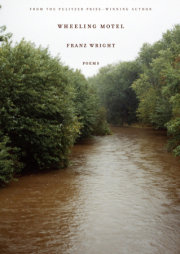
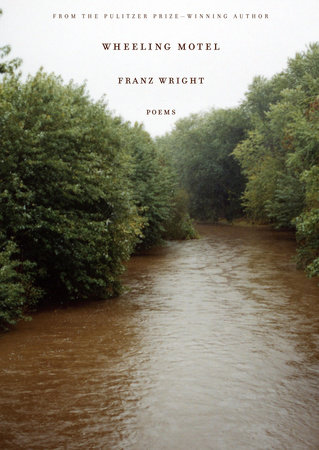
Wheeling Motel

Poems

Look inside
Paperback
$19.00 US
| $25.99 CAN
48 per carton
On sale Aug 16, 2011 | 112 Pages | 9780375711473

See Additional Formats
In his tenth collection of poetry, Franz Wright gives us an exquisite book of reconciliation with the past and acceptance of what may come in the future.

From his earliest years, he writes in “Will,” he had “the gift of impermanence / so I would be ready, / accompanied / by a rage to prove them wrong / . . . and that I too was worthy of love.” This rage comes coupled with the poet’s own brand of love, what he calls “one / strange alone / heart’s wish / to help all / hearts.” Poetry is indeed Wright’s help, and he delivers it to us with a wry sense of the daily in America: in his wonderfully local relationship to God (whom he encounters along with a catfish in the emerald shallows of Walden Pond); in the little West Virginia motel of the title poem, on the banks of the great Ohio River, where “Tammy Wynette’s on the marquee” and he is visited by the figure of Walt Whitman, “examining the tear on a dead face.”

Here, in Wheeling Motel, Wright’s poetry continues to surprise us with its frank appraisal of our soul, and with his own combustible loneliness and unstoppable joy.
Wheeling Motel

The vast waters flow past its backyard.
You can purchase a six- pack in bars!
Tammy Wynette’s on the marquee

a block down. It’s twenty- five years ago:
you went to death, I to life, and
which was luckier God only knows.

There’s this line in an unpublished poem of yours.
The river is like that,
a blind familiar.

The wind will die down when I say so;
the leaden and lessening light on
the current.

Then the moon will rise
like the word reconciliation,
like Walt Whitman examining the tear on a dead face.


Day One
Good morning class. Today
we’re going to be discussing
the deplorable adventures
of Franz Wright and his gory flute.
Just kidding. The topic this morning

is an unparaphrasable logic constructed
from parallelisms and images
and held together, on
occasion, by nothing
but the magical non sequitur—

but the hell with that.
We should really examine
your life, the one you bought,
and what happened when you got home
and attempted to assemble it:

that disfiguring explosion
no one witnessed, no one heard,
which you yourself cannot recall,
and by whose unimaginable light you seek
to write the name of beauty.
“These new poems refract the light of the poet’s insightful, humorous, and often humble gaze in ways that are surprising and rewarding.” —America

“Uningratiating, bumptiously witty . . . and routinely surprising.” —The New York Times Book Review
© Elizabeth Oehlkers Wright

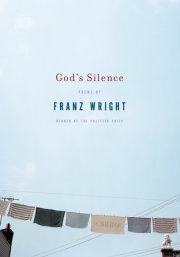
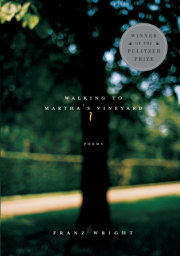
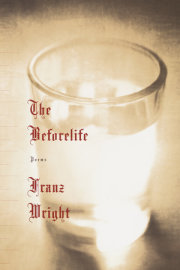
Franz Wright was born in Vienna, Austria in 1953 and grew up in the Northwest, the Midwest, and northern California. His works include The Beforelife (2001), Walking to Martha’s Vineyard (2003), God’s Silence (2006), Earlier Poems (2007), Wheeling Motel (2009), Kindertotenwald (2011), and F (2013). He was the recipient of two National Endowment for the Arts grants, a Guggenheim Fellowship, a Whiting Fellowship, the PEN/Voelcker Award for Poetry, and a Pulitzer Prize for Walking to Martha’s Vineyard. Wright, who was the son of the poet James Wright, died in 2015.

View titles by Franz Wright

About

In his tenth collection of poetry, Franz Wright gives us an exquisite book of reconciliation with the past and acceptance of what may come in the future.

From his earliest years, he writes in “Will,” he had “the gift of impermanence / so I would be ready, / accompanied / by a rage to prove them wrong / . . . and that I too was worthy of love.” This rage comes coupled with the poet’s own brand of love, what he calls “one / strange alone / heart’s wish / to help all / hearts.” Poetry is indeed Wright’s help, and he delivers it to us with a wry sense of the daily in America: in his wonderfully local relationship to God (whom he encounters along with a catfish in the emerald shallows of Walden Pond); in the little West Virginia motel of the title poem, on the banks of the great Ohio River, where “Tammy Wynette’s on the marquee” and he is visited by the figure of Walt Whitman, “examining the tear on a dead face.”

Here, in Wheeling Motel, Wright’s poetry continues to surprise us with its frank appraisal of our soul, and with his own combustible loneliness and unstoppable joy.

Excerpt

Wheeling Motel

The vast waters flow past its backyard.
You can purchase a six- pack in bars!
Tammy Wynette’s on the marquee

a block down. It’s twenty- five years ago:
you went to death, I to life, and
which was luckier God only knows.

There’s this line in an unpublished poem of yours.
The river is like that,
a blind familiar.

The wind will die down when I say so;
the leaden and lessening light on
the current.

Then the moon will rise
like the word reconciliation,
like Walt Whitman examining the tear on a dead face.


Day One
Good morning class. Today
we’re going to be discussing
the deplorable adventures
of Franz Wright and his gory flute.
Just kidding. The topic this morning

is an unparaphrasable logic constructed
from parallelisms and images
and held together, on
occasion, by nothing
but the magical non sequitur—

but the hell with that.
We should really examine
your life, the one you bought,
and what happened when you got home
and attempted to assemble it:

that disfiguring explosion
no one witnessed, no one heard,
which you yourself cannot recall,
and by whose unimaginable light you seek
to write the name of beauty.

Reviews

“These new poems refract the light of the poet’s insightful, humorous, and often humble gaze in ways that are surprising and rewarding.” —America

“Uningratiating, bumptiously witty . . . and routinely surprising.” —The New York Times Book Review

Author

© Elizabeth Oehlkers Wright

Franz Wright was born in Vienna, Austria in 1953 and grew up in the Northwest, the Midwest, and northern California. His works include The Beforelife (2001), Walking to Martha’s Vineyard (2003), God’s Silence (2006), Earlier Poems (2007), Wheeling Motel (2009), Kindertotenwald (2011), and F (2013). He was the recipient of two National Endowment for the Arts grants, a Guggenheim Fellowship, a Whiting Fellowship, the PEN/Voelcker Award for Poetry, and a Pulitzer Prize for Walking to Martha’s Vineyard. Wright, who was the son of the poet James Wright, died in 2015.

View titles by Franz Wright
  • More Websites from
    Penguin Random House
  • Common Reads
  • Library Marketing