Close Modal
"Reading this, it’s hard to not see alarming warning signs about today’s world—intolerance, extremism, misinformation, institutional decay, fanaticism and fundamentalism, technological disruption, demagogues, charlatans, and con artists... But I love that it also gives us solutions.” –Ryan Holiday, author of The Daily Stoic

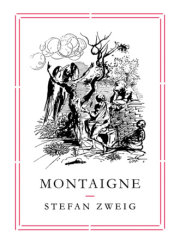
A brilliant and impassioned biography of one of the founding fathers of humanism, from one of its greatest defenders in the 20th century.

“An invaluable addition to Zweig's canon, casting as much light on the author's own preoccupation with personal and individual liberty as it does on Montaigne.” —Independent

Written during the Second World War, Zweig's typically passionate and readable biography of Michel de Montaigne is also a heartfelt argument for the importance of intellectual freedom, tolerance and humanism.

Zweig was already an émigré—driven far from a Europe torn apart by totalitarianism and war—when, in a damp Brazilian cellar, he found an old copy of Michel de Montaigne's Essais. Montaigne and his masterpiece were to become Zweig's last great meeting of minds, for both men were living through times of great turmoil: Montaigne in retreat from France’s appalling wars of religion, and Zweig amid the rise of Nazism across Europe. Just as Montaigne sought to remain aloof from the factionalism of his day, so Zweig tried to the last to defend his freedom of thought, and argue for peace and compromise.

With the intense psychological acuity and elegant prose so characteristic of Zweig's fiction, this account of Montaigne's life asks how we ought to think, how to face the world, and how to live. One of the final works Zweig wrote before his suicide, it offers both a brilliantly impassioned portrait of a great mind, and a moving plea for tolerance in a world ruled by cruelty.
There is a select group of writers who are accessible to anyone, at whatever age or stage of life—Homer, Shakespeare, Goethe, Balzac, Tolstoy—and then there are those whose significance is not prop-erly revealed until a particular moment. Montaigne is one of these. In order to recognize his true worth, you should not be too young, too deprived of experience and life’s deceptions, and it is precisely a generation like ours, cast by fate into the cataract of the world’s turmoil, to whom the freedom and consistency of his thought conveys the most precious aid.

Only he whose soul is in turmoil, forced to live in an epoch where war, violence and ideo-logical tyranny threaten the life of every individual, and the most precious substance in that life, the freedom of the soul, can know how much courage, sincerity and resolve are required to remain faithful to his inner self in these times of the herd’s rampancy. Only he knows that no task on earth is more burdensome and difficult than to maintain one’s intellectual and moral independence and preserve it unsullied through a mass cataclysm. Only once he has endured the necessary doubt and despair within himself can the individual play an exemplary role in standing firm amidst the world’s pandemonium. Only a seasoned man who has tested himself can appreciate the true worth of Montaigne, and I count myself one of them. When at the age of twenty I picked up a copy of the Essais, that incomparable book he left us, I must confess I had little idea what to do with it. Of course, I had enough literary discernment to realize that here was unveiled a compelling personality, a man with a peculiarly wide-ranging and lucid gaze, an endearing figure and, what’s more, an artist who knew how to engrave his own signature on each phrase and each expression. But my pleasure remained solely literary, like that of a collector before a beautiful antique; it lacked the interior spark of passion, the electric arc which spans two kindred souls. In their subject matter the Essais seemed to me rather wayward and on the whole to deny any possibility of meeting my own soul. Of what relevance to me, a young man of the new twentieth century, were the effusive divagations of this Seigneur de Montaigne on ‘La Cérémonie de l’entrevue des rois’ or his ‘Considérations sur Cicéron’? This Frenchman, already yellowed by time and lost in the riddles of his Latin quotations, seemed so scholarly and anachronistic. And even his wisdom, so gentle and tempered, remained foreign to me. It had arrived prematurely. What would I have done then with the judicious counsel of Montaigne, who warned against sacrificing oneself to ambition and committing oneself too ardently to the exterior world? What meaning could his gentle and insistent call for temperance, for tolerance, have on a hot-headed youth who did not want to be dispirited, who did not care for his calming message, who, without even being aware, only aspired to be inflamed by the vital effusion of youthful enthusiasm? It is the business of youth to recoil from the counsel of gentleness, of scepticism. Doubt becomes an obstacle, for a youth has need of faith and ideals to give free rein to the impetuosity borne within. And even the most radical, the most absurd illusions, as long as they inflame, would in his eyes have more importance than the most profound wisdom, which saps the strength of his will.

And furthermore, this freedom, of which Montaigne was the uncontested herald: did one really need to defend it with such obstinacy, now, in 1900? Surely, for so long now, all that had been taken for granted—had been humanity’s rightful possession, freed from all tyranny and servitude, sealed by law and custom? It seemed obvious that the right to have our own lives, our own thoughts, to express them freely through the spoken and written word, belonged to us as much as the breath that left our mouths or the beating of our hearts. The world unfurled before us with its numberless countries; we were neither prisoners of the state, nor yoked to the service of war, nor arbitrarily submitted to tyrannical ideologies. It seemed to our generation that Montaigne was simply rattling chains we thought long since broken, and we could never imagine that in fact Fate had reforged them for us, far stronger and crueller than ever before.

So then, we honoured, we respected his struggle for spiritual freedom like a historic battle, which seemed to us now superfluous and futile. For one of life’s mysterious laws shows that we only notice the authentic and essential values when it’s too late: youth, once it has fled, health at the moment it abandons us, freedom of the soul, that most precious essence, at the very moment when it is taken from us, or has already been taken.

It is crucial then that we strive to understand the art of living, the wise way of living according to Montaigne, and to realize that this struggle leads to the discovery of “soi-même”,* the most crucial struggle of the spirit, exemplified by his own life. We too need to stand the test, to endure one of the most horrifying collapses of humanity, which follows directly one of its most mag-nificent periods of advancement. We too are to be torn from our hopes, from our experiences, our expectations and our enthusiasms, chased out from them as if under the whip, until we have only our naked selves left to defend, that unique being which is irreplaceable. It was only when destiny made us brothers that Montaigne granted me his aid, his consolation, his irreplaceable friendship; how indeed does his fate seem so very similar to our own! When Michel de Montaigne made his entry into the world, a great hope was beginning to die, the same hope that we experienced at the opening of our century: that of a more humanistic world. In the space of a single generation, the Renaissance had lavished on humanity a gift that enabled its artists, painters, thinkers, its seers and poets to reach a level of perfection none had anticipated. A century—no, centuries were opening up where creative power, step by step, wave on wave, was carrying dark and chaotic existence towards the threshold of the divine. All at once the world had become vaster, richer. With Greek and Latin, the scholars rediscovered antiquity and gave back to mankind the wisdom of Plato and Aristotle. Under the guidance of Erasmus, humanism promised a unified and cosmopolitan culture; the Reformation seemed, alongside the new scope of knowledge, to have founded a new religious freedom. Distances, borders between peoples were beginning to dissolve, for printing, which had just been invented, gave to each word, to each thought, the means to soar, to spread; that which had once been the reserve of a single people seemed now open to all; a spirit of unity was emerging beyond the bloody quarrels of kings, princes and armies. And another miracle: just like the spiritual world the terrestrial world was expanding in dimensions no one could have conceived. Across an ocean thought impassable emerged new shores, new countries, a great uncharted continent, promising a safe haven for future generations. The arteries of com-merce experienced ever livelier pulsations, a wave of riches extended across old Europe leaving luxury in its wake, and in its turn the luxury left buildings, paintings, statues—a highly decorated, spiritualized world. And always when there is more space, the soul opens up. So it was at the beginning of our own century, when, once more, space increased in grandiose fashion thanks to the conquest of the ether by flight, thanks to physics, chemistry, technology. As science drew from nature her secrets one after another and revealed those secrets in the service of man, an inexpressible hope animated a humanity so often disappointed, and from a million souls arose Ulrich von Hutten’s jubilant cry: “What joy it is to live!”
But always when the wave climbs too high and too quickly, it falls the more violently, like a cataract. And just as, in our time, the miracles of technology have morphed into the most horrific elements of destruc-tion, so elements of the Renaissance and humanism which at first seemed to offer salvation proved a lethal poison. The Reformation, which dreamt of bringing to Europe a new Christian spirit, provoked unrestrained barbarism in the wars of religion; the printing press did not diffuse culture but furor theologicus;* instead of humanism it was intolerance that spread. Across the whole of Europe, a murderous civil war devastated each country, while in the new world the bestial excesses of the conquistadors led to unparalleled cruelty. The century of Raphael and Michelangelo, of Dürer and Erasmus, permitted the atrocities of Attila, Genghis Khan or Tamerlane.

How, in spite of its infallible clear-sightedness, in spite of the pity set deep in its soul, was humanity obliged to suffer this terrifying descent into bestiality, through one of those sporadic outbursts of insanity which some-times seize it, just like that which we endure today? In this question lies the real tragedy of Montaigne. At no moment in his life did he see reign in his country, or the world at large, peace, reason or tolerance, all those higher spiritual forces to which he had devoted his inner calling. When he opens his eyes to look out on the world and then lowers his gaze, he turns aside, like us stricken with horror at this mob frenzy of fury and hate which debilitates and profanes his homeland and humanity. He is still virtually a child, no more than fifteen years old, when, before his eyes, the riots against the gabelle* are ferociously repressed in Bordeaux, exhibiting an inhumanity which will leave him for the rest of his days the sworn enemy of all cruelty. The child witnesses how men in their hundreds are tortured to death, hanged, impaled, quartered, decapitated, burnt; he watches the crows, for days on end, wheeling around the gibbets, feeding on the burnt, half-putrefied flesh of the victims. He hears the cries of the martyred and cannot escape that odour of burnt flesh wafting through the streets. Hardly has he left childhood behind when war breaks out, which, due to the fanaticism of the opposing forces, devastates France almost as completely as today socialist and nationalist violence brings devastation to all four corners of the world. The Chambre Ardente sends the Protestants to the stake, the St Bartholomew’s Day massacre consumes 8,000 men in a single night. The Huguenots reply like for like: they assault the churches, destroy the statuary. Even the dead are not left in peace by the fanatical roaming bands: the tombs of Richard the Lionheart and William the Conqueror stand desecrated and pillaged. Troops of soldiers run from village to village, sometimes Catholics, sometimes Huguenots, but always Frenchman against Frenchman, citizen against citizen, each trying to outdo the other in ever more extreme acts of savage bestiality. Whole garrisons are exterminated, down to the last man, the rivers are cor-rupted with the corpses thronging them, thousands of villages are reported razed and pillaged, and soon the murder even dispenses with any religious pretext. Armed bands attack castles and travellers at will, not bothering to distinguish between Protestant and Catholic. A ride on horseback through the neighbouring wood is no less dangerous than a journey to the West Indies or to the lands of the cannibals. No one knows any more if his house and possessions are still his, or if come the morrow he will be alive or dead, prisoner or free man, and at the end of his life, in 1588, an aged Montaigne writes:
In this bedlam in which we have found ourselves for the last thirty years, every Frenchman, whether privately or in wider terms, may find himself at any given moment at a point where he suffers a complete reversal of his fortunes.

Nothing is assured any more on this earth: this fun-damental feeling is inescapably reflected through the spiritual intuition of Montaigne. One must seek another certitude beyond the world, beyond the homeland; one must refuse to join the chorus of the demoniacal and create one’s own homeland, one’s own world, outside the present time.
“Thanks to Stone’s assiduous translation, Zweig’s fascinating meditation on the writer in whom he saw himself mirrored appears now for the first time in English. Zweig weaves biographical elements into his study—Montaigne’s study of Latin at age four, his retirement from his public duties as a French nobleman at age 38—but the book is more properly an introduction to an endlessly inquisitive thinker who never stopped searching for the truth . . . This captivating study portrays a writer whose life and work can be summed up by his constant posing of the question, ‘How should I live?’”
—Publishers Weekly

“Zweig’s accumulated historical and cultural studies remain a body of achievement almost too impressive to take in.”
—Clive James, critic and journalist

“[Pushkin Press’s republication of Stefan Zweig's work] has been entirely successful. Zweigmania seems to break out with the publication of each book, with readers discovering his work by word-of-mouth and by accident.”
—Guardian

“[Zweig’s] life and work tell of the perilous flimsiness of our world of security-a message that many insistently deny, but somehow need to hear.”
—John Gray, New Statesman
Stefan Zweig was born in 1881 in Vienna, into a wealthy Austrian-Jewish family. He studied in Berlin and Vienna and was first known as a poet and translator, then as a biographer. Between the wars, Zweig was an international bestseller with a string of hugely popular novellas including Letter from an Unknown Woman, Amok and Fear.In 1934, with the rise of Nazism, he left Austria, and lived in London, Bath and New York—a period during which he produced his most celebrated works: his only novel,Beware of Pity, and his memoir, The World of Yesterday. He eventually settled in Brazil, where in 1942 he and his wife were found dead in an apparent double suicide. Much of his work is available from Pushkin Press. View titles by Stefan Zweig
About

"Reading this, it’s hard to not see alarming warning signs about today’s world—intolerance, extremism, misinformation, institutional decay, fanaticism and fundamentalism, technological disruption, demagogues, charlatans, and con artists... But I love that it also gives us solutions.” –Ryan Holiday, author of The Daily Stoic

A brilliant and impassioned biography of one of the founding fathers of humanism, from one of its greatest defenders in the 20th century.

“An invaluable addition to Zweig's canon, casting as much light on the author's own preoccupation with personal and individual liberty as it does on Montaigne.” —Independent

Written during the Second World War, Zweig's typically passionate and readable biography of Michel de Montaigne is also a heartfelt argument for the importance of intellectual freedom, tolerance and humanism.

Zweig was already an émigré—driven far from a Europe torn apart by totalitarianism and war—when, in a damp Brazilian cellar, he found an old copy of Michel de Montaigne's Essais. Montaigne and his masterpiece were to become Zweig's last great meeting of minds, for both men were living through times of great turmoil: Montaigne in retreat from France’s appalling wars of religion, and Zweig amid the rise of Nazism across Europe. Just as Montaigne sought to remain aloof from the factionalism of his day, so Zweig tried to the last to defend his freedom of thought, and argue for peace and compromise.

With the intense psychological acuity and elegant prose so characteristic of Zweig's fiction, this account of Montaigne's life asks how we ought to think, how to face the world, and how to live. One of the final works Zweig wrote before his suicide, it offers both a brilliantly impassioned portrait of a great mind, and a moving plea for tolerance in a world ruled by cruelty.

Excerpt

There is a select group of writers who are accessible to anyone, at whatever age or stage of life—Homer, Shakespeare, Goethe, Balzac, Tolstoy—and then there are those whose significance is not prop-erly revealed until a particular moment. Montaigne is one of these. In order to recognize his true worth, you should not be too young, too deprived of experience and life’s deceptions, and it is precisely a generation like ours, cast by fate into the cataract of the world’s turmoil, to whom the freedom and consistency of his thought conveys the most precious aid.

Only he whose soul is in turmoil, forced to live in an epoch where war, violence and ideo-logical tyranny threaten the life of every individual, and the most precious substance in that life, the freedom of the soul, can know how much courage, sincerity and resolve are required to remain faithful to his inner self in these times of the herd’s rampancy. Only he knows that no task on earth is more burdensome and difficult than to maintain one’s intellectual and moral independence and preserve it unsullied through a mass cataclysm. Only once he has endured the necessary doubt and despair within himself can the individual play an exemplary role in standing firm amidst the world’s pandemonium. Only a seasoned man who has tested himself can appreciate the true worth of Montaigne, and I count myself one of them. When at the age of twenty I picked up a copy of the Essais, that incomparable book he left us, I must confess I had little idea what to do with it. Of course, I had enough literary discernment to realize that here was unveiled a compelling personality, a man with a peculiarly wide-ranging and lucid gaze, an endearing figure and, what’s more, an artist who knew how to engrave his own signature on each phrase and each expression. But my pleasure remained solely literary, like that of a collector before a beautiful antique; it lacked the interior spark of passion, the electric arc which spans two kindred souls. In their subject matter the Essais seemed to me rather wayward and on the whole to deny any possibility of meeting my own soul. Of what relevance to me, a young man of the new twentieth century, were the effusive divagations of this Seigneur de Montaigne on ‘La Cérémonie de l’entrevue des rois’ or his ‘Considérations sur Cicéron’? This Frenchman, already yellowed by time and lost in the riddles of his Latin quotations, seemed so scholarly and anachronistic. And even his wisdom, so gentle and tempered, remained foreign to me. It had arrived prematurely. What would I have done then with the judicious counsel of Montaigne, who warned against sacrificing oneself to ambition and committing oneself too ardently to the exterior world? What meaning could his gentle and insistent call for temperance, for tolerance, have on a hot-headed youth who did not want to be dispirited, who did not care for his calming message, who, without even being aware, only aspired to be inflamed by the vital effusion of youthful enthusiasm? It is the business of youth to recoil from the counsel of gentleness, of scepticism. Doubt becomes an obstacle, for a youth has need of faith and ideals to give free rein to the impetuosity borne within. And even the most radical, the most absurd illusions, as long as they inflame, would in his eyes have more importance than the most profound wisdom, which saps the strength of his will.

And furthermore, this freedom, of which Montaigne was the uncontested herald: did one really need to defend it with such obstinacy, now, in 1900? Surely, for so long now, all that had been taken for granted—had been humanity’s rightful possession, freed from all tyranny and servitude, sealed by law and custom? It seemed obvious that the right to have our own lives, our own thoughts, to express them freely through the spoken and written word, belonged to us as much as the breath that left our mouths or the beating of our hearts. The world unfurled before us with its numberless countries; we were neither prisoners of the state, nor yoked to the service of war, nor arbitrarily submitted to tyrannical ideologies. It seemed to our generation that Montaigne was simply rattling chains we thought long since broken, and we could never imagine that in fact Fate had reforged them for us, far stronger and crueller than ever before.

So then, we honoured, we respected his struggle for spiritual freedom like a historic battle, which seemed to us now superfluous and futile. For one of life’s mysterious laws shows that we only notice the authentic and essential values when it’s too late: youth, once it has fled, health at the moment it abandons us, freedom of the soul, that most precious essence, at the very moment when it is taken from us, or has already been taken.

It is crucial then that we strive to understand the art of living, the wise way of living according to Montaigne, and to realize that this struggle leads to the discovery of “soi-même”,* the most crucial struggle of the spirit, exemplified by his own life. We too need to stand the test, to endure one of the most horrifying collapses of humanity, which follows directly one of its most mag-nificent periods of advancement. We too are to be torn from our hopes, from our experiences, our expectations and our enthusiasms, chased out from them as if under the whip, until we have only our naked selves left to defend, that unique being which is irreplaceable. It was only when destiny made us brothers that Montaigne granted me his aid, his consolation, his irreplaceable friendship; how indeed does his fate seem so very similar to our own! When Michel de Montaigne made his entry into the world, a great hope was beginning to die, the same hope that we experienced at the opening of our century: that of a more humanistic world. In the space of a single generation, the Renaissance had lavished on humanity a gift that enabled its artists, painters, thinkers, its seers and poets to reach a level of perfection none had anticipated. A century—no, centuries were opening up where creative power, step by step, wave on wave, was carrying dark and chaotic existence towards the threshold of the divine. All at once the world had become vaster, richer. With Greek and Latin, the scholars rediscovered antiquity and gave back to mankind the wisdom of Plato and Aristotle. Under the guidance of Erasmus, humanism promised a unified and cosmopolitan culture; the Reformation seemed, alongside the new scope of knowledge, to have founded a new religious freedom. Distances, borders between peoples were beginning to dissolve, for printing, which had just been invented, gave to each word, to each thought, the means to soar, to spread; that which had once been the reserve of a single people seemed now open to all; a spirit of unity was emerging beyond the bloody quarrels of kings, princes and armies. And another miracle: just like the spiritual world the terrestrial world was expanding in dimensions no one could have conceived. Across an ocean thought impassable emerged new shores, new countries, a great uncharted continent, promising a safe haven for future generations. The arteries of com-merce experienced ever livelier pulsations, a wave of riches extended across old Europe leaving luxury in its wake, and in its turn the luxury left buildings, paintings, statues—a highly decorated, spiritualized world. And always when there is more space, the soul opens up. So it was at the beginning of our own century, when, once more, space increased in grandiose fashion thanks to the conquest of the ether by flight, thanks to physics, chemistry, technology. As science drew from nature her secrets one after another and revealed those secrets in the service of man, an inexpressible hope animated a humanity so often disappointed, and from a million souls arose Ulrich von Hutten’s jubilant cry: “What joy it is to live!”
But always when the wave climbs too high and too quickly, it falls the more violently, like a cataract. And just as, in our time, the miracles of technology have morphed into the most horrific elements of destruc-tion, so elements of the Renaissance and humanism which at first seemed to offer salvation proved a lethal poison. The Reformation, which dreamt of bringing to Europe a new Christian spirit, provoked unrestrained barbarism in the wars of religion; the printing press did not diffuse culture but furor theologicus;* instead of humanism it was intolerance that spread. Across the whole of Europe, a murderous civil war devastated each country, while in the new world the bestial excesses of the conquistadors led to unparalleled cruelty. The century of Raphael and Michelangelo, of Dürer and Erasmus, permitted the atrocities of Attila, Genghis Khan or Tamerlane.

How, in spite of its infallible clear-sightedness, in spite of the pity set deep in its soul, was humanity obliged to suffer this terrifying descent into bestiality, through one of those sporadic outbursts of insanity which some-times seize it, just like that which we endure today? In this question lies the real tragedy of Montaigne. At no moment in his life did he see reign in his country, or the world at large, peace, reason or tolerance, all those higher spiritual forces to which he had devoted his inner calling. When he opens his eyes to look out on the world and then lowers his gaze, he turns aside, like us stricken with horror at this mob frenzy of fury and hate which debilitates and profanes his homeland and humanity. He is still virtually a child, no more than fifteen years old, when, before his eyes, the riots against the gabelle* are ferociously repressed in Bordeaux, exhibiting an inhumanity which will leave him for the rest of his days the sworn enemy of all cruelty. The child witnesses how men in their hundreds are tortured to death, hanged, impaled, quartered, decapitated, burnt; he watches the crows, for days on end, wheeling around the gibbets, feeding on the burnt, half-putrefied flesh of the victims. He hears the cries of the martyred and cannot escape that odour of burnt flesh wafting through the streets. Hardly has he left childhood behind when war breaks out, which, due to the fanaticism of the opposing forces, devastates France almost as completely as today socialist and nationalist violence brings devastation to all four corners of the world. The Chambre Ardente sends the Protestants to the stake, the St Bartholomew’s Day massacre consumes 8,000 men in a single night. The Huguenots reply like for like: they assault the churches, destroy the statuary. Even the dead are not left in peace by the fanatical roaming bands: the tombs of Richard the Lionheart and William the Conqueror stand desecrated and pillaged. Troops of soldiers run from village to village, sometimes Catholics, sometimes Huguenots, but always Frenchman against Frenchman, citizen against citizen, each trying to outdo the other in ever more extreme acts of savage bestiality. Whole garrisons are exterminated, down to the last man, the rivers are cor-rupted with the corpses thronging them, thousands of villages are reported razed and pillaged, and soon the murder even dispenses with any religious pretext. Armed bands attack castles and travellers at will, not bothering to distinguish between Protestant and Catholic. A ride on horseback through the neighbouring wood is no less dangerous than a journey to the West Indies or to the lands of the cannibals. No one knows any more if his house and possessions are still his, or if come the morrow he will be alive or dead, prisoner or free man, and at the end of his life, in 1588, an aged Montaigne writes:
In this bedlam in which we have found ourselves for the last thirty years, every Frenchman, whether privately or in wider terms, may find himself at any given moment at a point where he suffers a complete reversal of his fortunes.

Nothing is assured any more on this earth: this fun-damental feeling is inescapably reflected through the spiritual intuition of Montaigne. One must seek another certitude beyond the world, beyond the homeland; one must refuse to join the chorus of the demoniacal and create one’s own homeland, one’s own world, outside the present time.

Reviews

“Thanks to Stone’s assiduous translation, Zweig’s fascinating meditation on the writer in whom he saw himself mirrored appears now for the first time in English. Zweig weaves biographical elements into his study—Montaigne’s study of Latin at age four, his retirement from his public duties as a French nobleman at age 38—but the book is more properly an introduction to an endlessly inquisitive thinker who never stopped searching for the truth . . . This captivating study portrays a writer whose life and work can be summed up by his constant posing of the question, ‘How should I live?’”
—Publishers Weekly

“Zweig’s accumulated historical and cultural studies remain a body of achievement almost too impressive to take in.”
—Clive James, critic and journalist

“[Pushkin Press’s republication of Stefan Zweig's work] has been entirely successful. Zweigmania seems to break out with the publication of each book, with readers discovering his work by word-of-mouth and by accident.”
—Guardian

“[Zweig’s] life and work tell of the perilous flimsiness of our world of security-a message that many insistently deny, but somehow need to hear.”
—John Gray, New Statesman

Author

Stefan Zweig was born in 1881 in Vienna, into a wealthy Austrian-Jewish family. He studied in Berlin and Vienna and was first known as a poet and translator, then as a biographer. Between the wars, Zweig was an international bestseller with a string of hugely popular novellas including Letter from an Unknown Woman, Amok and Fear.In 1934, with the rise of Nazism, he left Austria, and lived in London, Bath and New York—a period during which he produced his most celebrated works: his only novel,Beware of Pity, and his memoir, The World of Yesterday. He eventually settled in Brazil, where in 1942 he and his wife were found dead in an apparent double suicide. Much of his work is available from Pushkin Press. View titles by Stefan Zweig
  • More Websites from
    Penguin Random House
  • Common Reads
  • Library Marketing