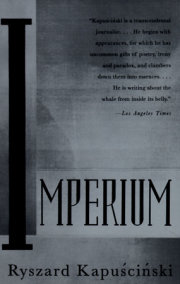
The Polish journalist whose The Soccer War and The Emperor are counted as classics of contemporary reportage now bears witness in Imperium to the disintegration of the Soviet Union. This magisterial book combines childhood memory with unblinking journalism, a radar for the truth with a keen appreciation of the absurd.

Imperium begins with Ryszard Kapuscinski's account of the Soviet occupation of his town in eastern Poland in 1939. It culminates fifty years later, with a forty-thousand-mile journey that takes him from the haunted corridors of the Kremlin to the abandoned gulag of Kolyma, from a miners' strike in the arctic circle to a panic-stricken bus ride through the war-torn Caucasus.

Out of passivity and paranoia, ethnic hatred and religious fanaticism that have riven two generations of Eastern Europeans, Kapuscinski has composed a symphony for a collapsing empire—a work that translates history into the hopes and sufferings of the human beings condemned to live it.
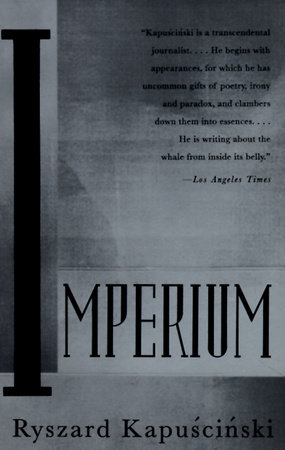
"Kapuscinski is a transcendental journalist. . . . He begins with appearances, for which he has uncommon gifts of poetry, irony and paradox, and clambers down them into essences. . . .He is writing about the whale from inside its belly."
Los Angeles Times

"Kapuscinski is an enchanting guide, combining boundless stamina, felicitous writing, childish curiosity and the literate authority of a true intellectual. . . . There are treasures in this book. . . .It is a triumphant combination of bleak history and black comedy."
The New York Times Book Review

"When our children's children want to study the cruelties of the late twentieth century . . . when they wonder why revolution after revolution betrayed its promises hrough greed, fear and confusion, they should read Ryszard Kapuscinski."
Wall Street Journal

"A compelling and convincing narrative that examines the extensive damage done to entire nations, the human psyche and the physical environment....This is a devastating picture of Russia [that] penetrates deeply into the depressing truths of 70 years of Soviet rule, the borders, the fear, the inhumanity.... His portrait of the 'Imperium' is tragic, but ever so true."
—Professor Thomas R. Beyer, Jr., Middlebury College, The Boston Globe
Ryszard Kapuscinski, Poland’s most celebrated foreign correspondent, was born in 1932 in Pinsk (in what is now Belarus) and spent four decades reporting on Asia, Latin America, and Africa. He is also the author of Imperium, Another Day of Life, and The Soccer War. His books have been translated into 28 languages. Kapuscinski died in 2007. View titles by Ryszard Kapuscinski
FIRST ENCOUNTERS (1939–1967)
Pinsk
The Trans-Siberian
The South

FROM A BIRD'S-EYE VIEW (1989–1991)
The Third Rome
The Temple and the Palace
We Look, We Cry
The Man on the Asphalt Mountain
Fleeing from Oneself
Vorkuta—to Freeze in Fire
Tomorrow, the Revolt of the Bashkirs
Russian Mystery Play
Jumping over Puddles
Kolyma, Fog and More Fog
The Kremlin: The Magic Mountain
The Trap
Central Asia—the Destruction of the Sea
Pomona of the Little Town of Drohobych
Return to My Hometown

THE SEQUEL CONTINUES (1992–1993)
The Sequel Continues

About

The Polish journalist whose The Soccer War and The Emperor are counted as classics of contemporary reportage now bears witness in Imperium to the disintegration of the Soviet Union. This magisterial book combines childhood memory with unblinking journalism, a radar for the truth with a keen appreciation of the absurd.

Imperium begins with Ryszard Kapuscinski's account of the Soviet occupation of his town in eastern Poland in 1939. It culminates fifty years later, with a forty-thousand-mile journey that takes him from the haunted corridors of the Kremlin to the abandoned gulag of Kolyma, from a miners' strike in the arctic circle to a panic-stricken bus ride through the war-torn Caucasus.

Out of passivity and paranoia, ethnic hatred and religious fanaticism that have riven two generations of Eastern Europeans, Kapuscinski has composed a symphony for a collapsing empire—a work that translates history into the hopes and sufferings of the human beings condemned to live it.

Reviews

"Kapuscinski is a transcendental journalist. . . . He begins with appearances, for which he has uncommon gifts of poetry, irony and paradox, and clambers down them into essences. . . .He is writing about the whale from inside its belly."
Los Angeles Times

"Kapuscinski is an enchanting guide, combining boundless stamina, felicitous writing, childish curiosity and the literate authority of a true intellectual. . . . There are treasures in this book. . . .It is a triumphant combination of bleak history and black comedy."
The New York Times Book Review

"When our children's children want to study the cruelties of the late twentieth century . . . when they wonder why revolution after revolution betrayed its promises hrough greed, fear and confusion, they should read Ryszard Kapuscinski."
Wall Street Journal

"A compelling and convincing narrative that examines the extensive damage done to entire nations, the human psyche and the physical environment....This is a devastating picture of Russia [that] penetrates deeply into the depressing truths of 70 years of Soviet rule, the borders, the fear, the inhumanity.... His portrait of the 'Imperium' is tragic, but ever so true."
—Professor Thomas R. Beyer, Jr., Middlebury College, The Boston Globe

Author

Ryszard Kapuscinski, Poland’s most celebrated foreign correspondent, was born in 1932 in Pinsk (in what is now Belarus) and spent four decades reporting on Asia, Latin America, and Africa. He is also the author of Imperium, Another Day of Life, and The Soccer War. His books have been translated into 28 languages. Kapuscinski died in 2007. View titles by Ryszard Kapuscinski

Table of Contents

FIRST ENCOUNTERS (1939–1967)
Pinsk
The Trans-Siberian
The South

FROM A BIRD'S-EYE VIEW (1989–1991)
The Third Rome
The Temple and the Palace
We Look, We Cry
The Man on the Asphalt Mountain
Fleeing from Oneself
Vorkuta—to Freeze in Fire
Tomorrow, the Revolt of the Bashkirs
Russian Mystery Play
Jumping over Puddles
Kolyma, Fog and More Fog
The Kremlin: The Magic Mountain
The Trap
Central Asia—the Destruction of the Sea
Pomona of the Little Town of Drohobych
Return to My Hometown

THE SEQUEL CONTINUES (1992–1993)
The Sequel Continues
  • More Websites from

    Penguin Random House
  • Common Reads
  • Library Marketing