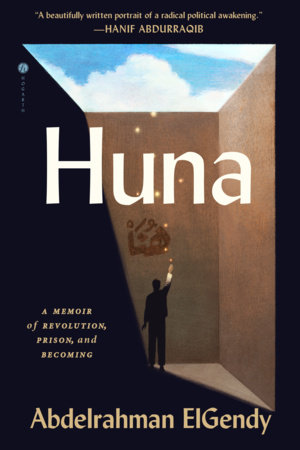
Huna

A Memoir of Revolution, Prison, and Becoming

A gripping, deeply moving memoir of survival, education, and resistance by a student protestor–turned–political prisoner in post-revolution Egypt.

“I will never be the same after reading Huna.” —Javier Zamora
“A beautifully written portrait of a radical political awakening.” —Hanif Abdurraqib
“The work of a truly liberated writer.” —Fady Joudah


In 2013, two years after the January 25 revolution, seventeen-year-old Abdelrahman ElGendy was a budding student activist in Cairo. Hope for a free Egypt had dissipated, and when that summer’s military coup unleashed unprecedented massacres of protesters, Abdelrahman didn’t hesitate—he joined the street movement. His father, fearing for his son’s safety, accompanied him to a mass demonstration. But minutes after they arrived, they were swept up in a brutal police crackdown, and their lives were shattered.

Crushed inside a holding cell, Abdelrahman first heard the words of the Arab world’s most enduring protest song, “Sawfa Nabqa Huna”—We Will Remain Here. He wondered: If no one wanted to remain behind bars, what was the “here” they chose to inhabit?

Abdelrahman would spend the next six years as a political prisoner chasing this Huna, shuffled, alongside his father, from jail cell, to pre-trial detention center, to The Scorpion, Egypt’s most infamous prison complex. As his body broke under the grind of incarceration with no end in sight, he turned to the only refuge left to him: the page. He earned his bachelor’s degree in engineering while imprisoned, read and wrote voraciously, and, through writing, bore witness.

In his remarkable debut, Abdelrahman offers not a promise of hope but a provocation. When the very things that can save you—tenderness, family, friendship, language—are used against you, how can you find the courage to love? Huna is a reckoning with what it takes—and what it costs—to remain when erased, and of what endures, perhaps more faithfully, beyond hope.
“In Abdelrahman ElGendy’s hands, the brutal, idiotic DNA of authoritarianism has no chance, its grip is futile. ElGendy has purposely sweetened the nightmare, I hope readers learn the lesson. I will never be the same after reading Huna—a pivotal addition to world literature.”—Javier Zamora, New York Times bestselling author of Solito

Huna is a beautifully written portrait of a radical political awakening—a portrait that does not prioritize the harms and brutalities of the state, even though they are endured. But a portrait that, instead, affords an immense patience and dignity to the land and its people.”—Hanif Abdurraqib, New York Times bestselling author of There’s Always This Year

“This riveting, extraordinary work communicates the literal experience of being a political prisoner within the emotional life of injustice. Abdelrahman ElGendy brings us closer to the physical suffering, the intellectual hunger, the deep friendships, the modes of survival, the petty brutalities of state players—not only of the regime of Egypt’s General Sisi, but of its resonance today in the United States.”—Sarah Schulman, author of The Fantasy and Necessity of Solidarity

“In documenting the arbitrary brutality of Egypt’s carceral system, ElGendy illuminates the plight of thousands of political prisoners suffering just out of sight. This memoir is a testament to the conscience they preserve in the darkest cells of the nation. It is a battle cry for their liberation.”—Noor Naga, author of If an Egyptian Cannot Speak English

“Abdelrahman ElGendy’s memoir Huna offers a powerful map of interconnected practices of resistance to surveillance, state violence, and the repression of political speech. A vital entry in the long tradition of narratives of political imprisonment, Huna reminds us that freedom is first in the mind.”—Zeyn Joukhadar, author of The Thirty Names of Night and The Map of Salt and Stars

Huna is a clandestine letter, a lyrical act of resistance, and a transcendent song in the darkness. ElGendy recounts his political imprisonment and journey to critical consciousness with unflinching honesty, masterful precision, and radical love.”—Nadia Owusu, author of Aftershocks

“Call it a manual on schooling the self, a deployment of fury to romp through prison life, a philosophical meditation, a love poem to family, friends, and a fruit worm. ElGendy has gifted us a book like no other. Read it and be moved, delighted, informed, and wiser.”—Ahdaf Soueif, author of Cairo: Memoir of a City Transformed

“Riveting, cinematic memory and poetic prose.”—Fady Joudah, author of [...] and Exhibit G

“This book broke me apart and put me back together again.”—Tareq Baconi, author of Fire in Every Direction

“More than a political-coming-of-age, more than a call to courageous struggle—Huna is a miracle.”—Sarah Aziza, author of The Hollow Half

“This is the story of oppression by and resistance to a cruel power and an unjust prison sentence, pierced through with the gentle love of a son finding tenderness for his father in a situation riddled with guilt, depravity, and shame.”Kirkus Reviews, starred review
© Fadel Dawod
Abdelrahman ElGendy is an author and translator from Cairo. A winner of the Samir Kassir Press Freedom Award, he holds an MFA in Nonfiction Writing from the University of Pittsburgh, and his work appears in publications including The Washington Post, Foreign Policy, The Nation, and Guernica. His poetry and prose translations from Arabic appear in Ploughshares, Poetry Northwest, Literary Hub, Words Without Borders, and elsewhere. ElGendy's work has received awards or fellowships from the Elizabeth George Foundation, the Heinz Foundation, the de Groot Foundation, Virginia Center for Creative Arts, and the Arab American National Museum. Huna is his debut memoir. View titles by Abdelrahman ElGendy

About

A gripping, deeply moving memoir of survival, education, and resistance by a student protestor–turned–political prisoner in post-revolution Egypt.

“I will never be the same after reading Huna.” —Javier Zamora
“A beautifully written portrait of a radical political awakening.” —Hanif Abdurraqib
“The work of a truly liberated writer.” —Fady Joudah


In 2013, two years after the January 25 revolution, seventeen-year-old Abdelrahman ElGendy was a budding student activist in Cairo. Hope for a free Egypt had dissipated, and when that summer’s military coup unleashed unprecedented massacres of protesters, Abdelrahman didn’t hesitate—he joined the street movement. His father, fearing for his son’s safety, accompanied him to a mass demonstration. But minutes after they arrived, they were swept up in a brutal police crackdown, and their lives were shattered.

Crushed inside a holding cell, Abdelrahman first heard the words of the Arab world’s most enduring protest song, “Sawfa Nabqa Huna”—We Will Remain Here. He wondered: If no one wanted to remain behind bars, what was the “here” they chose to inhabit?

Abdelrahman would spend the next six years as a political prisoner chasing this Huna, shuffled, alongside his father, from jail cell, to pre-trial detention center, to The Scorpion, Egypt’s most infamous prison complex. As his body broke under the grind of incarceration with no end in sight, he turned to the only refuge left to him: the page. He earned his bachelor’s degree in engineering while imprisoned, read and wrote voraciously, and, through writing, bore witness.

In his remarkable debut, Abdelrahman offers not a promise of hope but a provocation. When the very things that can save you—tenderness, family, friendship, language—are used against you, how can you find the courage to love? Huna is a reckoning with what it takes—and what it costs—to remain when erased, and of what endures, perhaps more faithfully, beyond hope.

Reviews

“In Abdelrahman ElGendy’s hands, the brutal, idiotic DNA of authoritarianism has no chance, its grip is futile. ElGendy has purposely sweetened the nightmare, I hope readers learn the lesson. I will never be the same after reading Huna—a pivotal addition to world literature.”—Javier Zamora, New York Times bestselling author of Solito

Huna is a beautifully written portrait of a radical political awakening—a portrait that does not prioritize the harms and brutalities of the state, even though they are endured. But a portrait that, instead, affords an immense patience and dignity to the land and its people.”—Hanif Abdurraqib, New York Times bestselling author of There’s Always This Year

“This riveting, extraordinary work communicates the literal experience of being a political prisoner within the emotional life of injustice. Abdelrahman ElGendy brings us closer to the physical suffering, the intellectual hunger, the deep friendships, the modes of survival, the petty brutalities of state players—not only of the regime of Egypt’s General Sisi, but of its resonance today in the United States.”—Sarah Schulman, author of The Fantasy and Necessity of Solidarity

“In documenting the arbitrary brutality of Egypt’s carceral system, ElGendy illuminates the plight of thousands of political prisoners suffering just out of sight. This memoir is a testament to the conscience they preserve in the darkest cells of the nation. It is a battle cry for their liberation.”—Noor Naga, author of If an Egyptian Cannot Speak English

“Abdelrahman ElGendy’s memoir Huna offers a powerful map of interconnected practices of resistance to surveillance, state violence, and the repression of political speech. A vital entry in the long tradition of narratives of political imprisonment, Huna reminds us that freedom is first in the mind.”—Zeyn Joukhadar, author of The Thirty Names of Night and The Map of Salt and Stars

Huna is a clandestine letter, a lyrical act of resistance, and a transcendent song in the darkness. ElGendy recounts his political imprisonment and journey to critical consciousness with unflinching honesty, masterful precision, and radical love.”—Nadia Owusu, author of Aftershocks

“Call it a manual on schooling the self, a deployment of fury to romp through prison life, a philosophical meditation, a love poem to family, friends, and a fruit worm. ElGendy has gifted us a book like no other. Read it and be moved, delighted, informed, and wiser.”—Ahdaf Soueif, author of Cairo: Memoir of a City Transformed

“Riveting, cinematic memory and poetic prose.”—Fady Joudah, author of [...] and Exhibit G

“This book broke me apart and put me back together again.”—Tareq Baconi, author of Fire in Every Direction

“More than a political-coming-of-age, more than a call to courageous struggle—Huna is a miracle.”—Sarah Aziza, author of The Hollow Half

“This is the story of oppression by and resistance to a cruel power and an unjust prison sentence, pierced through with the gentle love of a son finding tenderness for his father in a situation riddled with guilt, depravity, and shame.”Kirkus Reviews, starred review

Author

© Fadel Dawod
Abdelrahman ElGendy is an author and translator from Cairo. A winner of the Samir Kassir Press Freedom Award, he holds an MFA in Nonfiction Writing from the University of Pittsburgh, and his work appears in publications including The Washington Post, Foreign Policy, The Nation, and Guernica. His poetry and prose translations from Arabic appear in Ploughshares, Poetry Northwest, Literary Hub, Words Without Borders, and elsewhere. ElGendy's work has received awards or fellowships from the Elizabeth George Foundation, the Heinz Foundation, the de Groot Foundation, Virginia Center for Creative Arts, and the Arab American National Museum. Huna is his debut memoir. View titles by Abdelrahman ElGendy
  • More Websites from
    Penguin Random House
  • Common Reads
  • Library Marketing