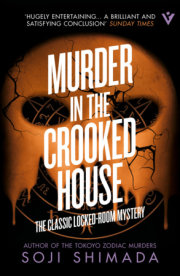
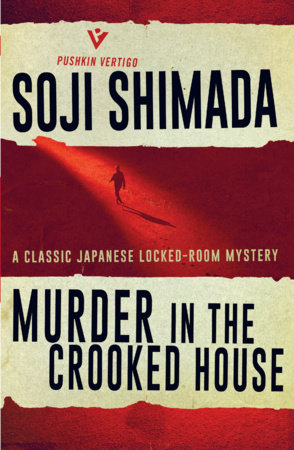
Murder in the Crooked House

Translated by Louise Heal Kawai
Look inside
A delightfully comic Japanese murder mystery “reminiscent of Agatha Christie” from a master of the genre—now available for the first time in English (Wall Street Journal)!

“One of those locked-room head-bangers that invite . . . the reader to decipher the clues and solve a murder along with an all-seeing detective.” —New York Times Book Review

The Crooked House sits on a snowbound cliff overlooking icy seas at the remote northern tip of Japan. A curious place for the millionaire Kozaburo Hamamoto to build a house, but even more curious is the house itself—a disorienting maze of sloping floors and strangely situated staircases, full of bloodcurdling masks and uncanny, lifesize dolls. When a man is found dead in one of the mansion's rooms, murdered in seemingly impossible circumstances, the police are called. But they are unable to solve the puzzle, and powerless to protect the party of house guests as more bizarre deaths follow.

Enter Kiyoshi Mitarai, the renowned sleuth, famous for unmasking the culprit behind the notorious Umezawa family massacre. Surely if anyone can crack these cryptic murders he will. But you have all the clues too—can you solve the mystery of the murders in The Crooked House first?
In the village of Hauterives in the south of France, there’s a curious building known as Cheval’s Palais Idéal. For thirty-three years, a humble postman by the name of Ferdinand Cheval laboured completely alone to create his dream palace, finally completing his task in 1912.

The structure is part Arabian palace, part Hindu temple; its entrance is like the gateway to a medieval European castle, with a Swiss-style shepherd’s hut sitting next to it. The whole effect lacks unity, but there is no doubt that this is a perfect rendition of a child’s fantasy castle. Here in Tokyo people worry too much about style, economy, or how they will be judged by others, and that is how they end up with characterless rows of rabbit hutches crammed in together.

Cheval was barely literate. The notes he left behind were full of spelling mistakes. But they were also alight with his burning belief that it was his life’s mission to build this unique place of worship.

According to these notes, he embarked on his project while delivering the mail. He began by picking up any interesting or unusually shaped rocks or pebbles he found while out on his rounds, and putting them in his pockets. He was already forty-three years old at this point. After a while, along with his postbag he began to carry a large basket over his shoulder for the rocks. And then it wasn’t long before he was taking a wheelbarrow out on his rounds.
One can only imagine how this eccentric postman was treated in his dull country village. Every day he took his col- lection of rocks and worked on building the foundation for his palace.
Twenty-six metres long, fourteen metres wide and twelve metres high—the construction of the palace building itself took three years. And then, slowly and steadily, all kinds of cement statues were added to its walls: cranes, leopards, ostriches, elephants, crocodiles. They would eventually cover all the surfaces of the building. Next, Cheval made a waterfall and three giant statues for the front wall.

He was seventy-six when he finally completed his great oeuvre. He enshrined his number one assistant—his trusty wheelbarrow—in the place of honour inside the palace, and built himself a modest house by the front entrance. After retir- ing from his job at the post office, he took up residence in the house with its excellent view of his palace. Apparently he had never intended the palace to be lived in.

In photos of Cheval’s palace, the materials used to construct it seem to have the soft texture of rubber. The ornamental statues that adorn its whole surface are more intricate than those of Angkor Wat, but the overall form and appearance of the walls are not fixed or uniform. There seems to be no order or balance—everything seems to be in a kind of warped confusion. If you weren’t interested in this kind of thing, you might just see the work of art to which Cheval dedicated the latter half of his life as a worthless antique or maybe even the equivalent of a pile of scrap metal.
It was easy for his fellow villagers to call Cheval a madman, but there was a clear commonality between the concept behind his palace and the work of the celebrated Spanish architect Antonio Gaudí. Cheval’s Palais Idéal is to this day the only tourist attraction in the otherwise unremarkable village of Hauterives.

If we’re talking oddballs with a mania for architecture, then there is one character who cannot be ignored: King Ludwig II of Bavaria. He is also famous for being the patron of the composer Richard Wagner. His two lifelong passions seem to have been the reverence he had for Wagner, and the construc- tion of his castles.

The Linderhof Palace was one of his architectural master- pieces. Many complained that it was a blatant rip-off of the style of the French House of Bourbon, but after pushing open the revolving stone door in the hill behind the castle and entering the high-roofed tunnel, you realize that the space you find yourself in is one of a kind.

The tunnel leads into a magnificent man-made cave with a wide, dark lake. In the middle of the lake sits a boat fashioned in the shape of a pearl oyster. The multicoloured lighting flickers, and at the water’s edge there is a table made from branches of imitation coral. The cave walls are painted with fantastic scenes of angels and cherubs. There is no human being who wouldn’t look at this scene and find their imagination piqued. It is said that when his beloved Wagner passed away, King Ludwig II buried himself away in this gloomy underground burrow, and took all his meals at that fake coral table while reminiscing about his dear friend.

In the West, there are all kinds of buildings with surprises built in: sliding walls, secret tunnels, hidden passageways. By comparison, Japan has relatively few.
There are a few ninja houses with their secret entrances and exits, but everything in those is designed with a practical purpose.

But there is one, the Nijotei, a strange residence built in Fukagawa in Tokyo after the Great Kanto Earthquake. It seems to have been fairly well known. There were ladders that went right up to the ceiling, glass peepholes in the doors, a pentagon-shaped window in the entrance way.
Maybe the equivalent of Cheval’s Palais Idéal exists some- where in Japan, but I’ve never heard of one. There is, however, one place I ought to tell you about—the Crooked House in Hokkaido.

At the top of Japan’s northernmost island, Hokkaido, on the very tip of Cape Soya, there’s a high plain that overlooks the Okhotsk Sea. On this plain stands a peculiar-looking structure known by the locals as “The Crooked House”.

It looks somewhat Elizabethan with its three-storey main building complete with pillars and white-painted walls. To the east of this is a cylindrical tower the spitting image of the Leaning Tower of Pisa.

The major difference between this tower and the one in Pisa is that all its surfaces are made from glass. And on this glass is a thin layer of aluminium, deposited by vacuum, or what is known as aluminium mirror-coating. Consequently, when the sun shines, everything that surrounds this tower is reflected in this glass cylinder.

On the edge of the high plain is a hill. Viewed from the summit of this hill, the giant cylindrical glass… or perhaps I should say mirror… anyway, this glass tower and Western-style house look like some kind of fairy-tale castle.
There’s not another house in any direction as far as the eye can see. Nothing but a vast plain of grass the colour of dead leaves, stirred up by the wind. The nearest settlement is a small village situated way past the mansion and down the slope from the plain, at least ten minutes by foot.
When the sun goes down, the north wind roars across the plain, and the glass tower turns golden in the sunset. Behind it stretches the northern sea.

Here, the cold north sea is a deep shade of indigo blue. If you were to run down the hill and dip your hand into its water, you’d expect to see your fingers emerge blue with dye. In front of this sea, the gold-tinted glass tower looks as solemn and imposing as any place of religious worship.
Just in front of the main, Western-style house is a large stone patio, dotted with sculptures, a small pond and a flight of stone steps. At the base of the tower is what appears to be a flower bed in the shape of a fan. I say “what appears to be” because it is quite overgrown, and clearly hasn’t been tended for a long while.

Neither the main house nor the tower is currently occupied. It’s been for sale for many years, but it will probably stay that way. It’s less the fault of the remote location; it’s far more likely the murder that keeps buyers away.

This particular murder case was a very mysterious one. It caused quite a stir among the crime buffs and murder enthu- siasts of the day. So for all of you who have not yet heard it, I am going to tell you the tale of “Murder in the Crooked House”. I believe I’ve done all that’s necessary to set the scene for this strange mystery. The setting is of course a bleak, wintry plain, and that crooked house.
"Shimada’s brilliant sequel to The Tokyo Zodiac Murders will thrill fans of golden age puzzle mysteries… The tension rises as one impossibility follows another before an effective and dramatic reveal. Shimada combines fantastic crimes with a logical and fair solution likely to stump even the most astute readers."
Publishers Weekly, starred review

"A delightfully intricate murder puzzle with retro charm, bound to tantalize readers."
Kirkus

"One of those locked-room head-bangers that invite—'taunt' is more like it—the reader to decipher the clues and solve a murder along with an all-seeing detective."
Marilyn Stasio, New York Times Book Review

"Reminiscent of Agatha Christie, [Murder in the Crooked House] is a strange brew—one with a taste that certain adventurous readers may be well pleased to savor."
The Wall Street Journal

"Famed detective Kiyoshi Mitarai investigates a murder that transpired in impossible circumstances, and the mind-bending puzzle reveals a trail of horror that is both satisfying and entertaining... It’s a clever and engaging mystery whose clues are revealed at a satisfying pace. The novel is translated with clarity and humor."
—Foreword Reviews

"A superb Japanese locked room mystery . . . Hugely entertaining... a brilliant and satisfying conclusion."
Sunday Times (A Crime Book of the Month Selection; 100 Best Summer Reads)

"This ingenious locked-room mystery is our crime novel of the month."
Times

"An inventive, page-turning comic-thriller . . . not only intellectually rewarding but also a hell of a lot of fun."
The Japan Times

"A locked room mystery worth reading for the setting alone"
—Crimereads


PRAISE FOR THE TOKYO ZODIAC MURDERS:

"The great Soji Shimada virtually invented the 'logic problem' sub-genre."
—Guardian, Top 10 Locked Room Mysteries (No. 2)

"Ignites the mind."
Huffington Post

"If you like your crime stories to be bloody and bizarre, then this may be one for you . . . the solution is one of the most original that I've ever read."
Anthony Horowitz, New York Times bestselling mystery author
Born in 1948 in Hiroshima prefecture, Soji Shimada has been dubbed the 'God of Mystery' by international audiences. A novelist, essayist and short-story writer, he made his literary debut in 1981 with The Tokyo Zodiac Murders, which was shortlisted for the Edogawa Rampo Prize. Blending classical detective fiction with grisly violence and elements of the occult, he has gone on to publish several highly acclaimed series of mystery fiction. He is the author of 100+ works in total. In 2009 Shimada received the prestigious Japan Mystery Literature Award in recognition of his life's work.
Dramatis Personae 7
Prologue 9
Act One
Scene 1 · The Entrance of the Ice Floe Mansion 23
Scene 2 · The Salon of the Ice Floe Mansion 29
Scene 3 · The Tower 45
Scene 4 · Room 1 53
Scene 5 · The Salon 59
Scene 6 · The Library 90
Act Two
Scene 1 · The Salon 123
Scene 2 · Room 14, Eikichi Kikuoka’s Bedroom 132
Scene 3 · Room 9, Mr and Mrs Kanai’s Bedroom 138
Scene 4 · Back in the Salon 147
Scene 5 · Kozaburo’s Room in the Tower 153
Scene 6 · The Salon 161
Scene 7 · The Library 175
Scene 8 · The Salon 205
Scene 9 · The Tengu Room 209
Scene 10 · The Salon 225
Act Three
Scene 1 · The Salon 235
Scene 2 · The Tengu Room 242
Scene 3 · Room 15, The Detectives’ Bedroom 247
Scene 4 · The Salon 249
Scene 5 · The Library 260
Scene 6 · The Salon 272
Entr’acte 277
Challenge to the Reader 285
Final Act
Scene 1 · The Ground Floor Landing of the West Wing Staircase, or By the Door of Room 12 289
Scene 2 · Room 14 297
Scene 3 · The Tengu Room 302
Scene 4 · The Salon 305
Scene 5 · The Hill 343
Epilogue 347

About

A delightfully comic Japanese murder mystery “reminiscent of Agatha Christie” from a master of the genre—now available for the first time in English (Wall Street Journal)!

“One of those locked-room head-bangers that invite . . . the reader to decipher the clues and solve a murder along with an all-seeing detective.” —New York Times Book Review

The Crooked House sits on a snowbound cliff overlooking icy seas at the remote northern tip of Japan. A curious place for the millionaire Kozaburo Hamamoto to build a house, but even more curious is the house itself—a disorienting maze of sloping floors and strangely situated staircases, full of bloodcurdling masks and uncanny, lifesize dolls. When a man is found dead in one of the mansion's rooms, murdered in seemingly impossible circumstances, the police are called. But they are unable to solve the puzzle, and powerless to protect the party of house guests as more bizarre deaths follow.

Enter Kiyoshi Mitarai, the renowned sleuth, famous for unmasking the culprit behind the notorious Umezawa family massacre. Surely if anyone can crack these cryptic murders he will. But you have all the clues too—can you solve the mystery of the murders in The Crooked House first?

Excerpt

In the village of Hauterives in the south of France, there’s a curious building known as Cheval’s Palais Idéal. For thirty-three years, a humble postman by the name of Ferdinand Cheval laboured completely alone to create his dream palace, finally completing his task in 1912.

The structure is part Arabian palace, part Hindu temple; its entrance is like the gateway to a medieval European castle, with a Swiss-style shepherd’s hut sitting next to it. The whole effect lacks unity, but there is no doubt that this is a perfect rendition of a child’s fantasy castle. Here in Tokyo people worry too much about style, economy, or how they will be judged by others, and that is how they end up with characterless rows of rabbit hutches crammed in together.

Cheval was barely literate. The notes he left behind were full of spelling mistakes. But they were also alight with his burning belief that it was his life’s mission to build this unique place of worship.

According to these notes, he embarked on his project while delivering the mail. He began by picking up any interesting or unusually shaped rocks or pebbles he found while out on his rounds, and putting them in his pockets. He was already forty-three years old at this point. After a while, along with his postbag he began to carry a large basket over his shoulder for the rocks. And then it wasn’t long before he was taking a wheelbarrow out on his rounds.
One can only imagine how this eccentric postman was treated in his dull country village. Every day he took his col- lection of rocks and worked on building the foundation for his palace.
Twenty-six metres long, fourteen metres wide and twelve metres high—the construction of the palace building itself took three years. And then, slowly and steadily, all kinds of cement statues were added to its walls: cranes, leopards, ostriches, elephants, crocodiles. They would eventually cover all the surfaces of the building. Next, Cheval made a waterfall and three giant statues for the front wall.

He was seventy-six when he finally completed his great oeuvre. He enshrined his number one assistant—his trusty wheelbarrow—in the place of honour inside the palace, and built himself a modest house by the front entrance. After retir- ing from his job at the post office, he took up residence in the house with its excellent view of his palace. Apparently he had never intended the palace to be lived in.

In photos of Cheval’s palace, the materials used to construct it seem to have the soft texture of rubber. The ornamental statues that adorn its whole surface are more intricate than those of Angkor Wat, but the overall form and appearance of the walls are not fixed or uniform. There seems to be no order or balance—everything seems to be in a kind of warped confusion. If you weren’t interested in this kind of thing, you might just see the work of art to which Cheval dedicated the latter half of his life as a worthless antique or maybe even the equivalent of a pile of scrap metal.

It was easy for his fellow villagers to call Cheval a madman, but there was a clear commonality between the concept behind his palace and the work of the celebrated Spanish architect Antonio Gaudí. Cheval’s Palais Idéal is to this day the only tourist attraction in the otherwise unremarkable village of Hauterives.

If we’re talking oddballs with a mania for architecture, then there is one character who cannot be ignored: King Ludwig II of Bavaria. He is also famous for being the patron of the composer Richard Wagner. His two lifelong passions seem to have been the reverence he had for Wagner, and the construc- tion of his castles.

The Linderhof Palace was one of his architectural master- pieces. Many complained that it was a blatant rip-off of the style of the French House of Bourbon, but after pushing open the revolving stone door in the hill behind the castle and entering the high-roofed tunnel, you realize that the space you find yourself in is one of a kind.

The tunnel leads into a magnificent man-made cave with a wide, dark lake. In the middle of the lake sits a boat fashioned in the shape of a pearl oyster. The multicoloured lighting flickers, and at the water’s edge there is a table made from branches of imitation coral. The cave walls are painted with fantastic scenes of angels and cherubs. There is no human being who wouldn’t look at this scene and find their imagination piqued. It is said that when his beloved Wagner passed away, King Ludwig II buried himself away in this gloomy underground burrow, and took all his meals at that fake coral table while reminiscing about his dear friend.

In the West, there are all kinds of buildings with surprises built in: sliding walls, secret tunnels, hidden passageways. By comparison, Japan has relatively few.
There are a few ninja houses with their secret entrances and exits, but everything in those is designed with a practical purpose.

But there is one, the Nijotei, a strange residence built in Fukagawa in Tokyo after the Great Kanto Earthquake. It seems to have been fairly well known. There were ladders that went right up to the ceiling, glass peepholes in the doors, a pentagon-shaped window in the entrance way.
Maybe the equivalent of Cheval’s Palais Idéal exists some- where in Japan, but I’ve never heard of one. There is, however, one place I ought to tell you about—the Crooked House in Hokkaido.

At the top of Japan’s northernmost island, Hokkaido, on the very tip of Cape Soya, there’s a high plain that overlooks the Okhotsk Sea. On this plain stands a peculiar-looking structure known by the locals as “The Crooked House”.

It looks somewhat Elizabethan with its three-storey main building complete with pillars and white-painted walls. To the east of this is a cylindrical tower the spitting image of the Leaning Tower of Pisa.

The major difference between this tower and the one in Pisa is that all its surfaces are made from glass. And on this glass is a thin layer of aluminium, deposited by vacuum, or what is known as aluminium mirror-coating. Consequently, when the sun shines, everything that surrounds this tower is reflected in this glass cylinder.

On the edge of the high plain is a hill. Viewed from the summit of this hill, the giant cylindrical glass… or perhaps I should say mirror… anyway, this glass tower and Western-style house look like some kind of fairy-tale castle.
There’s not another house in any direction as far as the eye can see. Nothing but a vast plain of grass the colour of dead leaves, stirred up by the wind. The nearest settlement is a small village situated way past the mansion and down the slope from the plain, at least ten minutes by foot.
When the sun goes down, the north wind roars across the plain, and the glass tower turns golden in the sunset. Behind it stretches the northern sea.

Here, the cold north sea is a deep shade of indigo blue. If you were to run down the hill and dip your hand into its water, you’d expect to see your fingers emerge blue with dye. In front of this sea, the gold-tinted glass tower looks as solemn and imposing as any place of religious worship.
Just in front of the main, Western-style house is a large stone patio, dotted with sculptures, a small pond and a flight of stone steps. At the base of the tower is what appears to be a flower bed in the shape of a fan. I say “what appears to be” because it is quite overgrown, and clearly hasn’t been tended for a long while.

Neither the main house nor the tower is currently occupied. It’s been for sale for many years, but it will probably stay that way. It’s less the fault of the remote location; it’s far more likely the murder that keeps buyers away.

This particular murder case was a very mysterious one. It caused quite a stir among the crime buffs and murder enthu- siasts of the day. So for all of you who have not yet heard it, I am going to tell you the tale of “Murder in the Crooked House”. I believe I’ve done all that’s necessary to set the scene for this strange mystery. The setting is of course a bleak, wintry plain, and that crooked house.

Reviews

"Shimada’s brilliant sequel to The Tokyo Zodiac Murders will thrill fans of golden age puzzle mysteries… The tension rises as one impossibility follows another before an effective and dramatic reveal. Shimada combines fantastic crimes with a logical and fair solution likely to stump even the most astute readers."
Publishers Weekly, starred review

"A delightfully intricate murder puzzle with retro charm, bound to tantalize readers."
Kirkus

"One of those locked-room head-bangers that invite—'taunt' is more like it—the reader to decipher the clues and solve a murder along with an all-seeing detective."
Marilyn Stasio, New York Times Book Review

"Reminiscent of Agatha Christie, [Murder in the Crooked House] is a strange brew—one with a taste that certain adventurous readers may be well pleased to savor."
The Wall Street Journal

"Famed detective Kiyoshi Mitarai investigates a murder that transpired in impossible circumstances, and the mind-bending puzzle reveals a trail of horror that is both satisfying and entertaining... It’s a clever and engaging mystery whose clues are revealed at a satisfying pace. The novel is translated with clarity and humor."
—Foreword Reviews

"A superb Japanese locked room mystery . . . Hugely entertaining... a brilliant and satisfying conclusion."
Sunday Times (A Crime Book of the Month Selection; 100 Best Summer Reads)

"This ingenious locked-room mystery is our crime novel of the month."
Times

"An inventive, page-turning comic-thriller . . . not only intellectually rewarding but also a hell of a lot of fun."
The Japan Times

"A locked room mystery worth reading for the setting alone"
—Crimereads


PRAISE FOR THE TOKYO ZODIAC MURDERS:

"The great Soji Shimada virtually invented the 'logic problem' sub-genre."
—Guardian, Top 10 Locked Room Mysteries (No. 2)

"Ignites the mind."
Huffington Post

"If you like your crime stories to be bloody and bizarre, then this may be one for you . . . the solution is one of the most original that I've ever read."
Anthony Horowitz, New York Times bestselling mystery author

Author

Born in 1948 in Hiroshima prefecture, Soji Shimada has been dubbed the 'God of Mystery' by international audiences. A novelist, essayist and short-story writer, he made his literary debut in 1981 with The Tokyo Zodiac Murders, which was shortlisted for the Edogawa Rampo Prize. Blending classical detective fiction with grisly violence and elements of the occult, he has gone on to publish several highly acclaimed series of mystery fiction. He is the author of 100+ works in total. In 2009 Shimada received the prestigious Japan Mystery Literature Award in recognition of his life's work.

Table of Contents

Dramatis Personae 7
Prologue 9
Act One
Scene 1 · The Entrance of the Ice Floe Mansion 23
Scene 2 · The Salon of the Ice Floe Mansion 29
Scene 3 · The Tower 45
Scene 4 · Room 1 53
Scene 5 · The Salon 59
Scene 6 · The Library 90
Act Two
Scene 1 · The Salon 123
Scene 2 · Room 14, Eikichi Kikuoka’s Bedroom 132
Scene 3 · Room 9, Mr and Mrs Kanai’s Bedroom 138
Scene 4 · Back in the Salon 147
Scene 5 · Kozaburo’s Room in the Tower 153
Scene 6 · The Salon 161
Scene 7 · The Library 175
Scene 8 · The Salon 205
Scene 9 · The Tengu Room 209
Scene 10 · The Salon 225
Act Three
Scene 1 · The Salon 235
Scene 2 · The Tengu Room 242
Scene 3 · Room 15, The Detectives’ Bedroom 247
Scene 4 · The Salon 249
Scene 5 · The Library 260
Scene 6 · The Salon 272
Entr’acte 277
Challenge to the Reader 285
Final Act
Scene 1 · The Ground Floor Landing of the West Wing Staircase, or By the Door of Room 12 289
Scene 2 · Room 14 297
Scene 3 · The Tengu Room 302
Scene 4 · The Salon 305
Scene 5 · The Hill 343
Epilogue 347
  • More Websites from
    Penguin Random House
  • Common Reads
  • Library Marketing