PreludePoets have been writing about the ending, and its child, eternity, for all of time. We are at the end of the long tail of the end, and you can taste the anguish in the air. We are apologizing to our offspring for the failure of our foresight—we thought we’d see the end only from our graves. It was a foolish assumption, given that the destruction and desecration of all that is precious on the earth are happening in our time and on our watch. Finally, the end has come upon us like a lid sliding across the mouth of a canyon.
The poet saw this coming. The poet divines. The poet witnesses our ignorance and tells us about the material and spiritual power of language, that which shapes our reality. The poet tells us the truest stories about who we are. The poet isn’t inherently good or bad, the poet isn’t a god, the poet is a reflection of what surrounds her.
I knew early on that I would be a poet. My instinct has always been to document my life and the universe that I’d entered so that this documentation could help me understand how to see. My sight had long been filtered through the rose-colored lens of democracy, until Aiyana, then Trayvon. Then Eric and Walter, Freddie and Alton. Every time there was a new name, God felt more obscure, more impossible. And once that faith was gone, what else was there to believe in? I had seen a boy close to my own age slain in his own blood, and a little girl stained in hers. I learned about it all as I watched the evening news with my mother and realized that this barbarity was directed at us, at me.
To understand how we arrived here, at this time, right now, is to understand the most insidious side of humanness: We crafted a genius manipulation tactic—language. We are all born to be poets. We are all born with the ability to absorb and experience the details of our days—the light graze of a summer breeze, the tongue tasting complexity—and to transfigure those details into images that tell stories about how we live and who we are. But there are poets who have cast themselves as the victors of language, who have used language as a way to envision and invent a future in which they are the owners of comfort and safety. In which they distribute it to whoever they have decided most deserves it. They take the neutrality of poetry and sully its blank slate with frenzied terror.
Poetry is an act, and some of us have used poetry to act against poetry’s best impulses.
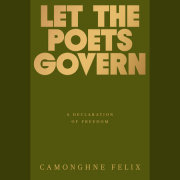
I write this book to tell you a story about how the legal documents of yesterday, written by those who used language to conjure a world where only they had power, have shaped the world of today. This book is about how the poetics of the past became the material of the future. It is about how the poem has functioned throughout time, how the poem collects data, and how the poem organizes that data to tell us something about history that we’d never known. It is about rejecting a language that seeks to obliterate those of us who need language the most.
There are consequences for the way we’ve used language to harm. Consequences for using language to exploit. We are witnessing, in real time, the consequences of weaponizing language for the benefit of capital. When the language is toxic, we hurt. When the language is healthy, we thrive. Language has no morals or ethics, but it defines our morals and our ethics, and we have used it to establish the worst of our morals, the worst of our ethics. We have yet to truly articulate the best of what we could be.
Language evolves and takes many forms, but we standardize it, force it into assimilation. Take the English language, for instance, which has been forced into the mouths of more than one billion speakers, a language that has achieved dominance. It is a tool of coercion, a tool that forces on the speaker an established set of values, values that are then encoded into the documents that organize our society. Every document tasked with the responsibility of speaking for the many fails as soon as it is written. When a word is translated, meaning is lost. And between each translation, intent is lost. When we lose intent, we lose language’s functionality: Intent is context. Intent is subtext. The poem proves that to us again and again. Intent gives us the information we need in order to know what the poem really wants to say.
I use the erasure poem in this book as not just a literary tool, but a comment on the necessity of revision. By creating erasure poems out of legal documents that have designed the last six hundred years of humanity, I revisit the past and superimpose a new narrative, manipulate language in order to represent poetry’s truest sense, the sense that turns language into a portal instead of a handshake. The erasure poem then becomes a way to enter, not only a way to be in touch. We cannot revise history but we can revise and redefine the language that governs history, the language that governs us.
The permission to be a poet is accessible to any of us. When we are kept away from that access, when that permission is withheld from us, we lose our relationship to the musicality of language, to a certain kind of intellect that our ancestors took care to cultivate. We lose our relationship to storytelling and our relationship to remembering. We lose the romance of being alive. We fall into the traps of solipsism and individualism, forgetting that interreliance is where our liberty lies. Each of us has the ability to see the world through a poet’s eyes, the ability to find ourselves in a process of constant curiosity and creation, where what we want to see is made visible in real time. We all have it, and that “it” is the difference between an ending world and an endless world. The world we imagine is possible. Poetry allows us to trust that, to have faith in it, to see the impossible as possible. Poetry allows us to abstract the present in order to construct a new and unexpected future. It fractures—and deepens—time.
If the poet is in a state of rebellion from the expectations of form and history, she becomes fugitive. “It is not merely with his whole soul,” Aimé Césaire—poet, politician, and hero of the negritude movement—says in his essay “Poetry and Knowledge,” “it is with his entire being that the poet approaches the poem. What presides over the poem is not the most lucid intelligence, or the most acute sensibility, but an entire experience.” Poetry is the most radical representation of fugitivity because it’s learned through a fugitive education—an education that cannot be taught in a classroom alone, not in the way mathematics is taught or the way the sciences can be taught. Certain forms like sonnets or ghazels have rules that require the poet to practice constraint. But when the poet breaks out of that constraint and challenges the rules, she remakes the form into something else. The poem insists on fugitivity—at once constrained and completely free. It is learned in reading the poets of the past, in understanding poetry as a way of being, a way of life.
At the end of the world, on the brink of extinction, we have finally begun to understand that language is alive. And that when we use it, we are divining a reality yet unrealized.
Poetry is where I go to become an architect of survival. I am abstracting survival, because I do not and cannot think of survival in concrete terms, because the world we’ve created and inherited does not want us to survive. Survival for the human being necessitates abstraction, it requires that we see outside the limitations of what is considered real. I use poetry to orient myself in the worlds I occupy. How am I situated within the imagination of the oppressor? Does my work make their job easier or harder? Do I puncture the oppressor’s fantasies, or am I punctured instead? Moten and Stefano tell us about what it means to puncture: “We preserve upheaval sent to fulfill by abolishing, to renew by unsettling, to open the enclosure whose immeasurable venality is inversely proportionate to its actual area, we got politics surrounded. We cannot represent ourselves. We can’t be represented.”
We resist the “enclosure”—that which encircles us and entraps us within the terms of its perpetual crises—by surrounding it, by breaking its gears, by shaking it up with our new and ancient logics.
When we recognize that access to poetry is free and that we all have the opportunity to use it, then we take language’s intimacies back, and we take it away from those who abuse it. Language belongs to the hungry, and if we seek nourishment from a future that feeds us all, then language will be the thing that frees us.
I write you a poem that folds in on itself, an epic account, a single stanza as document, itself the first and the last. I write with the hope that we can—and will—choose to construct a language of compassion. Because language is what governs us.
Copyright © 2026 by Camonghne Felix. All rights reserved. No part of this excerpt may be reproduced or reprinted without permission in writing from the publisher.