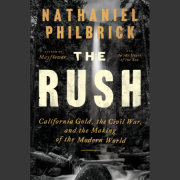
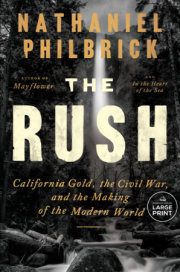
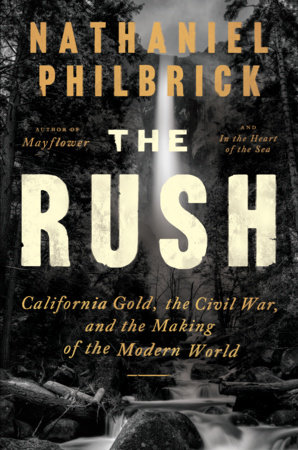
The Rush

California Gold, the Civil War, and the Making of the Modern World

National Book Award winner and Pulitzer Prize finalist Nathaniel Philbrick, author of In the Heart of the Sea and Mayflower, reveals how California’s Gold Rush forged the modern United States—and lit the long fuse to civil war

In January 1848, a carpenter spotted flecks of gold in a shallow stream at Sutter’s Mill in California—triggering the greatest voluntary migration in U.S. history and jolting a fragile republic already sliding toward crisis. In The Rush, Nathaniel Philbrick transforms the Gold Rush from a tale of sudden riches into the origin story of America’s modern contradictions: capital consolidated at dizzying speed, democracy in thrall to private power, xenophobia weaponized in the name of liberty—and a stubborn belief in the American experiment that refuses to die. This is the story of a nation tearing at the seams—a republic tested by its own ideals.

From the feverish gold-mining camps of the Sierra Nevada mountains to the wharves and vigilance committees of San Francisco, Philbrick renders a combustible, all-world society: Chilean brothers reinventing themselves to outrun prejudice; Native communities navigating dispossession and violence; the merchant-showman Samuel Brannan, drawn into the center of early vigilantism; and the politicians vying for control of California’s future—the ambitious free-soil political boss David Broderick, who squared off against William Gwin, the Southern power broker intent on tilting the state toward slavery and the Confederacy. Not until a year after the outbreak of the Civil War, when President Lincoln signed legislation that would unite the nation east to west by building a transcontinental railroad, was California’s loyalty secured.

Philbrick follows the gold as it moves from riverbed to countinghouse to the halls of power, revealing how vigilantism hardened into law and how debates over slavery in the West tipped the balance in Washington. The result is a clear, human story of how a scramble for wealth reshaped ideas of freedom, labor, and belonging—and how California's rise helped push a fractured nation toward war. The Rush is alive with characters whose choices still reverberate: a searing, panoramic epic that captures both the fury and the promise of America.
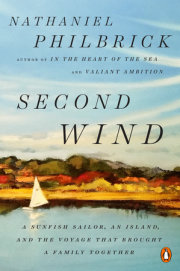
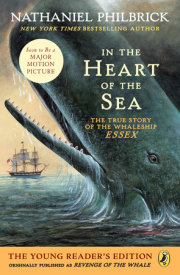
Nathaniel Philbrick grew up in Pittsburgh, Pennsylvania, and earned a BA in English from Brown University and an MA in America Literature from Duke University, where he was a James B. Duke Fellow. He was Brown University’s first Intercollegiate All-American sailor in 1978, the same year he won the Sunfish North Americans in Barrington, Rhode Island. After working as an editor at Sailing World magazine, he wrote and edited several books about sailing, including The Passionate Sailor, Second Wind, and Yaahting: A Parody. In 2000, Philbrick published the New York Times bestseller In the Heart of the Sea, which won the National Book Award for nonfiction. The book is the basis of the Warner Bros. motion picture Heart of the Sea, directed by Ron Howard and starring Chris Hemsworth, Cillian Murphy, Brendan Gleeson, Benjamin Walker, Ben Wishaw, and Tom Holland. The book also inspired a 2001 Dateline special on NBC as well as the 2010 two-hour PBS American Experience film Into the Deep by Ric Burns.   Philbrick’s writing has appeared in Vanity Fair, The New York Times Book Review, The Wall Street Journal, the Los Angeles Times, and the Boston Globe. He has appeared on the Today show, The Morning Show, Dateline, PBS’s American Experience, C-SPAN, and NPR. He and his wife live on Nantucket. View titles by Nathaniel Philbrick

About

National Book Award winner and Pulitzer Prize finalist Nathaniel Philbrick, author of In the Heart of the Sea and Mayflower, reveals how California’s Gold Rush forged the modern United States—and lit the long fuse to civil war

In January 1848, a carpenter spotted flecks of gold in a shallow stream at Sutter’s Mill in California—triggering the greatest voluntary migration in U.S. history and jolting a fragile republic already sliding toward crisis. In The Rush, Nathaniel Philbrick transforms the Gold Rush from a tale of sudden riches into the origin story of America’s modern contradictions: capital consolidated at dizzying speed, democracy in thrall to private power, xenophobia weaponized in the name of liberty—and a stubborn belief in the American experiment that refuses to die. This is the story of a nation tearing at the seams—a republic tested by its own ideals.

From the feverish gold-mining camps of the Sierra Nevada mountains to the wharves and vigilance committees of San Francisco, Philbrick renders a combustible, all-world society: Chilean brothers reinventing themselves to outrun prejudice; Native communities navigating dispossession and violence; the merchant-showman Samuel Brannan, drawn into the center of early vigilantism; and the politicians vying for control of California’s future—the ambitious free-soil political boss David Broderick, who squared off against William Gwin, the Southern power broker intent on tilting the state toward slavery and the Confederacy. Not until a year after the outbreak of the Civil War, when President Lincoln signed legislation that would unite the nation east to west by building a transcontinental railroad, was California’s loyalty secured.

Philbrick follows the gold as it moves from riverbed to countinghouse to the halls of power, revealing how vigilantism hardened into law and how debates over slavery in the West tipped the balance in Washington. The result is a clear, human story of how a scramble for wealth reshaped ideas of freedom, labor, and belonging—and how California's rise helped push a fractured nation toward war. The Rush is alive with characters whose choices still reverberate: a searing, panoramic epic that captures both the fury and the promise of America.

Author

Nathaniel Philbrick grew up in Pittsburgh, Pennsylvania, and earned a BA in English from Brown University and an MA in America Literature from Duke University, where he was a James B. Duke Fellow. He was Brown University’s first Intercollegiate All-American sailor in 1978, the same year he won the Sunfish North Americans in Barrington, Rhode Island. After working as an editor at Sailing World magazine, he wrote and edited several books about sailing, including The Passionate Sailor, Second Wind, and Yaahting: A Parody. In 2000, Philbrick published the New York Times bestseller In the Heart of the Sea, which won the National Book Award for nonfiction. The book is the basis of the Warner Bros. motion picture Heart of the Sea, directed by Ron Howard and starring Chris Hemsworth, Cillian Murphy, Brendan Gleeson, Benjamin Walker, Ben Wishaw, and Tom Holland. The book also inspired a 2001 Dateline special on NBC as well as the 2010 two-hour PBS American Experience film Into the Deep by Ric Burns.   Philbrick’s writing has appeared in Vanity Fair, The New York Times Book Review, The Wall Street Journal, the Los Angeles Times, and the Boston Globe. He has appeared on the Today show, The Morning Show, Dateline, PBS’s American Experience, C-SPAN, and NPR. He and his wife live on Nantucket. View titles by Nathaniel Philbrick
  • More Websites from
    Penguin Random House
  • Common Reads
  • Library Marketing