Q: Can you tell us a little bit about your book and what you hope readers take away from it?
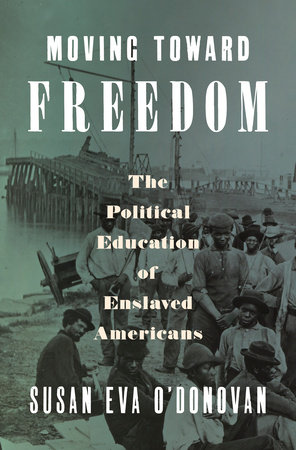
A: My book offers a radical new view of the history of enslaved Americans. Rather than studying them in place as has so often been the case – lending the impression that they had been pinned down by a slaveholder’s oppression – I study enslaved people in motion, as mobile and widely deployed laborers sent abroad (often literally) by owners who refused to do for themselves that which they could order an enslaved person do instead. It is a cognitive shift that reveals a wholly new landscape of American history, one in which forced deployments for labor changed not only the enslaved, but the institution of slavery too. Work, I argue, was the instrument by which the nation’s bound black workers transformed themselves into a politically aware population of such strength that when the Civil War broke out in 1861, they stood alongside presidents, politicians, field commanders, and foot shoulders in bringing about what Abraham Lincoln hailed as “a new birth of freedom.” This is a history of a working class that overcame countless legal and cultural obstacles to first craft their own distinctive set of political sensibilities and then to act upon them to create the nation anew.
Q: Were there particular libraries or collections that proved especially transformative for the project?
A: Oh my, yes. Sweeping as it does across time and space, Moving Toward Freedom rests heavily on equally as sweeping collections. The most important of these include Ulrich B. Phillips papers at Yale University’s Sterling Library, Loren Schweninger’s, Race and Slavery Petitions Project; Kenneth M. Stampp’s Records of the Ante-Bellum Southern Plantations from the Revolution through the Civil War; Charles B. Dew’s Slavery in Antebellum Southern Industries; and the Adam Matthew collection, Slavery, Abolition & Social Justice. Geographically and temporally expansive, these collections provided the empirical and interpretive backbone of my book by allowing me to broaden my field of vision and to better see the extent and effect of enslaved people’s movement and the political education they obtained.
Q: As more archival collections are digitized, how do you see digital access changing the way historians work?
A: With recent deep cuts to the one institution on which historians have long depended for the funding necessary to visit widely scattered archives in person, digital collections may soon be the primary means by which we do our work. This is especially relevant for those who, like me, strive to understand the histories of unlettered and usually subaltern people, individuals and communities who rarely leave behind a thickly written and cohesive paper trail. Studying them requires us to mine the archives for what amounts to shards of information that we then piece together into the most comprehensive and logical picture possible. A task its practitioners describe as slow history, it is also expensive history, requiring large outlays of money for travel and research. In the new, post-NEH age, such projects would have to be abandoned if it weren’t for our access to digitized archives.
To look at your question from a different direction, digitized archives lend themselves to deeper and wider reading as well. No longer restricted by time and cost, those of us who use these materials can download entire collections if that’s what we want. We can also take our time to read them more carefully and to read them again and again. Digitization also breaks us loose from the long practice at least in terms of American slavery from focusing tightly on one or two places, sometimes even just single plantations. As our research costs plummet, our access widens, allowing us to cover far longer distances and far longer expanses of time. I anticipate that as more historians take advantage of digitized sources and subsequently broaden their own fields of vision, they too will see new stories coming into view.
Q: What message would you offer to librarians and archivists about preserving materials that may not yet seem historically significant?
A: Nothing is historically insignificant. Every sheet of paper, every diary, every broken teapot, even the trash that curls up at the side of a road contains information about who we were, who we are, and who we might be. Of course, I also realize that keeping everything is out of the question, but at the same time, historical significance is subjective and impossible to anticipate. It is determined by scholarly interests that evolve over time. What is important to one researcher can be chaff to another. Take the materials I’ve been excavating for years. Brushed aside by all but a few American historians until the mid-1960s, when the Civil Rights Movement drew mainstream scholars to the African American past, much of what I used now informs countless historical studies, from architecture and political economy to a recent exploration of antebellum northern business practices. To have chucked those seemingly insignificant hotel receipts that I found so illuminating would have been to misunderstand one of the most politically turbulent periods in the American past.
Q: Who are some of your favorite historians, and what books of theirs do you recommend?
A: My favorite historians are those who pay attention to the grittiest detail. They are the “archive rats,” scholars who understand that the best historians work from the particular to the general, allowing the evidence to lead them to their conclusions. Writing history is a political act, but intellectual honesty does not permit it to be a partisan act. We need to have the courage to write not what we want, but rather the sum of what we encounter in the archives. My favorite historians adhere to those principles and include people like C.L.R. James whose magnificent Black Jacobins (1938) placed enslaved Haitians at the center of a revolution that ended with the creation of the first independent black republic. W.E.B. Du Bois is another, shocking a still white supremacist nation in 1935, when he reframed the American Civil War as a “great strike,” one led by the nation’s four million enslaved laborers. Black Reconstruction in America: An Essay Toward a History of the Part Which Black Folk Played in the Attempt to Reconstruct Democracy in America, 1860–1880 continues to figure into my research, my thinking, and my teaching. There are plenty of other, more contemporary historians who approach the past with the same clear-eyed understanding that it is not on us to argue with, ignore, or overlook relevant evidence. These include Ira Berlin (Many Thousands Gone: The First Two Centuries of Slavery), Peter Wood (Black Majority: Negroes in Colonial South Carolina from 1670 through the Stono Rebellion), and Marcus Rediker (The Slave Ship: A Human History and with Peter Linebaugh, The Many-Headed Hydra: Sailors, Slaves, Commoners, and the Hidden History of the Revolutionary Atlantic). I could go on, but these should suffice as examples of the most dog-eared books in my private library.