
Dear Librarian,
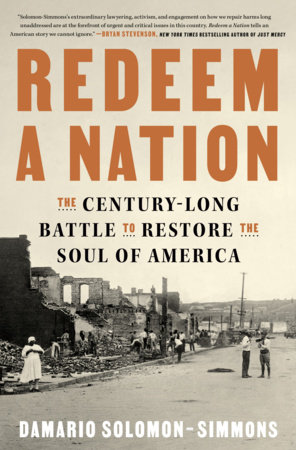
I grew up in North Tulsa, Oklahoma, in a community the world often talked about but rarely listened to. We carried the legacy of Black Wall Street and the Tulsa Race Massacre in our bones, yet no one spoke openly about what happened in 1921. I did not learn the truth until college.
In the absence of public memory, we had stories. Books—especially encyclopedias, which I devoured—were food for my restless mind. And for me, libraries were sanctuaries.
Libraries were where I encountered Frederick Douglass and James Baldwin — and just as importantly, the elders in my own community whose wisdom and beauty were rarely reflected in textbooks but fully alive within those walls. It was there that I began to understand both the brilliance and the brutality woven into the American story. I also learned that librarians were not merely custodians of books. They were champions of access and possibility.
One librarian changed my life.
After I dropped out of my first college and moved home, I did not own a computer. Keith Jemison of North Tulsa’s Rudisill Regional Library quietly opened his office to me. He let me use his computer whenever I needed it. No paperwork. No conditions. Just belief.
He also invited me into the African American Resource Center and to the Sankofa Freedom Awards, exposing me to Black intellectual tradition and historical preservation at a pivotal moment. That access was not just practical. It was transformational.
When I later enrolled at the University of Oklahoma, I carried that lesson with me. I have kept my library card active ever since. Supporting public libraries is not symbolic for me. It is personal.
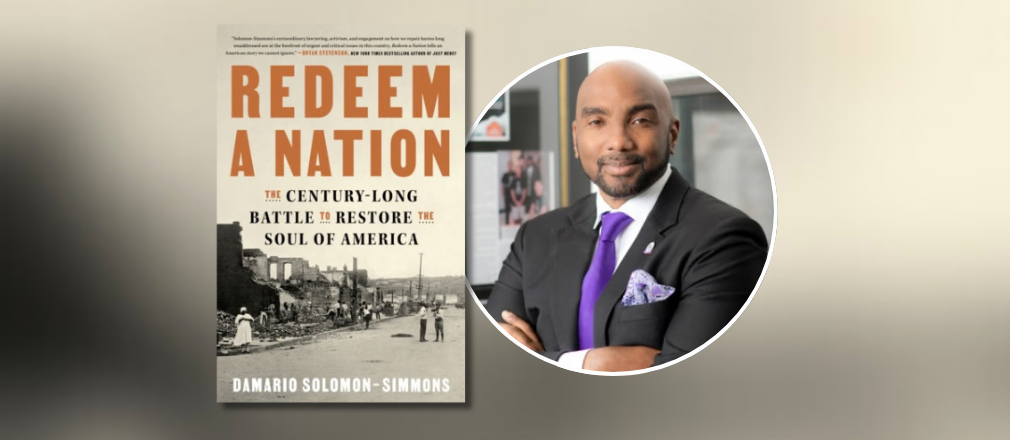
Today, I serve as a civil rights attorney representing the survivors of the Tulsa Race Massacre. I have filed cases, argued in court, and spent years seeking accountability for a crime once buried in silence. Redeem a Nation tells that story — but it also tells the deeper story of a community that refused erasure.
This book is not simply about a lawsuit. It is about historical memory, civic courage, and the unfinished work of American democracy. It is about how law can be used not only to confront injustice, but to repair it.
The seeds of that work were planted in quiet rooms lined with books.
When I imagine Redeem a Nation on library shelves, I see a full circle. A young Black boy who once searched for answers now offering context to the next generation. An invitation to learn, to question, to remember — and to act.
There are young people walking into your library today carrying questions they do not yet have language for. The work you do ensures that when they reach for truth, it is there.
If Redeem a Nation earns a place in your collection, I hope it will serve as both history and catalyst — especially for readers from communities like mine who need to see that their stories matter, their voices count, and their pursuit of justice is worthy.
Thank you for protecting the spaces that protect our democracy.
Damario Solomon-Simmons, Esq. M.Ed.