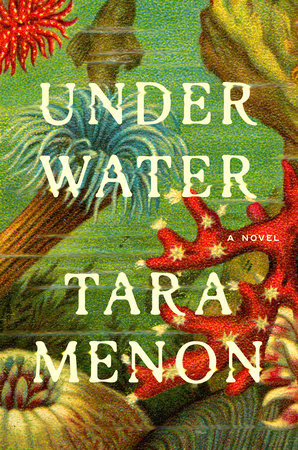

Q: Libraries are beloved for their sense of community. Do you remember a time when your library made you feel like a part of something bigger?
A: When I first arrived in America, as an undergraduate student, I often felt a little overwhelmed and bewildered. The one place that always made me feel calm and less alone was the sun-filled reading room of Butler Library at Columbia (it makes a short appearance in Under Water). I loved walking past Butler every day that I was on campus and reading the imposing names inscribed above the collonade, but not nearly as much as I loved being inside its walls—the perfect stillness of the reading room, everyone working by themselves but together, and the hushed conversations between harried researchers and the calm librarians who helped them find what they needed.
Q: There are strong elements of nature and science in Under Water. What research, if any, did you do when incorporating those parts? Did any of your research take place in a library?
A: My research for Under Water was really varied—I read meteorological reports about hurricanes and other weather events, academic research papers about manta rays, IPCC reports, interviews with conservation biologists, research trips to Thailand, firsthand accounts from tsunami survivors, newspaper articles about both natural disasters, narrative non-fiction about invasive species and biomass loss, documentaries about rainforests and coral reefs. I borrowed many big tomes of natural history from the university libraries of NYU and Harvard. I consulted a huge array of books, essays, articles, and guides. I cannot hope to name them all, but a few that were essential:
Manta: Secret Life of Devil Rays, Guy Stevens and Thomas Peschak
Guide to the Manta & Devil Rays of the World, Guy Stevens, Daniel Fernando, Marc Dando, and Giuseppe Notarbartolo di Sciara
Thailand: Travellers Wildlife Guide, David L. Pearson and Les Beletsky
Birds of Thailand, Craig Robson
Reef Life, Brandon Cole
Ghosts of the Tsunami, Richard Lloyd Parry
Wave, Sonali Deraniyagala
Wave of Destruction, Erich Krauss
Q: There are two major events that take place in Under Water. What inspired you to write about these two events?
A: In 2004, when the tsunami hit, I was a teenager living in Singapore. It was Boxing Day, right in the middle of Christmas holidays, and in a typical year, my family and I would have been on holiday in Thailand. For some reason, we were not that year. The tsunami killed a quarter of a million people; people at my school lost a sibling, a parent. In the aftermath, my school did significant fundraising for Banda Aceh (one of the worst affected areas) including a world-record setting basketball match which I played in, and which two survivors of the tsunami participated. I heard them speak about their experiences of losing their family, their homes. The tsunami has haunted my imagination since.
In 2012, I was a graduate student at NYU when Hurricane Sandy hit. I sheltered at home, on the Upper West Side: we never lost power; school was cancelled; we had every possible comfort. It felt like a holiday. In the aftermath, I volunteered in Chinatown distributing basic goods (batteries, canned food, bottled water) to residents living on the upper floors of NYCHA buildings. I volunteered for an NGO, but the National Guard were rolling through the streets in tanks. I was struck by the disparity between downtown powerless life and uptown brunch fun. But found myself thinking deeply about natural disaster response and relief, and thinking back to questions about the tsunami that I didn’t ask at the time. I was especially preoccupied by disparities between responses (material and emotional) between natural disasters across the world.
Q: What’s something you hope readers will take away from Under Water?
A: I also wanted to put off the two spectacular natural disasters to the end of the book so that the lead up could foreground to what is often called slow violence, harm that occurs gradually and mostly out of sight, like the bleaching of a coral reef or the introduction of an invasive species of turtle to a pond in Central Park. I wanted to call attention to the many kinds of unsung loss occurring all around us right now, rather than write a fantasy about an apocalyptic future that may or may not occur. As with grief for a friend, so much devastation in the natural world goes unattended, and yet both kinds of loss have seismic impact.
Q: Do you have a favorite library memory? Either from writing Under Water, or just browsing the shelves?
A: My favourite library memory is probably my earliest library memory. One day, in second grade, our teacher took the whole class to the school library for the first time. We didn’t have to do anything, we were just free to wander through the shelves and take any books we wanted. I couldn’t believe my luck. The other children left the library when the bell went for lunch, but I stayed until the librarian gently ushered me back to class.
Q: If you could say one thing to librarians right now, what would it be?
A: I would say: thank you. I know that resources at public libraries are currently under attack and book banning is on the rise and I imagine that being a librarian right now cannot be easy. But I hope they know how grateful we readers and writers are for the work they do. I spent my childhood immersed in books, many of which were recommended to me by my school librarian or borrowed from libraries, and I hope that all children can be lucky as I was.