
View a PDF of the letter here.
My Adventures as “Rosamond Smith”
A Message from Joyce Carol Oates
***
Sometime in 1986, after completing a lengthy, emotionally exhausting novel titled You Must Remember This, the idea came to me in a flash, with a promise of adventure: writing a sequence of short, cinematic novels exploring twins, doubles, soul-mates and secret selves under a pseudonym!
Not writing as “Joyce Carol Oates,” as I had done for more than twenty years since my first book was published in 1963; but writing, in 1986, under a fictitious name not linked to Oates, in a very different style than the (alleged) Oates style: “Rosamond Smith.”
Within an hour or so the first Rosamond Smith novel unfolded in my imagination, inspired by the idea, the freedom and relative anonymity, of a pseudonym: it would be short, quick-paced, with cinematic scenes, an emphasis on dialogue, few or no flashbacks, a minimum of description and exposition. The sheer momentum of storytelling, in contrast to the more dutiful responsibilities of the writer to set a scene, provide a historic context, assume a moral perspective, and hew to a plausible verisimilitude, carried me through the entire manuscript of Lives of the Twins in a few months—as quickly as the story of a young woman fatally in love with two men who are identical twins yet polar opposites came to me, I transcribed it, revising as I moved along, not really knowing, like my beleaguered heroine, what the final revelation would be.
As it happened, one of my Princeton friends was also a New York City agent, and it was to Rosalie that I brought this short manuscript; my agent of twenty years, Blanche Gregory, knew nothing about it. (Why did I not bring Lives of the Twins to Blanche, as I should have done? Because I knew, or half-knew, like a guilty adolescent, that Blanche would be baffled and disapproving; for after all I had just recently finished You Must Remember This, which was scheduled to be published in 1987. Blanche Gregory had placed that novel with my longtime publisher Vanguard Press, which had invested a good deal in my career at that point, beginning with my first book, By the North Gate, in 1963.)
Fairly quickly my (shadow) agent Rosalie placed Lives of the Twins with an editor (at Simon & Schuster) who had no idea who Rosamond Smith was, being led to believe that this was a first novel; the advance was very modest, but I could not have been more thrilled—it was like beginning my career again, setting off on an entirely different path, with no pre-existing identity or reputation, no “author’s” background at all. Unlike “Joyce Carol Oates,” “Rosamond Smith” literally had no identity in actual life: no awards or fellowships, no magazine publications, no university degrees, no birthplace! Here was the very essence of fiction: not only is the work fictitious, the creator of the work is fictitious as well.
However, the adventure did not end well. Somehow, it was never entirely explained how, or why, news of the “pseudonymous” novel was heralded in the New York Post. My longtime publishers were very upset, my agent Blanche Gregory was deeply wounded, embarrassed. Picking up the phone to hear Blanche’s aggrieved voice “Joyce! What have you done!”—has got to be one of the most mortifying experiences of my life. No matter that I was hardly a young writer at this time, nor a naive adolescent; yet, my surprise that others were so surprised, and so disapproving, seems to suggest an elemental naivete. Like many another adolescent I had to confess—I’d embarked upon an adventure that, though innocent and exciting to me, was in fact upsetting to others associated with me professionally. I just didn’t think . . . is a weak apology but in truth the most accurate explanation for my behavior.
Despite this debacle, I was encouraged to continue to write suspense/mystery novels under “Rosamond Smith” so long as “Joyce Carol Oates” also appeared on the cover and title page. (“Rosamond Smith” had been chosen for its mirroring of “Raymond Smith,” my husband whom I had married in 1961 and would remain married to for forty-seven years until his death in February 2008.)
There followed, then, in 1990, Soul-Mate, probably my favorite of the Rosamond Smith novels, for its sympathetic woman protagonist, in manner not unlike myself; a woman who finds herself confounded by an (unwilled, unchosen) alliance with an attractive young sociopath determined to do her bidding, as in a dark fairy tale replicating the artist in thrall to a fatal muse.
In succession there followed, under the name “Rosamond Smith,” a series of mystery/suspense novels exploring related themes in varied settings, with alternating female/male protagonists: Nemesis (1990), Snake Eyes (1992), You Can’t Catch Me (1995), Double Delight (1997), Starr Bright Will Be With You Soon (1999), and The Barrens (2001).
What explains this fascination with twins, doubles, soul-mates, secret selves? And why a connection with crime, transgression? Most of our lives, if we dare to explore our family histories, are related to violent acts, crimes—long ago in another generation, or century, perhaps. It would be a rare family history that didn’t originate in one or another upheaval, upset, fatality; I have always been fascinated by the ways in which, as Henry James once observed, in the preface to What Maisie Knew, what is “bane” for some persons will be “bliss” for others—a cruel sort of entanglement, as of deep-knotted roots in the soil, at the base of enormous trees, hidden to the ordinary eye.
In my own case—which reads, indeed, like a “hard case”—my very life, my existence, is only possible because two individuals, both men, died violently: one murdered, the other by suicide, long ago in the early 20th century. These were my grandfather and great-grandfather: the first, my mother’s father who was murdered in a tavern brawl in Buffalo, New York; the second, my father’s grandfather who took his own life, after trying to kill his wife, in Lockport, New York. Both violent deaths precipitated radical changes in the lives of the survivors, in ways too complicated to trace here, resulting in, however improbably, my young mother-to-be and my young father-to-be meeting, marrying, and becoming my parents in 1938. No wonder, my fascination with labyrinthine plots, desperate acts, heroic survivors.
Mystery, too, seems to us the most elemental of experiences: as infants we lie in our cradles gazing up at—what, who? Faces hovering over us, strangers who, we will gradually discover, created us; and insist upon naming, defining us. Only with effort, after years, will we untangle just a bit of this mystery, understanding that our parents—mother, father—had complete identities before we were born, and apart from us; we only think that we “know” them, though we are sure that they haven’t a clue about us.
Mystery/detective/crime novels explore literal “hard cases”—it is no wonder that so many readers are drawn to this format, for we yearn to “solve” mysteries as a sort of compensation for not being able to “solve” most of the mysteries of our lives.
***
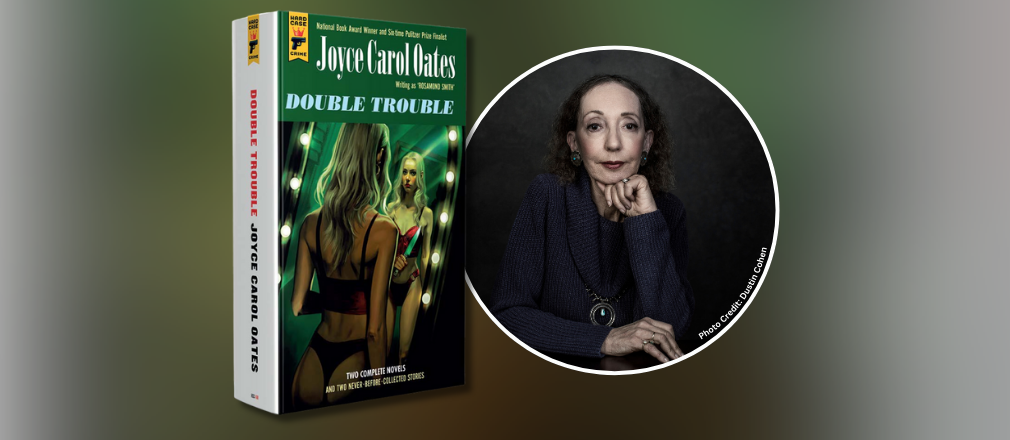
Most of these titles have been out of print for decades and so it is a pleasure to see them reprinted by Hard Case Crime with its retro-stylish cover designs replicating noir pulp fiction and films of the 1940s and 1950s. My first experience with Hard Case Crime was the reprinting of my serial-killer dark-comedy novella The Triumph of the Spider Monkey in 20l9, along with a companion novella Love, Careless Love, with an unabashedly sensational cover by the renowned pulp-paperback illustrator Robert E. McGinnis; illustrations for the Rosamond Smith novels, in twinned sets with appropriate titles Double Trouble and Second Nature, are similarly eye-catching, stylishly noir in a 21st century mode.
Again, it does feel like an adventure of beginning again. Thanks to the imaginative publishing of Charles Ardai at Hard Case Crime who has been hailed as one of the “best new American publishers to appear in the last decade” and who shares, with many of us, readers as well as writers, admiration for American noir in its astonishingly varied shapes.
Joyce Carol Oates
December 2025