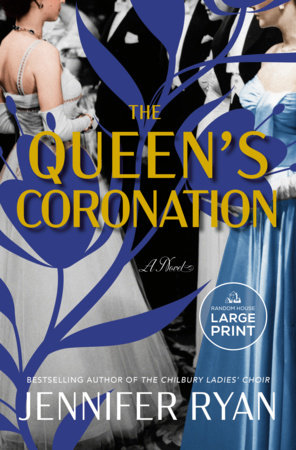
Caroline BrimstoneAssistant Dresser to Queen Elizabeth IIBuckingham Palace, LondonJanuary 1953Caroline stood back as the young queen stepped out, majestic in the gleaming silk gown. The soft, white fabric was close around the bodice and waist, flaring out to a full skirt, gold embroidery embellishing the garment to a truly spectacular level.
What a magnificent sight she was! This was a tipping point into a new age, the fresh, feminine monarch a symbol of the future, her taut traditional gown representing the weight of the past.
Following Her Majesty out of the dressing room was the head dresser, nodding to Caroline to start taking notes.
People present:The queenThe Queen MotherThe queen’s grandmother, Queen Mary, seatedNorman Hartnell, the gown’s designerThree seamstresses, waiting in the wingsMiss MacDonald, the head dresserTwo corgis, tails waggingStepping around the dogs, Caroline joined Miss MacDonald, swooping around the queen, smoothing down the thick silk, wondering how it must feel for the young woman getting ready for her coronation. It was almost a year since her father died and she’d become queen at the tender age of twenty-six. And now, she was preparing to be officially crowned.
Everything had to run like clockwork.
Caroline felt a rush of excitement to be there, witnessing the first fitting, listening to the jostle behind the scenes. With the new monarch, all the players were politely tussling for space. Not only were the Queen Mother and old Queen Mary trying to control the young queen, but so were the male advisors and the prime minister, Winston Churchill, dictating to her as if giving rules to a schoolgirl. Even her husband, Philip, expected her to do his bidding.
All her life Elizabeth had been told how to act, but now she was the one in charge.
Would she be able to push through her family and the advisors, take it on for herself?
As Caroline watched the queen balancing her thoughts, she wondered how it would feel, weighing up everyone’s opinions and yet trying to do what was best.
It was the opposite of Caroline’s life.
At thirty-three, Caroline had worked hard to get the promotion to assistant dresser, obtaining it only a few months ago. Like the queen, she’d had to take a deep breath and put herself forward. But for Caroline, it felt desperate, as if one wrong move could unbalance her precarious home life, sending her and her precious daughter into a tailspin.
“What did we decide for the embroidery?” The Queen Mother stepped forward to feel the soft fabric. Only a year ago, she had been the queen herself, and now she found herself widowed in her early fifties. Too young to don the name “dowager,” the title “Queen Mother” had been concocted, emphasizing her relationship to the new monarch rather than the last.
“We decided on embroidered flowers, Ma’am.” The designer, Norman Hartnell, stood to the side, his arms folded as he assessed the dress. A camp, hedonistic middle-aged man, he was a master of fashion and a favorite of the Queen Mother’s. He’d created the queen’s wedding gown only five years ago, with its fifteen-foot train. Based on a Botticelli portrait, it was the stuff of medieval princesses.
And now he had the task of producing a gown that was even more spectacular. After a few weeks of initial sketches, he’d presented nine designs. The queen and her mother had chosen the eighth, recommending that the gold and beaded embroidery depict colored flowers from across the realm.
“The heavy layers of pearl and gold stitchwork will add around twenty pounds of weight to it,” Hartnell said in his theatrical way. “Giving Her Majesty an authority, a dignity”—he paused to lift his hands to the heavens—“a transcendence.”
With this, the three seamstresses rushed forward to begin making small tacks to adjust for the queen’s figure.
Her voice quieter than the others, Elizabeth said, “Make sure we have flowers from the commonwealth countries, too. Do we have the list?” And it struck Caroline that the queen was more interested in making sure the job was done correctly than how glamorous she looked.
Miss MacDonald looked at her notes. “We have an English rose, a Scots thistle, a Welsh leek, an Irish shamrock, a Canadian maple leaf, an Australian wattle, a New Zealand silver fern, a South African protea, an Indian lotus flower, a lotus flower of Ceylon, and Pakistan’s wheat, cotton, and jute. We’re looking into including others, too, Ma’am.”
It was all-important to include the commonwealth countries, now that the empire was slipping away. And with the Cold War—everyone worrying about hydrogen bombs and the war in Korea—this was a time to keep friends close.
The queen’s grandmother, Queen Mary, had been sitting in a chair quietly observing, but now she spoke up. “The coronation is the day you become the monarch.” Her eyes narrowed sternly. “All sense of Lilibet will take second place to that of queen, the crown, the monarchy. It is your duty to bear the weight of the crown.”
At these words, the queen’s face reddened, although it was hard to tell whether it was because of her grandmother’s tone—indeed, the use of her childhood name seemed to reduce her to a little girl.
Queen Mary continued, “When your uncle Edward abdicated the throne in 1936, he made people question the monarchy. Fortunately, your father stepped in to become King George, smoothing a path through the crisis. And now it is your job, Lilibet, to uphold the tradition of self-discipline and self-sacrifice.”
The queen’s shoulders stiffened.
“Indeed.” Hartnell carefully diverted the conversation back to the gown. “The exuberance of the gold matches the auspiciousness of the nation. We want to show the world that we’ve come out of the post-war doldrums now. We’re still a main player on the world stage. The gilded carriages, the grand procession, the extravagance, the opulence, that’s what the people want. They want to know their rulers are majestic, omnipotent.” He closed his eyes theatrically, “Chosen by God.”
“You see, that’s why I wanted Hartnell to do the gown.” The Queen Mother nodded with approval while Caroline sighed. If the queen had let her mother choose the designer of her coronation gown, how would she run an empire without bowing to everyone’s wishes?
The dress fitting lasted over an hour, after which the entourage departed, leaving the queen to withdraw to the dressing room with the two dressers.
As Caroline put away her clipboard, she wondered how she’d describe the gown to Annabel once she was home from school. Her thirteen-year-old daughter loved the royals—together they kept a scrapbook of newspaper cuttings. Elizabeth will be a wonderful monarch, Annabel had declared—“Women always are.” Hadn’t Elizabeth I and Victoria become queens in their twenties? “It’s about time we have another queen on the throne.”
Gently, Miss MacDonald began to unbutton the gown. A quiet Scottish woman, the head dresser had been the queen’s nursemaid, sharing her bedroom until Elizabeth was eleven years old. She was the only servant who called her Lilibet—the name Elizabeth had given herself in childhood. In turn, the queen called her Bobo, a nickname that still stuck today. They were close, and Caroline sometimes overheard Elizabeth talking through a problem or worry with her.
If ever she needed a close, loyal friend, it was now.
As the assistant dresser, Caroline was a step back from Miss MacDonald. Although she had to help with the dressing, she also had to make sure that the royal garments were perfect, that the handful of wardrobe juniors had done the mending and laundry.
Every week, she received an update of the queen’s schedule months in advance. There were new outfits to order, fittings to arrange, matching shoes, hats, and gloves to source. Necklaces, earrings, and tiaras had to be selected and ordered from the Royal Jeweler.
Everything had to be prepared and perfect, backup outfits ready to be pulled out at a moment’s notice.
How important these gowns and outfits were, how central to the queen’s role. The perfectly coordinated garments reflected order, certainty, continuity. With her many duties, Elizabeth often needed a few costume changes every day. Her appearance and dress had to be perfect.
And the woman inside had to be flawless, too, her conversation apt and knowledgeable, her manners impeccable.
After the queen was unpinned from the coronation gown, she was dressed for an afternoon event, her hair reset and her makeup reapplied. It wasn’t long before an entourage of butlers and footmen came to escort her and Miss MacDonald to the car, leaving Caroline alone in the great wardrobe.
Copyright © 2026 by Jennifer Ryan. All rights reserved. No part of this excerpt may be reproduced or reprinted without permission in writing from the publisher.