Close Modal
Download high-resolution image
Listen to a clip from the audiobook
audio pause button
0:00
0:00

Summer of Love

Author Kerri Maher On Tour
Read by Lauryn Allman, Kerri Maher On Tour
Listen to a clip from the audiobook
audio pause button
0:00
0:00
"A love letter to California…. Through the deftly rendered lives of sisters, mothers and daughters, and longtime friends, Maher reveals how telling the truth can guide us back to ourselves and carry us forward with hope.”—Marjan Kamali, New York Times bestselling author of The Lion Women of Tehran

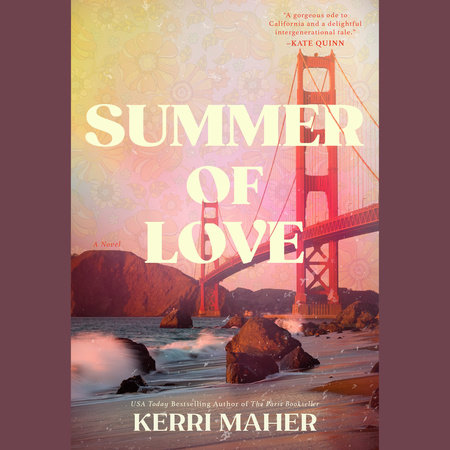
In this moving novel about the transformative power of storytelling, three women make life-changing decisions set in motion by the 1967 Summer of Love in San Francisco, from the USA Today bestselling author of The Paris Bookseller.


It’s the summer of 1967 and the counterculture revolution is in full swing in San Francisco. Every street is alive with the music of Jim Morrison and Dionne Warwick, and in view of the Golden Gate bridge young people come together, waving anti-war signs and shouting for equal rights. No one is more into the messages of love and peace than Winnie Hartley who has just graduated from UC Berkeley determined to use poetry to capture the ever-shifting world around her. When she reconnects with her high school boyfriend, an aspiring musician, their creative bond further fuels her work, and it feels like her life is finally taking off.

Meanwhile, miles up the winding coast, her sister Miranda stays close to home, throwing herself into running the family business, Hartley Vineyard. She’s determined to make California wine that rivals French. But change is in the air this wild and heady summer, and each sister will make choices that set their lives hurdling down paths neither would have imagined.

Fifty years later, Dawn Hartley stays as far as possible from her family’s famous vineyard, until a work assignment requires her to research the bestselling Vineland novels penned by a famously anonymous author. Determined to discover the identity of this mysterious writer—who seems to know things no one should about her family—Dawn embarks on a soul-searching journey along the windswept coast of California to uncover her family’s secrets even as she’s keeping a big one of her own.
Dawn

Phoebe missed her mother from the other side of the vines but had no hope of getting back to her until her work here was done.

-Phoebe and the Burning Vines

July 2015

Be in the moment, Dawn, I said to myself, because that was what my yoga teachers and the instructors in the online mindfulness class I took a year ago were always telling me to do. Alfie kept my feet warm in my damp, chilly kitchen while I checked my text messages and waited for coffee to brew. I closed my eyes and focused on the hiss and fragrance of the water hitting the freshly ground beans and the loving heat of my goldendoodle on my toes. He'd been my gift to myself after Clark and I finally broke up, when I'd needed someone to come home to who would be excited to see me even when I couldn't look in the mirror.

I reminded myself that had I been hungover-like I was most mornings six months ago-I'd be spending money I didn't have on an inferior paper cup of coffee at the place around the corner, along with a gooey egg sandwich to soak up the acid in my stomach. And I'd be wondering when-if-the fog in my brain would clear and what I could do that might legitimately be called work until it did. I needed to list all the reasons I could think of for not drinking while I reset my system and decided what would come next. I still couldn't fathom the idea of being alcohol-free forever. And even though I drank the most when I was by myself, it was birthdays and celebrations without the fizzy joy of a glass of champagne that were the hardest to imagine. I did like waking up with a clear head and a completely settled stomach, though, plus enough energy to get to a yoga mat before heading to work. Except when I saw something like this text message from Dennis:

Want to grab a drink Saturday?

A drink.

Why is it always a drink?

Six months ago, before the Incident, I would have been thrilled to throw off the promise I'd made to myself not to drink that day-that week, that month-because I had an excuse: Dennis, the handsome, intriguing professor I'd met at the Berkeley Art Museum, where we were the only two people at 11:00 a.m. on a Tuesday looking at film stills from the career of Elia Kazan. I'd noticed him because how could I not? He looked like a New York City transplant with his brown leather shoes and slim pressed white shirt tucked into well-fitting jeans. And that mop of black hair that hadn't grayed yet despite the telltale lines near his eyes. The prominent pointy nose. Had he been a Bay Area local, he'd have been wearing Birkenstocks or Tevas on that unusually warm day and probably chinos he'd owned since grad school. I'd been out with so many guys like that. It was getting old.

I was getting old.

I blame the pink cloud of early sobriety-though I hated using that word because of all it implied-for my boldness in sauntering up to him where he was casually looking at a glossy of Marlon Brando and Eva Marie Saint, and saying, "Did you know Grace Kelly was offered the role and turned it down to do Rear Window?" My heart hammered in my chest even though I knew I looked good that day, having squeezed my nearly forty-year-old self into faded black jeans I'd purchased as a promise to myself not to gain weight while not drinking, as I'd heard so many people did, along with a flowy pale-blue top that showed my tan arms.

Keeping his arms folded across his chest, he gave me a sideways look with a raised eyebrow, and I saw for the first time that his eyes, like mine, were as blue as my shirt. "I did know that, but then, I teach a class on Hitchcock. How do you know this wonderful bit of trivia?"

Oh shit, I thought. Do I have to admit to being a wannabe filmmaker stuck as a set designer creating immersive worlds that revealed character and foreshadowed plot but only ever other people's plots? I shrugged, buying myself a few seconds. Then, turning back to the picture so I wouldn't have to hold eye contact, I replied, "I really like movies from the '50s, especially the Hitchcock ones from that era. I even named my dog Alfred, though I call him Alfie."

He smiled exactly the kind of smile I hoped to see whenever I mentioned my dog: childlike and warm. "Alfie," he repeated. "That's a great name for a dog." Then he turned back to the picture. "Do you think Saint did the role justice? Or would Kelly have been better?"

"You know, I prefer to be content that she was fabulous in Rear Window. It was obviously the right choice."

"Agreed. Plus, her legacy doesn't have to be sullied by having worked with a McCarthy informer."

"Brando and Leigh and all the other actors he made stars don't seem to have suffered," I pointed out.

He chuckled with what I took to be an agreement, then said, "Forgive me, but this is what I'm knee deep in right now. I'm writing an essay on him and some others. What do we do with the great art and feats of politically problematic figures? Kazan, Lindbergh, Pound."

"Sounds suspiciously like you might be a professor."

Dropping his arms and looking squarely at me, he said, "Guilty as charged. Professor of film history here at Berkeley. I'm Dennis Schulz. No relation to Charles." He held out his hand to shake.

His hand was large and warm and dry, and I thought, Is it possible I'm actually meeting someone the old-fashioned way? I didn't know anyone who met off the dating apps anymore. "Too bad," I said, "because Snoopy is my hero."

"Is he now?" Dennis looked genuinely amused.

"I mean . . . Joe Cool? The World War I flying ace? Author of 'It was a dark and stormy night'?"

Dennis laughed more heartily this time, and I felt a blush bloom in my chest and cheeks. "You got me there," he said. "I think because of the name I share with his creator, I've gotten a little prickly over the years about not being able to get people signed originals of 1960s comic strips."

"I can see how that would be a burden."

"And what do you do?"

"I'm a set designer," I replied, knowing it sounded cooler than it had felt to me for a long time. "And my name is Dawn Hartley."

Dennis raised impressed eyebrows. "A set designer for films?"

"Mostly television advertisements, theaters, and museums. Some big functions here and there. I'm freelance." Interesting, I thought to myself, he didn't comment on my last name. Big wine drinkers were always intrigued by my name and asked if I might be connected to the famous Napa vineyard.

"You must be good, then."

I shrugged. I was good, but the career wasn't mine.

We moved on to other movies we loved and eventually books and music, and by the time he said he had to get to his class to teach, we had exchanged numbers.

That was two days ago.

And now . . . a drink? If only it was before I finally admitted to myself that I really needed to stop drinking, at least for a while. If only it was before I'd accumulated more than one hundred days, triple digits, and started feeling healthy for the first time in years. My original three-month goal had turned into those one hundred days and then into six months; I was three weeks away from that lofty half-year milestone. I'd never gotten that far before-the most I'd done was a day, maybe three. Even when I'd set a seven-day goal for myself, I'd always get to Friday, sometimes Thursday, and find a reason to have a glass of something.

The Incident had been galvanizing.

Audrey, my best and only sober friend, was cheering me on toward a year. Her theory was that if I could get that far, I'd never want to go back.

Of course, Audrey also thought I needed meetings and more sober friends than just her. She always said, "No one with long-term sobriety does this alone." Was that what I wanted, though? To be sober forever? Sober-sober? Did I have to go to meetings and use the word alcoholic, a word I sincerely felt did not describe me?

Audrey hadn't had a drop of alcohol for seven years, which was nothing short of amazing, given the mess she'd been in college when we first met in the dorms at Columbia. But she managed to make not drinking seem glamorous with her Goop spa treatments, hot yoga, and SoulCycle, all of which made her look even more gorgeous in the billowy caftans and trousers she favored. The Oscar on her mantel from her supporting role in a movie about aliens from when we were both nine didn't hurt her allure.

I grabbed my phone and called her.

"Dennis just texted to ask if I wanted to have a drink."

"That's great!" she chirped into the phone.

"Yeah, but . . . a drink?"

"Coffee is a drink, you know."

"But a coffee date is so lame," I said, pouring myself a first cup of my perfectly brewed elixir. Alfie stirred to his feet and looked at me expectantly with a cocked head and wagging tail, so I put Audrey on speaker while I got him some breakfast and fresh water.

"I disagree," she said.

"Do I have to tell him? You know, that I'm not drinking?"

"How long have you known this guy? An hour? No."

"Then why should I tell him I'm suggesting coffee? I don't want him to think I'm not that into him. Going out for a cocktail telegraphs real interest, sex appeal, sophistication . . ."

"So does Royal Coffee."

"Be serious."

"I'm dead serious. I once had amazing sex after a mimosa-free brunch in Brooklyn."

"Once."

"Do you want to see this guy or not?"

"Of course I do."

"Then get over it. Suggest Royal. Oh! Or the Japanese Tea Garden."

"I do love the Tea Garden. . . ."

"See? The Tea Garden. Just do it."

"Okay."

But I didn't.

I hung up with Audrey and started a text to him suggesting coffee or tea, then deleted it. Like, eight times. Finally, I wrote:

Work is nuts at the moment. Next week?

I cringed at myself. Chicken. This is why you're not a real filmmaker. Though I'd improved over the years, I'd always battled what I'd only realized in the last year was called anxiety. As a kid, I'd been called "nervous," the kind of student who always got sick-and I mean throwing-up sick-before important tests, who shied away from trying out for the school plays even though I wanted to, who majored in film with the intention of becoming the first female director to be a household name, only to move to San Francisco after graduation for a props job at the Curran Theatre that my mother had secured for me through some old friend of hers. And since I showed a talent for knowing exactly what to add to any set to make it come alive, I'd moved up through the ranks quickly, no doubt due to the many en plein air excursions Mom had taken me on, with my very own easel and paints, where she taught me how not just to see but to imagine what might enhance a scene. Now I could pick my projects, but I always stayed in my lane. I sometimes thought that, too, was part of my success; I didn't question the higher-ups. Directors knew I'd get the job done without being a diva.

Talking to Dennis at the museum had been very out of character for me, and looking back on it now, my stomach clenched at my own boldness. What had I been thinking?

I needed more time to get my bearings. I needed to not feel unsexy for suggesting coffee instead of a cocktail. I needed to come clean to the people closest to me before I started going on coffee dates with strangers.

I glanced at Mom's moody depiction of our favorite beach in Carmel that hung over my couch a few feet away, and I felt a pang of guilt. Mom. Miranda Hartley, the first woman vintner in Napa. Mom, who had no idea I was trying to stop drinking. How could I possibly tell her? How could I possibly tell her that I couldn't handle the thing she made, the beautiful bottles she'd refined and perfected over fifty years, the science and art she'd dedicated her life to. She always insisted winemaking was both science and art, and I wondered if that was because she was a painter at heart. It made me happy to see her indulging this love of hers as she got older, traveling to museums all over Europe and taking various classes abroad.

Mom and I had always shared everything, and here I was not telling her what had become the ruling factor of my life. Lately when she asked me how I was doing, I'd taken to giving her one-word answers like fine and tired, then steering the conversation toward something not-me, like the highly suspicious pickleball trend or where she was traveling next, all of which went against everything we'd ever been to each other. Dawn and Miranda were the Hartley Girls long before Rory and Lorelai were the Gilmore Girls, with a long-standing Sunday-evening ritual while I was growing up: We'd laze around on the couch eating popcorn and Red Vines while watching whatever old movie was on the local channels, eventually graduating to rented VHS tapes when those came on the market. "No ads!" we gleefully said as we popped one of those into the shiny new machine that made all those satisfying clicks. But Mom always made sure to pause the tapes so we could talk during a few breaks like we always had during commercials. It was during those evenings that I'd share about the girls who were being mean to me, the boys I liked, the teachers I feared.

Mom shared, too-her worries about the vineyard, which included her search for organic pest control, her stress over finding a new head grower after Emilio died suddenly of a heart attack, not to mention her intense sadness at losing such a close friend and colleague. Emilio had been at every family celebration, even after Grandma Joan died, and I shared Mom's sadness in losing him. My father was the only subject that had ever been off-limits. "He was a typical artist and didn't want to be a father, and he asked not to be contacted" was all she'd said. When my eyes filled with tears and I sniffled at this blunt information, she put her arm around me and offered a box of tissues and said, "I know, baby. It hurts. But really, it's my fault. I should have known better than to get involved with someone like him. If you need to be mad at anyone, be mad at me."
“A gorgeous golden ode to California history, from the sun-drenched Napa wineries to the hippy-jammed concerts of San Francisco at the height of the sixties. … A delightful intergenerational tale.”—Kate Quinn, New York Times bestselling author of The Briar Club

"A love letter to California, this moving novel is steeped in the beauty of the Bay Area from its towering redwoods to farm-to-table meals to the layered history of Napa’s vineyards. Maher skillfully pairs a deep sense of place with a refreshingly honest look at addiction and the quiet power of storytelling to help us heal. Through the deftly rendered lives of sisters, mothers and daughters, and longtime friends, Maher reveals how telling the truth can guide us back to ourselves and carry us forward with hope.”—Marjan Kamali, New York Times bestselling author of The Lion Women of Tehran

“Beautfiul… An uplifting novel that celebrates the importance of storytelling in recovery.”—Laura McKowen, bestselling author of We Are the Luckiest

"A delicious blend of sunshine and secrets along the California coast, Kerri Maher’s latest delivers a heartfelt and moving portrait of sisters facing great cultural and personal change. Poignant, page turning and relevant today, I couldn’t stop reading about these women living on the precipice of transformation until the final page. For fans of Elin Hilderbrand’s Summer of ‘69 and Beatriz Williams' Summer Wives.”Brooke Lea Foster, award-winning author of Summer Darlings

"An immersive page-turner that offers a complex braid of love, addiction, and the challenges of relationships between sisters and mothers, set against an authentic California and peopled with the real humans of that world. More than a tale of family, Summer of Love delves into the complex nature of secrets and addiction, the hope of recovery, and the power of storytelling to set us free. I genuinely loved this novel."—Barbara O’Neal, USA Today bestselling author of When We Believed in Mermaids and The Last Letter of Rachel Ellsworth

"Kerri Maher knocks it out of the park again with another multi-layered, deeply felt story peopled by characters who feel as real as our friends and neighbors. It's a captivating blend of mystery, history, family saga, and explosive secrets that can't stay hidden forever. An irresistible read."—Greer Macallister, USA Today bestselling author of The Magician's Lie and The Thirteenth Husband

"A delicious dose of California sunshine, heady romance and long-buried family secrets. Beautifully written and intriguingly moreish, Maher writes about the selves we keep hidden, and the unmasking thereof, with the greatest of humanity. For anyone who loved Daisy Jones and the Six."—Catherine Gray, Sunday Times bestselling author of The Unexpected Joys of Being Sober

"A provocative, deeply moving novel about California and the fierce aching rush of the American dream. With nuance and bold insight, Maher maps how family secrets can course for years like fire underground, and how a life can turn on one stunning loss or the singular grace of desire."—Dawn Tripp, nationally bestselling author of Jackie

"This special novel about sisters & secrets, wine & words, and addiction & absolution captivates with its stories of three women, tied together by blood and love, and the challenges they face. This dual timeline narrative deftly transports the reader to the sunny California landscapes of yesterday and today and delivers a wallop of a story that keeps the pages turning late into the night."Susie Orman Schnall, bestselling author of Anna Bright Is Hiding Something and We Came Here to Shine

"A gorgeously layered novel about sisterhood and the seductive promise of California, where beauty and excess blur and nothing is as simple as it appears. Kerri Maher writes about the baffling nature of alcohol abuse with rare empathy and restraint, honoring the complexity of women’s inner lives. It is a deeply human story that understands how memory, love, and self-deception intertwine—and how reckoning, when it comes, can change everything.” —Jessica Guerrieri, Award-winning author of Between the Devil and the Deep Blue Sea and Both Can Be True

“In this enjoyable family drama…Maher skillfully handles the delicate subjects of addiction and recovery and offers transportive descriptions of 1960s San Francisco and California wine country. It’s a sympathetic portrait of a woman’s search for fulfillment.”Publishers Weekly

"Maher’s latest novel is recommended for readers who enjoy big, messy family novels with strong women characters and a bit of nostalgia for the 1960s and 1970s. It’s perfect beach reading."Library Journal

“Maher’s lush descriptions engage the senses and bring to life this tale of family secrets and the strength of sisterhood and storytelling to bring them to light.” —Booklist

Praise for the novels of Kerri Maher

“[A] powerful, thought-provoking novel… not only important and timely, but deeply humanizing.”—Good Morning America

“Powerful. Dramatic. Insightful…. It’s not only a timely novel, but storytelling at its finest – a must-read.”NPR

“Remarkable.”The Washington Post
© Kate Eden Renyi Photography
KERRI MAHER is the USA Today bestselling author of The Paris Bookseller, The Girl in White Gloves, The Kennedy Debutante, and, under the name Kerri Majors, This Is Not a Writing Manual: Notes for the Young Writer in the Real World. She holds an MFA from Columbia University and lives with her daughter and dog in a leafy suburb west of Boston, Massachusetts. View titles by Kerri Maher

About

"A love letter to California…. Through the deftly rendered lives of sisters, mothers and daughters, and longtime friends, Maher reveals how telling the truth can guide us back to ourselves and carry us forward with hope.”—Marjan Kamali, New York Times bestselling author of The Lion Women of Tehran

In this moving novel about the transformative power of storytelling, three women make life-changing decisions set in motion by the 1967 Summer of Love in San Francisco, from the USA Today bestselling author of The Paris Bookseller.


It’s the summer of 1967 and the counterculture revolution is in full swing in San Francisco. Every street is alive with the music of Jim Morrison and Dionne Warwick, and in view of the Golden Gate bridge young people come together, waving anti-war signs and shouting for equal rights. No one is more into the messages of love and peace than Winnie Hartley who has just graduated from UC Berkeley determined to use poetry to capture the ever-shifting world around her. When she reconnects with her high school boyfriend, an aspiring musician, their creative bond further fuels her work, and it feels like her life is finally taking off.

Meanwhile, miles up the winding coast, her sister Miranda stays close to home, throwing herself into running the family business, Hartley Vineyard. She’s determined to make California wine that rivals French. But change is in the air this wild and heady summer, and each sister will make choices that set their lives hurdling down paths neither would have imagined.

Fifty years later, Dawn Hartley stays as far as possible from her family’s famous vineyard, until a work assignment requires her to research the bestselling Vineland novels penned by a famously anonymous author. Determined to discover the identity of this mysterious writer—who seems to know things no one should about her family—Dawn embarks on a soul-searching journey along the windswept coast of California to uncover her family’s secrets even as she’s keeping a big one of her own.

Excerpt

Dawn

Phoebe missed her mother from the other side of the vines but had no hope of getting back to her until her work here was done.

-Phoebe and the Burning Vines

July 2015

Be in the moment, Dawn, I said to myself, because that was what my yoga teachers and the instructors in the online mindfulness class I took a year ago were always telling me to do. Alfie kept my feet warm in my damp, chilly kitchen while I checked my text messages and waited for coffee to brew. I closed my eyes and focused on the hiss and fragrance of the water hitting the freshly ground beans and the loving heat of my goldendoodle on my toes. He'd been my gift to myself after Clark and I finally broke up, when I'd needed someone to come home to who would be excited to see me even when I couldn't look in the mirror.

I reminded myself that had I been hungover-like I was most mornings six months ago-I'd be spending money I didn't have on an inferior paper cup of coffee at the place around the corner, along with a gooey egg sandwich to soak up the acid in my stomach. And I'd be wondering when-if-the fog in my brain would clear and what I could do that might legitimately be called work until it did. I needed to list all the reasons I could think of for not drinking while I reset my system and decided what would come next. I still couldn't fathom the idea of being alcohol-free forever. And even though I drank the most when I was by myself, it was birthdays and celebrations without the fizzy joy of a glass of champagne that were the hardest to imagine. I did like waking up with a clear head and a completely settled stomach, though, plus enough energy to get to a yoga mat before heading to work. Except when I saw something like this text message from Dennis:

Want to grab a drink Saturday?

A drink.

Why is it always a drink?

Six months ago, before the Incident, I would have been thrilled to throw off the promise I'd made to myself not to drink that day-that week, that month-because I had an excuse: Dennis, the handsome, intriguing professor I'd met at the Berkeley Art Museum, where we were the only two people at 11:00 a.m. on a Tuesday looking at film stills from the career of Elia Kazan. I'd noticed him because how could I not? He looked like a New York City transplant with his brown leather shoes and slim pressed white shirt tucked into well-fitting jeans. And that mop of black hair that hadn't grayed yet despite the telltale lines near his eyes. The prominent pointy nose. Had he been a Bay Area local, he'd have been wearing Birkenstocks or Tevas on that unusually warm day and probably chinos he'd owned since grad school. I'd been out with so many guys like that. It was getting old.

I was getting old.

I blame the pink cloud of early sobriety-though I hated using that word because of all it implied-for my boldness in sauntering up to him where he was casually looking at a glossy of Marlon Brando and Eva Marie Saint, and saying, "Did you know Grace Kelly was offered the role and turned it down to do Rear Window?" My heart hammered in my chest even though I knew I looked good that day, having squeezed my nearly forty-year-old self into faded black jeans I'd purchased as a promise to myself not to gain weight while not drinking, as I'd heard so many people did, along with a flowy pale-blue top that showed my tan arms.

Keeping his arms folded across his chest, he gave me a sideways look with a raised eyebrow, and I saw for the first time that his eyes, like mine, were as blue as my shirt. "I did know that, but then, I teach a class on Hitchcock. How do you know this wonderful bit of trivia?"

Oh shit, I thought. Do I have to admit to being a wannabe filmmaker stuck as a set designer creating immersive worlds that revealed character and foreshadowed plot but only ever other people's plots? I shrugged, buying myself a few seconds. Then, turning back to the picture so I wouldn't have to hold eye contact, I replied, "I really like movies from the '50s, especially the Hitchcock ones from that era. I even named my dog Alfred, though I call him Alfie."

He smiled exactly the kind of smile I hoped to see whenever I mentioned my dog: childlike and warm. "Alfie," he repeated. "That's a great name for a dog." Then he turned back to the picture. "Do you think Saint did the role justice? Or would Kelly have been better?"

"You know, I prefer to be content that she was fabulous in Rear Window. It was obviously the right choice."

"Agreed. Plus, her legacy doesn't have to be sullied by having worked with a McCarthy informer."

"Brando and Leigh and all the other actors he made stars don't seem to have suffered," I pointed out.

He chuckled with what I took to be an agreement, then said, "Forgive me, but this is what I'm knee deep in right now. I'm writing an essay on him and some others. What do we do with the great art and feats of politically problematic figures? Kazan, Lindbergh, Pound."

"Sounds suspiciously like you might be a professor."

Dropping his arms and looking squarely at me, he said, "Guilty as charged. Professor of film history here at Berkeley. I'm Dennis Schulz. No relation to Charles." He held out his hand to shake.

His hand was large and warm and dry, and I thought, Is it possible I'm actually meeting someone the old-fashioned way? I didn't know anyone who met off the dating apps anymore. "Too bad," I said, "because Snoopy is my hero."

"Is he now?" Dennis looked genuinely amused.

"I mean . . . Joe Cool? The World War I flying ace? Author of 'It was a dark and stormy night'?"

Dennis laughed more heartily this time, and I felt a blush bloom in my chest and cheeks. "You got me there," he said. "I think because of the name I share with his creator, I've gotten a little prickly over the years about not being able to get people signed originals of 1960s comic strips."

"I can see how that would be a burden."

"And what do you do?"

"I'm a set designer," I replied, knowing it sounded cooler than it had felt to me for a long time. "And my name is Dawn Hartley."

Dennis raised impressed eyebrows. "A set designer for films?"

"Mostly television advertisements, theaters, and museums. Some big functions here and there. I'm freelance." Interesting, I thought to myself, he didn't comment on my last name. Big wine drinkers were always intrigued by my name and asked if I might be connected to the famous Napa vineyard.

"You must be good, then."

I shrugged. I was good, but the career wasn't mine.

We moved on to other movies we loved and eventually books and music, and by the time he said he had to get to his class to teach, we had exchanged numbers.

That was two days ago.

And now . . . a drink? If only it was before I finally admitted to myself that I really needed to stop drinking, at least for a while. If only it was before I'd accumulated more than one hundred days, triple digits, and started feeling healthy for the first time in years. My original three-month goal had turned into those one hundred days and then into six months; I was three weeks away from that lofty half-year milestone. I'd never gotten that far before-the most I'd done was a day, maybe three. Even when I'd set a seven-day goal for myself, I'd always get to Friday, sometimes Thursday, and find a reason to have a glass of something.

The Incident had been galvanizing.

Audrey, my best and only sober friend, was cheering me on toward a year. Her theory was that if I could get that far, I'd never want to go back.

Of course, Audrey also thought I needed meetings and more sober friends than just her. She always said, "No one with long-term sobriety does this alone." Was that what I wanted, though? To be sober forever? Sober-sober? Did I have to go to meetings and use the word alcoholic, a word I sincerely felt did not describe me?

Audrey hadn't had a drop of alcohol for seven years, which was nothing short of amazing, given the mess she'd been in college when we first met in the dorms at Columbia. But she managed to make not drinking seem glamorous with her Goop spa treatments, hot yoga, and SoulCycle, all of which made her look even more gorgeous in the billowy caftans and trousers she favored. The Oscar on her mantel from her supporting role in a movie about aliens from when we were both nine didn't hurt her allure.

I grabbed my phone and called her.

"Dennis just texted to ask if I wanted to have a drink."

"That's great!" she chirped into the phone.

"Yeah, but . . . a drink?"

"Coffee is a drink, you know."

"But a coffee date is so lame," I said, pouring myself a first cup of my perfectly brewed elixir. Alfie stirred to his feet and looked at me expectantly with a cocked head and wagging tail, so I put Audrey on speaker while I got him some breakfast and fresh water.

"I disagree," she said.

"Do I have to tell him? You know, that I'm not drinking?"

"How long have you known this guy? An hour? No."

"Then why should I tell him I'm suggesting coffee? I don't want him to think I'm not that into him. Going out for a cocktail telegraphs real interest, sex appeal, sophistication . . ."

"So does Royal Coffee."

"Be serious."

"I'm dead serious. I once had amazing sex after a mimosa-free brunch in Brooklyn."

"Once."

"Do you want to see this guy or not?"

"Of course I do."

"Then get over it. Suggest Royal. Oh! Or the Japanese Tea Garden."

"I do love the Tea Garden. . . ."

"See? The Tea Garden. Just do it."

"Okay."

But I didn't.

I hung up with Audrey and started a text to him suggesting coffee or tea, then deleted it. Like, eight times. Finally, I wrote:

Work is nuts at the moment. Next week?

I cringed at myself. Chicken. This is why you're not a real filmmaker. Though I'd improved over the years, I'd always battled what I'd only realized in the last year was called anxiety. As a kid, I'd been called "nervous," the kind of student who always got sick-and I mean throwing-up sick-before important tests, who shied away from trying out for the school plays even though I wanted to, who majored in film with the intention of becoming the first female director to be a household name, only to move to San Francisco after graduation for a props job at the Curran Theatre that my mother had secured for me through some old friend of hers. And since I showed a talent for knowing exactly what to add to any set to make it come alive, I'd moved up through the ranks quickly, no doubt due to the many en plein air excursions Mom had taken me on, with my very own easel and paints, where she taught me how not just to see but to imagine what might enhance a scene. Now I could pick my projects, but I always stayed in my lane. I sometimes thought that, too, was part of my success; I didn't question the higher-ups. Directors knew I'd get the job done without being a diva.

Talking to Dennis at the museum had been very out of character for me, and looking back on it now, my stomach clenched at my own boldness. What had I been thinking?

I needed more time to get my bearings. I needed to not feel unsexy for suggesting coffee instead of a cocktail. I needed to come clean to the people closest to me before I started going on coffee dates with strangers.

I glanced at Mom's moody depiction of our favorite beach in Carmel that hung over my couch a few feet away, and I felt a pang of guilt. Mom. Miranda Hartley, the first woman vintner in Napa. Mom, who had no idea I was trying to stop drinking. How could I possibly tell her? How could I possibly tell her that I couldn't handle the thing she made, the beautiful bottles she'd refined and perfected over fifty years, the science and art she'd dedicated her life to. She always insisted winemaking was both science and art, and I wondered if that was because she was a painter at heart. It made me happy to see her indulging this love of hers as she got older, traveling to museums all over Europe and taking various classes abroad.

Mom and I had always shared everything, and here I was not telling her what had become the ruling factor of my life. Lately when she asked me how I was doing, I'd taken to giving her one-word answers like fine and tired, then steering the conversation toward something not-me, like the highly suspicious pickleball trend or where she was traveling next, all of which went against everything we'd ever been to each other. Dawn and Miranda were the Hartley Girls long before Rory and Lorelai were the Gilmore Girls, with a long-standing Sunday-evening ritual while I was growing up: We'd laze around on the couch eating popcorn and Red Vines while watching whatever old movie was on the local channels, eventually graduating to rented VHS tapes when those came on the market. "No ads!" we gleefully said as we popped one of those into the shiny new machine that made all those satisfying clicks. But Mom always made sure to pause the tapes so we could talk during a few breaks like we always had during commercials. It was during those evenings that I'd share about the girls who were being mean to me, the boys I liked, the teachers I feared.

Mom shared, too-her worries about the vineyard, which included her search for organic pest control, her stress over finding a new head grower after Emilio died suddenly of a heart attack, not to mention her intense sadness at losing such a close friend and colleague. Emilio had been at every family celebration, even after Grandma Joan died, and I shared Mom's sadness in losing him. My father was the only subject that had ever been off-limits. "He was a typical artist and didn't want to be a father, and he asked not to be contacted" was all she'd said. When my eyes filled with tears and I sniffled at this blunt information, she put her arm around me and offered a box of tissues and said, "I know, baby. It hurts. But really, it's my fault. I should have known better than to get involved with someone like him. If you need to be mad at anyone, be mad at me."

Reviews

“A gorgeous golden ode to California history, from the sun-drenched Napa wineries to the hippy-jammed concerts of San Francisco at the height of the sixties. … A delightful intergenerational tale.”—Kate Quinn, New York Times bestselling author of The Briar Club

"A love letter to California, this moving novel is steeped in the beauty of the Bay Area from its towering redwoods to farm-to-table meals to the layered history of Napa’s vineyards. Maher skillfully pairs a deep sense of place with a refreshingly honest look at addiction and the quiet power of storytelling to help us heal. Through the deftly rendered lives of sisters, mothers and daughters, and longtime friends, Maher reveals how telling the truth can guide us back to ourselves and carry us forward with hope.”—Marjan Kamali, New York Times bestselling author of The Lion Women of Tehran

“Beautfiul… An uplifting novel that celebrates the importance of storytelling in recovery.”—Laura McKowen, bestselling author of We Are the Luckiest

"A delicious blend of sunshine and secrets along the California coast, Kerri Maher’s latest delivers a heartfelt and moving portrait of sisters facing great cultural and personal change. Poignant, page turning and relevant today, I couldn’t stop reading about these women living on the precipice of transformation until the final page. For fans of Elin Hilderbrand’s Summer of ‘69 and Beatriz Williams' Summer Wives.”Brooke Lea Foster, award-winning author of Summer Darlings

"An immersive page-turner that offers a complex braid of love, addiction, and the challenges of relationships between sisters and mothers, set against an authentic California and peopled with the real humans of that world. More than a tale of family, Summer of Love delves into the complex nature of secrets and addiction, the hope of recovery, and the power of storytelling to set us free. I genuinely loved this novel."—Barbara O’Neal, USA Today bestselling author of When We Believed in Mermaids and The Last Letter of Rachel Ellsworth

"Kerri Maher knocks it out of the park again with another multi-layered, deeply felt story peopled by characters who feel as real as our friends and neighbors. It's a captivating blend of mystery, history, family saga, and explosive secrets that can't stay hidden forever. An irresistible read."—Greer Macallister, USA Today bestselling author of The Magician's Lie and The Thirteenth Husband

"A delicious dose of California sunshine, heady romance and long-buried family secrets. Beautifully written and intriguingly moreish, Maher writes about the selves we keep hidden, and the unmasking thereof, with the greatest of humanity. For anyone who loved Daisy Jones and the Six."—Catherine Gray, Sunday Times bestselling author of The Unexpected Joys of Being Sober

"A provocative, deeply moving novel about California and the fierce aching rush of the American dream. With nuance and bold insight, Maher maps how family secrets can course for years like fire underground, and how a life can turn on one stunning loss or the singular grace of desire."—Dawn Tripp, nationally bestselling author of Jackie

"This special novel about sisters & secrets, wine & words, and addiction & absolution captivates with its stories of three women, tied together by blood and love, and the challenges they face. This dual timeline narrative deftly transports the reader to the sunny California landscapes of yesterday and today and delivers a wallop of a story that keeps the pages turning late into the night."Susie Orman Schnall, bestselling author of Anna Bright Is Hiding Something and We Came Here to Shine

"A gorgeously layered novel about sisterhood and the seductive promise of California, where beauty and excess blur and nothing is as simple as it appears. Kerri Maher writes about the baffling nature of alcohol abuse with rare empathy and restraint, honoring the complexity of women’s inner lives. It is a deeply human story that understands how memory, love, and self-deception intertwine—and how reckoning, when it comes, can change everything.” —Jessica Guerrieri, Award-winning author of Between the Devil and the Deep Blue Sea and Both Can Be True

“In this enjoyable family drama…Maher skillfully handles the delicate subjects of addiction and recovery and offers transportive descriptions of 1960s San Francisco and California wine country. It’s a sympathetic portrait of a woman’s search for fulfillment.”Publishers Weekly

"Maher’s latest novel is recommended for readers who enjoy big, messy family novels with strong women characters and a bit of nostalgia for the 1960s and 1970s. It’s perfect beach reading."Library Journal

“Maher’s lush descriptions engage the senses and bring to life this tale of family secrets and the strength of sisterhood and storytelling to bring them to light.” —Booklist

Praise for the novels of Kerri Maher

“[A] powerful, thought-provoking novel… not only important and timely, but deeply humanizing.”—Good Morning America

“Powerful. Dramatic. Insightful…. It’s not only a timely novel, but storytelling at its finest – a must-read.”NPR

“Remarkable.”The Washington Post

Author

© Kate Eden Renyi Photography
KERRI MAHER is the USA Today bestselling author of The Paris Bookseller, The Girl in White Gloves, The Kennedy Debutante, and, under the name Kerri Majors, This Is Not a Writing Manual: Notes for the Young Writer in the Real World. She holds an MFA from Columbia University and lives with her daughter and dog in a leafy suburb west of Boston, Massachusetts. View titles by Kerri Maher
  • More Websites from
    Penguin Random House
  • Common Reads
  • Library Marketing