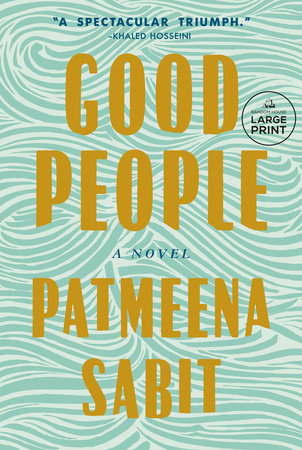
Good People

A Novel

Author Patmeena Sabit On Tour
Look inside
Large Print (Large Print - Tradepaper)
$31.00 US
| $41.00 CAN
On sale Feb 03, 2026 | 560 Pages | 9798217287758
Grades 9-12 + AP/IB

See Additional Formats
Good People is a stunning read. I could not recommend it more enthusiastically. . . . What a spectacular triumph this book is. This is the Afghan novel I have been eagerly waiting for.”—Khaled Hosseini

Zorah Sharaf could do no wrong. Zorah Sharaf brought shame upon her family. What’s the truth? Depends on who you ask.


The Sharaf family is the picture of success. Prosperous, rich, happy. They came to this country as refugees with nothing more than the clothes on their backs. And now, after years of hard work, they live in the most exclusive neighborhood, their growing family attending the most prestigious schools. Zorah, the eldest daughter, is the apple of her father’s eye.

When an unthinkable tragedy strikes, everyone is left reeling and the family is thrust into the court of public opinion. There is talk that behind closed doors the Sharafs’ happy household was anything but. Did the Sharaf family achieve the American dream? Or was the image of the model immigrant family just a façade?

Like a literary game of ping-pong, Good People compels the reader to reconsider what might have happened even on the previous page. Told through a kaleidoscope of perspectives, it is a riveting, provocative, and haunting story of family—sisters, brothers, mothers, fathers, and the communities that claim us as family in difficult times.
Qandi Gul

Sharaf family friend

. . . And our eyes fell on the children. Little flowers born in war and grown in war, who of all the world knew only the things war brought and the things it took. Then we said: God, You have brought this on our heads and made us endure and we have endured. In Your great wrath at we know not what sins of ours, You have doomed this dirt and turned it into a graveyard for the living and the dead. But even You—­even You have no right to these children.

So we fled. Leaving all. The bones of our mothers and fathers. Home. Honor. Hope. Sister away from sister. Brother from brother. Our people blown like ash to the four corners of the earth. Barbad barbad. Some of us, by what hand of fate, brought here. To this strange country that before the wars came we had never even seen in a dream of a dream of a dream. . . .

August 30

Margaret Hoffman

Former Sharaf family neighbor

I remember it clear as yesterday.

I was up with the birds, like always, puttering around the yard all morning, trying to get at the crabgrass before it got too hot out. We have someone who comes in every week to take care of the lawn and flowers and things, but in the summer the crabgrass shoots up like fire. Leave it alone for even a couple of days and just the one little spot’ll send off a zillion seeds. Ruins the whole yard before you can say go.

James doesn’t understand why I bother. He’s always saying we should just nuke the whole thing and start over. But all it needs is a little patience and effort. It’s a shallow grass and pulls out easy, and the whole trick is to scuff it up and lay down a bit of bark or pine straw where it used to be. Cut off its light and it’s gone for good.

I remember I was out there a little longer than usual that day. We were having a big cookout over the weekend and I wanted everything looking nice and neat. It was about midmorning by the time I finished up with all the weeding and watering, and after I turned the sprinklers off I went around and gave everything a once-­over, you know, just checking the nets for critters and the leaves for beetles and mites.

It was already broiling out. All summer long, we’d had the most glorious weather—­warm, sunny days and clear, cool nights. But toward the end of August it just started burning up. It hadn’t dipped below a hundred in a week straight, and they were blaring heat wave warnings day and night, going on about it being the hottest August in Fairfax since God knows when.

Well, my knees were starting to act up and I was more than ready to call it a day, but the hydrangeas had come in so gorgeous, I wanted to get some for the house before I went in. So I got my clippers and a little bucket of water and came around front. That’s when I saw them, right there across the street.

The two older kids were out in the driveway with their dad. There was a heap of bags just sitting there, and it looked like the kids were helping him fit everything into the trunk. The little ones were chasing each other around the yard, shouting their heads off and having the time of their lives, from the sound of it. And mom—­she was just standing at the front door, talking on the phone. She saw me and waved and I waved back.

To be honest I didn’t really pay much attention to them after that. I just wanted to get the heck out of the sun and put my feet up with something cool to drink. I cut a few bunches of flowers as quick as I could and went on inside.

It was about half an hour later when I came back out to check the mailbox. And by then they were all gone.

Ustad Khairyar

Sharaf family friend

That was in ’97 or ’98 when they came. In the winter.

One day we heard there was a new family in Arlington, a man and his wife and little son, come just a few days before, who didn’t have anyone here.

By that time, those of us who fled in those first years after the Russians invaded had been here for sixteen, seventeen years already. We’d made a little community. People of our own we could sit and stand and come and go with.

It’s true they were strangers to us and we to them. But that didn’t mean anything. Those of us who came before always tried to help the new ones any way we could. Because even if we lived here a hundred years more, we could never forget how those first times were like Judgment Day itself. How it wasn’t like coming to a new country but to a whole new world, and coming to it like penniless deaf-­mutes at that.

If nothing else they were our people. Our fathers and grandfathers were buried under the same black soil. That was enough.

Aziza Popal

Sharaf family friend

We women called each other and divided the cooking amongst ourselves so we could take them dinner that very day.

Early in the afternoon it started to snow, flakes as big as my hand, and by evening the roads were in a bad situation. Everywhere on the way there were accidents and the police. We were all in some six or seven cars, one behind the other, and the snow made us so slow it was black night by the time we reached there.

He opened the door to our knock and she was standing there behind him, both their mouths open and their eyes big, haq ow paq to see us, some twenty or thirty strangers crowded in the hall. Ustad said, “Country­man, put your shoes and coat on and come help us bring in the food. And sister, I hope to God your house is clean because we’ve brought the women and you know how they like to talk.”

Then he came out, barefoot, and took Ustad’s arm—­not his hand but his whole arm, like a child—­and she started crying like her heart had just burst.

Asma Sarwary

Sharaf family friend

They didn’t have anything. Not a splinter to call their own. They came at a bad time, just before Christmas, when all the refugee offices were closed for the holidays, and the caseworker told them to make do until they could see about everything in the New Year.

They were in a small one-­bedroom apartment in one of those old low-­rise buildings. On one side of the living room suitcases were stacked on top of each other and covered with a bedsheet, and on the other side blankets were folded on the bare floor where they sat and slept. In the kitchen there were just some few cups and plates and bowls and a little pot they were using to boil the water for tea.

When we saw how it was we called every Afghan in the county. The very next day people started bringing whatever they did or didn’t have from their own homes. Boxes and boxes of pots and pans and dishes. Mattresses and blankets and pillows. Farid brought an old television and VCR. Zarghoona gave them a little round dining table with four chairs. And Halima had just bought a whole new furniture set for her salon, and when it came she paid for a truck and sent them all the old things. Two nice black leather couches, a red Turkish carpet, and a beautiful glass coffee table. Soon the apartment was so full you couldn’t turn around in it.

We also put money together and bought them a month’s worth of groceries. Big big sacks of flour, sugar, rice, onions, potatoes, red beans, and black and green tea. Kilos and kilos of lamb and chicken and kofta. A ten-­gallon tin of oil.

Even after all that there was a pretty amount left over, so Aziza and I went to the K-­mart and bought them a stroller for the boy and a microwave and a nice big silver kettle that whistled when the water boiled.

You won’t believe it, but years and years later, when the children were all grown and our hair was half white, I would go visit, and Maryam would make tea with that same kettle. And it was still like new! Not a scratch on it. Things in those days were just of a different quality. Not like these cheap, two-­dollar things of today and tomorrow. But we always used to laugh about it, about how that kettle was going to outlive us all.
“Ingeniously structured, thought-provoking, and utterly addictive, Good People will have everyone talking.”—Paula Hawkins

“Brilliant. The best debut I’ve read in a very long time.”—Monica Ali, author of Brick Lane and Love Marriage

Good People is a thrilling tour de force of a novel. I’ll be recommending this book to everyone.”—Ann Patchett

Good People is equal parts an immigrant novel, a tightly wound mystery, and an oral history. Patmeena Sabit moves between these with insight, ease, and grace to give us a remarkable, unsettling snapshot of our complicated times.”—Sameer Pandya, author of Our Beautiful Boys

Good People is a stunning read. I could not recommend it more enthusiastically. The story of an investigation into a suspicious death, this rich novel is so much more. Written with raw emotional insight, this page-turner is a fascinating, kaleidoscopic look at a grieving Afghan family caught between culture and country. With startling empathy for all sides, Patmeena Sabit plumbs the fault lines of honor, truth, prejudice, and how identity shapes guilt in the aftermath of tragedy. What a spectacular triumph this book is. This is the Afghan novel I have been eagerly waiting for.”—Khaled Hosseini

“A triumphant debut! With the sophistication and assurance of a seasoned writer, Patmeena Sabit has crafted a prescient East-West story as only a third culture talent could have. The plot: masterful. The writing: beguiling. The pacing: breakneck. The possibility I will read this again and again: absolute. I can’t wait to read what Sabit will create next!”—Alka Joshi, author of The Henna Artist and the Jaipur Trilogy

“Sabit’s first novel masterfully dissects the glittering facade of the American Dream . . . This all unfolds like a binge-worthy true-crime podcast . . . It’s voyeuristic and intimate, pulling readers into the fray as if huddled around a kitchen table, trading secrets over chai. At once heartbreaking and hypnotic, Sabit's is a novel that demands to be devoured.”—Booklist, starred review
© David Chang Photography
Patmeena Sabit was born in Kabul a few years after the Soviet invasion of Afghanistan. When she was a month old, her family fled the conflict and became refugees in Pakistan, joining the millions of other Afghans that had sought refuge there. They later moved to the United States and she grew up in Virginia. She currently lives in Toronto. View titles by Patmeena Sabit

Discussion Guide for Good People

Provides questions, discussion topics, suggested reading lists, introductions and/or author Q&As, which are intended to enhance reading groups’ experiences.

(Please note: the guide displayed here is the most recently uploaded version; while unlikely, any page citation discrepancies between the guide and book is likely due to pagination differences between a book’s different formats.)

About

Good People is a stunning read. I could not recommend it more enthusiastically. . . . What a spectacular triumph this book is. This is the Afghan novel I have been eagerly waiting for.”—Khaled Hosseini

Zorah Sharaf could do no wrong. Zorah Sharaf brought shame upon her family. What’s the truth? Depends on who you ask.


The Sharaf family is the picture of success. Prosperous, rich, happy. They came to this country as refugees with nothing more than the clothes on their backs. And now, after years of hard work, they live in the most exclusive neighborhood, their growing family attending the most prestigious schools. Zorah, the eldest daughter, is the apple of her father’s eye.

When an unthinkable tragedy strikes, everyone is left reeling and the family is thrust into the court of public opinion. There is talk that behind closed doors the Sharafs’ happy household was anything but. Did the Sharaf family achieve the American dream? Or was the image of the model immigrant family just a façade?

Like a literary game of ping-pong, Good People compels the reader to reconsider what might have happened even on the previous page. Told through a kaleidoscope of perspectives, it is a riveting, provocative, and haunting story of family—sisters, brothers, mothers, fathers, and the communities that claim us as family in difficult times.

Excerpt

Qandi Gul

Sharaf family friend

. . . And our eyes fell on the children. Little flowers born in war and grown in war, who of all the world knew only the things war brought and the things it took. Then we said: God, You have brought this on our heads and made us endure and we have endured. In Your great wrath at we know not what sins of ours, You have doomed this dirt and turned it into a graveyard for the living and the dead. But even You—­even You have no right to these children.

So we fled. Leaving all. The bones of our mothers and fathers. Home. Honor. Hope. Sister away from sister. Brother from brother. Our people blown like ash to the four corners of the earth. Barbad barbad. Some of us, by what hand of fate, brought here. To this strange country that before the wars came we had never even seen in a dream of a dream of a dream. . . .

August 30

Margaret Hoffman

Former Sharaf family neighbor

I remember it clear as yesterday.

I was up with the birds, like always, puttering around the yard all morning, trying to get at the crabgrass before it got too hot out. We have someone who comes in every week to take care of the lawn and flowers and things, but in the summer the crabgrass shoots up like fire. Leave it alone for even a couple of days and just the one little spot’ll send off a zillion seeds. Ruins the whole yard before you can say go.

James doesn’t understand why I bother. He’s always saying we should just nuke the whole thing and start over. But all it needs is a little patience and effort. It’s a shallow grass and pulls out easy, and the whole trick is to scuff it up and lay down a bit of bark or pine straw where it used to be. Cut off its light and it’s gone for good.

I remember I was out there a little longer than usual that day. We were having a big cookout over the weekend and I wanted everything looking nice and neat. It was about midmorning by the time I finished up with all the weeding and watering, and after I turned the sprinklers off I went around and gave everything a once-­over, you know, just checking the nets for critters and the leaves for beetles and mites.

It was already broiling out. All summer long, we’d had the most glorious weather—­warm, sunny days and clear, cool nights. But toward the end of August it just started burning up. It hadn’t dipped below a hundred in a week straight, and they were blaring heat wave warnings day and night, going on about it being the hottest August in Fairfax since God knows when.

Well, my knees were starting to act up and I was more than ready to call it a day, but the hydrangeas had come in so gorgeous, I wanted to get some for the house before I went in. So I got my clippers and a little bucket of water and came around front. That’s when I saw them, right there across the street.

The two older kids were out in the driveway with their dad. There was a heap of bags just sitting there, and it looked like the kids were helping him fit everything into the trunk. The little ones were chasing each other around the yard, shouting their heads off and having the time of their lives, from the sound of it. And mom—­she was just standing at the front door, talking on the phone. She saw me and waved and I waved back.

To be honest I didn’t really pay much attention to them after that. I just wanted to get the heck out of the sun and put my feet up with something cool to drink. I cut a few bunches of flowers as quick as I could and went on inside.

It was about half an hour later when I came back out to check the mailbox. And by then they were all gone.

Ustad Khairyar

Sharaf family friend

That was in ’97 or ’98 when they came. In the winter.

One day we heard there was a new family in Arlington, a man and his wife and little son, come just a few days before, who didn’t have anyone here.

By that time, those of us who fled in those first years after the Russians invaded had been here for sixteen, seventeen years already. We’d made a little community. People of our own we could sit and stand and come and go with.

It’s true they were strangers to us and we to them. But that didn’t mean anything. Those of us who came before always tried to help the new ones any way we could. Because even if we lived here a hundred years more, we could never forget how those first times were like Judgment Day itself. How it wasn’t like coming to a new country but to a whole new world, and coming to it like penniless deaf-­mutes at that.

If nothing else they were our people. Our fathers and grandfathers were buried under the same black soil. That was enough.

Aziza Popal

Sharaf family friend

We women called each other and divided the cooking amongst ourselves so we could take them dinner that very day.

Early in the afternoon it started to snow, flakes as big as my hand, and by evening the roads were in a bad situation. Everywhere on the way there were accidents and the police. We were all in some six or seven cars, one behind the other, and the snow made us so slow it was black night by the time we reached there.

He opened the door to our knock and she was standing there behind him, both their mouths open and their eyes big, haq ow paq to see us, some twenty or thirty strangers crowded in the hall. Ustad said, “Country­man, put your shoes and coat on and come help us bring in the food. And sister, I hope to God your house is clean because we’ve brought the women and you know how they like to talk.”

Then he came out, barefoot, and took Ustad’s arm—­not his hand but his whole arm, like a child—­and she started crying like her heart had just burst.

Asma Sarwary

Sharaf family friend

They didn’t have anything. Not a splinter to call their own. They came at a bad time, just before Christmas, when all the refugee offices were closed for the holidays, and the caseworker told them to make do until they could see about everything in the New Year.

They were in a small one-­bedroom apartment in one of those old low-­rise buildings. On one side of the living room suitcases were stacked on top of each other and covered with a bedsheet, and on the other side blankets were folded on the bare floor where they sat and slept. In the kitchen there were just some few cups and plates and bowls and a little pot they were using to boil the water for tea.

When we saw how it was we called every Afghan in the county. The very next day people started bringing whatever they did or didn’t have from their own homes. Boxes and boxes of pots and pans and dishes. Mattresses and blankets and pillows. Farid brought an old television and VCR. Zarghoona gave them a little round dining table with four chairs. And Halima had just bought a whole new furniture set for her salon, and when it came she paid for a truck and sent them all the old things. Two nice black leather couches, a red Turkish carpet, and a beautiful glass coffee table. Soon the apartment was so full you couldn’t turn around in it.

We also put money together and bought them a month’s worth of groceries. Big big sacks of flour, sugar, rice, onions, potatoes, red beans, and black and green tea. Kilos and kilos of lamb and chicken and kofta. A ten-­gallon tin of oil.

Even after all that there was a pretty amount left over, so Aziza and I went to the K-­mart and bought them a stroller for the boy and a microwave and a nice big silver kettle that whistled when the water boiled.

You won’t believe it, but years and years later, when the children were all grown and our hair was half white, I would go visit, and Maryam would make tea with that same kettle. And it was still like new! Not a scratch on it. Things in those days were just of a different quality. Not like these cheap, two-­dollar things of today and tomorrow. But we always used to laugh about it, about how that kettle was going to outlive us all.

Reviews

“Ingeniously structured, thought-provoking, and utterly addictive, Good People will have everyone talking.”—Paula Hawkins

“Brilliant. The best debut I’ve read in a very long time.”—Monica Ali, author of Brick Lane and Love Marriage

Good People is a thrilling tour de force of a novel. I’ll be recommending this book to everyone.”—Ann Patchett

Good People is equal parts an immigrant novel, a tightly wound mystery, and an oral history. Patmeena Sabit moves between these with insight, ease, and grace to give us a remarkable, unsettling snapshot of our complicated times.”—Sameer Pandya, author of Our Beautiful Boys

Good People is a stunning read. I could not recommend it more enthusiastically. The story of an investigation into a suspicious death, this rich novel is so much more. Written with raw emotional insight, this page-turner is a fascinating, kaleidoscopic look at a grieving Afghan family caught between culture and country. With startling empathy for all sides, Patmeena Sabit plumbs the fault lines of honor, truth, prejudice, and how identity shapes guilt in the aftermath of tragedy. What a spectacular triumph this book is. This is the Afghan novel I have been eagerly waiting for.”—Khaled Hosseini

“A triumphant debut! With the sophistication and assurance of a seasoned writer, Patmeena Sabit has crafted a prescient East-West story as only a third culture talent could have. The plot: masterful. The writing: beguiling. The pacing: breakneck. The possibility I will read this again and again: absolute. I can’t wait to read what Sabit will create next!”—Alka Joshi, author of The Henna Artist and the Jaipur Trilogy

“Sabit’s first novel masterfully dissects the glittering facade of the American Dream . . . This all unfolds like a binge-worthy true-crime podcast . . . It’s voyeuristic and intimate, pulling readers into the fray as if huddled around a kitchen table, trading secrets over chai. At once heartbreaking and hypnotic, Sabit's is a novel that demands to be devoured.”—Booklist, starred review

Author

© David Chang Photography
Patmeena Sabit was born in Kabul a few years after the Soviet invasion of Afghanistan. When she was a month old, her family fled the conflict and became refugees in Pakistan, joining the millions of other Afghans that had sought refuge there. They later moved to the United States and she grew up in Virginia. She currently lives in Toronto. View titles by Patmeena Sabit

Guides

Discussion Guide for Good People

Provides questions, discussion topics, suggested reading lists, introductions and/or author Q&As, which are intended to enhance reading groups’ experiences.

(Please note: the guide displayed here is the most recently uploaded version; while unlikely, any page citation discrepancies between the guide and book is likely due to pagination differences between a book’s different formats.)

  • More Websites from
    Penguin Random House
  • Common Reads
  • Library Marketing