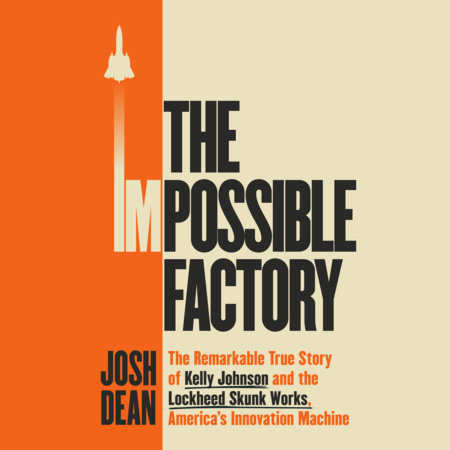
The Impossible Factory

The Remarkable True Story of Kelly Johnson and the Lockheed Skunk Works, America's Innovation Machine

Author Josh Dean On Tour
The extraordinary true story of Lockheed Martin’s “Skunk Works”—the radical innovation hub that designed the greatest airplanes of the twentieth century—and the visionary who made it all possible

"A kerosene-soaked masterclass in what extreme innovation looks, feels, and even smells like." —New York Times bestselling author Ashlee Vance


It began with a humble warehouse building in Burbank, California, and a charismatic young engineer named Kelly Johnson. In 1938, Johnson, who was then freshly out of the University of Michigan’s school of engineering, got the idea for a small, agile, disruptive engineering shop—one that could help America’s war machine innovate more quickly. By 1943, with the U.S. now in World War II and desperate for new technology, “Advanced Development Projects”—later nicknamed the “Skunk Works”—was born.

During Johnson’s forty-seven years at Lockheed Martin, the Skunk Works developed at least half a dozen planes that would have been the capstone achievement of anyone else’s career. There was the P-38 Lighting, which outdueled Axis pilots over Europe and the Pacific. The XP-80, America’s first ever fighter jet, which did indeed help the Allies win World War II. The Constellation, the first passenger plane with a pressurized cabin, revolutionized commercial air travel. The U-2 spy plane, which could reach an astonishing altitude of 70,000 feet, enabling it to fly dangerous covert missions in Soviet airspace during the height of the Cold War. And perhaps most famous of all, the A-12/SR-71 Blackbird, one of the most unusual, and iconic, planes ever designed.

But the planes were only part of Kelly Johnson’s legacy. There was also his management style, which would come to shape organizations for decades to come. Under him, the Skunk Works’ structure—flat management, no red tape, extraordinary speed—quickly became the model for nurturing innovation, and eventually would fuel the nimble startups of Silicon Valley. Half a century before Mark Zuckerberg coined the motto “move fast and break things,” Kelly Johnson was living that mantra—and at the same time helping the Department of Defense secure the fate of the free world.
1

The American Dream

The story Kelly Johnson liked to tell about how his father got from rural Sweden to upstate Michigan is not 100 percent verifiable, but it goes something like this: In November 1888, twenty-four-year-old Per Jonsson-as he was known in Sweden-made his way south to Copenhagen, Denmark, and boarded a ship, bound for New York City, alone. His wife, Christine Anderson, stayed back to wait until her husband was settled, a particular kind of devotion required during difficult times.

His father's impetus to flee, Kelly would say, was not what you'd expect, given those facts. This wasn't the typical immigrant tale-a desperately poor or persecuted European man seeking a better life for his family in the land of opportunity. No, Per Jonsson was escaping Sweden's compulsory military service because he was a pacifist and didn't want to carry a gun. So he decided to pack up his life and start over in a place that offered basically unfettered freedom. Including the freedom not to bear arms.

On December 10, 1888, or thereabouts, Per Jonsson landed in New York, and that's probably where he-or, more likely, some immigration official-Americanized his name to Peter Johnson.

Peter had six hundred dollars, which was his life savings, and a dream of buying a ranch in the fertile promised land of Nebraska. But things went a little sideways for him in Chicago.

There, Peter fell for a scam, handing over a large chunk of his savings for a train ticket that he thought would take him to Nebraska, land of plenty. Instead, Peter was put on a train heading north and ended up in the town of Marquette, on Michigan's Upper Peninsula, where the sight of Lake Superior-vast as an ocean, as viewed from the shore-surely would have revealed the harsh truth to him. That he was definitely not in Nebraska.

Nonetheless, Peter rolled with the punches. He parked himself there, in frigid, snowy far northern Michigan-still remote country, even today-and took the best work he could find. He laid railroad ties until he'd taught himself a more valuable trade: bricklayer.

As soon as he was stable-and had the funds to cover it-Peter sent for his wife, and once she too arrived from Sweden, he and Christine moved fifteen miles inland to Ishpeming, a small town settled because of its rich iron ore surface deposits and also known the birthplace of "organized skiing" in America, thanks to the many Norwegians who settled there.

In 1893, Peter and Christine had their first child, a girl named Ida, and kept going from there. The couple had nine children in total.

Kelly, born on February 27, 1910, was the seventh of those kids, and the third son, but no one called him Kelly yet. He was then, and for the early years of his life, Clarence Leonard Johnson.

Peter Johnson was a good mason, and a tireless one; he could lay more than two thousand bricks a day, and that work ethic was one of many qualities that Clarence picked up from his father. Christine, meanwhile, took care of the kids and hand-washed laundry for other families as time permitted. Theirs was not a life of plenty. Money was always short.

Clarence was self-conscious about this; being poor bothered him. He took back streets and alleys on his walk home from parades so that his friends wouldn't see where he lived, and young Clarence vowed to return one day with a chip on his shoulder-to walk proudly down Ishpeming's main streets as a man of real means.

The Johnsons pushed their children, and especially encouraged Clarence-who showed signs of being an intellectual standout from an early age-to take as much schooling as possible, education being the best way to escape poverty and make something in this vast and curious new country, where everyone seemed to have a hustle. Where you could show up looking for Nebraska and be sold train tickets to remote northern Michigan.

Anyway, the Johnsons didn't have to force Clarence to study. He would rush out the door to Ridge Street School, hoping to be first in line to enter and learn. This enthusiasm for education got him picked on, mostly by a rich kid named Cecil, who liked to push Clarence out of line and make fun of his name.

Young Clarence got sick of the abuse, especially the way that Cecil called him "Clara" in front of the other kids. And one day, Clarence just snapped.

The next time Cecil called him Clara, Clarence stuck his leg behind Cecil's-"kicked him behind the knee" is how he once described it-and then jumped on the bully. There was a loud crack, and Cecil's leg broke.

Cecil's parents were prominent folks, and they raised a fuss. They complained to school administrators and, despite the fact that he'd been bullied, Clarence was punished for fighting back with such overwhelming force. His teacher, Miss Hawes, smacked him so hard across the knuckles with a twelve-inch ruler that it snapped.

None of which deterred the boy. "I didn't care," Clarence later wrote. "I had accomplished my end." As in, he shut the bully up. And the fact that Clarence didn't cry when the teacher broke a ruler on his hand impressed his classmates even more. They told him that he needed a nickname-something stronger, and Irish (because he nearly always wore a green tie), to replace that awkward given name once and for all.

Someone suggested Kelly, from a song. Throughout his life, when Clarence Johnson told this story, he would say that the song was "Kelly with the Green Necktie," but that's wrong. The real title, it turns out, is "Has Anybody Here Seen Kelly?" an old English ditty that ended up in the 1910 Broadway musical The Jolly Bachelors.

Regardless, it stuck.


Kelly Johnson was an entrepreneurial kid and an adventurous one. Ishpeming was surrounded by wilderness, and he liked to build camps in the woods and sit on the bluffs outside town, watching iron ore trains travel to and from the mines. He did whatever work he could find, mostly odd jobs, and made thirty-one dollars one summer by picking fruit with his aunt at a nearby farm.

Kelly pocketed the cash, came home, and gave the entire sum to his mother. "She was so touched that I had not kept anything at all for myself," he wrote decades later. "No contribution I have ever made since has made me feel happier; none has been more important to me."

At ten, Kelly rode his horse, Mac, across town to his older brother Emil's house to learn how to lathe. Two years later, in 1922, he was earning ten dollars a week producing laths and paying seven dollars of that to his parents for room and board.

"From then on," he said, "I was self-supporting."

With eight siblings, there was always a kid, if not a few of them, around to play with. Once-the precise year is lost to history-Kelly nearly lost sight in one eye when his little sister Helen accidentally shot him in the face with an arrow during a game of Cowboys and Indians. The arrow barely missed his eye, but did some real damage. It took two weeks before Kelly's sight was normal again.

It was always a safe bet that if Kelly wasn't home, at school, or out camping, he was at the Carnegie Library-endowed by the steel mogul Andrew Carnegie, who owned Ispheming's mine-with his dog Putzie, who liked to follow him into the building and inevitably got thrown out.

On one of those trips, Kelly picked up and devoured Francis Collins's The Boys' Book of Model Aeroplanes, which was written in 1910, just six years after the Wright Brothers took flight. He also devoured the Rover Boys and Tom Swift book series. He especially loved the Swift stories, about planes and submarines and airships-"anything to do with mechanics"-and read entire volumes in a single sitting, becoming "convinced," he later said, "that I should be like Tom Swift."

Peter Johnson encouraged his son's curiosity. He built Kelly a workshop and let him use his tools, as long as he took care of them, which included making sure that every tool was back in its proper place. "If I dulled them or broke them, too bad, that was experience," Kelly later wrote. The only thing that would get him in trouble was losing a tool.

Working with his hands, turning ideas into objects-this thrilled Kelly. By the time he was twelve, Kelly had chosen his future. He wanted to build airplanes, and from that moment forward he prepared for it. This influenced every aspect of his life, from schooling to hobbies. He sketched planes, built models, and sometimes leaped from fence posts with a makeshift glider on his back-inevitably crashing right back down to earth.

Kelly's first design work was a book of collages and sketches titled Aviation. It contained mostly annotated clippings, but also his first-ever airplane design. He called it the Merlin 1 Battleplane-after the wizard Merlin from the King Arthur poems of Alfred, Lord Tennyson-and though it bore a strong resemblance to an existing plane (the Curtiss JN-4 Jenny), Kelly referred to this sketch throughout his life, right up to the very end, as his first original design.

That same year, Kelly gave his first public speech, too-at a Lions Club luncheon. Kelly was still so small that he had to stand on a chair to be seen. He talked until they told him to stop and must have made quite an impression on the assembled, because the following Saturday, April 28, 1923, the local paper devoted two columns to the talk by this "bright little lad" who'd become "greatly interested in the navigation of the air."

It sounds, from the paper's report, as if Kelly did what kid scholars tend to do: He regurgitated the history of aviation that he had absorbed during his daylong stints at the library. Kelly told wild stories of early experiments in flight, such as the tale of a Frenchman who was the first human to go aloft in a balloon, in 1783.

The Frenchman, young Kelly told his audience, traveled about a mile and caused quite a stir when the balloon landed in a field. "The peasants who saw it, being ignorant of the experiment and naturally superstitious," wrote the reporter, "attacked it with scythes, pitchforks and other keen-edged and pointed agricultural implements that were at hand, believing it to be some monster with evil intent." (Kelly was nearly right: it was actually two Frenchmen, the Montgolfier brothers, who stood on a wooden platform attached to the bottom of a large silk and paper balloon, and they had traveled about five and a half miles. The terrified peasants part seems to be true, too, and it's rumored the pilots served them champagne, to ease nerves and keep the peasants from goring them to death with pitchforks.)

Kelly talked enthusiastically about all the progress in aviation's short history and predicted that the greatest strides were still to come, most likely in the United States. "The speaker thought that the US would finally outclass all other countries in the air because of its inventive genius and energy," the reporter wrote. "He predicted immense planes of several hundred feet spread, capable of carrying immense loads at great speeds. . . . Master Johnson's talk was heartily applauded."

This young boy, people thought, reflected very well on Ishpeming's schools.


When Kelly was thirteen, the Johnson family moved three hundred miles south, from the remote Upper Peninsula to the relatively urban environs of Flint, a thriving automotive town where there was better-paying work to be had.

Kelly attended Flint Central High, did lathing for money, and made model airplanes in his free time. At sixteen, he won second prize, and twenty-five dollars, in a Kiwanis Club model airplane contest for an updated, 3D version of his original sketch, now called the Merlin One.

He also went aloft himself for the first time-paying five dollars for an abbreviated ride in a four-passenger biplane. The plane took off and flew 700 feet before its engine cut out, forcing the pilot to make an emergency landing. Even so, Kelly was thrilled, summing the experience up like this: "It was fun! It was noisy, it was drafty, it was great!"

By the time he graduated from high school, Kelly had saved six hundred dollars. But he was temporarily burned out on education and planned to use that money to travel the world for six months. Until his French teacher, Miss Davis, talked him out of it. "What you should do instead," she said, "is enroll at Flint Junior College and keep building that big brain of yours."

Kelly took her advice and thought of a new use for those savings. He would learn to fly. It's what the industry's fathers-men like the Wright brothers, Glenn Curtiss, and Glenn Martin-had done. But Jim Bishop, who ran the local flight school, refused to take Kelly's money for lessons.

"You don't want to start off on your career by giving me three hundred dollars to learn to fly," Bishop told him. "You have good grades, you will go a lot farther if you go on to the university. I won't take your money."

In 1929-on the eve of the stock market crash that would spin his country into the Great Depression-Kelly enrolled at Flint Junior College, with a focus on physics and math. He tutored other students in calculus and averaged ten to twelve dollars a weekend as a lather. That summer, he took a job at the local Buick factory, "swinging fenders on the production line or working on motor repair and block test." He also set out to read and understand the writings of Albert Einstein.

"Only twelve people in the whole world were supposed to be able to do so," he later wrote. "I wanted to be the thirteenth!"
“Josh Dean has delivered a kerosene-soaked masterclass in what extreme innovation looks, feels and even smells like. This story could not be more timely as the U.S. tries to revive its industrial base and rekindle its inventive spirit.” —Ashlee Vance, New York Times bestselling author of When The Heavens Went On Sale

"I absolutely loved The Impossible Factory. It's a page-turner that reveals who Kelly Johnson was as a person and how he and the brilliant team he assembled at Lockheed Skunk Works were able to design the aircraft that shaped the twentieth century. We learn about the evolution of planes over seventy years and meet test pilots and engineers, military leaders and politicians, collaborators and successors – all people essential to building the world we live in today. A must-read book." —Katherine Sharp Landdeck, author of The Women with Silver Wings

"An immersive account of Lockheed Martin's Skunk Works and its visionary founder, Kelly Johnson. The Impossible Factory brings to life the flat management and speed-focused approach that would become a precursor to the ‘move fast and break things’ mantra of Silicon Valley. Josh tells this epic story of the power of American ingenuity with style, making you feel like you're working with Johnson on the 20th century's signature aircraft.” New York Times bestselling author Kevin Maurer

“An engaging life of an inventor and aviation pioneer with an astonishing, if little-known, roster of accomplishments. … A key figure in the annals of aviation technology, Johnson well merits this detail-packed life.” Kirkus Reviews

“Johnson’s legacy with projects such as the U-2 reconnaissance aircraft to Area 51 will interest a wide audience, but it is the aviation enthusiasts who will truly relish this extensive history of Skunk Works and Kelly Johnson.” Booklist

“This improbable story of how impossible machines reshaped modern warfare and technology itself is highly recommended for readers of military history, aviation, and American innovation." Library Journal (starred)
© Josh Dean
Josh Dean is a New York–based journalist, author, and podcaster. His work has appeared in Popular Science, GQ, Men’s Journal, Rolling Stone, and many other places. He is the cofounder of the acclaimed narrative podcast studio Campside Media, and the author of The Taking of K-129: How the CIA Used Howard Hughes to Steal a Russian Sub in the Most Daring Covert Operation in History, as well as Show Dog: The Charmed Life and Trying Times of a Near-Perfect Purebred.
View titles by Josh Dean

About

The extraordinary true story of Lockheed Martin’s “Skunk Works”—the radical innovation hub that designed the greatest airplanes of the twentieth century—and the visionary who made it all possible

"A kerosene-soaked masterclass in what extreme innovation looks, feels, and even smells like." —New York Times bestselling author Ashlee Vance


It began with a humble warehouse building in Burbank, California, and a charismatic young engineer named Kelly Johnson. In 1938, Johnson, who was then freshly out of the University of Michigan’s school of engineering, got the idea for a small, agile, disruptive engineering shop—one that could help America’s war machine innovate more quickly. By 1943, with the U.S. now in World War II and desperate for new technology, “Advanced Development Projects”—later nicknamed the “Skunk Works”—was born.

During Johnson’s forty-seven years at Lockheed Martin, the Skunk Works developed at least half a dozen planes that would have been the capstone achievement of anyone else’s career. There was the P-38 Lighting, which outdueled Axis pilots over Europe and the Pacific. The XP-80, America’s first ever fighter jet, which did indeed help the Allies win World War II. The Constellation, the first passenger plane with a pressurized cabin, revolutionized commercial air travel. The U-2 spy plane, which could reach an astonishing altitude of 70,000 feet, enabling it to fly dangerous covert missions in Soviet airspace during the height of the Cold War. And perhaps most famous of all, the A-12/SR-71 Blackbird, one of the most unusual, and iconic, planes ever designed.

But the planes were only part of Kelly Johnson’s legacy. There was also his management style, which would come to shape organizations for decades to come. Under him, the Skunk Works’ structure—flat management, no red tape, extraordinary speed—quickly became the model for nurturing innovation, and eventually would fuel the nimble startups of Silicon Valley. Half a century before Mark Zuckerberg coined the motto “move fast and break things,” Kelly Johnson was living that mantra—and at the same time helping the Department of Defense secure the fate of the free world.

Excerpt

1

The American Dream

The story Kelly Johnson liked to tell about how his father got from rural Sweden to upstate Michigan is not 100 percent verifiable, but it goes something like this: In November 1888, twenty-four-year-old Per Jonsson-as he was known in Sweden-made his way south to Copenhagen, Denmark, and boarded a ship, bound for New York City, alone. His wife, Christine Anderson, stayed back to wait until her husband was settled, a particular kind of devotion required during difficult times.

His father's impetus to flee, Kelly would say, was not what you'd expect, given those facts. This wasn't the typical immigrant tale-a desperately poor or persecuted European man seeking a better life for his family in the land of opportunity. No, Per Jonsson was escaping Sweden's compulsory military service because he was a pacifist and didn't want to carry a gun. So he decided to pack up his life and start over in a place that offered basically unfettered freedom. Including the freedom not to bear arms.

On December 10, 1888, or thereabouts, Per Jonsson landed in New York, and that's probably where he-or, more likely, some immigration official-Americanized his name to Peter Johnson.

Peter had six hundred dollars, which was his life savings, and a dream of buying a ranch in the fertile promised land of Nebraska. But things went a little sideways for him in Chicago.

There, Peter fell for a scam, handing over a large chunk of his savings for a train ticket that he thought would take him to Nebraska, land of plenty. Instead, Peter was put on a train heading north and ended up in the town of Marquette, on Michigan's Upper Peninsula, where the sight of Lake Superior-vast as an ocean, as viewed from the shore-surely would have revealed the harsh truth to him. That he was definitely not in Nebraska.

Nonetheless, Peter rolled with the punches. He parked himself there, in frigid, snowy far northern Michigan-still remote country, even today-and took the best work he could find. He laid railroad ties until he'd taught himself a more valuable trade: bricklayer.

As soon as he was stable-and had the funds to cover it-Peter sent for his wife, and once she too arrived from Sweden, he and Christine moved fifteen miles inland to Ishpeming, a small town settled because of its rich iron ore surface deposits and also known the birthplace of "organized skiing" in America, thanks to the many Norwegians who settled there.

In 1893, Peter and Christine had their first child, a girl named Ida, and kept going from there. The couple had nine children in total.

Kelly, born on February 27, 1910, was the seventh of those kids, and the third son, but no one called him Kelly yet. He was then, and for the early years of his life, Clarence Leonard Johnson.

Peter Johnson was a good mason, and a tireless one; he could lay more than two thousand bricks a day, and that work ethic was one of many qualities that Clarence picked up from his father. Christine, meanwhile, took care of the kids and hand-washed laundry for other families as time permitted. Theirs was not a life of plenty. Money was always short.

Clarence was self-conscious about this; being poor bothered him. He took back streets and alleys on his walk home from parades so that his friends wouldn't see where he lived, and young Clarence vowed to return one day with a chip on his shoulder-to walk proudly down Ishpeming's main streets as a man of real means.

The Johnsons pushed their children, and especially encouraged Clarence-who showed signs of being an intellectual standout from an early age-to take as much schooling as possible, education being the best way to escape poverty and make something in this vast and curious new country, where everyone seemed to have a hustle. Where you could show up looking for Nebraska and be sold train tickets to remote northern Michigan.

Anyway, the Johnsons didn't have to force Clarence to study. He would rush out the door to Ridge Street School, hoping to be first in line to enter and learn. This enthusiasm for education got him picked on, mostly by a rich kid named Cecil, who liked to push Clarence out of line and make fun of his name.

Young Clarence got sick of the abuse, especially the way that Cecil called him "Clara" in front of the other kids. And one day, Clarence just snapped.

The next time Cecil called him Clara, Clarence stuck his leg behind Cecil's-"kicked him behind the knee" is how he once described it-and then jumped on the bully. There was a loud crack, and Cecil's leg broke.

Cecil's parents were prominent folks, and they raised a fuss. They complained to school administrators and, despite the fact that he'd been bullied, Clarence was punished for fighting back with such overwhelming force. His teacher, Miss Hawes, smacked him so hard across the knuckles with a twelve-inch ruler that it snapped.

None of which deterred the boy. "I didn't care," Clarence later wrote. "I had accomplished my end." As in, he shut the bully up. And the fact that Clarence didn't cry when the teacher broke a ruler on his hand impressed his classmates even more. They told him that he needed a nickname-something stronger, and Irish (because he nearly always wore a green tie), to replace that awkward given name once and for all.

Someone suggested Kelly, from a song. Throughout his life, when Clarence Johnson told this story, he would say that the song was "Kelly with the Green Necktie," but that's wrong. The real title, it turns out, is "Has Anybody Here Seen Kelly?" an old English ditty that ended up in the 1910 Broadway musical The Jolly Bachelors.

Regardless, it stuck.


Kelly Johnson was an entrepreneurial kid and an adventurous one. Ishpeming was surrounded by wilderness, and he liked to build camps in the woods and sit on the bluffs outside town, watching iron ore trains travel to and from the mines. He did whatever work he could find, mostly odd jobs, and made thirty-one dollars one summer by picking fruit with his aunt at a nearby farm.

Kelly pocketed the cash, came home, and gave the entire sum to his mother. "She was so touched that I had not kept anything at all for myself," he wrote decades later. "No contribution I have ever made since has made me feel happier; none has been more important to me."

At ten, Kelly rode his horse, Mac, across town to his older brother Emil's house to learn how to lathe. Two years later, in 1922, he was earning ten dollars a week producing laths and paying seven dollars of that to his parents for room and board.

"From then on," he said, "I was self-supporting."

With eight siblings, there was always a kid, if not a few of them, around to play with. Once-the precise year is lost to history-Kelly nearly lost sight in one eye when his little sister Helen accidentally shot him in the face with an arrow during a game of Cowboys and Indians. The arrow barely missed his eye, but did some real damage. It took two weeks before Kelly's sight was normal again.

It was always a safe bet that if Kelly wasn't home, at school, or out camping, he was at the Carnegie Library-endowed by the steel mogul Andrew Carnegie, who owned Ispheming's mine-with his dog Putzie, who liked to follow him into the building and inevitably got thrown out.

On one of those trips, Kelly picked up and devoured Francis Collins's The Boys' Book of Model Aeroplanes, which was written in 1910, just six years after the Wright Brothers took flight. He also devoured the Rover Boys and Tom Swift book series. He especially loved the Swift stories, about planes and submarines and airships-"anything to do with mechanics"-and read entire volumes in a single sitting, becoming "convinced," he later said, "that I should be like Tom Swift."

Peter Johnson encouraged his son's curiosity. He built Kelly a workshop and let him use his tools, as long as he took care of them, which included making sure that every tool was back in its proper place. "If I dulled them or broke them, too bad, that was experience," Kelly later wrote. The only thing that would get him in trouble was losing a tool.

Working with his hands, turning ideas into objects-this thrilled Kelly. By the time he was twelve, Kelly had chosen his future. He wanted to build airplanes, and from that moment forward he prepared for it. This influenced every aspect of his life, from schooling to hobbies. He sketched planes, built models, and sometimes leaped from fence posts with a makeshift glider on his back-inevitably crashing right back down to earth.

Kelly's first design work was a book of collages and sketches titled Aviation. It contained mostly annotated clippings, but also his first-ever airplane design. He called it the Merlin 1 Battleplane-after the wizard Merlin from the King Arthur poems of Alfred, Lord Tennyson-and though it bore a strong resemblance to an existing plane (the Curtiss JN-4 Jenny), Kelly referred to this sketch throughout his life, right up to the very end, as his first original design.

That same year, Kelly gave his first public speech, too-at a Lions Club luncheon. Kelly was still so small that he had to stand on a chair to be seen. He talked until they told him to stop and must have made quite an impression on the assembled, because the following Saturday, April 28, 1923, the local paper devoted two columns to the talk by this "bright little lad" who'd become "greatly interested in the navigation of the air."

It sounds, from the paper's report, as if Kelly did what kid scholars tend to do: He regurgitated the history of aviation that he had absorbed during his daylong stints at the library. Kelly told wild stories of early experiments in flight, such as the tale of a Frenchman who was the first human to go aloft in a balloon, in 1783.

The Frenchman, young Kelly told his audience, traveled about a mile and caused quite a stir when the balloon landed in a field. "The peasants who saw it, being ignorant of the experiment and naturally superstitious," wrote the reporter, "attacked it with scythes, pitchforks and other keen-edged and pointed agricultural implements that were at hand, believing it to be some monster with evil intent." (Kelly was nearly right: it was actually two Frenchmen, the Montgolfier brothers, who stood on a wooden platform attached to the bottom of a large silk and paper balloon, and they had traveled about five and a half miles. The terrified peasants part seems to be true, too, and it's rumored the pilots served them champagne, to ease nerves and keep the peasants from goring them to death with pitchforks.)

Kelly talked enthusiastically about all the progress in aviation's short history and predicted that the greatest strides were still to come, most likely in the United States. "The speaker thought that the US would finally outclass all other countries in the air because of its inventive genius and energy," the reporter wrote. "He predicted immense planes of several hundred feet spread, capable of carrying immense loads at great speeds. . . . Master Johnson's talk was heartily applauded."

This young boy, people thought, reflected very well on Ishpeming's schools.


When Kelly was thirteen, the Johnson family moved three hundred miles south, from the remote Upper Peninsula to the relatively urban environs of Flint, a thriving automotive town where there was better-paying work to be had.

Kelly attended Flint Central High, did lathing for money, and made model airplanes in his free time. At sixteen, he won second prize, and twenty-five dollars, in a Kiwanis Club model airplane contest for an updated, 3D version of his original sketch, now called the Merlin One.

He also went aloft himself for the first time-paying five dollars for an abbreviated ride in a four-passenger biplane. The plane took off and flew 700 feet before its engine cut out, forcing the pilot to make an emergency landing. Even so, Kelly was thrilled, summing the experience up like this: "It was fun! It was noisy, it was drafty, it was great!"

By the time he graduated from high school, Kelly had saved six hundred dollars. But he was temporarily burned out on education and planned to use that money to travel the world for six months. Until his French teacher, Miss Davis, talked him out of it. "What you should do instead," she said, "is enroll at Flint Junior College and keep building that big brain of yours."

Kelly took her advice and thought of a new use for those savings. He would learn to fly. It's what the industry's fathers-men like the Wright brothers, Glenn Curtiss, and Glenn Martin-had done. But Jim Bishop, who ran the local flight school, refused to take Kelly's money for lessons.

"You don't want to start off on your career by giving me three hundred dollars to learn to fly," Bishop told him. "You have good grades, you will go a lot farther if you go on to the university. I won't take your money."

In 1929-on the eve of the stock market crash that would spin his country into the Great Depression-Kelly enrolled at Flint Junior College, with a focus on physics and math. He tutored other students in calculus and averaged ten to twelve dollars a weekend as a lather. That summer, he took a job at the local Buick factory, "swinging fenders on the production line or working on motor repair and block test." He also set out to read and understand the writings of Albert Einstein.

"Only twelve people in the whole world were supposed to be able to do so," he later wrote. "I wanted to be the thirteenth!"

Reviews

“Josh Dean has delivered a kerosene-soaked masterclass in what extreme innovation looks, feels and even smells like. This story could not be more timely as the U.S. tries to revive its industrial base and rekindle its inventive spirit.” —Ashlee Vance, New York Times bestselling author of When The Heavens Went On Sale

"I absolutely loved The Impossible Factory. It's a page-turner that reveals who Kelly Johnson was as a person and how he and the brilliant team he assembled at Lockheed Skunk Works were able to design the aircraft that shaped the twentieth century. We learn about the evolution of planes over seventy years and meet test pilots and engineers, military leaders and politicians, collaborators and successors – all people essential to building the world we live in today. A must-read book." —Katherine Sharp Landdeck, author of The Women with Silver Wings

"An immersive account of Lockheed Martin's Skunk Works and its visionary founder, Kelly Johnson. The Impossible Factory brings to life the flat management and speed-focused approach that would become a precursor to the ‘move fast and break things’ mantra of Silicon Valley. Josh tells this epic story of the power of American ingenuity with style, making you feel like you're working with Johnson on the 20th century's signature aircraft.” New York Times bestselling author Kevin Maurer

“An engaging life of an inventor and aviation pioneer with an astonishing, if little-known, roster of accomplishments. … A key figure in the annals of aviation technology, Johnson well merits this detail-packed life.” Kirkus Reviews

“Johnson’s legacy with projects such as the U-2 reconnaissance aircraft to Area 51 will interest a wide audience, but it is the aviation enthusiasts who will truly relish this extensive history of Skunk Works and Kelly Johnson.” Booklist

“This improbable story of how impossible machines reshaped modern warfare and technology itself is highly recommended for readers of military history, aviation, and American innovation." Library Journal (starred)

Author

© Josh Dean
Josh Dean is a New York–based journalist, author, and podcaster. His work has appeared in Popular Science, GQ, Men’s Journal, Rolling Stone, and many other places. He is the cofounder of the acclaimed narrative podcast studio Campside Media, and the author of The Taking of K-129: How the CIA Used Howard Hughes to Steal a Russian Sub in the Most Daring Covert Operation in History, as well as Show Dog: The Charmed Life and Trying Times of a Near-Perfect Purebred.
View titles by Josh Dean
  • More Websites from
    Penguin Random House
  • Common Reads
  • Library Marketing