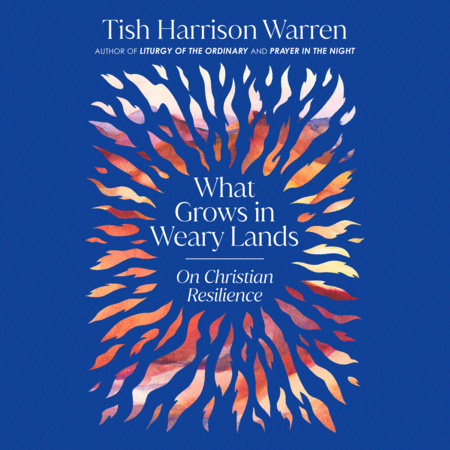
Download high-resolution image
Listen to a clip from the audiobook
audio pause button
0:00
0:00

What Grows in Weary Lands

On Christian Resilience

Listen to a clip from the audiobook
audio pause button
0:00
0:00
How do we cultivate faith that endures? From award-winning author and former New York Times writer Tish Harrison Warren comes a fresh vision for navigating burnout and weariness through ancient Christian practices—guiding us toward lives of resilience, renewal, and flourishing.

“Warren is one of our best living spiritual writers. . . . It would be impossible to overstate how warmly I recommend this book to all.”—John Mark Comer, New York Times bestselling author of Practicing the Way and The Ruthless Elimination of Hurry

Early Christians often grappled with a reality we rarely talk about in contemporary life: that God seems to abandon the soul at times, leaving us feeling as if we are alone and left to our own resources. These are times of futility, when work and relationships feel hard, when prayer feels unsatisfying, and we question whether our efforts are amounting to anything.

For centuries, Warren notes, times of “aridity” were seen as necessary prerequisites for growth and maturity. Yet in our culture fixated on speed and optimization, we risk losing this deeper sense of the human journey and the resilience that comes with it.

Writing for a moment when two-thirds of Americans are dissatisfied with their work, and a sense of languishing is widespread, Warren draws from both her own season of exhaustion and the rich well of Christian tradition—particularly that of the earliest Christian monks—to discover the habits and mindsets that anchor us in times of doubt, difficulty, and spiritual dryness. She offers hope to those who feel like life is overwhelming, taxing, and disorienting.

What Grows in Weary Lands speaks to anyone longing for a life of depth in a distracted age. Warren helps us see that nothing is wasted—that even in desert seasons something good is growing, rooted in grace and reaching toward glory.
1

Discovery in the Desert

lost and found in a weary land

I.

Though we experience this differently, all of us hit points in our lives where we’re out of steam, where we can’t get traction, where we feel lifeless or tired, disoriented and unsure of ourselves. Things seem hard, maybe harder than we think they should be.

Paul wrote to the early church in Galatia urging them to “not become weary in doing good, for at the proper time we will reap a harvest if we do not give up.” But he would not have needed to issue this reminder if the course of life—­even a life of faith—­did not often make us weary. If the Christian life were meant to feel like a perpetual rock concert or an ecstatic mystical journey, if it was not difficult to pray or believe or obey God, the apostle would not have had to encourage us to keep going, to not give up. Instead, he implies that doing good—­that staying true to the commitments of our lives—­costs us something.

In the past few years, I found myself in something akin to a spiritual drought or a desert, yearning for rain, for renewal. I did not know how to name what I was experiencing. It was not a time of tragedy or deepest suffering, but neither was I flourishing. To call it a midlife crisis feels too dismissive and cliché. There was no plastic surgery or Botox. I didn’t run off with some charming stranger I’d met in a hot yoga class or “find myself” in some exotic locale. This was a quiet crisis, as inarticulable as it was unignorable. And it touched nearly every realm of my life.

I had written for The New York Times every week for two years. I’d published tens of thousands of words about the value of faith in public discourse and private life. And I had believed them, every word. But my actual faith—­my connection to God in a typical day—­felt wavering. God began to seem less like a kind, present friend and more like a corpse on a table that we, like medical examiners, analyzed and debated in the comment sections of my articles. Less like a being of overwhelming beauty, the Maker of heaven and earth, and more of a sociological artifact used to track American voting blocs.

Prayer grew halting and frustrating. I would sit to pray, but it felt as though the line had gone dead. I did not feel a sense of God’s nearness. I didn’t feel much of anything at all. And I’d begin to think, Is anyone there? Am I fooling myself? Is this a waste of my time?

At work, I met deadlines. I got positive feedback. But I had lost much of the initial joy I’d had when I first became a writer. Once words flowed from me, feeling electric, urgent, and at times ecstatic. Now my mind meandered and froze. I’d write a sentence and delete it. I’d stare at the empty page. Then came a heaviness in my limbs, a sighing in the soul. Sometimes I’d get up from my desk, lower myself onto the floor, and weakly moan, thinking about how my once beloved work now felt like pushing a boulder up a hill—­punishing and pointless. Like Sisyphus, if he were under deadline. I’d stare at the ceiling and wonder, Am I just being lazy? Am I a fraud? Is it time to give up?

It seemed I was always worrying over something or other. The online critics, whose voices echoed in my head like some kind of demon parrot who only knew insults. Or the headlines that blared on my news feed. Or the feuding state of the American church. Or my slowing metabolism and sudden appearance of gray hair, which my youngest daughter had kindly begun referring to as my “tinsel.”

I wasn’t sure anymore who I was, where I was in life, or how to keep going. I was disoriented.

At the same time, I felt overwhelmingly and unavoidably busy, sandwiched between kids—­a preschooler, a tween, and a teen—­and an aging mother who, for over a decade, had drifted slowly into the fog of Alzheimer’s. They needed me, all in vastly different ways. My husband needed me. Friends needed me. The dog needed me. The church needed me. The chores and bills needed me. I, on the other hand, wanted to crawl into a cave and hide from it all for a few weeks or years or decades.

I had grown weary. But I wasn’t sure what to do next.

In the midst of this season, on one ordinary day, my husband Jonathan and I had been low-­key squabbling on and off for hours, both feeling crabby. I was tired after a bad night of sleep. Writing that day had felt like a failure, and I’d gotten a discouraging comment from a colleague. I had not used my time well and felt wired and addled from being plugged in to distant sorrows and debates online all day. And as the sun set, my daughter and I got in an ­argument—­I don’t even recall about what.

And I’d had it. The walls were closing in on me. I grabbed the car keys, slammed the door, and sped down the street. But where was I to go? I had no idea. So I just drove around, the anger in my chest melting into hot tears until I couldn’t see the road anymore. I pulled into an empty Barnes & Noble parking lot, turned off the engine, and wept as I wailed six words that I’ve since yelled at God a hundred more times: “I don’t know what to do!”

Silence. There was no voice speaking back, no flash of insight or clarity, no “heart strangely warmed.” After a long while, my tears slowed, my breathing steadied, and I drove back home.

In some ways, it’s a stupid story to share—­so common it doesn’t feel worth writing about. The headline would never go viral: “Middle-­Aged White Lady Drives to Strip Center Parking Lot, Cries.”

What would have made it worth telling is if I’d kept driving, escaped to Mexico, had an epic adventure, and discovered some zingy new spirituality. Or if I’d walked into the Barnes & Noble, stole something, and slowly broken bad into a life of crime. Or if I’d stopped somewhere to drown my sorrows, bumped into an old flame, and we both realized that everything in the last twenty years had led us to this very moment, together at last. All of that would make good fodder for a memoir. I could spin it all to sound courageous, deep, and original. I would tell how I invented my own path and learned to embrace radical self-­love. It would be romantic, passionate, and possibly lucrative.

Instead, I just drove home, with my face all puffy, to put the kids to bed, reconcile with my daughter and husband, and get some sleep. And in our moment in history, such an ending to this small story does not seem brave or profound or worthwhile. Because of this, we end up not telling the stories of these weary yet undramatic seasons—­unless those stories end in a total dismantling and re­invention of our lives.

It is vulnerable to talk about long seasons of unfulfillment and of spiritual, creative, and emotional dryness. We can feel as if we are simply being whiny or wimpy. We can tell ourselves we just need to get over it, stop moaning, cheer up. We can also fear that if something feels off or unsatisfying about our life, we must be doing it wrong. We must have made poor choices or forsaken the blissful path we were made for.

But because we don’t sit with these stories, we lack the resources to understand what is happening to us when these wearying seasons inevitably come. We miss what these times are meant to do in us, what they shift and grow within us, what they call forth from us, and where God may be in the midst of them. We miss the gifts they offer, gifts we desperately need if we are to flourish.
“So many of us are bone-tired—tired of all the noise, the hurry, the drama, and, at times, even tired of prayer. Into our cultural moment of chronic exhaustion, Tish Harrison Warren offers us a spirituality for the weary. . . . Warren is one of our best living spiritual writers; her ability to blend Christian spirituality and insights from church history with beautifully down-to-earth honesty and raw humor, all while keeping our soul hopeful in God, is a rare gift.”—John Mark Comer, New York Times bestselling author of Practicing the Way and The Ruthless Elimination of Hurry

“Tish Harrison Warren has written the book we need in this time as believers, as neighbors, and as men and women navigating the modern world.”—Annie F. Downs, New York Times bestselling author of That Sounds Fun

“I have loved all of Tish Harrison Warren’s books, but I may have a new favorite. What Grows in Weary Lands is a rich application of ancient monastic wisdom to the burnout tendencies of modern life. You need to read it.”—Justin Whitmel Earley, author of Habits of the Household and The Body Teaches the Soul

“If you are looking for a way of being Christian when you feel like you are at the end of your rope, this is the book for you. Warren is one of the best spiritual writers of our day, and this may be her best work to date.”—Esau McCaulley, Ph.D., professor at Wheaton College, author of How Far to the Promised Land

“Read this book if you have discovered that you do not get through life without going through a desert; read this book to discover that the desert brings a kind of life you cannot find anywhere else.”—Andy Crouch, partner for theology and culture, Praxis, and author of The Life We’re Looking For

“[Warren] excels at energizing familiar wisdom (“If salvation is to meet us at all, it must meet us in the slog”) as she effectively reassures believers that the disorientation of ‘spiritual drought’ is as old as faith itself. Despairing Christians will be rejuvenated.”Publishers Weekly

“Warren writes in such a way that often—sometimes more than once on a page—I had to stop and journal or stop and pray. Whatever spiritual season in which a reader approaches this book, there are gifts abundant. Her honesty and hope bring balm to the soul of the hurting and zeal to the heart of the eager.”—Rev. Dr. Amy Peeler, Kenneth T. Wessner Professor of New Testament at Wheaton College, Associate Rector at St. Mark’s Episcopal Church, and author of Women and Gender of God

“This book is like a friend who reminds you who you are and who God is when you’re too weary to remember. It’s a theology of staying-put—a gospel for those of us in the long middle of faith who are tired not because we’ve lost our faith, but because we’ve kept it.”—Jon Guerra, devotional music singer-songwriter

What Grows in Weary Lands is poised to become a modern spiritual classic and another must-read offering from one of the brightest spiritual writers of our day.”—Rev. Claude Atcho, pastor of Church of the Resurrection (Charlottesville, Va.), author of Rhythms of Faith and Reading Black Books

“Honest, wise and persistent in imagination, this is a book to refresh the seasoned spiritual traveler. A beautifully crafted weave of both resilience and wonder.”—Martin Shaw, author of Liturgies of the Wild
© Shelley Elena Photography, LLC
Tish Harrison Warren is a writer and an Anglican priest. She is the author of several books, including Liturgy of the Ordinary, which won Christianity Today’s 2018 Book of the Year, and Prayer in the Night, which won Christianity Today’s 2022 Book of the Year and the 2022 ECPA Christian Book of the Year. She formerly wrote a weekly newsletter for The New York Times, which focused on faith in public discourse and private life. She was also a columnist at Christianity Today. Her articles and essays have appeared in Comment Magazine, the The Point Magazine, Religion News Service, and elsewhere. She currently serves as the C.S. Lewis Theological Writer-in-Residence for The Anglican Episcopal House of Studies at Baylor’s George W. Truett Theological Seminary. She is a senior fellow with the Trinity Forum and an assisting priest at Immanuel Anglican Church. She lives in Austin, Texas, with her husband and three children. View titles by Tish Harrison Warren

About

How do we cultivate faith that endures? From award-winning author and former New York Times writer Tish Harrison Warren comes a fresh vision for navigating burnout and weariness through ancient Christian practices—guiding us toward lives of resilience, renewal, and flourishing.

“Warren is one of our best living spiritual writers. . . . It would be impossible to overstate how warmly I recommend this book to all.”—John Mark Comer, New York Times bestselling author of Practicing the Way and The Ruthless Elimination of Hurry

Early Christians often grappled with a reality we rarely talk about in contemporary life: that God seems to abandon the soul at times, leaving us feeling as if we are alone and left to our own resources. These are times of futility, when work and relationships feel hard, when prayer feels unsatisfying, and we question whether our efforts are amounting to anything.

For centuries, Warren notes, times of “aridity” were seen as necessary prerequisites for growth and maturity. Yet in our culture fixated on speed and optimization, we risk losing this deeper sense of the human journey and the resilience that comes with it.

Writing for a moment when two-thirds of Americans are dissatisfied with their work, and a sense of languishing is widespread, Warren draws from both her own season of exhaustion and the rich well of Christian tradition—particularly that of the earliest Christian monks—to discover the habits and mindsets that anchor us in times of doubt, difficulty, and spiritual dryness. She offers hope to those who feel like life is overwhelming, taxing, and disorienting.

What Grows in Weary Lands speaks to anyone longing for a life of depth in a distracted age. Warren helps us see that nothing is wasted—that even in desert seasons something good is growing, rooted in grace and reaching toward glory.

Excerpt

1

Discovery in the Desert

lost and found in a weary land

I.

Though we experience this differently, all of us hit points in our lives where we’re out of steam, where we can’t get traction, where we feel lifeless or tired, disoriented and unsure of ourselves. Things seem hard, maybe harder than we think they should be.

Paul wrote to the early church in Galatia urging them to “not become weary in doing good, for at the proper time we will reap a harvest if we do not give up.” But he would not have needed to issue this reminder if the course of life—­even a life of faith—­did not often make us weary. If the Christian life were meant to feel like a perpetual rock concert or an ecstatic mystical journey, if it was not difficult to pray or believe or obey God, the apostle would not have had to encourage us to keep going, to not give up. Instead, he implies that doing good—­that staying true to the commitments of our lives—­costs us something.

In the past few years, I found myself in something akin to a spiritual drought or a desert, yearning for rain, for renewal. I did not know how to name what I was experiencing. It was not a time of tragedy or deepest suffering, but neither was I flourishing. To call it a midlife crisis feels too dismissive and cliché. There was no plastic surgery or Botox. I didn’t run off with some charming stranger I’d met in a hot yoga class or “find myself” in some exotic locale. This was a quiet crisis, as inarticulable as it was unignorable. And it touched nearly every realm of my life.

I had written for The New York Times every week for two years. I’d published tens of thousands of words about the value of faith in public discourse and private life. And I had believed them, every word. But my actual faith—­my connection to God in a typical day—­felt wavering. God began to seem less like a kind, present friend and more like a corpse on a table that we, like medical examiners, analyzed and debated in the comment sections of my articles. Less like a being of overwhelming beauty, the Maker of heaven and earth, and more of a sociological artifact used to track American voting blocs.

Prayer grew halting and frustrating. I would sit to pray, but it felt as though the line had gone dead. I did not feel a sense of God’s nearness. I didn’t feel much of anything at all. And I’d begin to think, Is anyone there? Am I fooling myself? Is this a waste of my time?

At work, I met deadlines. I got positive feedback. But I had lost much of the initial joy I’d had when I first became a writer. Once words flowed from me, feeling electric, urgent, and at times ecstatic. Now my mind meandered and froze. I’d write a sentence and delete it. I’d stare at the empty page. Then came a heaviness in my limbs, a sighing in the soul. Sometimes I’d get up from my desk, lower myself onto the floor, and weakly moan, thinking about how my once beloved work now felt like pushing a boulder up a hill—­punishing and pointless. Like Sisyphus, if he were under deadline. I’d stare at the ceiling and wonder, Am I just being lazy? Am I a fraud? Is it time to give up?

It seemed I was always worrying over something or other. The online critics, whose voices echoed in my head like some kind of demon parrot who only knew insults. Or the headlines that blared on my news feed. Or the feuding state of the American church. Or my slowing metabolism and sudden appearance of gray hair, which my youngest daughter had kindly begun referring to as my “tinsel.”

I wasn’t sure anymore who I was, where I was in life, or how to keep going. I was disoriented.

At the same time, I felt overwhelmingly and unavoidably busy, sandwiched between kids—­a preschooler, a tween, and a teen—­and an aging mother who, for over a decade, had drifted slowly into the fog of Alzheimer’s. They needed me, all in vastly different ways. My husband needed me. Friends needed me. The dog needed me. The church needed me. The chores and bills needed me. I, on the other hand, wanted to crawl into a cave and hide from it all for a few weeks or years or decades.

I had grown weary. But I wasn’t sure what to do next.

In the midst of this season, on one ordinary day, my husband Jonathan and I had been low-­key squabbling on and off for hours, both feeling crabby. I was tired after a bad night of sleep. Writing that day had felt like a failure, and I’d gotten a discouraging comment from a colleague. I had not used my time well and felt wired and addled from being plugged in to distant sorrows and debates online all day. And as the sun set, my daughter and I got in an ­argument—­I don’t even recall about what.

And I’d had it. The walls were closing in on me. I grabbed the car keys, slammed the door, and sped down the street. But where was I to go? I had no idea. So I just drove around, the anger in my chest melting into hot tears until I couldn’t see the road anymore. I pulled into an empty Barnes & Noble parking lot, turned off the engine, and wept as I wailed six words that I’ve since yelled at God a hundred more times: “I don’t know what to do!”

Silence. There was no voice speaking back, no flash of insight or clarity, no “heart strangely warmed.” After a long while, my tears slowed, my breathing steadied, and I drove back home.

In some ways, it’s a stupid story to share—­so common it doesn’t feel worth writing about. The headline would never go viral: “Middle-­Aged White Lady Drives to Strip Center Parking Lot, Cries.”

What would have made it worth telling is if I’d kept driving, escaped to Mexico, had an epic adventure, and discovered some zingy new spirituality. Or if I’d walked into the Barnes & Noble, stole something, and slowly broken bad into a life of crime. Or if I’d stopped somewhere to drown my sorrows, bumped into an old flame, and we both realized that everything in the last twenty years had led us to this very moment, together at last. All of that would make good fodder for a memoir. I could spin it all to sound courageous, deep, and original. I would tell how I invented my own path and learned to embrace radical self-­love. It would be romantic, passionate, and possibly lucrative.

Instead, I just drove home, with my face all puffy, to put the kids to bed, reconcile with my daughter and husband, and get some sleep. And in our moment in history, such an ending to this small story does not seem brave or profound or worthwhile. Because of this, we end up not telling the stories of these weary yet undramatic seasons—­unless those stories end in a total dismantling and re­invention of our lives.

It is vulnerable to talk about long seasons of unfulfillment and of spiritual, creative, and emotional dryness. We can feel as if we are simply being whiny or wimpy. We can tell ourselves we just need to get over it, stop moaning, cheer up. We can also fear that if something feels off or unsatisfying about our life, we must be doing it wrong. We must have made poor choices or forsaken the blissful path we were made for.

But because we don’t sit with these stories, we lack the resources to understand what is happening to us when these wearying seasons inevitably come. We miss what these times are meant to do in us, what they shift and grow within us, what they call forth from us, and where God may be in the midst of them. We miss the gifts they offer, gifts we desperately need if we are to flourish.

Reviews

“So many of us are bone-tired—tired of all the noise, the hurry, the drama, and, at times, even tired of prayer. Into our cultural moment of chronic exhaustion, Tish Harrison Warren offers us a spirituality for the weary. . . . Warren is one of our best living spiritual writers; her ability to blend Christian spirituality and insights from church history with beautifully down-to-earth honesty and raw humor, all while keeping our soul hopeful in God, is a rare gift.”—John Mark Comer, New York Times bestselling author of Practicing the Way and The Ruthless Elimination of Hurry

“Tish Harrison Warren has written the book we need in this time as believers, as neighbors, and as men and women navigating the modern world.”—Annie F. Downs, New York Times bestselling author of That Sounds Fun

“I have loved all of Tish Harrison Warren’s books, but I may have a new favorite. What Grows in Weary Lands is a rich application of ancient monastic wisdom to the burnout tendencies of modern life. You need to read it.”—Justin Whitmel Earley, author of Habits of the Household and The Body Teaches the Soul

“If you are looking for a way of being Christian when you feel like you are at the end of your rope, this is the book for you. Warren is one of the best spiritual writers of our day, and this may be her best work to date.”—Esau McCaulley, Ph.D., professor at Wheaton College, author of How Far to the Promised Land

“Read this book if you have discovered that you do not get through life without going through a desert; read this book to discover that the desert brings a kind of life you cannot find anywhere else.”—Andy Crouch, partner for theology and culture, Praxis, and author of The Life We’re Looking For

“[Warren] excels at energizing familiar wisdom (“If salvation is to meet us at all, it must meet us in the slog”) as she effectively reassures believers that the disorientation of ‘spiritual drought’ is as old as faith itself. Despairing Christians will be rejuvenated.”Publishers Weekly

“Warren writes in such a way that often—sometimes more than once on a page—I had to stop and journal or stop and pray. Whatever spiritual season in which a reader approaches this book, there are gifts abundant. Her honesty and hope bring balm to the soul of the hurting and zeal to the heart of the eager.”—Rev. Dr. Amy Peeler, Kenneth T. Wessner Professor of New Testament at Wheaton College, Associate Rector at St. Mark’s Episcopal Church, and author of Women and Gender of God

“This book is like a friend who reminds you who you are and who God is when you’re too weary to remember. It’s a theology of staying-put—a gospel for those of us in the long middle of faith who are tired not because we’ve lost our faith, but because we’ve kept it.”—Jon Guerra, devotional music singer-songwriter

What Grows in Weary Lands is poised to become a modern spiritual classic and another must-read offering from one of the brightest spiritual writers of our day.”—Rev. Claude Atcho, pastor of Church of the Resurrection (Charlottesville, Va.), author of Rhythms of Faith and Reading Black Books

“Honest, wise and persistent in imagination, this is a book to refresh the seasoned spiritual traveler. A beautifully crafted weave of both resilience and wonder.”—Martin Shaw, author of Liturgies of the Wild

Author

© Shelley Elena Photography, LLC
Tish Harrison Warren is a writer and an Anglican priest. She is the author of several books, including Liturgy of the Ordinary, which won Christianity Today’s 2018 Book of the Year, and Prayer in the Night, which won Christianity Today’s 2022 Book of the Year and the 2022 ECPA Christian Book of the Year. She formerly wrote a weekly newsletter for The New York Times, which focused on faith in public discourse and private life. She was also a columnist at Christianity Today. Her articles and essays have appeared in Comment Magazine, the The Point Magazine, Religion News Service, and elsewhere. She currently serves as the C.S. Lewis Theological Writer-in-Residence for The Anglican Episcopal House of Studies at Baylor’s George W. Truett Theological Seminary. She is a senior fellow with the Trinity Forum and an assisting priest at Immanuel Anglican Church. She lives in Austin, Texas, with her husband and three children. View titles by Tish Harrison Warren
  • More Websites from
    Penguin Random House
  • Common Reads
  • Library Marketing