Download high-resolution image
Listen to a clip from the audiobook
audio pause button
0:00
0:00

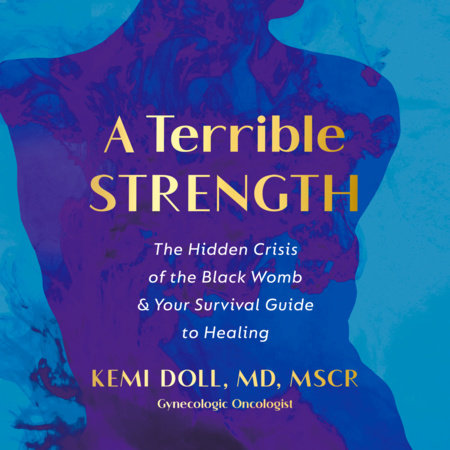
A Terrible Strength

The Hidden Crisis of the Black Womb and Your Survival Guide to Healing

Listen to a clip from the audiobook
audio pause button
0:00
0:00
Audiobook Download
On sale May 05, 2026 | 10 Hours and 15 Minutes | 9798217279487

See Additional Formats
Black women are facing a systemic gynecological health crisis. This book gives them the tools needed to unlearn the medical normalization of their suffering and offers a path forward to healing—by a foremost physician, surgeon, researcher, and gynecological cancer expert.

When Dr. Kemi Doll first began training to be a gynecologic cancer surgeon, she quickly noticed that the level of care being offered to women was rarely equal. She started to ask herself: Whose pain was believed? Who was “high maintenance” vs. “angry and non-compliant”? Who died? White women’s pain was doubted, but Black women’s pain was often outright denied. And the locus of this crisis was the womb. Day by day, fibroids, bleeding, inflammation, and cancer struck Black women the hardest, yet the medical field cared very little about their fate. When student physicians would explicitly bring up these alarming disparities, Dr. Doll's teachers would reply: “Black women just don’t do well with this,” followed by, “We don’t really know why.”

Since then, Dr. Doll has made it her goal to give Black women the tools they need to unlearn what she calls “womb suffering.” For all women navigating gynecologic care, and the medical professionals who care for them, this comprehensive, authoritative book of science-backed information and lived experience covers:

• The mechanisms behind the four primary conditions that affect the womb—often with fatal consequences—including Endometriosis, Fibroids, Heavy Bleeding, and Endometrial cancer.
• An overview of the research conducted on reproductive health outside pregnancy—the lack of which has caused healthcare inequity and obstructed access to care
• Gripping stories of smart, successful women struggling with and overcoming Womb Suffering
• What good gynecologic health looks like
and why it is vital to reclaiming a full, healthy life; how to feel and respond to your body’s signals; and the tools and vocabulary needed to help advocate and prepare for medical visits.

A Terrible Strength links women’s health care to timely conversations on racial justice and healthcare inequity, arming women with the power to secure vibrant health and well-being for the rest of their lives.


* This audiobook edition includes a downloadable PDF of illustrations and appendices from the book.
Introduction

As a Black gynecologic oncologist and scientist, every day I live the reality of the Black womb in crisis. Not the womb in the middle of birth, although God knows Black maternal mortality numbers are shameful, but the nonpregnant, everyday Black womb. The womb housed in our bodies that all too often lies like a ticking time bomb in our lives. We are taught to focus on our wombs’ ability to get pregnant (or not) and hone our ability to hide anything that comes out of it, except a baby. Meanwhile, the complex ways that the womb functions and can be in dysfunction are ignored, silenced, suppressed, and normalized. Diseases that take years to develop and become severe are “discovered” abruptly at their most destructive, leaving us with few options and reinforcing to the medical establishment the long-­enduring belief that Black bodies are inherently broken. The tick tick tick of the signs are ignored until the disease explosion arrives. For many, all we hear back is something that sounds like thoughts, prayers, and birth control pills.

Some books gently explain the ins and outs of menstruation to pubescent girls, others aim to be an encyclopedia of gynecologic health for everyone, or can promise the secret solutions to overcoming the tumultuous years of menopause. This book is not any of that. This is a vital book for Black women and those who love them. This is a lifesaving resource that aids us in understanding, navigating, and healing from the four primary conditions affecting the Black womb that devastate Black women today—­women like your mother, your sister, your aunt, your cousin, your best friend, your wife, and you.

When I refer to women in these pages, it is shorthand to mean cisgender women born with a uterus. Trans women are women, full stop. And their reproductive organs, diseases, and journeys are distinct from those who are born with a uterus. And so trans men, gender-­fluid, genderqueer, nonbinary, and all those who fall under the gender-­expansive umbrella—­and were assigned female at birth (AFAB)—­will find relevance in these pages. Thus, you will find me using language including both women and individuals / folks / all those with a uterus. However, my expertise is in cisgender women’s health, and that is the lens through which my story, my explanations, and my advice is given.

I want to offer to you that gynecologic suffering, what I’ll call Womb Suffering, is a purely colonial idea, steeped in racist patriarchy. Like most things originating from here, this toxic normalization of Womb Suffering hurts not just Black women but all women and folks of any gender born with a uterus. We are not broken. And we should not live out the consequences of a broken society in our own bodies. It is an inappropriate inheritance.

With this book, I want to reset the norms of gynecologic health in our lives entirely. I want Black women to stop accepting Womb Suffering, just like we don’t accept being followed around a store, suspected of stealing. Both insults come from the same place. Just as we have broken loose from the respectability politics of turning the other cheek when disrespected in public spaces, we must break loose from the internalized acceptance of Womb Suffering as intractable, inevitable, or worse, a badge of honor.

When I began medical school, the Black womb was not apparent to me as a locus of crisis for Black women. To me, the womb was a painful inconvenience in my own life, something I barely talked about with friends, and certainly not with family. I was a smart and driven student with a goal of using education to leave behind my homelife forever. By this time, I had already picked myself back up from my rock bottom and had no patience for anything that might make me vulnerable again. I had hardly dated anyone and wasn’t having the kind of sex that could get me pregnant. My womb was something that cramped and bled, and that was it. It wasn’t until my residency that I began to connect a series of devastating dots around sickness and silence. Dots like learning about the threshold for profound clinical anemia and then seeing Black women at levels far below that who were routinely working full-­time with barely livable oxygen levels in their blood. Dots like how common it was for the Emergency Department doctor to suspect pelvic inflammatory disease (PID) caused by sexually transmitted infections, instead of endometriosis, in Black women who dared to show up for help with excruciating pelvic pain. Dots like Black women who’d been seeing their doctors faithfully and routinely for years suddenly diagnosed with stage IV uterine cancer because no one ever asked them about vaginal bleeding.

My OB-­GYN residency training was in Chicago, Illinois, at the brand-­new Prentice Women’s Hospital on the Magnificent Mile, where the labor and delivery rooms were bigger than some city apartments and every floor looked like it was designated VIP. It was in this beautiful environment, where the only thing delineating one patient from another was their race, that I began to see how blatant anti–­Black woman medical racism is. Despite all the patients being in nice rooms, I saw the disparity in treatment: Who got drug tested? Whose pain was believed? Who was “high-­maintenance” versus “angry and noncompliant”? Who died? My colleagues had purposely chosen women’s health just like I had, yet the care being offered to all women was not equal. For as much as White women’s pain was doubted, Black women’s pain was all too often outright denied. For as much as we knew too little about White women’s bodies from lack of research, we knew even less about how to treat Black bodies like mine.

This noticing began to add up. At the beginning of my second year of residency, my training program merged with and took over the residency training program at Cook County Hospital, now known as John H. Stroger, Jr. Hospital of Cook County. I split my time between bright and shiny Prentice and older, shabbier Stroger—­two hospitals a few miles apart that might as well have been on different planets. It was at Stroger that I first noticed how many Black women were diagnosed with advanced-­stage uterine cancer—­a cancer that grows in the heart of the womb. This observation led to my first published research project, a simple study comparing the stage of uterine cancer at diagnosis among women at Stroger (majority Black) compared to the National Cancer Database (majority White). There was a striking and fatal disparity: We had many fewer stage I diagnoses and double the number of stage IV cases. Black women were routinely showing up with cancers that spread beyond the womb, where treatment was tough and cures were remote.

I had chosen OB-­GYN to become a surgeon in service of women’s health. I wanted to use my expertise to mediate the relationship between a woman and her womb. And yet the more independence I gained in diagnosing and treating the conditions that arise from the uterus, the more I could see, day by day, that there was shocking violence in this most sacred part of the body: hemorrhage, inflammation, fibroids, and cancers. This violence struck Black women the hardest, yet gynecology cared very little about our fate. In medical school, we learned precious little about gynecologic health, much less the specifics of Black women’s challenges within it. I am ashamed at the aggressiveness with which I learned in residency to push hysterectomy as the best treatment choice without empathy for the neglectful care that led to years of unnecessary womb suffering. How physically draining and humiliating is it to have people constantly think you are pregnant because you are carrying around bowling-­ball-­size fibroids? What is more vulnerable than sitting in a waiting room, bleeding through your clothes? Black women always had the biggest fibroids, the worst anemia from blood loss, and the most aggressive cancers. On the days we physicians would explicitly discuss this alarming fact, the answers my teachers gave to my burning questions were no answers at all. “Black women just don’t do well with this,” followed by, “We don’t really know why.
“Unflinching. In a world where we’ve been forced to interpret our own health through the darkest veils, Dr. Kemi Doll peels them back with courage and clarity. Not only is this book the necessary indictment against white-dominated medical systems that have used, discarded, and neglected Black bodies across time, but it also delivers an invitation—to reclaim and reimagine truer methods of protection and care for the Black womb. Dr. Doll is sounding an alarm. We can’t afford not to hear it.”—Cole Arthur Riley, New York Times bestselling author of Black Liturgies

“Dr. Kemi Doll writes with the clarity of a scientist and the soul of a healer. Every chapter cuts deep and builds hope. This is ‘womb wisdom’ we all need.”—Sharon Malone, MD, New York Times bestselling author of Grown Woman Talk

“Meticulously researched yet deeply accessible, A Terrible Strength is both a reckoning and a road map. Dr. Kemi Doll exposes how many gynecologic conditions disproportionately harm Black women, as well as the systemic neglect, bias, and silence within medicine. Blending evidence, reflection, and reclamation, this book is essential reading for all women seeking to understand their health, their care, and the systems and inequalities that govern both.”—Dr. Jen Gunter, New York Times bestselling author of The Menopause Manifesto

“Dr. Kemi Doll exposes how women are taught to normalize pain and delay care until it’s too late. Drawing from the devastating disparities faced by Black women, she shows how a system designed without women’s full humanity harms everyone it touches. This book gives you the language and confidence to demand better care. It is essential reading for anyone who’s ever been dismissed by a doctor, which is most of us.”—Myleik Teele, entrepreneur and life + career strategist
© Mia K Visuals
Dr. Kemi Doll is a physician, surgeon, advocate, career coach, and a double-board certified gynecologic oncologist and uterine cancer scientist. She is a professor in the department of obstetrics and gynecology at the University of Washington School of Medicine and an adjunct professor in the department of health systems and population health at the University of Washington School of Public Health. View titles by Kemi Doll, MD, MSCR

About

Black women are facing a systemic gynecological health crisis. This book gives them the tools needed to unlearn the medical normalization of their suffering and offers a path forward to healing—by a foremost physician, surgeon, researcher, and gynecological cancer expert.

When Dr. Kemi Doll first began training to be a gynecologic cancer surgeon, she quickly noticed that the level of care being offered to women was rarely equal. She started to ask herself: Whose pain was believed? Who was “high maintenance” vs. “angry and non-compliant”? Who died? White women’s pain was doubted, but Black women’s pain was often outright denied. And the locus of this crisis was the womb. Day by day, fibroids, bleeding, inflammation, and cancer struck Black women the hardest, yet the medical field cared very little about their fate. When student physicians would explicitly bring up these alarming disparities, Dr. Doll's teachers would reply: “Black women just don’t do well with this,” followed by, “We don’t really know why.”

Since then, Dr. Doll has made it her goal to give Black women the tools they need to unlearn what she calls “womb suffering.” For all women navigating gynecologic care, and the medical professionals who care for them, this comprehensive, authoritative book of science-backed information and lived experience covers:

• The mechanisms behind the four primary conditions that affect the womb—often with fatal consequences—including Endometriosis, Fibroids, Heavy Bleeding, and Endometrial cancer.
• An overview of the research conducted on reproductive health outside pregnancy—the lack of which has caused healthcare inequity and obstructed access to care
• Gripping stories of smart, successful women struggling with and overcoming Womb Suffering
• What good gynecologic health looks like
and why it is vital to reclaiming a full, healthy life; how to feel and respond to your body’s signals; and the tools and vocabulary needed to help advocate and prepare for medical visits.

A Terrible Strength links women’s health care to timely conversations on racial justice and healthcare inequity, arming women with the power to secure vibrant health and well-being for the rest of their lives.


* This audiobook edition includes a downloadable PDF of illustrations and appendices from the book.

Excerpt

Introduction

As a Black gynecologic oncologist and scientist, every day I live the reality of the Black womb in crisis. Not the womb in the middle of birth, although God knows Black maternal mortality numbers are shameful, but the nonpregnant, everyday Black womb. The womb housed in our bodies that all too often lies like a ticking time bomb in our lives. We are taught to focus on our wombs’ ability to get pregnant (or not) and hone our ability to hide anything that comes out of it, except a baby. Meanwhile, the complex ways that the womb functions and can be in dysfunction are ignored, silenced, suppressed, and normalized. Diseases that take years to develop and become severe are “discovered” abruptly at their most destructive, leaving us with few options and reinforcing to the medical establishment the long-­enduring belief that Black bodies are inherently broken. The tick tick tick of the signs are ignored until the disease explosion arrives. For many, all we hear back is something that sounds like thoughts, prayers, and birth control pills.

Some books gently explain the ins and outs of menstruation to pubescent girls, others aim to be an encyclopedia of gynecologic health for everyone, or can promise the secret solutions to overcoming the tumultuous years of menopause. This book is not any of that. This is a vital book for Black women and those who love them. This is a lifesaving resource that aids us in understanding, navigating, and healing from the four primary conditions affecting the Black womb that devastate Black women today—­women like your mother, your sister, your aunt, your cousin, your best friend, your wife, and you.

When I refer to women in these pages, it is shorthand to mean cisgender women born with a uterus. Trans women are women, full stop. And their reproductive organs, diseases, and journeys are distinct from those who are born with a uterus. And so trans men, gender-­fluid, genderqueer, nonbinary, and all those who fall under the gender-­expansive umbrella—­and were assigned female at birth (AFAB)—­will find relevance in these pages. Thus, you will find me using language including both women and individuals / folks / all those with a uterus. However, my expertise is in cisgender women’s health, and that is the lens through which my story, my explanations, and my advice is given.

I want to offer to you that gynecologic suffering, what I’ll call Womb Suffering, is a purely colonial idea, steeped in racist patriarchy. Like most things originating from here, this toxic normalization of Womb Suffering hurts not just Black women but all women and folks of any gender born with a uterus. We are not broken. And we should not live out the consequences of a broken society in our own bodies. It is an inappropriate inheritance.

With this book, I want to reset the norms of gynecologic health in our lives entirely. I want Black women to stop accepting Womb Suffering, just like we don’t accept being followed around a store, suspected of stealing. Both insults come from the same place. Just as we have broken loose from the respectability politics of turning the other cheek when disrespected in public spaces, we must break loose from the internalized acceptance of Womb Suffering as intractable, inevitable, or worse, a badge of honor.

When I began medical school, the Black womb was not apparent to me as a locus of crisis for Black women. To me, the womb was a painful inconvenience in my own life, something I barely talked about with friends, and certainly not with family. I was a smart and driven student with a goal of using education to leave behind my homelife forever. By this time, I had already picked myself back up from my rock bottom and had no patience for anything that might make me vulnerable again. I had hardly dated anyone and wasn’t having the kind of sex that could get me pregnant. My womb was something that cramped and bled, and that was it. It wasn’t until my residency that I began to connect a series of devastating dots around sickness and silence. Dots like learning about the threshold for profound clinical anemia and then seeing Black women at levels far below that who were routinely working full-­time with barely livable oxygen levels in their blood. Dots like how common it was for the Emergency Department doctor to suspect pelvic inflammatory disease (PID) caused by sexually transmitted infections, instead of endometriosis, in Black women who dared to show up for help with excruciating pelvic pain. Dots like Black women who’d been seeing their doctors faithfully and routinely for years suddenly diagnosed with stage IV uterine cancer because no one ever asked them about vaginal bleeding.

My OB-­GYN residency training was in Chicago, Illinois, at the brand-­new Prentice Women’s Hospital on the Magnificent Mile, where the labor and delivery rooms were bigger than some city apartments and every floor looked like it was designated VIP. It was in this beautiful environment, where the only thing delineating one patient from another was their race, that I began to see how blatant anti–­Black woman medical racism is. Despite all the patients being in nice rooms, I saw the disparity in treatment: Who got drug tested? Whose pain was believed? Who was “high-­maintenance” versus “angry and noncompliant”? Who died? My colleagues had purposely chosen women’s health just like I had, yet the care being offered to all women was not equal. For as much as White women’s pain was doubted, Black women’s pain was all too often outright denied. For as much as we knew too little about White women’s bodies from lack of research, we knew even less about how to treat Black bodies like mine.

This noticing began to add up. At the beginning of my second year of residency, my training program merged with and took over the residency training program at Cook County Hospital, now known as John H. Stroger, Jr. Hospital of Cook County. I split my time between bright and shiny Prentice and older, shabbier Stroger—­two hospitals a few miles apart that might as well have been on different planets. It was at Stroger that I first noticed how many Black women were diagnosed with advanced-­stage uterine cancer—­a cancer that grows in the heart of the womb. This observation led to my first published research project, a simple study comparing the stage of uterine cancer at diagnosis among women at Stroger (majority Black) compared to the National Cancer Database (majority White). There was a striking and fatal disparity: We had many fewer stage I diagnoses and double the number of stage IV cases. Black women were routinely showing up with cancers that spread beyond the womb, where treatment was tough and cures were remote.

I had chosen OB-­GYN to become a surgeon in service of women’s health. I wanted to use my expertise to mediate the relationship between a woman and her womb. And yet the more independence I gained in diagnosing and treating the conditions that arise from the uterus, the more I could see, day by day, that there was shocking violence in this most sacred part of the body: hemorrhage, inflammation, fibroids, and cancers. This violence struck Black women the hardest, yet gynecology cared very little about our fate. In medical school, we learned precious little about gynecologic health, much less the specifics of Black women’s challenges within it. I am ashamed at the aggressiveness with which I learned in residency to push hysterectomy as the best treatment choice without empathy for the neglectful care that led to years of unnecessary womb suffering. How physically draining and humiliating is it to have people constantly think you are pregnant because you are carrying around bowling-­ball-­size fibroids? What is more vulnerable than sitting in a waiting room, bleeding through your clothes? Black women always had the biggest fibroids, the worst anemia from blood loss, and the most aggressive cancers. On the days we physicians would explicitly discuss this alarming fact, the answers my teachers gave to my burning questions were no answers at all. “Black women just don’t do well with this,” followed by, “We don’t really know why.

Reviews

“Unflinching. In a world where we’ve been forced to interpret our own health through the darkest veils, Dr. Kemi Doll peels them back with courage and clarity. Not only is this book the necessary indictment against white-dominated medical systems that have used, discarded, and neglected Black bodies across time, but it also delivers an invitation—to reclaim and reimagine truer methods of protection and care for the Black womb. Dr. Doll is sounding an alarm. We can’t afford not to hear it.”—Cole Arthur Riley, New York Times bestselling author of Black Liturgies

“Dr. Kemi Doll writes with the clarity of a scientist and the soul of a healer. Every chapter cuts deep and builds hope. This is ‘womb wisdom’ we all need.”—Sharon Malone, MD, New York Times bestselling author of Grown Woman Talk

“Meticulously researched yet deeply accessible, A Terrible Strength is both a reckoning and a road map. Dr. Kemi Doll exposes how many gynecologic conditions disproportionately harm Black women, as well as the systemic neglect, bias, and silence within medicine. Blending evidence, reflection, and reclamation, this book is essential reading for all women seeking to understand their health, their care, and the systems and inequalities that govern both.”—Dr. Jen Gunter, New York Times bestselling author of The Menopause Manifesto

“Dr. Kemi Doll exposes how women are taught to normalize pain and delay care until it’s too late. Drawing from the devastating disparities faced by Black women, she shows how a system designed without women’s full humanity harms everyone it touches. This book gives you the language and confidence to demand better care. It is essential reading for anyone who’s ever been dismissed by a doctor, which is most of us.”—Myleik Teele, entrepreneur and life + career strategist

Author

© Mia K Visuals
Dr. Kemi Doll is a physician, surgeon, advocate, career coach, and a double-board certified gynecologic oncologist and uterine cancer scientist. She is a professor in the department of obstetrics and gynecology at the University of Washington School of Medicine and an adjunct professor in the department of health systems and population health at the University of Washington School of Public Health. View titles by Kemi Doll, MD, MSCR
  • More Websites from
    Penguin Random House
  • Common Reads
  • Library Marketing