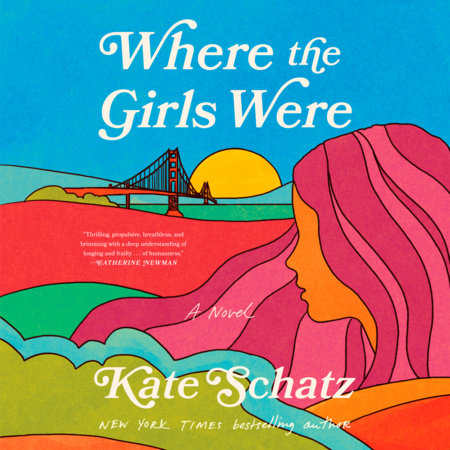
Where the Girls Were

A Novel

They were sent away to be forgotten. This is their story.

In this electrifying historical novel about coming of age in tumultuous 1960s San Francisco, a pregnant teenager reckons with womanhood and agency after being sent to a home for unwed mothers.

"Thrilling, propulsive, breathless, and brimming with a deep understanding of longing and frailty . . . of humanness.”—Catherine Newman, New York Times bestselling author of Sandwich and Wreck


It’s 1968, and the future is bright for seventeen-year-old Elizabeth “Baker” Phillips: She’s the valedictorian of her high school, with a place at Stanford in the fall and big dreams of becoming a journalist. But the seductive free-spirited San Francisco atmosphere seeps into her carefully planned, strait-laced life in the form of a hippie named Wiley. At first, letting loose and letting herself fall in love for the first time feels incredible. But then, everything changes.

Pregnancy hits Baker with the force of whiplash—in the blink of an eye, she goes from good girl to fallen woman, from her family’s shining star to their embarrassing secret. Without any other options, Baker is sent to a home for unwed mothers, and finds herself trapped in an old Victorian house packed with pregnant girls who share her shame and fear. As she grapples with her changing body, lack of choice, and uncertain future, Baker finds unexpected community and empowerment among the “girls who went away.”

Where the Girls Were is a timely unearthing of a little-known moment in American history, when the sexual revolution and feminist movement collided with the limits of reproductive rights—and society's expectations of women. As Baker finds her strength and her voice, she shows us how to step into your power, even when the world is determined to keep you silent.
It’s 7:00 p.m. on New Year’s Eve when May calls Baker to tell her she’ll pick her up in an hour. Just make something up. Tell your mom we’ll be hanging out at my place, May coos with convincing confidence. Trust me, you don’t want to miss this concert. It’s New Year’s, cuz. Time to live a little!

A new year, Baker tells herself. Time to get out and grow up.

The dealership calendar on the wall is already flipped to January. 1968 is printed in big block letters above a photo of a sleek baby blue Galaxie 500, two-door, hardtop, the exact same one sitting out front in the driveway, on loan to her father from the lot since its release in September. The neighbors love it. Baker’s cousins keep plotting to steal the keys.

The party is in full swing on the patio out back and the sounds fill the house, muffled but familiar—men talking, women laughing, glasses clinking, record playing. Nineteen sixty-eight. The number feels sharp and bright, confident and decisive. Your mouth smiles when you say it. Full of potential and ready for change.

When the patio door slides open, the party rushes in like the tide: the smoke from the cigarettes, the sweet citronella from the burning tiki torches, the tinkling sounds of the Arthur Lyman Orchestra record. The soft shuffle of her mother’s feet, size eight, narrow, scuffing across the low-pile carpet, never clomping. Baker bites her tongue. She should be rehearsing her story.

Rose Phillips looks great. She always does. Her green caftan spins out around her fit frame like a tropical flower. Her freshly styled hair frames her face in soft waves, just brushing her jaw. A long Winston in one hand, an empty champagne bucket in the other, a hostess’s smile on her face. She looks at her daughter and leans in close.

“Well? Are you going to make an appearance, or is there something more exciting here on this kitchen wall?”

“I’m sorry, mother, I was on the phone. May called.”

“Oh, May. Delightful.” Rose opens the refrigerator and pulls out a tray of hors d’oeuvres. She pops a salami roll into her mouth. “And what kind of psychedelic mess is your cousin getting into tonight?”

“It’s not like that, at least not tonight.” Baker places a hand on the Formica countertop, bracing herself. Her heart races as she gathers the courage to lie to her mother. “She’s going to a concert. And I’d like to join her.”

“Mm-hmm.” Rose pulls a box of Ritz crackers from the cupboard and begins fanning them out on the tray next to the cheese slices and meat roll-ups. “And where is this concert?”

“San Francisco.” Baker shrugs, attempting casual. “It’ll be . . . mellow.”

Rose laughs her tinkly party-laugh. “Your cousin is anything but mellow.”

“I think it’s, like, folk music.”

“Folk. Music.” Rose delivers each word staccato. “On New Year’s Eve. In San Francisco. With May.”

Baker pulls her shoulders back, lifts her chin, sucks her navel back toward her spine. Her bare feet on the kitchen floor, also size eight, also narrow. She’s taller than her mother now, no longer gazing up at her face. Nearly an adult. Nearly a woman.

“It’s a special occasion. And, besides, I graduate in six months.”

“Don’t remind me!” Rose puts her hands over her ears, as if she can’t bear to hear it.

“And then I can do whatever I want!” Baker grins and Rose raises an eyebrow, then laughs.

“Oh, is that how it works, my clever child?” When Rose laughs, Baker can see so clearly that they have the exact same teeth. Straight and white and just a little too crowded. Rose eats a Ritz and holds one out to Baker, who shakes her head and wrinkles her nose.

“May’s on her way to pick me up. She’ll be here in an hour.” Rose raises an eyebrow, and that’s all it takes for Baker to falter slightly, to remember who’s in charge. “I mean, if it’s okay with you.”

Voices call out from the patio: Where’s the hostess? Who’s got my drink? Gerald’s deep voice hollers Rose, the natives are restless! Rose sucks on her cigarette and gazes at her daughter. Baker feels her mother’s eyes on her—assessing, judging—and crosses her arms, self-conscious of her lanky, changing body. Her taut breasts. Her once-chubby cheeks that now hang on sharp cheekbones.

“I do like your hair like this,” Rose says. Baker’s hand flies to her head, patting the straight shiny sheet that she brushes one hundred times each night. “It’s nice to see your hair out of that same old ponytail. I wish you’d wear some lipstick, though, and a little rouge. Instead of all that smudgy eye junk.” Baker blushes in spite of herself. “All those brains, and now beauty, too? You’re really something else. We’re so proud.”

“Because I brushed my hair?”

“Because you’re Elizabeth Baker Phillips! The best and the brightest! The valedictorian!”

“That’s not official yet, mother.”

“Pish posh, what are they waiting for? You’re exceptional, and everyone knows it! Now go get dressed. You can’t go to a concert in the city on New Year’s Eve wearing that. Put on that nice green dress that you refused to wear on Christmas. And bring the good coat.”

“I can go?”

“Don’t question me! I’m in a wonderful mood, and besides.” Rose takes Baker’s hand in hers and squeezes. Her long, slender fingers are cool and soft, identical to Baker’s but with more lines, more texture, more years coursing through the blue-green veins. “Your father and I trust you.”

The pit that has been hovering somewhere in Baker’s abdomen drops hard and fast. It’s a familiar feeling: the weight of expectation. The same pit she felt at age eleven, when they decided to have her skip sixth grade and go straight to junior high. The pit she’s always felt when she hears her parents’ late-night arguments and knows exactly why they’re both so worried. When she does her own private mathematics: the sum of what she dreams of doing with her life, divided by what’s expected of her. When she’s not in control of her surroundings, when she feels the eyes of boys and men along her body and can’t figure out why she hates and loves it at the same damn time.

“It’s okay to put down the books and have a little fun!” Rose opens the icebox and pulls out two frosty glass bottles. Baker notes the labels, black and gold, the words all in French. She doesn’t know exactly how much that champagne costs, but she knows it’s more than they can afford. And all that sophisticated cheese, the cured meats from the fancy delicatessen in North Beach. And the olives—the imported Italian kind that come floating in glass jars with bay leaves and peppercorns, not the regular black ones in cans that the kids stick on their fingers. Those aren’t cheap. Her mind immediately begins to calculate what Rose must have spent to put up a spread like this. She knows what’s in the accounts right now—she did the books just last week, staying up past ten on a school night to finish.

She shoots her mother a look and folds her arms. “This party doesn’t look ‘little.’ ”

Rose’s voice drops to a hiss. “I got the wine on sale, and Mr. Villa gave me a discount on the food in exchange for those dance lessons I did for his daughter.” Baker relaxes a little. Always figuring out a fix—classic Rose. “There are nearly fifty people out there, including your father’s colleagues. They expect nothing short of excellence. And that,” Rose says, popping the cork, “is what we provide.”

Rose places two of great-grandma Mary’s crystal glasses onto the counter. She pours herself a glass, then a few inches of the pale yellow liquid for Baker, who wonders how on earth a bottle of fermented, fizzy grape juice could possibly be worth that much money.

“Now raise your glass and go get dressed. And have a good time, dammit.”

Rose raises her glass, and Baker meets her mother’s gaze. She knows she’s Rose’s precious pride and joy, a brilliant baby who stands there, growing, glaring, threatening to fly away and become some kind of woman. Part of her feels so ready to be done with it all: high school, this house, the smothering fog of parental love and high expectations. But that part is still overshadowed by the part that wants to make her mother happy. Making Rose proud is still irresistible. Baker lifts her glass.

“To living a little!”

“To living a little.”

“To the valedictorian!”

“To the hostess.”

“To the new year!”

“To 1968.”
“1968 may not feel so very long ago to some, but in terms of attitudes toward women and their rights it may as well have been a century ago. And yet, Schatz’s book feels timely for these difficult times.”Booklist

“The illuminating latest from Schatz . . . looks back on the impact of the sexual revolution before Roe v. Wade. . . . Schatz convincingly evokes the confusion and conflicting emotions of an unplanned pregnancy at a time when abortion was outlawed across the U.S. This resonates.”Publishers Weekly

“A timely and important novel, and one of the most heartfelt I have read in years . . . Readers will gain eye-opening insight, empathy, and understanding as Baker struggles to find a voice amid society’s shaming and to discover—and persevere—with what is best for her. . . . A must-read work, especially now.”—Natalie Jenner, internationally bestselling author of The Jane Austen Society

A beautifully told story about an important moment in history, explored with such compassion and heart . . . With gorgeous prose and cinematic scenes, Kate Schatz has given us a remarkable novel.”—Edan Lepucki, author of Time’s Mouth

“With a fierce heart and an unflinching eye, Kate Schatz’s Where the Girls Were portrays the sexual revolution and the fight for women’s reproductive rights at the height of the countercultural movement. It’s a compelling debut, timely as ever, proving that some battles never truly end.”—Vanessa Hua, author of Forbidden City

“Kate Schatz's Where the Girls Were is a triumph, warm and whip-smart, a total page-turner. I can't think of another story that portrays with such heart and insight what life was like for American women in the decades before Roe. I turned the last page full of hope and righteous outrage, with a renewed sense of urgency to fight the good fight.”—Molly Wizenberg, author of The Fixed Stars

Where the Girls Were, like all the best historical fiction, is wide, urgent, and, above all, timely.”—Laurie Frankel, author of Family Family

“With this intimate and visionary novel, Kate Schatz has given us a gorgeous, moving, unforgettable tale of what it means to come of age, claim your power, and defy the forces of injustice against the odds.”—Caro De Robertis, author of The Palace of Eros

“An urgent and nuanced glimpse into the experience of womanhood in America . . . Kate Schatz leads us on a breathtaking journey with these thoughtful, fully realized characters, and I’ll be recommending this book to everyone I know.”—Sarah Damoff, bestselling author of The Bright Years

“In this compulsively readable novel, Kate Schatz creates a world with much to teach our own.”—Domenica Ruta, New York Times bestselling author of With or Without You and All the Mothers

“[Kate Schatz's] prose is like poetry. It’s like hands in a bowl of candy. Thrilling, propulsive, breathless, and brimming with Schatz’s deep understanding of longing and frailty . . . of humanness.”—Catherine Newman, New York Times bestselling author of Sandwich

“Affecting . . . The stories of all the young women whose choices have been winnowed are important to remember, and Schatz memorably brings one to light. . . . Excellent historical fiction about women’s reproductive choices.”—Kirkus Reviews


© Lauren Pariani
Kate Schatz is a feminist author from California. She's the New York Times bestselling author of Do the Work: An Anti-Racist Activity Book, with W. Kamau Bell, and the "Rad Women" book series (including Rad American Women A-Z, Rad Women Worldwide, and Rad American History A-Z). Her book of fiction, Rid of Me: A Story, was published as part of the cult-favorite 33 1/3 series. View titles by Kate Schatz

About

They were sent away to be forgotten. This is their story.

In this electrifying historical novel about coming of age in tumultuous 1960s San Francisco, a pregnant teenager reckons with womanhood and agency after being sent to a home for unwed mothers.

"Thrilling, propulsive, breathless, and brimming with a deep understanding of longing and frailty . . . of humanness.”—Catherine Newman, New York Times bestselling author of Sandwich and Wreck


It’s 1968, and the future is bright for seventeen-year-old Elizabeth “Baker” Phillips: She’s the valedictorian of her high school, with a place at Stanford in the fall and big dreams of becoming a journalist. But the seductive free-spirited San Francisco atmosphere seeps into her carefully planned, strait-laced life in the form of a hippie named Wiley. At first, letting loose and letting herself fall in love for the first time feels incredible. But then, everything changes.

Pregnancy hits Baker with the force of whiplash—in the blink of an eye, she goes from good girl to fallen woman, from her family’s shining star to their embarrassing secret. Without any other options, Baker is sent to a home for unwed mothers, and finds herself trapped in an old Victorian house packed with pregnant girls who share her shame and fear. As she grapples with her changing body, lack of choice, and uncertain future, Baker finds unexpected community and empowerment among the “girls who went away.”

Where the Girls Were is a timely unearthing of a little-known moment in American history, when the sexual revolution and feminist movement collided with the limits of reproductive rights—and society's expectations of women. As Baker finds her strength and her voice, she shows us how to step into your power, even when the world is determined to keep you silent.

Excerpt

It’s 7:00 p.m. on New Year’s Eve when May calls Baker to tell her she’ll pick her up in an hour. Just make something up. Tell your mom we’ll be hanging out at my place, May coos with convincing confidence. Trust me, you don’t want to miss this concert. It’s New Year’s, cuz. Time to live a little!

A new year, Baker tells herself. Time to get out and grow up.

The dealership calendar on the wall is already flipped to January. 1968 is printed in big block letters above a photo of a sleek baby blue Galaxie 500, two-door, hardtop, the exact same one sitting out front in the driveway, on loan to her father from the lot since its release in September. The neighbors love it. Baker’s cousins keep plotting to steal the keys.

The party is in full swing on the patio out back and the sounds fill the house, muffled but familiar—men talking, women laughing, glasses clinking, record playing. Nineteen sixty-eight. The number feels sharp and bright, confident and decisive. Your mouth smiles when you say it. Full of potential and ready for change.

When the patio door slides open, the party rushes in like the tide: the smoke from the cigarettes, the sweet citronella from the burning tiki torches, the tinkling sounds of the Arthur Lyman Orchestra record. The soft shuffle of her mother’s feet, size eight, narrow, scuffing across the low-pile carpet, never clomping. Baker bites her tongue. She should be rehearsing her story.

Rose Phillips looks great. She always does. Her green caftan spins out around her fit frame like a tropical flower. Her freshly styled hair frames her face in soft waves, just brushing her jaw. A long Winston in one hand, an empty champagne bucket in the other, a hostess’s smile on her face. She looks at her daughter and leans in close.

“Well? Are you going to make an appearance, or is there something more exciting here on this kitchen wall?”

“I’m sorry, mother, I was on the phone. May called.”

“Oh, May. Delightful.” Rose opens the refrigerator and pulls out a tray of hors d’oeuvres. She pops a salami roll into her mouth. “And what kind of psychedelic mess is your cousin getting into tonight?”

“It’s not like that, at least not tonight.” Baker places a hand on the Formica countertop, bracing herself. Her heart races as she gathers the courage to lie to her mother. “She’s going to a concert. And I’d like to join her.”

“Mm-hmm.” Rose pulls a box of Ritz crackers from the cupboard and begins fanning them out on the tray next to the cheese slices and meat roll-ups. “And where is this concert?”

“San Francisco.” Baker shrugs, attempting casual. “It’ll be . . . mellow.”

Rose laughs her tinkly party-laugh. “Your cousin is anything but mellow.”

“I think it’s, like, folk music.”

“Folk. Music.” Rose delivers each word staccato. “On New Year’s Eve. In San Francisco. With May.”

Baker pulls her shoulders back, lifts her chin, sucks her navel back toward her spine. Her bare feet on the kitchen floor, also size eight, also narrow. She’s taller than her mother now, no longer gazing up at her face. Nearly an adult. Nearly a woman.

“It’s a special occasion. And, besides, I graduate in six months.”

“Don’t remind me!” Rose puts her hands over her ears, as if she can’t bear to hear it.

“And then I can do whatever I want!” Baker grins and Rose raises an eyebrow, then laughs.

“Oh, is that how it works, my clever child?” When Rose laughs, Baker can see so clearly that they have the exact same teeth. Straight and white and just a little too crowded. Rose eats a Ritz and holds one out to Baker, who shakes her head and wrinkles her nose.

“May’s on her way to pick me up. She’ll be here in an hour.” Rose raises an eyebrow, and that’s all it takes for Baker to falter slightly, to remember who’s in charge. “I mean, if it’s okay with you.”

Voices call out from the patio: Where’s the hostess? Who’s got my drink? Gerald’s deep voice hollers Rose, the natives are restless! Rose sucks on her cigarette and gazes at her daughter. Baker feels her mother’s eyes on her—assessing, judging—and crosses her arms, self-conscious of her lanky, changing body. Her taut breasts. Her once-chubby cheeks that now hang on sharp cheekbones.

“I do like your hair like this,” Rose says. Baker’s hand flies to her head, patting the straight shiny sheet that she brushes one hundred times each night. “It’s nice to see your hair out of that same old ponytail. I wish you’d wear some lipstick, though, and a little rouge. Instead of all that smudgy eye junk.” Baker blushes in spite of herself. “All those brains, and now beauty, too? You’re really something else. We’re so proud.”

“Because I brushed my hair?”

“Because you’re Elizabeth Baker Phillips! The best and the brightest! The valedictorian!”

“That’s not official yet, mother.”

“Pish posh, what are they waiting for? You’re exceptional, and everyone knows it! Now go get dressed. You can’t go to a concert in the city on New Year’s Eve wearing that. Put on that nice green dress that you refused to wear on Christmas. And bring the good coat.”

“I can go?”

“Don’t question me! I’m in a wonderful mood, and besides.” Rose takes Baker’s hand in hers and squeezes. Her long, slender fingers are cool and soft, identical to Baker’s but with more lines, more texture, more years coursing through the blue-green veins. “Your father and I trust you.”

The pit that has been hovering somewhere in Baker’s abdomen drops hard and fast. It’s a familiar feeling: the weight of expectation. The same pit she felt at age eleven, when they decided to have her skip sixth grade and go straight to junior high. The pit she’s always felt when she hears her parents’ late-night arguments and knows exactly why they’re both so worried. When she does her own private mathematics: the sum of what she dreams of doing with her life, divided by what’s expected of her. When she’s not in control of her surroundings, when she feels the eyes of boys and men along her body and can’t figure out why she hates and loves it at the same damn time.

“It’s okay to put down the books and have a little fun!” Rose opens the icebox and pulls out two frosty glass bottles. Baker notes the labels, black and gold, the words all in French. She doesn’t know exactly how much that champagne costs, but she knows it’s more than they can afford. And all that sophisticated cheese, the cured meats from the fancy delicatessen in North Beach. And the olives—the imported Italian kind that come floating in glass jars with bay leaves and peppercorns, not the regular black ones in cans that the kids stick on their fingers. Those aren’t cheap. Her mind immediately begins to calculate what Rose must have spent to put up a spread like this. She knows what’s in the accounts right now—she did the books just last week, staying up past ten on a school night to finish.

She shoots her mother a look and folds her arms. “This party doesn’t look ‘little.’ ”

Rose’s voice drops to a hiss. “I got the wine on sale, and Mr. Villa gave me a discount on the food in exchange for those dance lessons I did for his daughter.” Baker relaxes a little. Always figuring out a fix—classic Rose. “There are nearly fifty people out there, including your father’s colleagues. They expect nothing short of excellence. And that,” Rose says, popping the cork, “is what we provide.”

Rose places two of great-grandma Mary’s crystal glasses onto the counter. She pours herself a glass, then a few inches of the pale yellow liquid for Baker, who wonders how on earth a bottle of fermented, fizzy grape juice could possibly be worth that much money.

“Now raise your glass and go get dressed. And have a good time, dammit.”

Rose raises her glass, and Baker meets her mother’s gaze. She knows she’s Rose’s precious pride and joy, a brilliant baby who stands there, growing, glaring, threatening to fly away and become some kind of woman. Part of her feels so ready to be done with it all: high school, this house, the smothering fog of parental love and high expectations. But that part is still overshadowed by the part that wants to make her mother happy. Making Rose proud is still irresistible. Baker lifts her glass.

“To living a little!”

“To living a little.”

“To the valedictorian!”

“To the hostess.”

“To the new year!”

“To 1968.”

Reviews

“1968 may not feel so very long ago to some, but in terms of attitudes toward women and their rights it may as well have been a century ago. And yet, Schatz’s book feels timely for these difficult times.”Booklist

“The illuminating latest from Schatz . . . looks back on the impact of the sexual revolution before Roe v. Wade. . . . Schatz convincingly evokes the confusion and conflicting emotions of an unplanned pregnancy at a time when abortion was outlawed across the U.S. This resonates.”Publishers Weekly

“A timely and important novel, and one of the most heartfelt I have read in years . . . Readers will gain eye-opening insight, empathy, and understanding as Baker struggles to find a voice amid society’s shaming and to discover—and persevere—with what is best for her. . . . A must-read work, especially now.”—Natalie Jenner, internationally bestselling author of The Jane Austen Society

A beautifully told story about an important moment in history, explored with such compassion and heart . . . With gorgeous prose and cinematic scenes, Kate Schatz has given us a remarkable novel.”—Edan Lepucki, author of Time’s Mouth

“With a fierce heart and an unflinching eye, Kate Schatz’s Where the Girls Were portrays the sexual revolution and the fight for women’s reproductive rights at the height of the countercultural movement. It’s a compelling debut, timely as ever, proving that some battles never truly end.”—Vanessa Hua, author of Forbidden City

“Kate Schatz's Where the Girls Were is a triumph, warm and whip-smart, a total page-turner. I can't think of another story that portrays with such heart and insight what life was like for American women in the decades before Roe. I turned the last page full of hope and righteous outrage, with a renewed sense of urgency to fight the good fight.”—Molly Wizenberg, author of The Fixed Stars

Where the Girls Were, like all the best historical fiction, is wide, urgent, and, above all, timely.”—Laurie Frankel, author of Family Family

“With this intimate and visionary novel, Kate Schatz has given us a gorgeous, moving, unforgettable tale of what it means to come of age, claim your power, and defy the forces of injustice against the odds.”—Caro De Robertis, author of The Palace of Eros

“An urgent and nuanced glimpse into the experience of womanhood in America . . . Kate Schatz leads us on a breathtaking journey with these thoughtful, fully realized characters, and I’ll be recommending this book to everyone I know.”—Sarah Damoff, bestselling author of The Bright Years

“In this compulsively readable novel, Kate Schatz creates a world with much to teach our own.”—Domenica Ruta, New York Times bestselling author of With or Without You and All the Mothers

“[Kate Schatz's] prose is like poetry. It’s like hands in a bowl of candy. Thrilling, propulsive, breathless, and brimming with Schatz’s deep understanding of longing and frailty . . . of humanness.”—Catherine Newman, New York Times bestselling author of Sandwich

“Affecting . . . The stories of all the young women whose choices have been winnowed are important to remember, and Schatz memorably brings one to light. . . . Excellent historical fiction about women’s reproductive choices.”—Kirkus Reviews


Author

© Lauren Pariani
Kate Schatz is a feminist author from California. She's the New York Times bestselling author of Do the Work: An Anti-Racist Activity Book, with W. Kamau Bell, and the "Rad Women" book series (including Rad American Women A-Z, Rad Women Worldwide, and Rad American History A-Z). Her book of fiction, Rid of Me: A Story, was published as part of the cult-favorite 33 1/3 series. View titles by Kate Schatz
  • More Websites from
    Penguin Random House
  • Common Reads
  • Library Marketing