Download high-resolution image
Listen to a clip from the audiobook
audio pause button
0:00
0:00

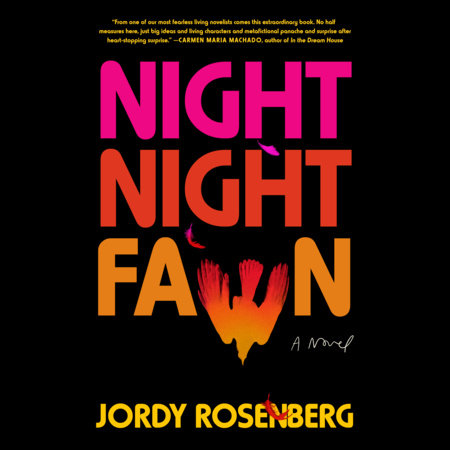
Night Night Fawn

A Novel

Listen to a clip from the audiobook
audio pause button
0:00
0:00
Audiobook Download
On sale Mar 03, 2026 | 8 Hours and 19 Minutes | 9798217278633
Grades 9-12 + AP/IB

See Additional Formats
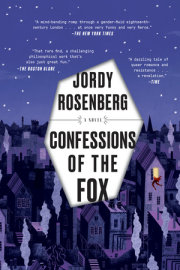
From the author of Confessions of the Fox comes a novel in which a yenta on her deathbed gives an unrepentant account of all her failures—including her child.

“From one of our most fearless living novelists comes this extraordinary book. No half measures here, just big ideas and living characters and metafictional panache and surprise after heart-stopping surprise.”—Carmen Maria Machado, author of In the Dream House

A MOST ANTICIPATED BOOK OF THE YEAR: them, Literary Hub, BookPage, Library Journal, Electric Lit

In a cluttered rent-controlled apartment in the middle of Manhattan, Barbara Rosenberg is terminally ill, high on opioids, and writing the story of her life. She has opinions about her smutty late husband, her career as the receptionist for a disreputable plastic surgeon, her glory days as an accomplished jazzerciser, and her failed aspirations to be a film noir actress. But what she really wants to talk about are unhinged thoughts on gender, Karl Marx, Zionism, and her two great disappointing loves: an estranged trans son and a long-lost best friend whose betrayal haunts Barbara still. As she descends further into delirium and illness, Barbara finds herself in a nightmare from which she cannot escape, and her circumstances put her on a crash course with these intimates—or are they avenging nemeses?—once again.

Part novel, part someone’s mother’s unauthorized memoir—all diatribe, gutter schtick, and deranged manifesto, Night Night Fawn is a ferociously candid account of intergenerational conflict.
A Woman Marked for Death

Roused from a damp OxyContin slumber into the dirty orange Manhattan night, I lay there, trying to pick the nocturnal sounds apart. The ocean squall of traffic, constant. The intermittent beep of a forklift at the post office loading dock. The wind pouring down the canyon of East Sixty-­ninth Street.

And something else. An ambient noise, like static in the air. From inside the apartment.

I pushed myself to sit and swung my legs out of bed, sliding them to the floor. There was the terrible ache I’ve come to expect, but they didn’t fold, so I pumped myself into a stagger, one hand on the bottom of the bed, the other on the dresser, and made my way toward the door.

I did not have a weapon, I realized, as I reached the mirrored dressing table at the threshold of my bedroom. In addition to that, I am a Woman. A woman marked for death and caught in the jaws of a notoriously lethal illness. An arrhythmic banging came from somewhere and then a terrible, vague sloshing. On my dressing table I spotted my pink and black Tweezermans, sharp as little baby teeth. I grabbed them and, holding them out in front of me, advanced farther into the apartment like Rita Hayworth sneaking around the Mundson mansion in Gilda, the hem of my robe flittering along the carpet.

In my daughter’s bedroom the traffic along Second Avenue cast stripes of light through the blinds; they floated across the ceiling like empty frames of film reel ticking off after a show. My eyes traced the perimeter. Small writing desk, wheeled office chair, slim bookshelf. And then, along the far wall—­my god!—­a coffin, quiet as a turd, lewd and horrible. Heat flew up my neck. How did someone get a coffin in here? And who was inside it? Or—I trembled—­was it for me?

Cars whirred past down below, indifferent. Then the bedroom glowed red. The light had changed and the traffic paused. The shadows fleeing across the ceiling paused. Shapes sharpened in the dark. The coffin resolved into its ordinary form, just an empty twin bed sagging against the floral wallpaper, pink blossoms pale with time.

The noise, meanwhile, had become a low rumble punctuated by thuds.

I backed out of the bedroom and crossed the living room. I began to make out choking, gurgling sounds. Locking my elbows, I pushed the Tweezermans farther out in front of me and turned the corner like a cowboy sliding into a saloon, flicking on the light with the back of my shoulder. The fluorescent ceiling ring sizzled to life, and the thin needle of the galley kitchen flashed bright as a surgical theater. A shiny cockroach toddled across the Formica and slipped into a crack between the sink and countertop.

My eyes searched every surface until they reached the small dishwasher, chugging its load. Of course! I’d turned it on before I went to bed. Exhaling with relief, I sank against the doorframe, bubbly with decades of thick acrylic paint.

Making my way back across the living room, crisis averted, my legs began to shake. I had exerted myself too much.

Silly, Barbara, I muttered.

I felt a bolt of fury at Stephen for being dead and unable to do his husbandly duty of investigating weird noises. And maybe a little teasing appreciation of my hysterics. Say what you will—­and seventy years of life have clarified to me that people always do, though rarely to your face—­I loved it when he treated me like a dumb shiksa bimbo.

Then, underneath the dishwasher’s slurp and rattle, there was a whisper. I froze.

Someone was standing between the plastic fern and the credenza, facing the wall and sighing, like a teacher getting composed before addressing an unruly class. I begged the vision to become something benign. Furniture, a shadow, a mirage. But the image held. The figure began to turn. The room radiated with the inevitability of our encounter.

I had seen glimpses before. Always out of the corner of my eye, always in the middle of the night. Once, getting up to pee, I caught a flash of something darting around a corner. Another time, teetering to the kitchen for water, I swore I heard a peculiar scratching behind me, like claws moving across the carpet. What was I to do! It’s a dream, I convinced myself, scuttling back to bed.

But, after each of these episodes, I’d wake with the feeling that someone had been in my room. Accompanied by the strange, deflated sensation of having been scolded for hours on end, and the overpowering sense that I needed to apologize for my life.

The face was familiar—­that was the most unnerving part.

Because my terror did not vanish when I realized that it was familiar. Actually, my terror increased. Something was very wrong with the face.

Its nose was not a nose.

Or, maybe it was a nose. But it was not made of nose flesh. Where a nose should have been, something hard and black curled down into a shiny tip.

The figure just stood there, blinking at me. And as I was staring back, the inscrutable hard black thing on its face began to take shape.

It was a beak.

A big hawk-­like beak.

And then the figure opened its beak.

And said, Mom.

This Other You

The next morning when you came to check on me, I shuddered and pulled the pilly yellow blanket all the way up to my face, the worn satin edge soft against my lips. My eyes peeked out like a child at a scary movie. I couldn’t get this image of you—­this other you—­out of my head.

You, meanwhile, were acting like everything was normal. Your nose looked nose-­like again. Maybe it had retracted like a flaccid penis back into your regular nose. This is one theory I am developing. You were acting like I wouldn’t remember, probably telling yourself that I had been so out of it that I couldn’t put two and two together.

You leaned across the bed and placed one of those green shakes you’re always forcing on me onto the dresser. I followed you with my eyes as you started back out the doorway. Eager to go make one of your endless phone calls.

Am I awake? I heard myself slur against the blanket’s wet rim.

You turned back, exasperated, which wasn’t fair. It’s not like I’d been haranguing you all morning. I’d been lying there for hours, frankly parched.

What do you mean?

Is this real?

Is what real.

I tunneled one hand out and waved it around at the gargoyling mahogany bedroom set, the constantly playing television, the pawn shop paintings of Parisian dancing ladies. This, I said. All of it. You squinched your face, assessed the row of pills along the edge of the dresser. Your doctor said the OxyContin could have a “derealizing effect,” remember? You had that cloyingly calm, ultra reasonable tone you always have now. I know exactly where you get it from. I found it infuriating when your father used to do it, so you can just imagine how I feel about it coming from you.

But you were enjoying this. You have all the power now and you know it. I’m wearing a diaper, after all.

The thing is, though, I saw something sticking out from between your shirt and the waist of your jeans when you bent over to put down the shake. A feather? And at that moment I realized several things:

• ­I wasn’t dreaming last night.

•­ (But you’d like me to think I was.)

• ­You are changing.

• ­(And I can’t tell you that I know.)

This is my punishment for having been cruel to you. Isn’t it enough that I should die with only you as my caretaker? That I should end up needing the specific individual I had successfully purged from the family decades ago?

Back then, in the 1990s, I had been at the height of my powers and I was just not having it. I was not having my daughter running around in combat boots and no lipstick. Frankly, I am proud to say I didn’t budge one goddamned inch. It wasn’t so hard. In fact, things were easier without you around. For two decades I simply told everyone you were still dating that one boy from high school and no one asked another thing about it. (There is a yenta code of ethics, believe it or not, which is to leave people alone in their misery.)

So isn’t it humiliation enough that after all these years I should have to admit I needed help? From you, no less. Isn’t it enough that I should have to die overhearing you conduct your sordid business, wishing (multiple?) women good night on the phone. Talking filthy, using syrupy words. That I should die completely at your mercy.

But now this.

My daughter, what have you become?
“Incendiary . . . Rosenberg crafts his satirical portrayal of Barbara’s transphobia with a dizzying blend of broad humor and vitriol . . . her voice is consistently arresting, and a shocking final twist will cause readers to reexamine everything that came before. It’s a memorable familial reckoning.”Publishers Weekly

Night Night Fawn is comic fiction as political firepower . . . Rosenberg’s novel is a bright streetlight illuminating one strip of a dark street: The dangers are still nearby, but it’s a place to stand and laugh loud enough for the whole neighborhood to hear.”BookPage, starred review

Night Night Fawn is undoubtedly the Marxist, trans, comedic dystopia we need in 2026. . . Jordy Rosenberg’s second novel subverts form to become an inherently transgressive unauthorized fictional 'memoir' that reads as hysterical manifesto . . . As with Rosenberg’s first book, the prose crackles.”Electric Literature

“Readers familiar with any intergenerational family friction will find catharsis here. And that's the gift of Rosenberg, the author: funny, readable prose inviting everyone into the thrill of relatable satire.”Booklist, starred review

“From one of our most fearless living novelists comes this extraordinary book. No half measures here, just big ideas and living characters and metafictional panache and surprise after heart-stopping surprise.”—Carmen Maria Machado, author of In the Dream House

“Hot damn, Jordy Rosenberg can write! Night Night Fawn contains an unabashed, unhinged, urgent id that rockets around its pages at escape velocity—and yet it voices that id with control, precision, and originality. Moving! Thrilling! This is me applauding in blurb form.”—Torrey Peters, author of Detransition, Baby

Night Night Fawn is one of the most astounding novels of our time, a triumph of voice and social critique, a generational reckoning that is as urgent and gripping as it is playful and wickedly funny. Trust again the singular brilliance and heart of Jordy Rosenberg.”—David Chariandy, author of Brother

“A singularly hysterical and ferocious novel, a book that has you in stitches while re-suturing you—inviting you to feel how history both moves through and acts upon a body . . . an urgent intervention into contemporary Jewish letters and the ways in which settler colonialism and gendered violence reproduce inside our families. . . . I was absolutely floored by this book and am just now peeling myself up off the ground.”—Sam Sax, author of Yr Dead

“An epic, audacious and daring act of literary trespass through the ruins of family, history, and Zionism.”—Andrea Lawlor, author of Paul Takes the Form of a Mortal Girl

“Jordy Rosenberg’s exuberant, exasperating narrator unleashes the full, hilarious, and ultimately revealing power of the rant. Night Night Fawn is a hugely enjoyable novel, devious and rich in irony.”—Sofia Samatar, British Fantasy Award-winning author of The White Mosque

“A bravura performance . . . Rosenberg breaks open a library of silences here.”—Alexander Chee, author of How to Write an Autobiographical Novel

“A novel as wickedly funny as it is smart . . . I have simply never read anything like it.”—Melissa Febos, author of Body Work
© Boewulf Sheehan
Jordy Rosenberg is the author of the novel Confessions of the Fox, a New York Times Editors Choice selection, shortlisted for the Center for Fiction First Novel Prize, a Lambda Literary Award, a Publishing Triangle Award, the UK Historical Writers Association Debut Crown Award, longlisted for The Dublin Literary Award, and named one of the best books of the year by The New Yorker, Kirkus Reviews and others. Jordy’s work has been supported by MacDowell, The Lannan Foundation, The Banff Centre, and The Ahmanson-Getty Foundation. He is a professor in the Department of English and Associated MFA Faculty in the Program for Poets and Writers at UMass-Amherst. View titles by Jordy Rosenberg

About

From the author of Confessions of the Fox comes a novel in which a yenta on her deathbed gives an unrepentant account of all her failures—including her child.

“From one of our most fearless living novelists comes this extraordinary book. No half measures here, just big ideas and living characters and metafictional panache and surprise after heart-stopping surprise.”—Carmen Maria Machado, author of In the Dream House

A MOST ANTICIPATED BOOK OF THE YEAR: them, Literary Hub, BookPage, Library Journal, Electric Lit

In a cluttered rent-controlled apartment in the middle of Manhattan, Barbara Rosenberg is terminally ill, high on opioids, and writing the story of her life. She has opinions about her smutty late husband, her career as the receptionist for a disreputable plastic surgeon, her glory days as an accomplished jazzerciser, and her failed aspirations to be a film noir actress. But what she really wants to talk about are unhinged thoughts on gender, Karl Marx, Zionism, and her two great disappointing loves: an estranged trans son and a long-lost best friend whose betrayal haunts Barbara still. As she descends further into delirium and illness, Barbara finds herself in a nightmare from which she cannot escape, and her circumstances put her on a crash course with these intimates—or are they avenging nemeses?—once again.

Part novel, part someone’s mother’s unauthorized memoir—all diatribe, gutter schtick, and deranged manifesto, Night Night Fawn is a ferociously candid account of intergenerational conflict.

Excerpt

A Woman Marked for Death

Roused from a damp OxyContin slumber into the dirty orange Manhattan night, I lay there, trying to pick the nocturnal sounds apart. The ocean squall of traffic, constant. The intermittent beep of a forklift at the post office loading dock. The wind pouring down the canyon of East Sixty-­ninth Street.

And something else. An ambient noise, like static in the air. From inside the apartment.

I pushed myself to sit and swung my legs out of bed, sliding them to the floor. There was the terrible ache I’ve come to expect, but they didn’t fold, so I pumped myself into a stagger, one hand on the bottom of the bed, the other on the dresser, and made my way toward the door.

I did not have a weapon, I realized, as I reached the mirrored dressing table at the threshold of my bedroom. In addition to that, I am a Woman. A woman marked for death and caught in the jaws of a notoriously lethal illness. An arrhythmic banging came from somewhere and then a terrible, vague sloshing. On my dressing table I spotted my pink and black Tweezermans, sharp as little baby teeth. I grabbed them and, holding them out in front of me, advanced farther into the apartment like Rita Hayworth sneaking around the Mundson mansion in Gilda, the hem of my robe flittering along the carpet.

In my daughter’s bedroom the traffic along Second Avenue cast stripes of light through the blinds; they floated across the ceiling like empty frames of film reel ticking off after a show. My eyes traced the perimeter. Small writing desk, wheeled office chair, slim bookshelf. And then, along the far wall—­my god!—­a coffin, quiet as a turd, lewd and horrible. Heat flew up my neck. How did someone get a coffin in here? And who was inside it? Or—I trembled—­was it for me?

Cars whirred past down below, indifferent. Then the bedroom glowed red. The light had changed and the traffic paused. The shadows fleeing across the ceiling paused. Shapes sharpened in the dark. The coffin resolved into its ordinary form, just an empty twin bed sagging against the floral wallpaper, pink blossoms pale with time.

The noise, meanwhile, had become a low rumble punctuated by thuds.

I backed out of the bedroom and crossed the living room. I began to make out choking, gurgling sounds. Locking my elbows, I pushed the Tweezermans farther out in front of me and turned the corner like a cowboy sliding into a saloon, flicking on the light with the back of my shoulder. The fluorescent ceiling ring sizzled to life, and the thin needle of the galley kitchen flashed bright as a surgical theater. A shiny cockroach toddled across the Formica and slipped into a crack between the sink and countertop.

My eyes searched every surface until they reached the small dishwasher, chugging its load. Of course! I’d turned it on before I went to bed. Exhaling with relief, I sank against the doorframe, bubbly with decades of thick acrylic paint.

Making my way back across the living room, crisis averted, my legs began to shake. I had exerted myself too much.

Silly, Barbara, I muttered.

I felt a bolt of fury at Stephen for being dead and unable to do his husbandly duty of investigating weird noises. And maybe a little teasing appreciation of my hysterics. Say what you will—­and seventy years of life have clarified to me that people always do, though rarely to your face—­I loved it when he treated me like a dumb shiksa bimbo.

Then, underneath the dishwasher’s slurp and rattle, there was a whisper. I froze.

Someone was standing between the plastic fern and the credenza, facing the wall and sighing, like a teacher getting composed before addressing an unruly class. I begged the vision to become something benign. Furniture, a shadow, a mirage. But the image held. The figure began to turn. The room radiated with the inevitability of our encounter.

I had seen glimpses before. Always out of the corner of my eye, always in the middle of the night. Once, getting up to pee, I caught a flash of something darting around a corner. Another time, teetering to the kitchen for water, I swore I heard a peculiar scratching behind me, like claws moving across the carpet. What was I to do! It’s a dream, I convinced myself, scuttling back to bed.

But, after each of these episodes, I’d wake with the feeling that someone had been in my room. Accompanied by the strange, deflated sensation of having been scolded for hours on end, and the overpowering sense that I needed to apologize for my life.

The face was familiar—­that was the most unnerving part.

Because my terror did not vanish when I realized that it was familiar. Actually, my terror increased. Something was very wrong with the face.

Its nose was not a nose.

Or, maybe it was a nose. But it was not made of nose flesh. Where a nose should have been, something hard and black curled down into a shiny tip.

The figure just stood there, blinking at me. And as I was staring back, the inscrutable hard black thing on its face began to take shape.

It was a beak.

A big hawk-­like beak.

And then the figure opened its beak.

And said, Mom.

This Other You

The next morning when you came to check on me, I shuddered and pulled the pilly yellow blanket all the way up to my face, the worn satin edge soft against my lips. My eyes peeked out like a child at a scary movie. I couldn’t get this image of you—­this other you—­out of my head.

You, meanwhile, were acting like everything was normal. Your nose looked nose-­like again. Maybe it had retracted like a flaccid penis back into your regular nose. This is one theory I am developing. You were acting like I wouldn’t remember, probably telling yourself that I had been so out of it that I couldn’t put two and two together.

You leaned across the bed and placed one of those green shakes you’re always forcing on me onto the dresser. I followed you with my eyes as you started back out the doorway. Eager to go make one of your endless phone calls.

Am I awake? I heard myself slur against the blanket’s wet rim.

You turned back, exasperated, which wasn’t fair. It’s not like I’d been haranguing you all morning. I’d been lying there for hours, frankly parched.

What do you mean?

Is this real?

Is what real.

I tunneled one hand out and waved it around at the gargoyling mahogany bedroom set, the constantly playing television, the pawn shop paintings of Parisian dancing ladies. This, I said. All of it. You squinched your face, assessed the row of pills along the edge of the dresser. Your doctor said the OxyContin could have a “derealizing effect,” remember? You had that cloyingly calm, ultra reasonable tone you always have now. I know exactly where you get it from. I found it infuriating when your father used to do it, so you can just imagine how I feel about it coming from you.

But you were enjoying this. You have all the power now and you know it. I’m wearing a diaper, after all.

The thing is, though, I saw something sticking out from between your shirt and the waist of your jeans when you bent over to put down the shake. A feather? And at that moment I realized several things:

• ­I wasn’t dreaming last night.

•­ (But you’d like me to think I was.)

• ­You are changing.

• ­(And I can’t tell you that I know.)

This is my punishment for having been cruel to you. Isn’t it enough that I should die with only you as my caretaker? That I should end up needing the specific individual I had successfully purged from the family decades ago?

Back then, in the 1990s, I had been at the height of my powers and I was just not having it. I was not having my daughter running around in combat boots and no lipstick. Frankly, I am proud to say I didn’t budge one goddamned inch. It wasn’t so hard. In fact, things were easier without you around. For two decades I simply told everyone you were still dating that one boy from high school and no one asked another thing about it. (There is a yenta code of ethics, believe it or not, which is to leave people alone in their misery.)

So isn’t it humiliation enough that after all these years I should have to admit I needed help? From you, no less. Isn’t it enough that I should have to die overhearing you conduct your sordid business, wishing (multiple?) women good night on the phone. Talking filthy, using syrupy words. That I should die completely at your mercy.

But now this.

My daughter, what have you become?

Reviews

“Incendiary . . . Rosenberg crafts his satirical portrayal of Barbara’s transphobia with a dizzying blend of broad humor and vitriol . . . her voice is consistently arresting, and a shocking final twist will cause readers to reexamine everything that came before. It’s a memorable familial reckoning.”Publishers Weekly

Night Night Fawn is comic fiction as political firepower . . . Rosenberg’s novel is a bright streetlight illuminating one strip of a dark street: The dangers are still nearby, but it’s a place to stand and laugh loud enough for the whole neighborhood to hear.”BookPage, starred review

Night Night Fawn is undoubtedly the Marxist, trans, comedic dystopia we need in 2026. . . Jordy Rosenberg’s second novel subverts form to become an inherently transgressive unauthorized fictional 'memoir' that reads as hysterical manifesto . . . As with Rosenberg’s first book, the prose crackles.”Electric Literature

“Readers familiar with any intergenerational family friction will find catharsis here. And that's the gift of Rosenberg, the author: funny, readable prose inviting everyone into the thrill of relatable satire.”Booklist, starred review

“From one of our most fearless living novelists comes this extraordinary book. No half measures here, just big ideas and living characters and metafictional panache and surprise after heart-stopping surprise.”—Carmen Maria Machado, author of In the Dream House

“Hot damn, Jordy Rosenberg can write! Night Night Fawn contains an unabashed, unhinged, urgent id that rockets around its pages at escape velocity—and yet it voices that id with control, precision, and originality. Moving! Thrilling! This is me applauding in blurb form.”—Torrey Peters, author of Detransition, Baby

Night Night Fawn is one of the most astounding novels of our time, a triumph of voice and social critique, a generational reckoning that is as urgent and gripping as it is playful and wickedly funny. Trust again the singular brilliance and heart of Jordy Rosenberg.”—David Chariandy, author of Brother

“A singularly hysterical and ferocious novel, a book that has you in stitches while re-suturing you—inviting you to feel how history both moves through and acts upon a body . . . an urgent intervention into contemporary Jewish letters and the ways in which settler colonialism and gendered violence reproduce inside our families. . . . I was absolutely floored by this book and am just now peeling myself up off the ground.”—Sam Sax, author of Yr Dead

“An epic, audacious and daring act of literary trespass through the ruins of family, history, and Zionism.”—Andrea Lawlor, author of Paul Takes the Form of a Mortal Girl

“Jordy Rosenberg’s exuberant, exasperating narrator unleashes the full, hilarious, and ultimately revealing power of the rant. Night Night Fawn is a hugely enjoyable novel, devious and rich in irony.”—Sofia Samatar, British Fantasy Award-winning author of The White Mosque

“A bravura performance . . . Rosenberg breaks open a library of silences here.”—Alexander Chee, author of How to Write an Autobiographical Novel

“A novel as wickedly funny as it is smart . . . I have simply never read anything like it.”—Melissa Febos, author of Body Work

Author

© Boewulf Sheehan
Jordy Rosenberg is the author of the novel Confessions of the Fox, a New York Times Editors Choice selection, shortlisted for the Center for Fiction First Novel Prize, a Lambda Literary Award, a Publishing Triangle Award, the UK Historical Writers Association Debut Crown Award, longlisted for The Dublin Literary Award, and named one of the best books of the year by The New Yorker, Kirkus Reviews and others. Jordy’s work has been supported by MacDowell, The Lannan Foundation, The Banff Centre, and The Ahmanson-Getty Foundation. He is a professor in the Department of English and Associated MFA Faculty in the Program for Poets and Writers at UMass-Amherst. View titles by Jordy Rosenberg
  • More Websites from
    Penguin Random House
  • Common Reads
  • Library Marketing