Download high-resolution image
Listen to a clip from the audiobook
audio pause button
0:00
0:00

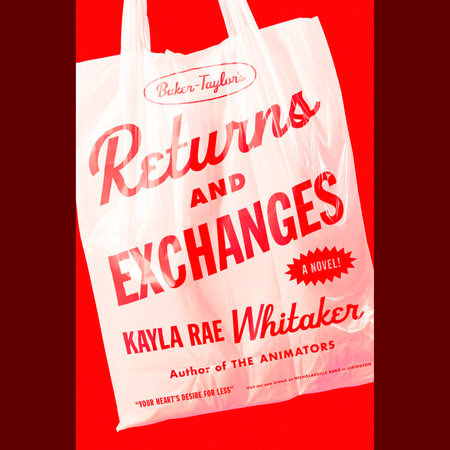
Returns and Exchanges

A Novel

Listen to a clip from the audiobook
audio pause button
0:00
0:00
Audiobook Download
On sale May 19, 2026 | 15 Hours and 2 Minutes | 9798217278558
Grades 9-12 + AP/IB

See Additional Formats
A sweeping novel of one Kentucky family’s rise and fall throughout the 1980s—a tragicomic tour de force about love and marriage, parents and children, and the perils of mixing family with business, from the acclaimed author of The Animators

“This is the novel I’ve been missing: a sprawling, emotional, and true family saga. I fell completely in love with the characters, the story, the setting. All of it. It’s damn near perfect.”—Ayelet Waldman, author of Love & Treasure

It’s December 24, 1979, just before closing at Baker-Taylor’s discount department store, and Fran (née Baker) is surveying her domain. Her husband, Fred, is charming customers in the front of the store, while last-minute shoppers in the toy aisle are fighting over the lone remaining Atari. The older Taylor kids are on register, while the younger ones’ chaos is contained to the stockroom. All is right in the world as the new decade approaches.

With four healthy children and financial stability their own parents could have only dreamed of, Fred and Fran are the picture of the American Dream—rags to riches—with a successful chain of family-owned stores built on years of hard work and long hours. Underneath the surface, however, the business is changing at a breakneck pace, and each member of the family is struggling to keep up.

Money is transforming Fred, and the extremes he will go to in order to fit in with the slicked-back high society crowd of Lexington, Kentucky, are embarrassing, if not downright dangerous. Josiah, the oldest son, wants nothing to do with the family business; Sam is seeing things that might not really be there; and Benny and Birdie are growing up with a fraction of the parenting that their older brothers had. Meanwhile, Fran, her family’s stable core, is falling for Wendy, a cashier at Baker-Taylor’s, risking everything along the way. While trying to maintain the facade of a perfect success story, Fred and Fran learn that in matters of love and money, once it’s gone, it’s gone—no returns, no exchanges.
1.

Winter 1979–­Fall 1981

It was December 24, your routine parade of customer service snarls: the woman who tried to return the Connect 4 set that had clearly been cracked by a human foot (It was like that when I took it out of the box). The two teenage girls in identical flares who’d attempted to shoplift mascara—­teenage girls were legion: if you let one lift, they’d all lift—­and began to cry when Gerald from security stepped in. By the time Fran arrived at the toy aisle to see a man and a woman wrestling over the store’s sole remaining Atari VCS, their big seller that year, she’d been smiling for so long that her cheeks felt like meat.

After the standard Alright, folks, who had it first? then the ensuing He took it out of my cart and Oh bull and Sir, if you keep that up we won’t sell it to you and I ain’t never shoppin here again y’all got too expensive anyway, Fran had to call Gerald away from the comfort of the security nest and his Penthouse Forum—­again—­to escort the man, face appropriately pruned, to the parking lot.

She was relieved to hear Josiah pick up the intercom receiver at 7:55: “AttentionBakerTaylor’sshoppers the store will be closing in five minutes please make your final selections and approach the front forpurchasethankyou.” Click.

Fran cruised by the front. “Warmth, Josiah.”

“What, you want me to hop back on and tell them I love them?” The late holiday closure was new (the radio promo was Fran: Now open ’til eight Christmas Eve!), and she’d had to put her oldest boys on register: Josiah stared at her while Sam, younger by four years, tried to suppress a smile with his fist. Josiah had come home from his first semester at college insufferable—­Henry Miller and Norman Mailer tucked under one arm, with a new favorite expression, uttered in response to anything from reruns of Mannix to pound cake: a cool not to my taste.

For a holiday that was supposed to make you feel good, she was always surprised at how tired, how irritable, how empty she felt at its end. She’d had a strip of twine pulled taut in her gut since the week before Thanksgiving, and the closer they came to the twenty-­fifth, the tighter that twine became, the dull roar of the holidays swelling into the jaw-­clenching panic it always, inevitably, became. And she hurt. The pinch in her spine, the strain in her left shoulder she’d acquired unloading cases of pop, and always, always, her jaw. She hurt, all over.

Fred appeared, holding the door open for a couple hugging packages to their chests. “This one ain’t been good this year,” he commented to the man, who chuckled and placed a hand to his woman’s back. Fran caught her husband’s eye and here he came, hustling over. Eager to please, today.

“Could you start straightening?” she said. “I’m trying to get us out of here by a quarter after. I have to start cooking.”

Fred hated shelf duty, secretly considered it housework. But, “Yes, dear.” Then he fell into step beside her and picked up the threads of their conversation, pre–­Atari blowout. “This is a big chance.”

“It’s a big risk.”

“One worth taking.”

She headed for the stockroom, winding her way through home and garden, hardware, kitchen goods, linens, health and beauty. Tidying up. Though there wasn’t much need—­other than an emptied pop can in the wrenches and a shipment of Pert that required a serious realignment, the mess was relegated to the toys.

“Say what you want to about how it’s gone downhill in the past few years,” Fred said from behind her, “Emmerson’s is a solid name. We could really do something with them stores.”

In makeup, she saw a Rubik’s Cube lying among the blushers. Handed it to Fred. “Jack’s on board to do this?”

Jack, currently on his Miami hiatus to, as he put it, build up the salt to stare down the rest of a Kentucky winter, likely with a drink in his hand and a faceful of suntan lotion. Fred, with a bounce—­“Jack’s on fire to do this.” The word emerged as far. “He thinks we can put up part of the capital. Apply for a loan pretty easy for the other half.” She parted the stockroom doors. “I’m just trying to get you to see it. We’ve got to move quick on this thing if we’re thinking serious about it.”

“So you’ve mentioned.” She grabbed the closedown checklist and went into the shelves. Hot Wheels up top, Big Wheels down below. They typically aimed to keep overstock at a minimum, but the toys: they could not be caught short this week, not at this branch, on this side of town, the disposable income side of town. Fred started again: “We got the next board meeting in two weeks. We could—­”

The doors flew open. “Ow,” Birdie yelled.

Benny: “Not like that, dingus. You gotta, like, pitch it.” A thock. Boxes toppling to the floor. Her youngest two were winging those high jumpers at each other again, the superballs they sold for a dime apiece in the vending machine by the cart stand alongside gum and yo-­yos that snapped and sailed treacherously free within an hour of use. Another cry, another deflection from Benny: “That one was your fault. You got in the way.”

“Y’all quit,” Fred bawled.

Fran refolded the checklist. “Honey. Could you go straighten? Please?”

“Right.” Fred looked down to find himself still holding the Rubik’s Cube. He placed it on a shelf and turned, telling the kids “Quieten down” as he left.

Fran retrieved the Rubik’s Cube, craned out. “I told you all to quit that. You’re gonna break something.”

Birdie lowered her throwing hand. She was seven, still little enough to be sorry. Benny was ten, let his arms hang by his sides. “When do we get to leave?”

“Not long. After closedown.”

He huffed. “We still have closedown?”

“When have we not had closedown?” Fran rolled past them: dump trucks, dreamhouses. More of those Penny P. Buckle dolls that pissed themselves when you pressed the navel. When she turned, Benny was staring at her reproachfully. Fran snapped her fingers, held one hand out. “Give it, please.”

He sighed. Slapped two superballs into her hand.

“That it?”

Yes.

It wasn’t. But Fran held up a finger. Fixed Benny, then Birdie, with an unblinking gaze. “Behave. I mean it.”

Through the double doors (on the wall: a framing of the Herald article from when they’d opened this branch: she and Fred, arm in arm in front of the Baker-­Taylor’s placard with all four kids in tow—­Josiah and Sam sedate, but toddler Birdie poised to bite Benny, who held a pair of rabbit’s­ears above her head) and back onto the floor. She took a pen out of her pocket and scrawled a note on her hand—­Call vending on the 26th—­then surveyed the central power walk, the sale items facing out, pegboard trimmed with ribbons and garlands. Empty. Extended holiday hours were a tall order for Lexington, a city that shut down entirely the night before Christmas, its population relegated to home or church services. There was the faint hum of holiday music, a reel-­to-­reel played on repeat every single day since November 23. Tinny renditions of “Silver Bells” and “White Christmas” she now heard perpetually, just south of her actual thoughts. Like to drive you crazy, and she wasn’t the only one. She’d heard Sam in the kitchen that morning humming the one about roasting chestnuts, perfectly mimicking the warp in the tape that smeared Jack Frost nooo-­ipping at your nose.

She motioned to Josiah to shut off the reel-­to-­reel. It cut mid-­note. Gauzy silence.

Gerald yawned, shoved hands into the pockets of his coat, taking long strides. He reached the front doors and locked them. “Gerald,” Fran called out, and produced the envelope from her pocket. “Merry Christmas. Thanks for taking the new shift. I can do walk-­through.”

“Thanks, Mrs. Taylor.” He lofted a hand to them all as he strode toward the back.

Fred had passed straightening duties on to Josiah and Sam, who were edging along, nudging stock to the front (“Neatly,” went the refrain, all through their childhoods, “all in a row like this, see?”). From the parking lot, the phantom sounds of sedan doors buckling shut, engines chopping to life. Like magic: Fran could feel her blood pressure ticking down.

Fred, approaching with his own envelope, fatter than Gerald’s. He didn’t like housework, but he liked cash-­out. “Say,” he said, “how about we call up Jack tomorrow and we set up a meeting?”

She looked out over the empty floor—­lights partly extinguished, resulting in a dim, pleasing half glow. Saw the floating forms of her boys at work. This was the magic hour. She tried to see the good in things, and this part of the day—­it was good. She wanted to enjoy it, and so she nodded.
“This is the novel I’ve been missing: a sprawling, emotional and true family saga. I picked it up knowing nothing about it and fell completely in love with the characters, the story, the setting. All of it. It’s damn near perfect.”—Ayelet Waldman, New York Times bestselling author of Love & Treasure

“Wildly ambitious and deeply satisfying, Returns and Exchanges is a new kind of great American novel. Kayla Rae Whitaker deftly animates the ambitions and desires of a family on the rise, painting each character with a hard-eyed compassion that makes it impossible not to root for all of them, even as they break each other’s hearts again and again. This novel is smart, funny, loving, and utterly beautiful. I didn’t want it to end.”—Erin O. White, author of Like Family

“Whitaker has written a sprawling, extravagantly intelligent novel about people quietly breaking free from constraints—marital, gender, class. . . . Superb. Like a blue-collar Franzen novel.”Kirkus Reviews, starred review

“Whitaker expertly juggles the expansive cast of characters and elicits sympathy for all of them even when they exhibit the worst parts of themselves. [Returns and Exchanges] is an openhearted epic of the American dream and the bargains struck to achieve it.”Publishers Weekly, starred review

“This singular story is timely and telling, distinctive and resonant, familiar and grand. It’s no small thing to craft a family saga that somehow feels new and ageless all at once, but Whitaker manages it with verve and grace.”—Laurie Frankel, author of This Is How It Always Is

“Whitaker is one of contemporary fiction’s most astute, empathetic chroniclers of all the messy complexities that make us human. With a heart so strong you can hear it beat on the page, Returns and Exchanges deftly explores the price of ambition as one family grapples with the weight of its own success.”—Grant Ginder, author of The People We Hate at the Wedding

“In Returns and Exchanges, the Baker-Taylors discover what it truly takes to build and preserve a legacy—not just in business, but in love. A tender, funny, and sharply observed story about the complicated promise of the American Dream and how to hold a family together.”—Heather Aimee O’Neill, author of The Irish Goodbye

“Ambitious and engrossing, a weekend read, written with sympathy, insight, humor, and style.”—Susan Rieger, author of Like Mother, Like Mother

“With engaging characters and immersive prose, Whitaker shows readers both an intimate family portrait and a lesson in the perils of greed, and by the book’s thoughtful, softly bittersweet ending, a commentary on humanity’s determination to make beauty despite society’s rejection of it.”Booklist, starred review
Kayla Rae Whitaker is a graduate of the University of Kentucky and New York University. Her first novel, The Animators, was named a best book of the year by Entertainment Weekly, NPR, Kirkus Reviews, and BookPage. She lives in Queens, New York. View titles by Kayla Rae Whitaker

About

A sweeping novel of one Kentucky family’s rise and fall throughout the 1980s—a tragicomic tour de force about love and marriage, parents and children, and the perils of mixing family with business, from the acclaimed author of The Animators

“This is the novel I’ve been missing: a sprawling, emotional, and true family saga. I fell completely in love with the characters, the story, the setting. All of it. It’s damn near perfect.”—Ayelet Waldman, author of Love & Treasure

It’s December 24, 1979, just before closing at Baker-Taylor’s discount department store, and Fran (née Baker) is surveying her domain. Her husband, Fred, is charming customers in the front of the store, while last-minute shoppers in the toy aisle are fighting over the lone remaining Atari. The older Taylor kids are on register, while the younger ones’ chaos is contained to the stockroom. All is right in the world as the new decade approaches.

With four healthy children and financial stability their own parents could have only dreamed of, Fred and Fran are the picture of the American Dream—rags to riches—with a successful chain of family-owned stores built on years of hard work and long hours. Underneath the surface, however, the business is changing at a breakneck pace, and each member of the family is struggling to keep up.

Money is transforming Fred, and the extremes he will go to in order to fit in with the slicked-back high society crowd of Lexington, Kentucky, are embarrassing, if not downright dangerous. Josiah, the oldest son, wants nothing to do with the family business; Sam is seeing things that might not really be there; and Benny and Birdie are growing up with a fraction of the parenting that their older brothers had. Meanwhile, Fran, her family’s stable core, is falling for Wendy, a cashier at Baker-Taylor’s, risking everything along the way. While trying to maintain the facade of a perfect success story, Fred and Fran learn that in matters of love and money, once it’s gone, it’s gone—no returns, no exchanges.

Excerpt

1.

Winter 1979–­Fall 1981

It was December 24, your routine parade of customer service snarls: the woman who tried to return the Connect 4 set that had clearly been cracked by a human foot (It was like that when I took it out of the box). The two teenage girls in identical flares who’d attempted to shoplift mascara—­teenage girls were legion: if you let one lift, they’d all lift—­and began to cry when Gerald from security stepped in. By the time Fran arrived at the toy aisle to see a man and a woman wrestling over the store’s sole remaining Atari VCS, their big seller that year, she’d been smiling for so long that her cheeks felt like meat.

After the standard Alright, folks, who had it first? then the ensuing He took it out of my cart and Oh bull and Sir, if you keep that up we won’t sell it to you and I ain’t never shoppin here again y’all got too expensive anyway, Fran had to call Gerald away from the comfort of the security nest and his Penthouse Forum—­again—­to escort the man, face appropriately pruned, to the parking lot.

She was relieved to hear Josiah pick up the intercom receiver at 7:55: “AttentionBakerTaylor’sshoppers the store will be closing in five minutes please make your final selections and approach the front forpurchasethankyou.” Click.

Fran cruised by the front. “Warmth, Josiah.”

“What, you want me to hop back on and tell them I love them?” The late holiday closure was new (the radio promo was Fran: Now open ’til eight Christmas Eve!), and she’d had to put her oldest boys on register: Josiah stared at her while Sam, younger by four years, tried to suppress a smile with his fist. Josiah had come home from his first semester at college insufferable—­Henry Miller and Norman Mailer tucked under one arm, with a new favorite expression, uttered in response to anything from reruns of Mannix to pound cake: a cool not to my taste.

For a holiday that was supposed to make you feel good, she was always surprised at how tired, how irritable, how empty she felt at its end. She’d had a strip of twine pulled taut in her gut since the week before Thanksgiving, and the closer they came to the twenty-­fifth, the tighter that twine became, the dull roar of the holidays swelling into the jaw-­clenching panic it always, inevitably, became. And she hurt. The pinch in her spine, the strain in her left shoulder she’d acquired unloading cases of pop, and always, always, her jaw. She hurt, all over.

Fred appeared, holding the door open for a couple hugging packages to their chests. “This one ain’t been good this year,” he commented to the man, who chuckled and placed a hand to his woman’s back. Fran caught her husband’s eye and here he came, hustling over. Eager to please, today.

“Could you start straightening?” she said. “I’m trying to get us out of here by a quarter after. I have to start cooking.”

Fred hated shelf duty, secretly considered it housework. But, “Yes, dear.” Then he fell into step beside her and picked up the threads of their conversation, pre–­Atari blowout. “This is a big chance.”

“It’s a big risk.”

“One worth taking.”

She headed for the stockroom, winding her way through home and garden, hardware, kitchen goods, linens, health and beauty. Tidying up. Though there wasn’t much need—­other than an emptied pop can in the wrenches and a shipment of Pert that required a serious realignment, the mess was relegated to the toys.

“Say what you want to about how it’s gone downhill in the past few years,” Fred said from behind her, “Emmerson’s is a solid name. We could really do something with them stores.”

In makeup, she saw a Rubik’s Cube lying among the blushers. Handed it to Fred. “Jack’s on board to do this?”

Jack, currently on his Miami hiatus to, as he put it, build up the salt to stare down the rest of a Kentucky winter, likely with a drink in his hand and a faceful of suntan lotion. Fred, with a bounce—­“Jack’s on fire to do this.” The word emerged as far. “He thinks we can put up part of the capital. Apply for a loan pretty easy for the other half.” She parted the stockroom doors. “I’m just trying to get you to see it. We’ve got to move quick on this thing if we’re thinking serious about it.”

“So you’ve mentioned.” She grabbed the closedown checklist and went into the shelves. Hot Wheels up top, Big Wheels down below. They typically aimed to keep overstock at a minimum, but the toys: they could not be caught short this week, not at this branch, on this side of town, the disposable income side of town. Fred started again: “We got the next board meeting in two weeks. We could—­”

The doors flew open. “Ow,” Birdie yelled.

Benny: “Not like that, dingus. You gotta, like, pitch it.” A thock. Boxes toppling to the floor. Her youngest two were winging those high jumpers at each other again, the superballs they sold for a dime apiece in the vending machine by the cart stand alongside gum and yo-­yos that snapped and sailed treacherously free within an hour of use. Another cry, another deflection from Benny: “That one was your fault. You got in the way.”

“Y’all quit,” Fred bawled.

Fran refolded the checklist. “Honey. Could you go straighten? Please?”

“Right.” Fred looked down to find himself still holding the Rubik’s Cube. He placed it on a shelf and turned, telling the kids “Quieten down” as he left.

Fran retrieved the Rubik’s Cube, craned out. “I told you all to quit that. You’re gonna break something.”

Birdie lowered her throwing hand. She was seven, still little enough to be sorry. Benny was ten, let his arms hang by his sides. “When do we get to leave?”

“Not long. After closedown.”

He huffed. “We still have closedown?”

“When have we not had closedown?” Fran rolled past them: dump trucks, dreamhouses. More of those Penny P. Buckle dolls that pissed themselves when you pressed the navel. When she turned, Benny was staring at her reproachfully. Fran snapped her fingers, held one hand out. “Give it, please.”

He sighed. Slapped two superballs into her hand.

“That it?”

Yes.

It wasn’t. But Fran held up a finger. Fixed Benny, then Birdie, with an unblinking gaze. “Behave. I mean it.”

Through the double doors (on the wall: a framing of the Herald article from when they’d opened this branch: she and Fred, arm in arm in front of the Baker-­Taylor’s placard with all four kids in tow—­Josiah and Sam sedate, but toddler Birdie poised to bite Benny, who held a pair of rabbit’s­ears above her head) and back onto the floor. She took a pen out of her pocket and scrawled a note on her hand—­Call vending on the 26th—­then surveyed the central power walk, the sale items facing out, pegboard trimmed with ribbons and garlands. Empty. Extended holiday hours were a tall order for Lexington, a city that shut down entirely the night before Christmas, its population relegated to home or church services. There was the faint hum of holiday music, a reel-­to-­reel played on repeat every single day since November 23. Tinny renditions of “Silver Bells” and “White Christmas” she now heard perpetually, just south of her actual thoughts. Like to drive you crazy, and she wasn’t the only one. She’d heard Sam in the kitchen that morning humming the one about roasting chestnuts, perfectly mimicking the warp in the tape that smeared Jack Frost nooo-­ipping at your nose.

She motioned to Josiah to shut off the reel-­to-­reel. It cut mid-­note. Gauzy silence.

Gerald yawned, shoved hands into the pockets of his coat, taking long strides. He reached the front doors and locked them. “Gerald,” Fran called out, and produced the envelope from her pocket. “Merry Christmas. Thanks for taking the new shift. I can do walk-­through.”

“Thanks, Mrs. Taylor.” He lofted a hand to them all as he strode toward the back.

Fred had passed straightening duties on to Josiah and Sam, who were edging along, nudging stock to the front (“Neatly,” went the refrain, all through their childhoods, “all in a row like this, see?”). From the parking lot, the phantom sounds of sedan doors buckling shut, engines chopping to life. Like magic: Fran could feel her blood pressure ticking down.

Fred, approaching with his own envelope, fatter than Gerald’s. He didn’t like housework, but he liked cash-­out. “Say,” he said, “how about we call up Jack tomorrow and we set up a meeting?”

She looked out over the empty floor—­lights partly extinguished, resulting in a dim, pleasing half glow. Saw the floating forms of her boys at work. This was the magic hour. She tried to see the good in things, and this part of the day—­it was good. She wanted to enjoy it, and so she nodded.

Reviews

“This is the novel I’ve been missing: a sprawling, emotional and true family saga. I picked it up knowing nothing about it and fell completely in love with the characters, the story, the setting. All of it. It’s damn near perfect.”—Ayelet Waldman, New York Times bestselling author of Love & Treasure

“Wildly ambitious and deeply satisfying, Returns and Exchanges is a new kind of great American novel. Kayla Rae Whitaker deftly animates the ambitions and desires of a family on the rise, painting each character with a hard-eyed compassion that makes it impossible not to root for all of them, even as they break each other’s hearts again and again. This novel is smart, funny, loving, and utterly beautiful. I didn’t want it to end.”—Erin O. White, author of Like Family

“Whitaker has written a sprawling, extravagantly intelligent novel about people quietly breaking free from constraints—marital, gender, class. . . . Superb. Like a blue-collar Franzen novel.”Kirkus Reviews, starred review

“Whitaker expertly juggles the expansive cast of characters and elicits sympathy for all of them even when they exhibit the worst parts of themselves. [Returns and Exchanges] is an openhearted epic of the American dream and the bargains struck to achieve it.”Publishers Weekly, starred review

“This singular story is timely and telling, distinctive and resonant, familiar and grand. It’s no small thing to craft a family saga that somehow feels new and ageless all at once, but Whitaker manages it with verve and grace.”—Laurie Frankel, author of This Is How It Always Is

“Whitaker is one of contemporary fiction’s most astute, empathetic chroniclers of all the messy complexities that make us human. With a heart so strong you can hear it beat on the page, Returns and Exchanges deftly explores the price of ambition as one family grapples with the weight of its own success.”—Grant Ginder, author of The People We Hate at the Wedding

“In Returns and Exchanges, the Baker-Taylors discover what it truly takes to build and preserve a legacy—not just in business, but in love. A tender, funny, and sharply observed story about the complicated promise of the American Dream and how to hold a family together.”—Heather Aimee O’Neill, author of The Irish Goodbye

“Ambitious and engrossing, a weekend read, written with sympathy, insight, humor, and style.”—Susan Rieger, author of Like Mother, Like Mother

“With engaging characters and immersive prose, Whitaker shows readers both an intimate family portrait and a lesson in the perils of greed, and by the book’s thoughtful, softly bittersweet ending, a commentary on humanity’s determination to make beauty despite society’s rejection of it.”Booklist, starred review

Author

Kayla Rae Whitaker is a graduate of the University of Kentucky and New York University. Her first novel, The Animators, was named a best book of the year by Entertainment Weekly, NPR, Kirkus Reviews, and BookPage. She lives in Queens, New York. View titles by Kayla Rae Whitaker
  • More Websites from
    Penguin Random House
  • Common Reads
  • Library Marketing