Download high-resolution image
Listen to a clip from the audiobook
audio pause button
0:00
0:00

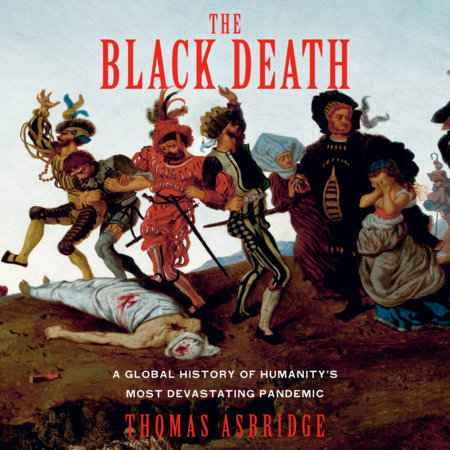
The Black Death

A Global History of Humanity's Most Devastating Pandemic

Listen to a clip from the audiobook
audio pause button
0:00
0:00
Audiobook Download
On sale May 26, 2026 | 19 Hours and 1 Minute | 9798217278534
Grades 9-12 + AP/IB

See Additional Formats
“A magisterial history” (The Guardian) of humanity’s greatest natural disaster—the Black Death—that reveals the true global impact and terrible human cost of this calamity, from the renowned author of The Crusades and The Greatest Knight.

“Terrific—and truly terrifying. Thomas Asbridge puts a human face—or rather multiple faces—on the Black Death.”—Eric Cline, author of 1177 B.C.

In the mid-fourteenth century, a lethal plague struck the medieval world, causing unimaginable suffering and destruction. The Black Death was unquestionably one of history’s defining episodes, yet a critical feature of its progress has often been ignored: the disease was not confined to Europe, but rather affected almost all of the known world, including the Near and Middle East, Byzantium, north Africa and Asia.

Tracing the pandemic’s course across the medieval globe, The Black Death contrasts the experiences of different peoples, including Christians, Muslims, and Jews, charting this catastrophe’s transformative effects on diverse aspects of medieval life. And crucially, Asbridge demonstrates that the plague was often at its most destructive in the Islamic world, where it ultimately played a role in the collapse of the mighty Mamluk Empire.

The Black Death also brings the human drama of this calamitous era to life, evoking the terror and the turmoil that beset cities such as London, Cairo, and Florence. Asbridge reconstructs the lives of the men, women and children who faced the Black Death—from ruling monarchs to peasant farmers—laying bare both the abject horror they endured and the courageous resolve they often demonstrated while striving to survive.

Uncovering a story that speaks to our own age, The Black Death highlights humankind’s capacity for compassion and resilience amidst a global crisis to explain how the medieval world confronted, and ultimately overcame, this shattering pandemic.
Introduction

In 1347, a band of Genoese merchants found themselves on the brink of annihilation, 1,000 miles from home. For more than two years, their isolated trading outpost at Kaffa—a Black Sea port on the Crimean Peninsula—had been under siege. The great Khan Djanibeg had surrounded their walls with a host of heavily armed Mongols and Turks, intent upon the destruction of this insolent colony. Such was the alarm caused by his assault that, back in Europe, the pope sought to launch a new crusade to save Kaffa, but few if any came to the aid of this embattled satellite, perched on the very fringe of the western Christian world. The port’s doughty fortifications had held firm through many months, but to those within it must have seemed that, against such odds, defeat was inevitable.

Then, unbidden, a glint of hope appeared. Rumor spread of a strange and merciless pestilence burning through Djanibeg’s force, which left some tortured by grotesque swellings and tumors, and others coughing up streams of blood. Among the besiegers, thousands died and still more fled. The pace of the khan’s assault slackened as his campaign began to fracture. It appeared that the Genoese would survive. But Djanibeg had one final ghastly attack to launch. Throughout the investment, his mighty engines of war had bombarded Kaffa’s walls with boulders. Now he ordered the bodies of the dead to be loaded on to these same machines and propelled into the port—there to spread their dreadful miasma.

One contemporary wrote that “what seemed like mountains of corpses [rained down on Kaffa] and the Christians could not hide or flee or escape from them, although they dumped as many as they could in the sea.” Soon “the rotting corpses tainted the air and poisoned the water supply [and] no one knew or could discover a defence” against the lethal disease that raged within the port. Faced with such horror, a small group of Genoese sailors found a ship and made good their escape. Leaving the cataclysmic scenes at Kaffa behind them, they set a course for safety and home, all the while unaware that they were themselves carrying death in their midst.

The story of the siege of Kaffa and its terrible aftermath was recorded by an elderly Italian lawyer and resident of Piacenza, Gabriele de’ Mussis, who lived through the first devastating phase of what is now known to history as the Black Death. Gabriele’s Historia de Morbo (History of the Disease) described how those who escaped from Kaffa bore a “poisonous disease” back to Genoa and other Italian ports:


When the sailors reached these places and mixed with the people there, it was as if they had brought evil spirits with them: every city, every settlement, every place was poisoned by the contagious pestilence, and their inhabitants, both men and women, died suddenly. And when one person had contracted the illness, he poisoned his whole family even as he fell and died, so that those preparing to bury his body were seized by death in the same way.


Gabriele mourned the fact that “bitter death, cruel death . . . divides parents, divorces spouses, parts children, separates brothers and sisters,” and saw this as an apocalyptic act of divine retribution for mankind’s manifold sins. He imagined God declaring his intent to “let the sharp arrows of sudden death have dominion through the world . . . let the innocent perish with the guilty [for] I shall take savage vengeance on them [and] wipe them from the face of the earth.”2

At that same moment, on the other side of the Mediterranean Sea, the noted Syrian poet and geographer Abu Hafs Umar Ibn al-Wardi wrote an eyewitness account of an “attack on humanity” that was being waged by what he called “al-waba” (“the pestilence”). He described how the Black Death struck the Muslim world in 1348, having spread from China and India, through the land of the Uzbeks to Crimea and on into Egypt. Ibn al-Wardi also interpreted the suffering he witnessed as a punishment from God and as one of the plagues foretold by the Prophet Muhammad that would afflict disbelievers, but he argued that for true Muslims such a death should be regarded as “a martyrdom and a reward.”

He recorded that in Damascus “the plague sat like a king on a throne . . . killing daily 1,000 or more and decimating the population,” while in Aleppo he saw firsthand how the pestilence “triumphed,” bringing “entire famil[ies] to their graves after two or three nights.” Diverse remedies were attempted, from smearing the body with Armenian clay, to wearing ruby rings and putting “onions, vinegar, and sardines together with the daily meal,” but to no effect. Towards the end of his treatise, Ibn al-Wardi affirmed that “this plague has captured all people and is about to send its ultimate destruction. There is no protection today from it other than His mercy, praise be to God.” Within a year, the poet had himself succumbed to the Black Death.

By the late summer of 1348, the disease’s inexorable advance had brought it to the shores of England. There, a cleric in the Oxfordshire abbey of Osney named Geoffrey le Baker chronicled its terrifying effects, noting how it struck first in the West Country, then spread through Gloucester, Oxford, London, and beyond, such that it “violently attacked” all of England and “completely emptied many rural settlements of human beings.” Geoffrey stated that at this time:


Hardly anyone dared to have anything to do with the sick. They fled from the things left by the dead, which had once been precious but were now poisonous to health. People who one day had been full of happiness, on the next were found dead. Some were tormented by boils which broke out suddenly in various parts of the body . . . Other victims had little black pustules scattered over the skin [and of these] hardly any recovered life and health.


These writers—Gabriele de’ Mussis, Ibn al-Wardi, and Geoffrey le Baker—authored detailed, and deeply distressing, personal accounts of the advent of the Black Death in the mid-fourteenth century. But all three were themselves dead within a decade. As such, none witnessed the ultimate and unparalleled destructive force of this scourge—the most lethal natural disaster in human history. During its most intense phase, between 1347 and 1353, the Black Death wiped out an estimated 100 million people, or around half the population in the areas that it affected, and the disease then recurred for decades, even centuries, to come, in what has come to be known as the Second Plague Pandemic. This was unquestionably one of the defining episodes in the history of our species, and a critical turning point in the development of human civilization—an event that wrought extraordinary transformations and arguably paved the way towards modernity. These three accounts do, however, lay bare one critical fact that has too often been sidelined in studies of the Black Death: this terrible plague was not solely, or even primarily, a European phenomenon, but rather a catastrophe that touched almost all of the medieval world.
“A magisterial history . . . takes the reader on a vivid tour . . . Asbridge evokes terror and pity by focusing in on what he calls ‘micro-histories.’ . . . [His] rich use of contemporary chronicles emphasizes people’s bafflement as well as horror.”—The Guardian

“Asbridge skillfully combines a global narrative of the plague with examples of horrendous personal tragedy to build a powerful portrait of a world that stared death in the face.”The Times

“A gripping and authoritative global history of the plague . . . its impeccable, wide-ranging scholarship and its suitability for general readers make it an impressive achievement.”—Financial Times

“Terrific—and truly terrifying . . . Asbridge puts a human face—or rather multiple faces—on the Black Death, the most famous pandemic to have afflicted humankind prior to [the pandemic].”—Eric Cline, author of 1177 B.C

“Comprehensive history of a devastating plague that stretched over centuries. . . . a capable work that, as modern readers will understand, underscores the fragility of societies in the face of pandemic.”Kirkus Reviews

“A rich, multifaceted history that finally makes sense of the research that has shifted our picture of the Black Death so much over the last twenty years . . . Asbridge’s account of how the Black Death was finally identified reads like a detective novel. . . . Truly mind-opening history, on a global scale that makes you rethink what you thought you knew.”—Lyndal Roper, author of Martin Luther

“Thomas Asbridge does for the Black Death what John Keegan did for battle: evoking the feeling of being there, recapturing the experience of the sufferers and survivors. Admiring the flawless scholarship, in language that is lucid, vivid, uncluttered with theory and uninfected by jargon, I’d be tempted—if it weren’t too paradoxical—to say that he makes plague a pleasure.”—Felipe Fernández-Armesto, author of Millennium and Civilizations

“An up-to-the-hour work of scholarship that is at the same time a page turner: intimate stories of suffering, death and resilience are situated in large-scale social, cultural, and economic histories of the ravages of the Black Death as it spread across the globe. Asbridge's definitive biography of Yersinia pestis, the germ that caused the world’s deadliest disease, is a masterpiece.”—Thomas Laqueur, author of The Work of the Dead

“This accessible and engaging global history of the Black Death takes readers on a grand tour of the plague’s ravages, revealing the lived experience both of the leading figures of the day and of ordinary men and women struggling to make sense of this calamity.”—John Aberth, author of The Black Death and Doctoring the Black Death
© Aoibheann
Thomas Asbridge is a historian of the Middle Ages, previously specializing in the study of the crusades, knighthood and chivalry, and is Reader in Medieval History at Queen Mary, University of London. He is the author of The Crusades: The Authoritative History of the War for the Holy Land and The Greatest Knight: The Remarkable Life of William Marshal, the Power behind Five English Thrones. He also wrote and presented the landmark three-part BBC television series The Crusades. View titles by Thomas Asbridge

About

“A magisterial history” (The Guardian) of humanity’s greatest natural disaster—the Black Death—that reveals the true global impact and terrible human cost of this calamity, from the renowned author of The Crusades and The Greatest Knight.

“Terrific—and truly terrifying. Thomas Asbridge puts a human face—or rather multiple faces—on the Black Death.”—Eric Cline, author of 1177 B.C.

In the mid-fourteenth century, a lethal plague struck the medieval world, causing unimaginable suffering and destruction. The Black Death was unquestionably one of history’s defining episodes, yet a critical feature of its progress has often been ignored: the disease was not confined to Europe, but rather affected almost all of the known world, including the Near and Middle East, Byzantium, north Africa and Asia.

Tracing the pandemic’s course across the medieval globe, The Black Death contrasts the experiences of different peoples, including Christians, Muslims, and Jews, charting this catastrophe’s transformative effects on diverse aspects of medieval life. And crucially, Asbridge demonstrates that the plague was often at its most destructive in the Islamic world, where it ultimately played a role in the collapse of the mighty Mamluk Empire.

The Black Death also brings the human drama of this calamitous era to life, evoking the terror and the turmoil that beset cities such as London, Cairo, and Florence. Asbridge reconstructs the lives of the men, women and children who faced the Black Death—from ruling monarchs to peasant farmers—laying bare both the abject horror they endured and the courageous resolve they often demonstrated while striving to survive.

Uncovering a story that speaks to our own age, The Black Death highlights humankind’s capacity for compassion and resilience amidst a global crisis to explain how the medieval world confronted, and ultimately overcame, this shattering pandemic.

Excerpt

Introduction

In 1347, a band of Genoese merchants found themselves on the brink of annihilation, 1,000 miles from home. For more than two years, their isolated trading outpost at Kaffa—a Black Sea port on the Crimean Peninsula—had been under siege. The great Khan Djanibeg had surrounded their walls with a host of heavily armed Mongols and Turks, intent upon the destruction of this insolent colony. Such was the alarm caused by his assault that, back in Europe, the pope sought to launch a new crusade to save Kaffa, but few if any came to the aid of this embattled satellite, perched on the very fringe of the western Christian world. The port’s doughty fortifications had held firm through many months, but to those within it must have seemed that, against such odds, defeat was inevitable.

Then, unbidden, a glint of hope appeared. Rumor spread of a strange and merciless pestilence burning through Djanibeg’s force, which left some tortured by grotesque swellings and tumors, and others coughing up streams of blood. Among the besiegers, thousands died and still more fled. The pace of the khan’s assault slackened as his campaign began to fracture. It appeared that the Genoese would survive. But Djanibeg had one final ghastly attack to launch. Throughout the investment, his mighty engines of war had bombarded Kaffa’s walls with boulders. Now he ordered the bodies of the dead to be loaded on to these same machines and propelled into the port—there to spread their dreadful miasma.

One contemporary wrote that “what seemed like mountains of corpses [rained down on Kaffa] and the Christians could not hide or flee or escape from them, although they dumped as many as they could in the sea.” Soon “the rotting corpses tainted the air and poisoned the water supply [and] no one knew or could discover a defence” against the lethal disease that raged within the port. Faced with such horror, a small group of Genoese sailors found a ship and made good their escape. Leaving the cataclysmic scenes at Kaffa behind them, they set a course for safety and home, all the while unaware that they were themselves carrying death in their midst.

The story of the siege of Kaffa and its terrible aftermath was recorded by an elderly Italian lawyer and resident of Piacenza, Gabriele de’ Mussis, who lived through the first devastating phase of what is now known to history as the Black Death. Gabriele’s Historia de Morbo (History of the Disease) described how those who escaped from Kaffa bore a “poisonous disease” back to Genoa and other Italian ports:


When the sailors reached these places and mixed with the people there, it was as if they had brought evil spirits with them: every city, every settlement, every place was poisoned by the contagious pestilence, and their inhabitants, both men and women, died suddenly. And when one person had contracted the illness, he poisoned his whole family even as he fell and died, so that those preparing to bury his body were seized by death in the same way.


Gabriele mourned the fact that “bitter death, cruel death . . . divides parents, divorces spouses, parts children, separates brothers and sisters,” and saw this as an apocalyptic act of divine retribution for mankind’s manifold sins. He imagined God declaring his intent to “let the sharp arrows of sudden death have dominion through the world . . . let the innocent perish with the guilty [for] I shall take savage vengeance on them [and] wipe them from the face of the earth.”2

At that same moment, on the other side of the Mediterranean Sea, the noted Syrian poet and geographer Abu Hafs Umar Ibn al-Wardi wrote an eyewitness account of an “attack on humanity” that was being waged by what he called “al-waba” (“the pestilence”). He described how the Black Death struck the Muslim world in 1348, having spread from China and India, through the land of the Uzbeks to Crimea and on into Egypt. Ibn al-Wardi also interpreted the suffering he witnessed as a punishment from God and as one of the plagues foretold by the Prophet Muhammad that would afflict disbelievers, but he argued that for true Muslims such a death should be regarded as “a martyrdom and a reward.”

He recorded that in Damascus “the plague sat like a king on a throne . . . killing daily 1,000 or more and decimating the population,” while in Aleppo he saw firsthand how the pestilence “triumphed,” bringing “entire famil[ies] to their graves after two or three nights.” Diverse remedies were attempted, from smearing the body with Armenian clay, to wearing ruby rings and putting “onions, vinegar, and sardines together with the daily meal,” but to no effect. Towards the end of his treatise, Ibn al-Wardi affirmed that “this plague has captured all people and is about to send its ultimate destruction. There is no protection today from it other than His mercy, praise be to God.” Within a year, the poet had himself succumbed to the Black Death.

By the late summer of 1348, the disease’s inexorable advance had brought it to the shores of England. There, a cleric in the Oxfordshire abbey of Osney named Geoffrey le Baker chronicled its terrifying effects, noting how it struck first in the West Country, then spread through Gloucester, Oxford, London, and beyond, such that it “violently attacked” all of England and “completely emptied many rural settlements of human beings.” Geoffrey stated that at this time:


Hardly anyone dared to have anything to do with the sick. They fled from the things left by the dead, which had once been precious but were now poisonous to health. People who one day had been full of happiness, on the next were found dead. Some were tormented by boils which broke out suddenly in various parts of the body . . . Other victims had little black pustules scattered over the skin [and of these] hardly any recovered life and health.


These writers—Gabriele de’ Mussis, Ibn al-Wardi, and Geoffrey le Baker—authored detailed, and deeply distressing, personal accounts of the advent of the Black Death in the mid-fourteenth century. But all three were themselves dead within a decade. As such, none witnessed the ultimate and unparalleled destructive force of this scourge—the most lethal natural disaster in human history. During its most intense phase, between 1347 and 1353, the Black Death wiped out an estimated 100 million people, or around half the population in the areas that it affected, and the disease then recurred for decades, even centuries, to come, in what has come to be known as the Second Plague Pandemic. This was unquestionably one of the defining episodes in the history of our species, and a critical turning point in the development of human civilization—an event that wrought extraordinary transformations and arguably paved the way towards modernity. These three accounts do, however, lay bare one critical fact that has too often been sidelined in studies of the Black Death: this terrible plague was not solely, or even primarily, a European phenomenon, but rather a catastrophe that touched almost all of the medieval world.

Reviews

“A magisterial history . . . takes the reader on a vivid tour . . . Asbridge evokes terror and pity by focusing in on what he calls ‘micro-histories.’ . . . [His] rich use of contemporary chronicles emphasizes people’s bafflement as well as horror.”—The Guardian

“Asbridge skillfully combines a global narrative of the plague with examples of horrendous personal tragedy to build a powerful portrait of a world that stared death in the face.”The Times

“A gripping and authoritative global history of the plague . . . its impeccable, wide-ranging scholarship and its suitability for general readers make it an impressive achievement.”—Financial Times

“Terrific—and truly terrifying . . . Asbridge puts a human face—or rather multiple faces—on the Black Death, the most famous pandemic to have afflicted humankind prior to [the pandemic].”—Eric Cline, author of 1177 B.C

“Comprehensive history of a devastating plague that stretched over centuries. . . . a capable work that, as modern readers will understand, underscores the fragility of societies in the face of pandemic.”Kirkus Reviews

“A rich, multifaceted history that finally makes sense of the research that has shifted our picture of the Black Death so much over the last twenty years . . . Asbridge’s account of how the Black Death was finally identified reads like a detective novel. . . . Truly mind-opening history, on a global scale that makes you rethink what you thought you knew.”—Lyndal Roper, author of Martin Luther

“Thomas Asbridge does for the Black Death what John Keegan did for battle: evoking the feeling of being there, recapturing the experience of the sufferers and survivors. Admiring the flawless scholarship, in language that is lucid, vivid, uncluttered with theory and uninfected by jargon, I’d be tempted—if it weren’t too paradoxical—to say that he makes plague a pleasure.”—Felipe Fernández-Armesto, author of Millennium and Civilizations

“An up-to-the-hour work of scholarship that is at the same time a page turner: intimate stories of suffering, death and resilience are situated in large-scale social, cultural, and economic histories of the ravages of the Black Death as it spread across the globe. Asbridge's definitive biography of Yersinia pestis, the germ that caused the world’s deadliest disease, is a masterpiece.”—Thomas Laqueur, author of The Work of the Dead

“This accessible and engaging global history of the Black Death takes readers on a grand tour of the plague’s ravages, revealing the lived experience both of the leading figures of the day and of ordinary men and women struggling to make sense of this calamity.”—John Aberth, author of The Black Death and Doctoring the Black Death

Author

© Aoibheann
Thomas Asbridge is a historian of the Middle Ages, previously specializing in the study of the crusades, knighthood and chivalry, and is Reader in Medieval History at Queen Mary, University of London. He is the author of The Crusades: The Authoritative History of the War for the Holy Land and The Greatest Knight: The Remarkable Life of William Marshal, the Power behind Five English Thrones. He also wrote and presented the landmark three-part BBC television series The Crusades. View titles by Thomas Asbridge
  • More Websites from
    Penguin Random House
  • Common Reads
  • Library Marketing