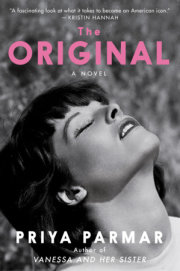
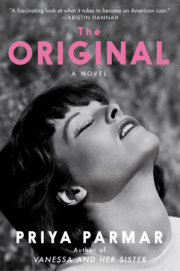
Download high-resolution image
Listen to a clip from the audiobook
audio pause button
0:00
0:00

The Original

A Novel

Listen to a clip from the audiobook
audio pause button
0:00
0:00
This stunning novel plunges into the tumultuous life of screen icon Katharine Hepburn, a star whose fierce independence, passionate spirit, and fluid sexuality shattered Hollywood’s rules and redefined what it meant to be a woman in film.

“A riveting and unputdownable journey through fame, rebellion, and the relentless pursuit of authenticity.”—#1 New York Times bestselling author Christina Baker Kline

“A bold, breathtaking novel about the making of Katharine Hepburn—vivid, daring and full of emotional bite. This is a novel you press into your best friend’s hands the moment you finish.”—Paula McLain, New York Times bestselling author of Skylark and The Paris Wife

When young Katharine Hepburn loses her beloved brother, she makes two decisions: she will become famous, and she will never let anyone hurt her again. Leaving home at twenty-one to pursue an acting career Kate is lured to Hollywood, accompanied by her lover, Laura.

Los Angeles in the early 1930s is a town full of secrets and Kate has plenty to hide. Soon she is scooped into the studio system and launched as a star—but stars must play by the rules and Kate, brilliant, bisexual, and strong-willed, refuses to conform.

Surrounded by a legendary circle of intimates, including the powerful David and Irene Selznick, charming and romantically conflicted actor Cary Grant, ambitious director John Ford, and millionaire tycoon Howard Hughes, Kate navigates a web of sex, ambition, and betrayal. As her career ascends, she faces an agonizing choice: be the star everyone wants her to be, or risk everything to become the woman she always was.

The author of New York Times Notable Book Vanessa and Her Sister has created a propulsive, emotionally charged novel exploring the cost of fame. With sharp prose and unforgettable characters, The Original is a story of love, aspiration, and the price of living authentically.
Kate

Hartford, Connecticut
1921

To understand her, you should start with him. She begins with him.

But you don’t have to.

The girl also begins with salt and fir and glacial soil. With a family that talks about bodies and disease and reads at the table. The father believes in water, the chemical properties, the health benefits: cold baths, ice shocked skin and nude swimming. The mother believes in Margaret Sanger, Bryn Mawr, votes for women, New En­gland and her husband.

One night in November, in the big yellow house, the girl’s parents give a dinner party. The new daily maid has arranged the flowers and laid the second best family china. She drops a knife and wipes it on her skirt. No one sees. She is annoyed and wants to get home. On a junior doctor’s salary, the Hepburns cannot afford for her to live in like Fanny. Bus fare is five cents. Nickel there, nickel back. She plans to ask the Hepburns for a raise.

Friends of the Hepburns sit around the couple’s oval table. They discuss the country’s poor, how to help, what to do. The Hepburns are still young. They look at each other often, soft, blunt gusts of affection. They look for approval, yes, but more for love. The girl will always be proud of the way her parents love each other. But a child can never really know a parents’ marriage. Sitting at opposite ends of the dinner table, the Hepburns are enclosed, like a phrase. Kit Hepburn observes the old rules, one never sits next to one’s husband.

On this night in November the new daily maid stands by the swinging door, waiting for a gap in the conversation, a moment when the guests chew, or cough. When it comes, she goes in to tell them that a man without a home has come to the kitchen door looking for food. She moves toward Mrs. Hepburn, knowing Mrs. Hepburn would want to feed the man without a home, bends to speak low into her ear but the girl’s father does not like anyone to be that close to his wife. The new daily maid straightens and speaks so all at the table can hear. Irritated at the intrusion—­they have guests after all—­Dr. Hepburn tells her that they cannot receive a visitor at this time of night. He looks at his wife, for approval, for love. And then he swallows his food.

If you are looking for the girl, she is not here yet. She will arrive soon, two years after him. After the boy. They will be called Tom and Kate.


There are six of them at their peak. After Kate come four more. All flame-­headed and freckled but smaller, less articulated. Maybe that happens when there are six? The last ones get a little out of focus? Mrs. Hepburn was always sure she was going to be the kind of mother who checks to make sure her children comb their hair and keep their fingernails clean. She assumed she would want to stand over them while they brush their teeth and to patch their clothes herself. But she has found that raising children is tedious work and she has other things to do. She wants to be a person in the world. By her third child, she has resumed her suffrage work. By her fifth, she is president of the Connecticut Women’s Suffrage Association. But Mrs. Hepburn, a natural leader, can delegate. There are so many of them and they have each other. And she does not want to make them soft. At night, she reads to them. They pack the bed like a fish crate, all fresh socks and pajamas, wet hair and clean teeth. Eight pages of George Eliot before lights out.

In the winter they live in Hartford, near Dr. Hepburn’s hospital, but in the warm months, they live here, in the shingled summer house sitting on a finger of land, across the narrow causeway from Old Saybrook. Birds fly low over the roof and land on the long stripe of gun blue water. It is called Fenwick, this circle of houses that hug the sandy road, grouped around the small private golf course. The houses tend to be large, baggy, with front porches that need painting. It is not the thing here to be pristine. This is salty New England country and it does not do to be showy. Dr. Hepburn is from Virginia and wants the porch painted. Mrs. Hepburn tells him she will get to it soon but does not call the painters. Better to do it in the winter so that it will look broken in by summer. And, anyway, it will just need it again next year.

The Hepburns believe in vigor, noise. The walls here are thin and none of the doors close properly but no matter. “We have nothing to hide,” Dr. Hepburn says. He means it. They are a medical family. The body is not mysterious. They are the sort of family who are not fazed by nudity or sex but refuse to discuss fear. Dr. Hepburn teaches his children to rise early, shower in cold water before confronting the day. Kit Hepburn teaches them to blow on hot soup, chew with their mouths closed and to never use contractions. She says shortcuts are a sign of a lazy mind. The Hepburn children like heights and dares and are proud when a bruise turns from blue to green. They can always be found on roofs and up trees. Dr. Hepburn sends them up to clean gutters on autumn after­noons and to push the snow off the gables in the winter. He likes that the neighbors talk about the rowdy Hepburn brood and warn their own children to take care when they go to the Hepburn house. Dr. Hepburn does not speak to the old guard Fenwick neighbors himself; Mrs. Hepburn does that. He is still worried he will sound like backroads Virginia. Mrs. Hepburn knows they are not popular with their neighbors. Kit Hepburn does not care.


The small Hepburns pile their shoes at the base of the ash tree and climb barefoot to get a better grip. Kate climbs highest, up to where the branches thin. Tom watches from a low, thick limb. Children are tribal, they form their own governments. The Hepburn children have divided into camps: older, younger. The younger Hepburns try to keep up but there is no room for them in Tom and Kate.


There is a lot of yelling the summer Kate cuts off her hair. Tom sits on the rolled edge of the bathtub that Saturday morning and watches as Kate shoves her skinny fingers through the scissor rings. She slices off a panel of her red waves, leaving a pad of bristle over her right ear. She keeps going, clipping off long rectangles, and does not look in the mirror. The scissors make a fibrous, grassy sound; they are not sharp enough. She finishes, drops the scissors in the sink and looks at Tom, her head terraced with uneven red stumps.

Tom cannot quite look in the sink. The scissors are lying half open on the white enamel. Red hair still tangled in the mouth. He feels it’s too private, too female, something personal he should not see. Tom does not join in the kitchen table discussions of bodies and medicine. Instead, he keeps a Buster Brown comic book on his lap. He does not open it, his father would not like that, but he feels safer knowing it is there.

He looks at Kate. “You’re a mess.”

Kate reaches in and pulls the scissors from the sink. “Fix it.”

Tom tries to neaten up the sides and the back of her neck, the way the barber always does to him. Kate closes her eyes and drops her head forward, unafraid as the blades slide over her skin.

When he is done, they stand side by side, looking into the bathroom mirror.

“You look like my brother,” Tom says.

“I am your brother.”

They go downstairs. Tom will come back up after breakfast to sweep up the bathroom floor. He is not a boy to leave a mess for someone else to clean up.

The family gapes.

“It was in my way,” Kate says, shaking salt onto her eggs.

“Good god,” her father shouts, banging his open hand down on the table, clattering the dishes and jumping the spoons. “What were you thinking?”

Bob and Dick giggle but one look from their mother and they bite their lips, hard, and sit up straight.

“Kate! Answer me!”

Kate does not answer.

Dr. Hepburn turns to his wife. Quieter, he doesn’t want to rattle his son. “What has she done? Why? Why has she done this?”

“She seems to have cut her hair, dear,” Mrs. Hepburn says. “It is summer. It is hot. We let Tom, Bob and Dick keep short hair. Why not Kate?” Kit Hepburn is trying to pry open the tight air in the room.

“Tom did the back,” Kate speaks up and then looks at her brother and wishes she hadn’t.

“He what?” her father said, turning on Tom. “You did this to her?”

Tom swallows, turns. “The line wasn’t straight,” Tom says, “so I straightened it.” His words slip back down his throat and he struggles to project his voice, to calm down, the way he and his mother have been practicing. Fanny puts a plate of eggs down in front of him and quickly cups his cheek. Tom is her favorite.

“I think you’ve done a very good job,” Mrs. Hepburn says. “Especially around her ears. The ears are always the hardest.” Mrs. Hepburn hates it when her husband snaps and her eldest son flinches. It has been getting worse this year.

“This is a ridiculous conversation,” Dr. Hepburn shouts. “No one should see her ears. Her ears are supposed to be under her hair! She looks like a tufted baboon.”
“A bold, breathtaking novel about the making of Katharine Hepburn—vivid, daring, and full of emotional bite. This is a novel you press into your best friend’s hands the moment you finish. Priya Parmar is a true original, and this novel proves it.”—Paula McLain, New York Times bestselling author of Skylark

“A riveting and unputdownable journey through fame, rebellion, and the relentless pursuit of authenticity. Priya Parmar has written a novel that lingers in the mind and heart. . . . As thought-provoking as it is beautiful.”—Christina Baker Kline, New York Times bestselling author of The Foursome

“The magnificent Priya Parmar has written an unforgettable novel about a beloved American icon. The Original is an imaginative and daring leap into the Golden Age of Hollywood star machine. Lights! Camera! Read!”—Adriana Trigiani, New York Times bestselling author of The View from Lake Como

“A brilliant, ambitious woman determined to live—and love—on her own terms, in an era when bold and unconventional choices could destroy a career overnight . . . Fans of early Hollywood will devour this novel.”—Kristin Hannah, New York Times bestselling author of The Women

A luminous, fiercely intimate portrait of a fascinating and enigmatic legend carving her own path . . . Parmar’s prose is poetic, electric, and deeply affecting.”—John Searles, New York Times bestselling author of Single Girls

“I read The Original with real delight—Priya Parmar’s complex evocation of Hepburn’s youth and early career, of the woman behind the icon, is tender, fierce, and beautiful. What a terrific novel!”—Claire Messud, New York Times bestselling author of This Strange Eventful History

“Historical fiction fans will be drawn to this immersive portrait of the legendary actor.”—Publishers Weekly
© J.D. Cohen
Priya Parmar is the author of the novels Exit the Actress and Vanessa and Her Sister, a New York Times Notable Book. Co-author of the musical Sylvia (London Old Vic), she lives between London and Connecticut with her family and four rescue dogs. View titles by Priya Parmar

About

This stunning novel plunges into the tumultuous life of screen icon Katharine Hepburn, a star whose fierce independence, passionate spirit, and fluid sexuality shattered Hollywood’s rules and redefined what it meant to be a woman in film.

“A riveting and unputdownable journey through fame, rebellion, and the relentless pursuit of authenticity.”—#1 New York Times bestselling author Christina Baker Kline

“A bold, breathtaking novel about the making of Katharine Hepburn—vivid, daring and full of emotional bite. This is a novel you press into your best friend’s hands the moment you finish.”—Paula McLain, New York Times bestselling author of Skylark and The Paris Wife

When young Katharine Hepburn loses her beloved brother, she makes two decisions: she will become famous, and she will never let anyone hurt her again. Leaving home at twenty-one to pursue an acting career Kate is lured to Hollywood, accompanied by her lover, Laura.

Los Angeles in the early 1930s is a town full of secrets and Kate has plenty to hide. Soon she is scooped into the studio system and launched as a star—but stars must play by the rules and Kate, brilliant, bisexual, and strong-willed, refuses to conform.

Surrounded by a legendary circle of intimates, including the powerful David and Irene Selznick, charming and romantically conflicted actor Cary Grant, ambitious director John Ford, and millionaire tycoon Howard Hughes, Kate navigates a web of sex, ambition, and betrayal. As her career ascends, she faces an agonizing choice: be the star everyone wants her to be, or risk everything to become the woman she always was.

The author of New York Times Notable Book Vanessa and Her Sister has created a propulsive, emotionally charged novel exploring the cost of fame. With sharp prose and unforgettable characters, The Original is a story of love, aspiration, and the price of living authentically.

Excerpt

Kate

Hartford, Connecticut
1921

To understand her, you should start with him. She begins with him.

But you don’t have to.

The girl also begins with salt and fir and glacial soil. With a family that talks about bodies and disease and reads at the table. The father believes in water, the chemical properties, the health benefits: cold baths, ice shocked skin and nude swimming. The mother believes in Margaret Sanger, Bryn Mawr, votes for women, New En­gland and her husband.

One night in November, in the big yellow house, the girl’s parents give a dinner party. The new daily maid has arranged the flowers and laid the second best family china. She drops a knife and wipes it on her skirt. No one sees. She is annoyed and wants to get home. On a junior doctor’s salary, the Hepburns cannot afford for her to live in like Fanny. Bus fare is five cents. Nickel there, nickel back. She plans to ask the Hepburns for a raise.

Friends of the Hepburns sit around the couple’s oval table. They discuss the country’s poor, how to help, what to do. The Hepburns are still young. They look at each other often, soft, blunt gusts of affection. They look for approval, yes, but more for love. The girl will always be proud of the way her parents love each other. But a child can never really know a parents’ marriage. Sitting at opposite ends of the dinner table, the Hepburns are enclosed, like a phrase. Kit Hepburn observes the old rules, one never sits next to one’s husband.

On this night in November the new daily maid stands by the swinging door, waiting for a gap in the conversation, a moment when the guests chew, or cough. When it comes, she goes in to tell them that a man without a home has come to the kitchen door looking for food. She moves toward Mrs. Hepburn, knowing Mrs. Hepburn would want to feed the man without a home, bends to speak low into her ear but the girl’s father does not like anyone to be that close to his wife. The new daily maid straightens and speaks so all at the table can hear. Irritated at the intrusion—­they have guests after all—­Dr. Hepburn tells her that they cannot receive a visitor at this time of night. He looks at his wife, for approval, for love. And then he swallows his food.

If you are looking for the girl, she is not here yet. She will arrive soon, two years after him. After the boy. They will be called Tom and Kate.


There are six of them at their peak. After Kate come four more. All flame-­headed and freckled but smaller, less articulated. Maybe that happens when there are six? The last ones get a little out of focus? Mrs. Hepburn was always sure she was going to be the kind of mother who checks to make sure her children comb their hair and keep their fingernails clean. She assumed she would want to stand over them while they brush their teeth and to patch their clothes herself. But she has found that raising children is tedious work and she has other things to do. She wants to be a person in the world. By her third child, she has resumed her suffrage work. By her fifth, she is president of the Connecticut Women’s Suffrage Association. But Mrs. Hepburn, a natural leader, can delegate. There are so many of them and they have each other. And she does not want to make them soft. At night, she reads to them. They pack the bed like a fish crate, all fresh socks and pajamas, wet hair and clean teeth. Eight pages of George Eliot before lights out.

In the winter they live in Hartford, near Dr. Hepburn’s hospital, but in the warm months, they live here, in the shingled summer house sitting on a finger of land, across the narrow causeway from Old Saybrook. Birds fly low over the roof and land on the long stripe of gun blue water. It is called Fenwick, this circle of houses that hug the sandy road, grouped around the small private golf course. The houses tend to be large, baggy, with front porches that need painting. It is not the thing here to be pristine. This is salty New England country and it does not do to be showy. Dr. Hepburn is from Virginia and wants the porch painted. Mrs. Hepburn tells him she will get to it soon but does not call the painters. Better to do it in the winter so that it will look broken in by summer. And, anyway, it will just need it again next year.

The Hepburns believe in vigor, noise. The walls here are thin and none of the doors close properly but no matter. “We have nothing to hide,” Dr. Hepburn says. He means it. They are a medical family. The body is not mysterious. They are the sort of family who are not fazed by nudity or sex but refuse to discuss fear. Dr. Hepburn teaches his children to rise early, shower in cold water before confronting the day. Kit Hepburn teaches them to blow on hot soup, chew with their mouths closed and to never use contractions. She says shortcuts are a sign of a lazy mind. The Hepburn children like heights and dares and are proud when a bruise turns from blue to green. They can always be found on roofs and up trees. Dr. Hepburn sends them up to clean gutters on autumn after­noons and to push the snow off the gables in the winter. He likes that the neighbors talk about the rowdy Hepburn brood and warn their own children to take care when they go to the Hepburn house. Dr. Hepburn does not speak to the old guard Fenwick neighbors himself; Mrs. Hepburn does that. He is still worried he will sound like backroads Virginia. Mrs. Hepburn knows they are not popular with their neighbors. Kit Hepburn does not care.


The small Hepburns pile their shoes at the base of the ash tree and climb barefoot to get a better grip. Kate climbs highest, up to where the branches thin. Tom watches from a low, thick limb. Children are tribal, they form their own governments. The Hepburn children have divided into camps: older, younger. The younger Hepburns try to keep up but there is no room for them in Tom and Kate.


There is a lot of yelling the summer Kate cuts off her hair. Tom sits on the rolled edge of the bathtub that Saturday morning and watches as Kate shoves her skinny fingers through the scissor rings. She slices off a panel of her red waves, leaving a pad of bristle over her right ear. She keeps going, clipping off long rectangles, and does not look in the mirror. The scissors make a fibrous, grassy sound; they are not sharp enough. She finishes, drops the scissors in the sink and looks at Tom, her head terraced with uneven red stumps.

Tom cannot quite look in the sink. The scissors are lying half open on the white enamel. Red hair still tangled in the mouth. He feels it’s too private, too female, something personal he should not see. Tom does not join in the kitchen table discussions of bodies and medicine. Instead, he keeps a Buster Brown comic book on his lap. He does not open it, his father would not like that, but he feels safer knowing it is there.

He looks at Kate. “You’re a mess.”

Kate reaches in and pulls the scissors from the sink. “Fix it.”

Tom tries to neaten up the sides and the back of her neck, the way the barber always does to him. Kate closes her eyes and drops her head forward, unafraid as the blades slide over her skin.

When he is done, they stand side by side, looking into the bathroom mirror.

“You look like my brother,” Tom says.

“I am your brother.”

They go downstairs. Tom will come back up after breakfast to sweep up the bathroom floor. He is not a boy to leave a mess for someone else to clean up.

The family gapes.

“It was in my way,” Kate says, shaking salt onto her eggs.

“Good god,” her father shouts, banging his open hand down on the table, clattering the dishes and jumping the spoons. “What were you thinking?”

Bob and Dick giggle but one look from their mother and they bite their lips, hard, and sit up straight.

“Kate! Answer me!”

Kate does not answer.

Dr. Hepburn turns to his wife. Quieter, he doesn’t want to rattle his son. “What has she done? Why? Why has she done this?”

“She seems to have cut her hair, dear,” Mrs. Hepburn says. “It is summer. It is hot. We let Tom, Bob and Dick keep short hair. Why not Kate?” Kit Hepburn is trying to pry open the tight air in the room.

“Tom did the back,” Kate speaks up and then looks at her brother and wishes she hadn’t.

“He what?” her father said, turning on Tom. “You did this to her?”

Tom swallows, turns. “The line wasn’t straight,” Tom says, “so I straightened it.” His words slip back down his throat and he struggles to project his voice, to calm down, the way he and his mother have been practicing. Fanny puts a plate of eggs down in front of him and quickly cups his cheek. Tom is her favorite.

“I think you’ve done a very good job,” Mrs. Hepburn says. “Especially around her ears. The ears are always the hardest.” Mrs. Hepburn hates it when her husband snaps and her eldest son flinches. It has been getting worse this year.

“This is a ridiculous conversation,” Dr. Hepburn shouts. “No one should see her ears. Her ears are supposed to be under her hair! She looks like a tufted baboon.”

Reviews

“A bold, breathtaking novel about the making of Katharine Hepburn—vivid, daring, and full of emotional bite. This is a novel you press into your best friend’s hands the moment you finish. Priya Parmar is a true original, and this novel proves it.”—Paula McLain, New York Times bestselling author of Skylark

“A riveting and unputdownable journey through fame, rebellion, and the relentless pursuit of authenticity. Priya Parmar has written a novel that lingers in the mind and heart. . . . As thought-provoking as it is beautiful.”—Christina Baker Kline, New York Times bestselling author of The Foursome

“The magnificent Priya Parmar has written an unforgettable novel about a beloved American icon. The Original is an imaginative and daring leap into the Golden Age of Hollywood star machine. Lights! Camera! Read!”—Adriana Trigiani, New York Times bestselling author of The View from Lake Como

“A brilliant, ambitious woman determined to live—and love—on her own terms, in an era when bold and unconventional choices could destroy a career overnight . . . Fans of early Hollywood will devour this novel.”—Kristin Hannah, New York Times bestselling author of The Women

A luminous, fiercely intimate portrait of a fascinating and enigmatic legend carving her own path . . . Parmar’s prose is poetic, electric, and deeply affecting.”—John Searles, New York Times bestselling author of Single Girls

“I read The Original with real delight—Priya Parmar’s complex evocation of Hepburn’s youth and early career, of the woman behind the icon, is tender, fierce, and beautiful. What a terrific novel!”—Claire Messud, New York Times bestselling author of This Strange Eventful History

“Historical fiction fans will be drawn to this immersive portrait of the legendary actor.”—Publishers Weekly

Author

© J.D. Cohen
Priya Parmar is the author of the novels Exit the Actress and Vanessa and Her Sister, a New York Times Notable Book. Co-author of the musical Sylvia (London Old Vic), she lives between London and Connecticut with her family and four rescue dogs. View titles by Priya Parmar
  • More Websites from
    Penguin Random House
  • Common Reads
  • Library Marketing