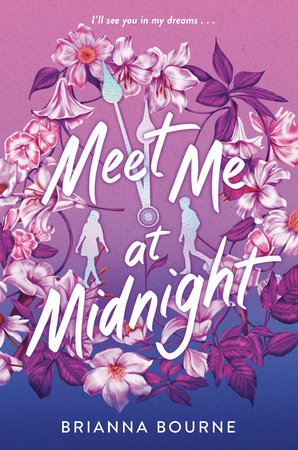
Meet Me at Midnight

If I Stay meets Taylor Swift’s Midnights album in this breathtaking love story about a girl who sees the same boy every night in her dreams.

Every night at midnight, time stops and Aria wakes up somewhere she’s never been: under a sparkling waterfall in Bali, in the romantic Italian countryside, on a moonlit path between towering sequoias. And every night, she meets the same dreamy boy.

As the two are drawn to each other, midnight after midnight, Aria knows in her heart there must be a reason why . . . and if she gives in, their connection might be more than she could have ever dreamed of.

A truly timeless love story with a twist that will stay in your heart, Meet Me at Midnight is destined to be a classic epic romance.
Chapter One

The First Midnight

The first time it happens, I wake in a dim lavender glow, a thick layer of mist curling over the ground like smoke.

I jolt up, blinking into the night, eyes wide in the half-­light. Trying to take it all in. Trying to make sense of what I’m seeing. I’m sure I fell asleep in my own bed, in my own house. But now I’m—­

Where am I?

The bedroom I share with my twin sister, Cady, is gone, replaced by a forest of towering, otherworldly trees.

Sequoias. The sight of them calls up fluttering images of long-­ago field trips: lunch boxes and buddy systems, a line of yellow school buses trundling into the foothills of the Sierra Nevada. It’s a fifteen-­minute drive from my town to a stand of giant sequoias like this one, so maybe I could have sleepwalked here. But I’ve never heard of anyone sleepwalking more than a mile.

I rise on unsteady legs and turn in a cautious circle. There’s something hypnotic about the purple-­blue light—­something whispering that this is no ordinary forest. No ordinary night.

I check my watch, a delicate gold bracelet with a pearl face that belonged to my grandmother. The minute and hour hands both point firmly to twelve. Midnight exactly.

At my feet, a ribbon of red dirt winds deeper into the woods. A path. And because it feels like an invitation, I begin to walk.

The scale of the world is fever-­dream warped, and I am a dollhouse version of myself weaving between the sequoias. I should be feeling a low simmer of apprehension—­forests at night are not safe places to be—­but fear seems like a faraway, impossible thing.

Am I dreaming? It doesn’t feel like it. My dreams are usually disjointed and nonsensical and almost always end up morphing into a nightmare featuring my deepest, oldest fear: facing something new without my twin sister at my side.

But this forest, this night . . . it’s more lucid than any dream I’ve ever had. I can smell the peaty bark, the green newness of the leaves overhead. I can dig my bare toes into the dirt and feel the dark, rich damp hiding underneath.

Inside my chest, in a place I thought had been hollowed out, something stirs. Something I haven’t felt in so long. My pulse becomes an eager throb in my neck, beating out one thought over and over: beautiful, beautiful, beautiful.

All my life, I have been a dreamer. When I was a little girl, my mom’s friends would murmur about me, things like Oh, she’s off with the fairies again or Gosh, her head is in the clouds, isn’t it? My sour-­faced second-­grade teacher called me “spacey,” and my favorite grandma called me her “starry-­eyed daydreamer” right up until the night she slipped away from us. I didn’t mind the murmurs. I loved being a dreamer. The world was prettier in my imagination, and I loved sliding into my own spin-­off realities. It was always easier there than in real life.

This strange forest feels even better than those daydreams.

The ground slopes downward, and the trees start to thin. If these are the same sequoias from those childhood field trips, I should spill into the valley that leads to my hometown. People think of beaches and surfboards when they think of California, but I live on the eastern edge of the Central Valley, where the forests grow thick and the mountainsides are dotted with log cabins and stony mountain lodges.

But instead of breaking into the valley, the forest suddenly opens onto a wide, empty clearing. The sequoias here stand sentry in an almost perfect circle, leaving the sky open to a strangely bright, blue-­violet moon.

When I see what’s in the center of the glade, the night stutters.

A grand piano.

For a full minute, I stare at it, too stunned to move. And then, slowly, as if the piano is a creature that might spook, I step into the clearing.

The moonlight shines down on the piano like a ghostly, diluted spotlight. The wood is soggy, blanketed with tufts of emerald moss and laceworks of lichen. The keys are more yellow than white, broken like teeth. I touch one carefully. Middle C, I think, calling up the brief run of piano lessons I took when I was ten. I press the key, but no sound comes out.

I peer under the propped-­open lid and discover a tiny, mossy world growing over the strings. Softly rolling hills, the shiny marching carapaces of june bugs. And flowers: prairie smoke and chokecherry, skyrocket and mallow. I know their names the way I know the names of every fabric I’ve ever run through a sewing machine: chiffon, organza, bombazine.

As I run my fingertips over the velvet petals of the nearest bloom, a smile spreads across my face. For the first time in three months, I’m able to breathe without the crushing weight of real life sitting on my chest.

My smile falters. Just thinking about that weight has it settling back over my lungs, pressing the air out of me. Reminding me of my life outside this dream.

Real life is the subtle but unmistakable rattle of everything falling apart.

I wish I could be the sort of person who can handle it, but I’ve never been strong like that. Not like Cady.

I slip my hand into my dress pocket and find the double penny that comes with me everywhere. It’s two pennies melded together, side by side. As strange as an egg with double yolks. My dad has always wanted to sell it; says it will get hundreds, maybe thousands, of dollars on the coin-­collector circuit. But Cady and I found it on the boardwalk in Santa Cruz when we were eight, and we’ve taken turns carrying it around ever since. I pull it out, rubbing the bright copper with my thumb.

Cady.

My breath catches, and I force myself to focus on the moonlight, the forest, the piano. I’m not there. I’m here.

As the mist curls around my ankles, the weight on my chest lifts again, replaced by a stillness so deep it almost makes me cry. Whatever this night is, I love it. It’s . . . frictionless.

“Thank you,” I whisper, letting go of the double penny in my pocket so I can lay a hand on the mossy piano. This gorgeous, undemanding calm . . . I need this. All I’ve ever wanted is to escape, and this place can be that for me. My forest, my glade. Nothing and nobody to remind me of reality.

I run my fingers over the silent keys again. If I dreamed of this place three months ago, I would have whirled wide-­eyed and carefree into the glade, drinking up the magic and letting it inspire an entire flock of daydreams.

Now I start to spin, slowly, with my face tipped up. Maybe I can be that girl again, just for a little while, just in here before I wake up.

The sound of something thrashing through the underbrush sends my heartbeat skittering. I stumble out of my spin, but before I can run or hide or grab a stick to brandish like a sword—­someone surges into the clearing.

He stops short when he sees me, surprise flaring in his eyes. For a moment, we are two pulsing, startled people locked in a standoff in the woods, both of us too shocked to speak.

My heart lurches. Because this person—­this boy—­

He’s everything my hopeless romantic heart would have dreamed up.

In the blue light, he seems etched out of something harder and more valuable than skin. A precious stone, quartzite or marble. Everything else about the night feels soft, but this boy is cut in high definition. His nose is a noble, almost haughty thing. Two thousand years ago, they would have called it aquiline. The slow way he blinks—­those large, lucid eyes—­it’s as if a Roman emperor stepped out of the pages of a book and into a pair of jeans. The only thing tempering all that hard dignity is the reckless, playful softness of his curly hair.

My heart climbs into my throat.

Escape.

He’s the first to move, striding toward me with a loose, easy confidence. Something about his unhurried saunter reminds me of East Coast royalty: summer in the Hamptons and trust funds and boys clapping each other on the back after a game of polo. Maybe it’s the sharp navy-­blue blazer he’s wearing, the sleeves pushed halfway up his forearms, or the gleaming watch on his wrist. The forest has to take a breath to wrap around the space of him.

I take a step toward him, dizzy with anticipation.

My foot catches on something—­a gnarled loop of root I swear wasn’t there a second ago. I lurch forward, my arms wheeling for balance, but it’s hopeless. I go down.

I land sprawled flat on the ground, knees and palms stinging.

It’s like a record scratch, the way the fantasy falls apart. I press my eyes shut. No, no, no. My body curves inward on a full-­body cringe. I don’t know why I’m surprised—­for a hopeless romantic, my track record around boys is appalling. I just thought I’d be smoother in my dreams. The unfairness of it stings worse than my scraped knees.
"An emotion-filled, magic-tinged romance for dreamy types." —Kirkus Reviews
Brianna Bourne is the Carnegie-nominated author of the YA novels The Half-Life of Love and You & Me at the End of the World, which have been translated into seven languages. Originally from Texas, Bri grew up in Indonesia and Egypt and just returned to Houston after living in the UK. View titles by Brianna Bourne

About

If I Stay meets Taylor Swift’s Midnights album in this breathtaking love story about a girl who sees the same boy every night in her dreams.

Every night at midnight, time stops and Aria wakes up somewhere she’s never been: under a sparkling waterfall in Bali, in the romantic Italian countryside, on a moonlit path between towering sequoias. And every night, she meets the same dreamy boy.

As the two are drawn to each other, midnight after midnight, Aria knows in her heart there must be a reason why . . . and if she gives in, their connection might be more than she could have ever dreamed of.

A truly timeless love story with a twist that will stay in your heart, Meet Me at Midnight is destined to be a classic epic romance.

Excerpt

Chapter One

The First Midnight

The first time it happens, I wake in a dim lavender glow, a thick layer of mist curling over the ground like smoke.

I jolt up, blinking into the night, eyes wide in the half-­light. Trying to take it all in. Trying to make sense of what I’m seeing. I’m sure I fell asleep in my own bed, in my own house. But now I’m—­

Where am I?

The bedroom I share with my twin sister, Cady, is gone, replaced by a forest of towering, otherworldly trees.

Sequoias. The sight of them calls up fluttering images of long-­ago field trips: lunch boxes and buddy systems, a line of yellow school buses trundling into the foothills of the Sierra Nevada. It’s a fifteen-­minute drive from my town to a stand of giant sequoias like this one, so maybe I could have sleepwalked here. But I’ve never heard of anyone sleepwalking more than a mile.

I rise on unsteady legs and turn in a cautious circle. There’s something hypnotic about the purple-­blue light—­something whispering that this is no ordinary forest. No ordinary night.

I check my watch, a delicate gold bracelet with a pearl face that belonged to my grandmother. The minute and hour hands both point firmly to twelve. Midnight exactly.

At my feet, a ribbon of red dirt winds deeper into the woods. A path. And because it feels like an invitation, I begin to walk.

The scale of the world is fever-­dream warped, and I am a dollhouse version of myself weaving between the sequoias. I should be feeling a low simmer of apprehension—­forests at night are not safe places to be—­but fear seems like a faraway, impossible thing.

Am I dreaming? It doesn’t feel like it. My dreams are usually disjointed and nonsensical and almost always end up morphing into a nightmare featuring my deepest, oldest fear: facing something new without my twin sister at my side.

But this forest, this night . . . it’s more lucid than any dream I’ve ever had. I can smell the peaty bark, the green newness of the leaves overhead. I can dig my bare toes into the dirt and feel the dark, rich damp hiding underneath.

Inside my chest, in a place I thought had been hollowed out, something stirs. Something I haven’t felt in so long. My pulse becomes an eager throb in my neck, beating out one thought over and over: beautiful, beautiful, beautiful.

All my life, I have been a dreamer. When I was a little girl, my mom’s friends would murmur about me, things like Oh, she’s off with the fairies again or Gosh, her head is in the clouds, isn’t it? My sour-­faced second-­grade teacher called me “spacey,” and my favorite grandma called me her “starry-­eyed daydreamer” right up until the night she slipped away from us. I didn’t mind the murmurs. I loved being a dreamer. The world was prettier in my imagination, and I loved sliding into my own spin-­off realities. It was always easier there than in real life.

This strange forest feels even better than those daydreams.

The ground slopes downward, and the trees start to thin. If these are the same sequoias from those childhood field trips, I should spill into the valley that leads to my hometown. People think of beaches and surfboards when they think of California, but I live on the eastern edge of the Central Valley, where the forests grow thick and the mountainsides are dotted with log cabins and stony mountain lodges.

But instead of breaking into the valley, the forest suddenly opens onto a wide, empty clearing. The sequoias here stand sentry in an almost perfect circle, leaving the sky open to a strangely bright, blue-­violet moon.

When I see what’s in the center of the glade, the night stutters.

A grand piano.

For a full minute, I stare at it, too stunned to move. And then, slowly, as if the piano is a creature that might spook, I step into the clearing.

The moonlight shines down on the piano like a ghostly, diluted spotlight. The wood is soggy, blanketed with tufts of emerald moss and laceworks of lichen. The keys are more yellow than white, broken like teeth. I touch one carefully. Middle C, I think, calling up the brief run of piano lessons I took when I was ten. I press the key, but no sound comes out.

I peer under the propped-­open lid and discover a tiny, mossy world growing over the strings. Softly rolling hills, the shiny marching carapaces of june bugs. And flowers: prairie smoke and chokecherry, skyrocket and mallow. I know their names the way I know the names of every fabric I’ve ever run through a sewing machine: chiffon, organza, bombazine.

As I run my fingertips over the velvet petals of the nearest bloom, a smile spreads across my face. For the first time in three months, I’m able to breathe without the crushing weight of real life sitting on my chest.

My smile falters. Just thinking about that weight has it settling back over my lungs, pressing the air out of me. Reminding me of my life outside this dream.

Real life is the subtle but unmistakable rattle of everything falling apart.

I wish I could be the sort of person who can handle it, but I’ve never been strong like that. Not like Cady.

I slip my hand into my dress pocket and find the double penny that comes with me everywhere. It’s two pennies melded together, side by side. As strange as an egg with double yolks. My dad has always wanted to sell it; says it will get hundreds, maybe thousands, of dollars on the coin-­collector circuit. But Cady and I found it on the boardwalk in Santa Cruz when we were eight, and we’ve taken turns carrying it around ever since. I pull it out, rubbing the bright copper with my thumb.

Cady.

My breath catches, and I force myself to focus on the moonlight, the forest, the piano. I’m not there. I’m here.

As the mist curls around my ankles, the weight on my chest lifts again, replaced by a stillness so deep it almost makes me cry. Whatever this night is, I love it. It’s . . . frictionless.

“Thank you,” I whisper, letting go of the double penny in my pocket so I can lay a hand on the mossy piano. This gorgeous, undemanding calm . . . I need this. All I’ve ever wanted is to escape, and this place can be that for me. My forest, my glade. Nothing and nobody to remind me of reality.

I run my fingers over the silent keys again. If I dreamed of this place three months ago, I would have whirled wide-­eyed and carefree into the glade, drinking up the magic and letting it inspire an entire flock of daydreams.

Now I start to spin, slowly, with my face tipped up. Maybe I can be that girl again, just for a little while, just in here before I wake up.

The sound of something thrashing through the underbrush sends my heartbeat skittering. I stumble out of my spin, but before I can run or hide or grab a stick to brandish like a sword—­someone surges into the clearing.

He stops short when he sees me, surprise flaring in his eyes. For a moment, we are two pulsing, startled people locked in a standoff in the woods, both of us too shocked to speak.

My heart lurches. Because this person—­this boy—­

He’s everything my hopeless romantic heart would have dreamed up.

In the blue light, he seems etched out of something harder and more valuable than skin. A precious stone, quartzite or marble. Everything else about the night feels soft, but this boy is cut in high definition. His nose is a noble, almost haughty thing. Two thousand years ago, they would have called it aquiline. The slow way he blinks—­those large, lucid eyes—­it’s as if a Roman emperor stepped out of the pages of a book and into a pair of jeans. The only thing tempering all that hard dignity is the reckless, playful softness of his curly hair.

My heart climbs into my throat.

Escape.

He’s the first to move, striding toward me with a loose, easy confidence. Something about his unhurried saunter reminds me of East Coast royalty: summer in the Hamptons and trust funds and boys clapping each other on the back after a game of polo. Maybe it’s the sharp navy-­blue blazer he’s wearing, the sleeves pushed halfway up his forearms, or the gleaming watch on his wrist. The forest has to take a breath to wrap around the space of him.

I take a step toward him, dizzy with anticipation.

My foot catches on something—­a gnarled loop of root I swear wasn’t there a second ago. I lurch forward, my arms wheeling for balance, but it’s hopeless. I go down.

I land sprawled flat on the ground, knees and palms stinging.

It’s like a record scratch, the way the fantasy falls apart. I press my eyes shut. No, no, no. My body curves inward on a full-­body cringe. I don’t know why I’m surprised—­for a hopeless romantic, my track record around boys is appalling. I just thought I’d be smoother in my dreams. The unfairness of it stings worse than my scraped knees.

Reviews

"An emotion-filled, magic-tinged romance for dreamy types." —Kirkus Reviews

Author

Brianna Bourne is the Carnegie-nominated author of the YA novels The Half-Life of Love and You & Me at the End of the World, which have been translated into seven languages. Originally from Texas, Bri grew up in Indonesia and Egypt and just returned to Houston after living in the UK. View titles by Brianna Bourne
  • More Websites from
    Penguin Random House
  • Common Reads
  • Library Marketing