CAUTION: This email originated from outside of Penguin Random House. Please be extra cautious when opening file attachments or clicking on links.
Chapter 1
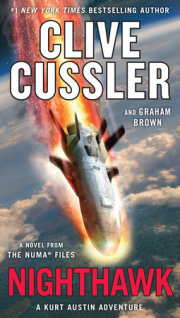
Fifty thousand feet above the Arctic Circle the air temperature was a frigid one hundred nineteen degrees below zero. A heavily modified C-17 transport cut through this bitterly cold air with two F-35 fighters trailing a mile behind. At this temperature, the atmosphere held nothing in the way of moisture and offered crystal clear views of the stars above and the moon, which oddly appeared below the aircraft, as it had just emerged on the far horizon.
Inside the C-17, in a comfortably heated compartment just aft of the cockpit, a group of engineers and technicians sat at various computer consoles watching different systems and analyzing incoming data.
"Target spotted," a voice announced across the compartment.
Senior test engineer Dan Caldwell looked up from his screen. There wasn't supposed to be a target for them to shoot at yet. He glanced around to see who'd spoken. He was not surprised to see Ridley Wiles, one of the systems analysts, standing at the window. Ridley was twenty-three, a civilian contractor, and not all that big on discipline. But he understood the laser system they were using like no one else.
"What target are you talking about?" Caldwell asked sharply. "Nothing on my scope."
"It's big and round . . . and allegedly made of cream cheese," Ridley replied. "We can hit it from here. Then it's bagels for everyone."
Groans and mild laughter wafted through the cabin as Ridley stepped back from the window and pointed at the moon.
Caldwell was not amused. "Get in your seat, Ridley. The punishment for failed attempts at humor is washing the plane by hand once we get back to Greenland. No gloves allowed."
Ridley took his seat and strapped himself in like he was supposed to. Caldwell let it go at that. He didn't mind the break in tension that a few well-placed groaners could bring on, but it was time to get serious.
The aircraft and laser system they were about to test was known as the EAGL, Enhanced Aerial Gunnery Laser. Caldwell had always wondered why someone hadn't added another word to the name so they could call it the EAGLE proper, but that was above his pay grade.
The laser in question was the most powerful laser in the world by a wide margin. It was far too heavy to be mounted in a fighter or attack craft. But placed aboard the modified C-17 and lifted to a high altitude, it could do things that would alter the rules of war. Assuming, of course, that it worked as planned.
Time to find out, Caldwell thought.
He pressed the intercom switch and spoke to the captain. "All systems go," he reported. "Cryogenics functioning at optimal levels. Laser waveguides are tuned. Change course to two-four-zero. We're entering the firing window now. Test protocol commencing."
The pilot replied affirmatively, and the big aircraft banked into a turn. For the next few minutes, they would watch their screens and wait, while an extremely powerful radar system mounted below the craft scanned the ocean's surface out to the edge of the curvature of the earth.
Several hundred miles away, an American submarine was about to launch an unarmed ballistic missile. It would burst from the surface in a spray of mist and foam, linger for an instant, and then rocket skyward on a pillar of flame.
As it climbed above the horizon, the radar system mounted on the underside of the C-17 would find it, lock on, and track it. Seconds ticked by. Then several tense minutes. They knew roughly when and where the missile would be launched, but to make the test realistic they hadn't been given the exact data.
Finally, something appeared on the scope. "Target acquired," a radar technician said. "Altitude three thousand feet and climbing. Range, speed, and acceleration computing now."
"Bring the laser to ready," Caldwell ordered.
Ridley moved a trio of switches from standby to active. The system, which had been tested before at lower settings, would be operating at the maximum power level for this final test. The high-pitched whine of rapidly spinning generators could be heard emanating from the aft section of the aircraft.
"Energy storage at full," another of the techs announced. "All systems green."
"Targeting solution confirmed," Ridley reported. "We're locked on."
"Activate laser," Caldwell said calmly.
Ridley reached forward, flipped open a protective plastic cover, and pressed a square, red button. A soft click was heard, but nothing else. There was no pulse, no recoil, no crash of thunder. There was no bright beam of a death ray to be seen, as the laser operated in the X-ray part of the spectrum.
Four hundred miles away, the submarine-launched ballistic missile was at ten thousand feet and streaking skyward at five thousand miles an hour; three times the speed of a rifle bullet. To the laser, which traveled at the speed of light, it might as well have been standing still.
The laser hit the target squarely, melting through the exterior in a hundredth of a second and detonating the rocket propellant. The explosion in the night sky over the Atlantic was visible for a hundred miles. Confirmation came to the C-17 via radar.
"Target separating," the radar tech announced as the green dot on the scope spread out and faded. In seconds, the rapidly expanding ball of fire and fragments had diffused past the point of radar detection. The blip vanished from the screen. "Target eliminated."
A small round of applause and congratulatory shouts erupted. Caldwell cut them short. "We still have work to do, gentlemen."
He heard the grumbling behind his back, but didn't turn around lest the team see the broad smile on his face.
As he ran through a systems check, a loud pop sounded behind him. Now he was angry. He spun in his chair, shouting as he turned. "That better not be champagne, Ridley!"
As he spoke the last word, Caldwell's mouth hung open in shock. Ridley held a gun and was firing it into the backs of the other technicians. Blood was splattering across the computer screens and consoles. They slumped forward or recoiled backward as the bullets hit. One of them managed to undo his seat belt and get up, only to get hit at point-blank range in the chest.
Caldwell freed himself from his harness and launched himself at Ridley, tackling him before he could swing the pistol around. The two men slammed to the floor of the aircraft, with Caldwell trying to drive his shoulder downward into the traitor's neck.
The gun discharged beneath him. It felt like a small explosion. A burning fire flared in Caldwell's gut.
Caldwell knew he'd been hit, but sensed it wasn't a mortal wound. He kept his weight on Ridley, rising up and slugging him in the jaw with a right hook. Ridley's head snapped to the side and blood splattered from his lips. It was a solid blow, but not a knockout punch. And it left Caldwell off balance. His core muscles, torn by the first shot, were too weak to keep him upright as Ridley bucked him off.
He fell to the side, put his hands on the deck, and spun back toward his opponent.
Ridley fired a second shot. This time the gun was pointed upward not sideways. Caldwell felt as if he'd been kicked in the chest. He reeled from the impact, rocking backward and then toppling over as his vision blurred. He slumped to the deck gasping for air.
Ridley got to one knee, leaning over him, trying to determine if he needed another bullet.
"Why?" Caldwell asked, his voice a raspy whisper.
"Why not," Ridley replied nastily, as if that explained everything.
Caldwell barely heard the words; he'd lost too much blood. He lay his head on the deck and closed his eyes.
Ridley looked around the compartment. The first part of the job was done. The test crew were dead. The compartment secure. Now for the more difficult disappearing act.
He stood up, put a hand to his bruised mouth, and wiggled a tooth free. He looked at it for a second and then tossed it aside. He'd get implants, and anything else he wanted once he had money to burn.
Ahead of him the cockpit door opened. Ridley raised the gun as the copilot came out. Instead of firing, he lowered the pistol.
The copilot held a bloody knife, which had been used to good effect on the aircraft's captain. "I assume we're flying on autopilot," Ridley said.
"For the moment," the copilot said. "I came back to see if you needed any help."
"Good work," Ridley told him. "Time for the second act. Turn toward Murmansk and shut down all the data relays. It's time for this plane to disappear."
"What about the F-35s?"
Ridley tried to smile, but his bruised face wouldn't allow it. "I'll take care of them."
Eight hundred miles away in a high-tech conference room a group of senior military officers watched the successful test and cheered. They pumped their fists and slapped each other on the back. They spoke enthusiastically about controlling the twenty-first-century battlefield with fleets of EAGL aircraft circling high above.
"The EAGL can shoot down a hundred ballistic missiles before they leave enemy territory," an Air Force general named Offerman boasted. "It can stand two hundred miles from a battlefield and take out a thousand drones in an hour's work."
"We could park one over every major city," the Assistant Secretary of Defense added. "And office workers can take their lunch at sidewalk cafés in the middle of a war."
A representative from Scion, the company that had built the laser, grinned and shrugged as if that was a little far-fetched in his mind. But his smile suggested it wasn't too far off. The main idea behind the EAGL was not to shoot down drones, but to make ballistic missiles obsolete. The plan was to build a fleet of the aircraft and have them patrol the Arctic, where all the ballistic missiles from Russia or China would have to travel to reach the United States. It was conservatively estimated that nine such aircraft could eradicate the entire Russian ballistic missile force even if it were launched simultaneously. Half the missiles would be destroyed before they reached the upper atmosphere. The other half would be wiped out as they raced directly overhead through the dark limits of space.
The Israelis had built an Iron Dome to protect their country. The United States would have one made of X-rays and invisible light.
Amid the celebration, one of the technicians noticed a problem. After confirming it wasn't on the receiving end, he alerted Offerman. "General, we're losing telemetry on the EAGL."
The celebration hit a wall. The laughter died. Everyone turned back to the screens they'd been watching earlier. Video from the chase planes showed the aircraft flying straight and level. It appeared fine.
"What data blocks are dropping out?" Offerman asked.
"We've lost navigation," the technician said. "Speed, altitude, heading, temperature."
On another screen, which showed a virtual mock-up of the cockpit, the indicators went from accurate numbers to a series of question marks. Seconds later they became dashed lines. Engine readouts failed next.
"Were losing laser telemetry now," a technician from Scion reported.
Offerman wavered as he felt a sudden numbness in his knees. If not for the view from the chase plane they would have no way of knowing if the C-17 was still flying or had exploded midair.
"Contact the pilot," Offerman said calmly.
The Air Force communication specialist put in several calls, but to no avail. "No response."
"Aircraft is turning and descending," someone called out.
"Contact the chase planes," Offerman ordered. "Find out what the hell is going on."
The communications specialist made the calls. "Blue Shadow Leader, this is Bullfrog. We've lost communications and telemetry with the EAGL. Track shows it changing course and descending. Can you confirm?"
The fighter pilot's steely voice came back an instant later. "Confirmed. EAGL is departing approved course. Aircraft is not responding to radio calls."
"Look at this," the Scion representative said. He'd pulled up a low-resolution feed from the cameras inside the aircraft. The video wasn't watched live because it was really only useful to review the crew performance after the fact. It showed the laser technicians slumped in their chairs. Caldwell's body could be seen on the floor, a swath of dark liquid seeping out from underneath him.
"Damn," someone blurted out. "It's a hijacking."
Offerman wasted no more time. "Send the self-destruct signal. Take it down."
Keys were turned. A switch guarded by plastic glass was revealed. The keys were turned again, arming the system. The Air Force staff sergeant in charge of the self-destruct system looked up for confirmation.
"Do it," Offerman snapped.
The switch was pressed and held. The signal went out via satellite. A sickening delay followed during which Offerman wondered what his next career would be after blowing up a billion-dollar aircraft. At least he'd go out with a bang.
Every eye focused on the view from the chase plane, awaiting a series of explosions that would start in the center of the fuselage, rupture the fuel lines, and quickly produce a massive fireball.
But nothing happened.
The sergeant reset the system and sent the signal again. "No response," he announced.
Curses filled the room. The assembled officers couldn't believe what they were seeing and hearing.
Offerman grabbed the microphone and spoke to the F-35 pilots. "Chase team, this is Bullfrog actual. The EAGL has been hijacked. I repeat, the EAGL has been hijacked. I'm giving you a direct order: Shoot down that plane."
The lead pilot responded in a businesslike tone, asking for a code word only they and Offerman knew.
"Confirmation code Red Whistle Falcon," Offerman said.
"Red Whistle confirmed," the fighter pilot replied. "Stand by."
General Offerman turned to the screen in time to see a missile launched from one of the F-35s. It raced forward in a trail of smoke, exploding long before it reached the EAGL. A second missile met the same fate.
"They're using the laser," someone shouted.
The screen flared once more as the first F-35 exploded in a ball of flame. Offerman pressed the talk switch, communicating with the second chase plane. "Shadow Two, switch to guns," he snapped. "Fire immediately! Fire imm-"
It was too late. This time there was no explosion, only a flare on the lens, followed by static. A moment later, the screen went dark, and the words signal loss appeared at the top.
Offerman froze, stunned into silence while staring at the dark screen. Somewhere over the Arctic, the second fireball in the sky was dimming. It marked the end of Falcon Two and the beginning of a new danger, the true depths of which Offerman struggled to fathom. They'd built a machine that could rule the sky, proven its worth in a difficult test, and now lost it to parties unknown.
Copyright © 2026 by Graham Brown. All rights reserved. No part of this excerpt may be reproduced or reprinted without permission in writing from the publisher.