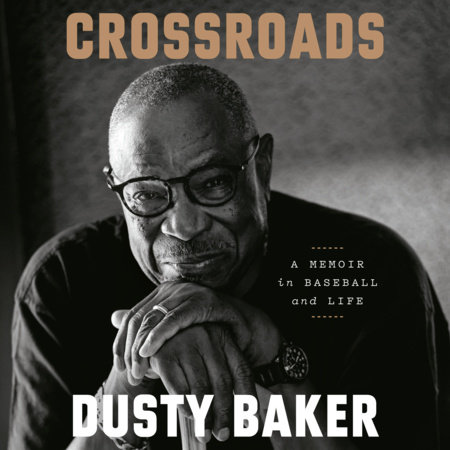
Download high-resolution image
Listen to a clip from the audiobook
audio pause button
0:00
0:00

Crossroads

A Memoir in Baseball and Life

Author Dusty Baker On Tour
Read by Dominic Hoffman, Dusty Baker On Tour
Listen to a clip from the audiobook
audio pause button
0:00
0:00
Audiobook Download
On sale Jun 09, 2026 | 18 Hours and 2 Minutes | 9798217175376
Grades 9-12

See Additional Formats
Legendary baseball player and manager Dusty Baker reflects on his extraordinary career—filled with invaluable lessons on perseverance, leadership, and living life meaningfully on the field and off.

Dusty Baker walked with baseball legends and became one himself. After he signed with the Braves in 1968 at the age of nineteen against his father’s wishes, no less than the great Hank Aaron promised to take Baker under his wing. Mentored by Aaron, Orlando Cepeda, and Willie Mays, Baker became a premier hitter, helping take the Dodgers to a World Series victory in 1981. He would bookend this with another championship in 2022, this time as a manager helping guide and redeem a Houston Astros team humbled by a cheating scandal. Respected by generations across the game, Baker has come to embody the spirit of the sport—and yet, to discuss his baseball career is only to scratch the surface of a remarkable life.

Crossroads will bring readers into the mind of one of baseball’s mavericks: a curious, inquisitive thinker whose deep interest in the worlds of music, wine, and the simpler joys of life charts a journey of success, struggle, faith, and perseverance. Baker's memoir is filled with hard-earned wisdom and a love for life so plentiful, it seems to radiate from every sentence.

A true American original, counting among his friends presidents and dignitaries, bluesmen and artists, Baker weaves a spell of life at the crossroads, where fate turns on our decisions and the unexpected answers that sometimes seek us out when we least expect it.
Chapter 1

Mom and Dad Gave Us Our Strength

I was raised to give everyone a chance. Or at least to try. My parents taught us to keep our eyes open and to trust our feelings about people. If you did that, you could trust that person enough to let them show you who they are. You might end up being disappointed, but more often than not, you would see the good in people. That core conviction has turned into a lifelong philosophy of mine. The devil might show up to lead some people astray, but most people have a lot of good in them, so why not look for the good?

Mom and Dad were both strong personalities. They gave me a strong moral foundation. From the time I could first crawl, my parents made sure to build up in me a sense of responsibility and a sense of possibility. I was the oldest of five, and my younger siblings and I would know the difference between right and wrong. My dad instilled tremendous common sense into me from an early age, and my mom always wanted to expose me to book-learning and intelligence, which I associated with her side of the family. It was a basic contrast between the two of them. I’m a combination of both. Thanks to Mom, all of us siblings would take our educations as far as we could. The emphasis on education came from my mom, but my dad was the enforcer. Dad led by example. He encouraged us to always be aware of our surroundings and be ready for whatever came along.

We were raised to be open to life and open to people—to what Dr. King called “the content of their character.” Here’s the thing about growing up Black in America: You have to see more. You have to notice more. You have to think more about getting along with white people than they ever have to think about getting along with you. There’s no sense being bitter or angry about that. It’s just reality.

Every time you meet someone new, it represents a crossroads. To set aside your fears and your self-doubt, to shut down your overactive mind that sometimes throws too many thoughts at you—that can be challenging. Do I keep my heart open to that person? Do I trust in my faith in God and my faith in the basic good in people? Do I keep looking out at the world with the spirit of a child? I’m still working on that.


I was born Johnnie B. Baker Jr. in June 1949, four years after World War II. I look back now and see that if I hadn’t been raised the way I was, if I hadn’t been taught by both parents to be responsible, I probably would have wound up in trouble later in life. I came of age in the 1960s, when the Vietnam War was raging and tearing the country apart. You had the Civil Rights Movement and then the Black Power Movement, hippies, and free love. It was a confusing but beautiful time all at once.

We hosted National Association for the Advancement of Colored People (NAACP) meetings at our house, usually about twenty-five or thirty people, a few white or Mexican American but mostly Black. My dad built that house with a big picture window in the living room, where everyone gathered on Saturday evening, since both my parents worked all week and Sunday was reserved for church activities. I was in the Junior NAACP from the time I was twelve or so, and I listened closely when my mom talked about the importance of voting. I learned young about the unfairness of hiring practices and discrepancies in pay structure, and how there was no governing body to which one could appeal. I first realized in those years that some racism can be triggered by your parents’ economic success. I found out that before the Black Power Movement came along and united us, there was a separation of dark skin and light skin within our race. I only made one all-star team in youth baseball, when I was twelve, and never made another one until I got to the big leagues. But I noticed kids making that all-star team who just happened to have the same last name as the sponsor on the back of their uniform. The world was not always fair.

My parents were always trying to find a way to help me see and know more. As the firstborn, I was forced to notice more because I was subjected to more, and more was asked of me. At the time, I didn’t always take too kindly to that. Usually I just wanted to forget myself playing outside, which was how I came to be called “Dusty.”

In my family, there was only one Johnnie B., and that was my dad. He never let anybody call me “Junior.” There was a dispute in the family over who first gave me my name. My dad would say he did, but my mom and her sister, my Aunt Loreena, were just sure it was one of them.

Loreena was my cool aunt. She was my mom’s older sister, and she taught me a lot. I learned from her about forgiveness. She gave me books to read and opened me up to spiritual things that went way beyond what I learned as a junior deacon in church. My Aunt Loreena was my spiritual leader. She was an entertainer, lived in Oakland, and always drove a big new Lincoln or Cadillac. When I was old enough, she let me drive her car and cruise around with my buddies. Aunt Loreena said she first gave me the name “Dusty,” and I wasn’t going to argue. I was always out in the yard playing and couldn’t keep my clothes clean for more than half an hour.

But my mom said she was the one to give me the name. She claimed she started calling me “Dusty” because I used to like to eat dirt. She said dirt-eating ran in the family. She had an aunt who also liked to eat dirt, she insisted. Something about the elements, iron or whatever else, which the body needed for nutrition. “Boy, what you doing eating dirt?” my mom would cry out into the yard. My mom was a very intelligent woman who spoke with clarity and precision and would later serve as my agent in early negotiations with the Atlanta Braves. Hear me when I say ain’t no way I’m challenging her word on that—and I put it that way knowing full well how much my mom hated the word “ain’t.”

I grew up in the small city of Riverside, California, which doubled in size from 50,000 to 100,000 when I was still a kid, but I was raised country all the way. My dad would not have had it any other way. That was how he had been raised back in Florida, and what was good for him was good for us. We might as well have been living in the South, like my dad as a boy. We had a chicken coop, and it was my job to collect the eggs most mornings—and ever since I dropped one, I can’t eat eggs over easy with yolk running all over. We hunted and we fished, and we did both to put food on the table. My dad could flat-out shoot. He would pull out his single-shot shotgun and empty a chamber at a rabbit or bird and then load that thing up again, all as fast as you could fire an automatic. He could shoot, but he couldn’t run, not with that bad leg of his. So I was his hunting dog. Dad shot the birds and I went and got them. It was a good way to learn. If you think like a hunting dog, you’re always going to have an edge as a hunter. That turned me into a lifelong hunter, the way that gardening and tending our fruit trees as a boy inspired in me a lifelong passion. Any time I’m at home in Sacramento, I love to work in my garden and tend to my fruit trees.

You look back at your childhood and ask yourself questions about how you turned out. Was I always destined to become me? From the time I was a baby? Or was I shaped by my environment to grow up into the man I would become? I was very fortunate to have the parents I did and to grow up where I did, an hour east of L.A., where at the time we had total integration, in sports and in school, Blacks and whites and Mexicans and Asians.

I was raised in the church, and that was where I was instilled with my fundamentals and my outlook on life that shaped the man I am today. I can thank the church for steering me away from the pool hall. In fact, to this day, I have never learned to shoot pool, because the pool hall was right across the street from Park Avenue Baptist Church. I knew I better not dare to be caught coming out of that pool hall. Someone was always watching. They would tell on you in a heartbeat. They would reprimand you and send you home, and then you’d get a whipping. You were reminded to never embarrass the family name. Consequently, very few of us got into any kind of trouble. That was the epitome of a village raising a child, Neighborhood Watch in the true sense, before Neighborhood Watch ever existed.

We always ate as a family and said grace every night when we sat down to dinner. On Sundays, we went to church all day. I was a junior deacon and my dad was a deacon. I also sang in the junior choir, and my mom and dad were both in the choir. Sunday school started at nine-thirty a.m., then you had the regular service from eleven a.m. to one p.m., then you went home to eat lunch as a family and play ball out in the yard and eat dinner. We went back to church at night for Baptist Training Union, which was where I played piano recitals for the church. I wanted to play the boogie-woogie or Jerry Lee Lewis, but instead I had to perform “The Blue Danube” followed by “Hungarian Rhapsody.” I had to bow, and all my buddies were there, snickering as I banged my way through. I was so embarrassed, man. It wasn’t always easy being my mom’s son, the way she was always focused on giving us class and culture.
Johnnie B. “Dusty” Baker Jr. is the former manager of the Houston Astros, San Francisco Giants, Chicago Cubs, Cincinnati Reds, and Washington Nationals. Baker was drafted by the Atlanta Braves after graduating high school in 1967 and went on to win the World Series in 1981 with the Los Angeles Dodgers. Baker retired as a player in 1986 and has since become one of the most celebrated managers in MLB history. He was the recipient of Baseball Digest’s Lifetime Achievement Award in 2024. View titles by Dusty Baker

About

Legendary baseball player and manager Dusty Baker reflects on his extraordinary career—filled with invaluable lessons on perseverance, leadership, and living life meaningfully on the field and off.

Dusty Baker walked with baseball legends and became one himself. After he signed with the Braves in 1968 at the age of nineteen against his father’s wishes, no less than the great Hank Aaron promised to take Baker under his wing. Mentored by Aaron, Orlando Cepeda, and Willie Mays, Baker became a premier hitter, helping take the Dodgers to a World Series victory in 1981. He would bookend this with another championship in 2022, this time as a manager helping guide and redeem a Houston Astros team humbled by a cheating scandal. Respected by generations across the game, Baker has come to embody the spirit of the sport—and yet, to discuss his baseball career is only to scratch the surface of a remarkable life.

Crossroads will bring readers into the mind of one of baseball’s mavericks: a curious, inquisitive thinker whose deep interest in the worlds of music, wine, and the simpler joys of life charts a journey of success, struggle, faith, and perseverance. Baker's memoir is filled with hard-earned wisdom and a love for life so plentiful, it seems to radiate from every sentence.

A true American original, counting among his friends presidents and dignitaries, bluesmen and artists, Baker weaves a spell of life at the crossroads, where fate turns on our decisions and the unexpected answers that sometimes seek us out when we least expect it.

Excerpt

Chapter 1

Mom and Dad Gave Us Our Strength

I was raised to give everyone a chance. Or at least to try. My parents taught us to keep our eyes open and to trust our feelings about people. If you did that, you could trust that person enough to let them show you who they are. You might end up being disappointed, but more often than not, you would see the good in people. That core conviction has turned into a lifelong philosophy of mine. The devil might show up to lead some people astray, but most people have a lot of good in them, so why not look for the good?

Mom and Dad were both strong personalities. They gave me a strong moral foundation. From the time I could first crawl, my parents made sure to build up in me a sense of responsibility and a sense of possibility. I was the oldest of five, and my younger siblings and I would know the difference between right and wrong. My dad instilled tremendous common sense into me from an early age, and my mom always wanted to expose me to book-learning and intelligence, which I associated with her side of the family. It was a basic contrast between the two of them. I’m a combination of both. Thanks to Mom, all of us siblings would take our educations as far as we could. The emphasis on education came from my mom, but my dad was the enforcer. Dad led by example. He encouraged us to always be aware of our surroundings and be ready for whatever came along.

We were raised to be open to life and open to people—to what Dr. King called “the content of their character.” Here’s the thing about growing up Black in America: You have to see more. You have to notice more. You have to think more about getting along with white people than they ever have to think about getting along with you. There’s no sense being bitter or angry about that. It’s just reality.

Every time you meet someone new, it represents a crossroads. To set aside your fears and your self-doubt, to shut down your overactive mind that sometimes throws too many thoughts at you—that can be challenging. Do I keep my heart open to that person? Do I trust in my faith in God and my faith in the basic good in people? Do I keep looking out at the world with the spirit of a child? I’m still working on that.


I was born Johnnie B. Baker Jr. in June 1949, four years after World War II. I look back now and see that if I hadn’t been raised the way I was, if I hadn’t been taught by both parents to be responsible, I probably would have wound up in trouble later in life. I came of age in the 1960s, when the Vietnam War was raging and tearing the country apart. You had the Civil Rights Movement and then the Black Power Movement, hippies, and free love. It was a confusing but beautiful time all at once.

We hosted National Association for the Advancement of Colored People (NAACP) meetings at our house, usually about twenty-five or thirty people, a few white or Mexican American but mostly Black. My dad built that house with a big picture window in the living room, where everyone gathered on Saturday evening, since both my parents worked all week and Sunday was reserved for church activities. I was in the Junior NAACP from the time I was twelve or so, and I listened closely when my mom talked about the importance of voting. I learned young about the unfairness of hiring practices and discrepancies in pay structure, and how there was no governing body to which one could appeal. I first realized in those years that some racism can be triggered by your parents’ economic success. I found out that before the Black Power Movement came along and united us, there was a separation of dark skin and light skin within our race. I only made one all-star team in youth baseball, when I was twelve, and never made another one until I got to the big leagues. But I noticed kids making that all-star team who just happened to have the same last name as the sponsor on the back of their uniform. The world was not always fair.

My parents were always trying to find a way to help me see and know more. As the firstborn, I was forced to notice more because I was subjected to more, and more was asked of me. At the time, I didn’t always take too kindly to that. Usually I just wanted to forget myself playing outside, which was how I came to be called “Dusty.”

In my family, there was only one Johnnie B., and that was my dad. He never let anybody call me “Junior.” There was a dispute in the family over who first gave me my name. My dad would say he did, but my mom and her sister, my Aunt Loreena, were just sure it was one of them.

Loreena was my cool aunt. She was my mom’s older sister, and she taught me a lot. I learned from her about forgiveness. She gave me books to read and opened me up to spiritual things that went way beyond what I learned as a junior deacon in church. My Aunt Loreena was my spiritual leader. She was an entertainer, lived in Oakland, and always drove a big new Lincoln or Cadillac. When I was old enough, she let me drive her car and cruise around with my buddies. Aunt Loreena said she first gave me the name “Dusty,” and I wasn’t going to argue. I was always out in the yard playing and couldn’t keep my clothes clean for more than half an hour.

But my mom said she was the one to give me the name. She claimed she started calling me “Dusty” because I used to like to eat dirt. She said dirt-eating ran in the family. She had an aunt who also liked to eat dirt, she insisted. Something about the elements, iron or whatever else, which the body needed for nutrition. “Boy, what you doing eating dirt?” my mom would cry out into the yard. My mom was a very intelligent woman who spoke with clarity and precision and would later serve as my agent in early negotiations with the Atlanta Braves. Hear me when I say ain’t no way I’m challenging her word on that—and I put it that way knowing full well how much my mom hated the word “ain’t.”

I grew up in the small city of Riverside, California, which doubled in size from 50,000 to 100,000 when I was still a kid, but I was raised country all the way. My dad would not have had it any other way. That was how he had been raised back in Florida, and what was good for him was good for us. We might as well have been living in the South, like my dad as a boy. We had a chicken coop, and it was my job to collect the eggs most mornings—and ever since I dropped one, I can’t eat eggs over easy with yolk running all over. We hunted and we fished, and we did both to put food on the table. My dad could flat-out shoot. He would pull out his single-shot shotgun and empty a chamber at a rabbit or bird and then load that thing up again, all as fast as you could fire an automatic. He could shoot, but he couldn’t run, not with that bad leg of his. So I was his hunting dog. Dad shot the birds and I went and got them. It was a good way to learn. If you think like a hunting dog, you’re always going to have an edge as a hunter. That turned me into a lifelong hunter, the way that gardening and tending our fruit trees as a boy inspired in me a lifelong passion. Any time I’m at home in Sacramento, I love to work in my garden and tend to my fruit trees.

You look back at your childhood and ask yourself questions about how you turned out. Was I always destined to become me? From the time I was a baby? Or was I shaped by my environment to grow up into the man I would become? I was very fortunate to have the parents I did and to grow up where I did, an hour east of L.A., where at the time we had total integration, in sports and in school, Blacks and whites and Mexicans and Asians.

I was raised in the church, and that was where I was instilled with my fundamentals and my outlook on life that shaped the man I am today. I can thank the church for steering me away from the pool hall. In fact, to this day, I have never learned to shoot pool, because the pool hall was right across the street from Park Avenue Baptist Church. I knew I better not dare to be caught coming out of that pool hall. Someone was always watching. They would tell on you in a heartbeat. They would reprimand you and send you home, and then you’d get a whipping. You were reminded to never embarrass the family name. Consequently, very few of us got into any kind of trouble. That was the epitome of a village raising a child, Neighborhood Watch in the true sense, before Neighborhood Watch ever existed.

We always ate as a family and said grace every night when we sat down to dinner. On Sundays, we went to church all day. I was a junior deacon and my dad was a deacon. I also sang in the junior choir, and my mom and dad were both in the choir. Sunday school started at nine-thirty a.m., then you had the regular service from eleven a.m. to one p.m., then you went home to eat lunch as a family and play ball out in the yard and eat dinner. We went back to church at night for Baptist Training Union, which was where I played piano recitals for the church. I wanted to play the boogie-woogie or Jerry Lee Lewis, but instead I had to perform “The Blue Danube” followed by “Hungarian Rhapsody.” I had to bow, and all my buddies were there, snickering as I banged my way through. I was so embarrassed, man. It wasn’t always easy being my mom’s son, the way she was always focused on giving us class and culture.

Author

Johnnie B. “Dusty” Baker Jr. is the former manager of the Houston Astros, San Francisco Giants, Chicago Cubs, Cincinnati Reds, and Washington Nationals. Baker was drafted by the Atlanta Braves after graduating high school in 1967 and went on to win the World Series in 1981 with the Los Angeles Dodgers. Baker retired as a player in 1986 and has since become one of the most celebrated managers in MLB history. He was the recipient of Baseball Digest’s Lifetime Achievement Award in 2024. View titles by Dusty Baker
  • More Websites from
    Penguin Random House
  • Common Reads
  • Library Marketing