Download high-resolution image
Listen to a clip from the audiobook
audio pause button
0:00
0:00

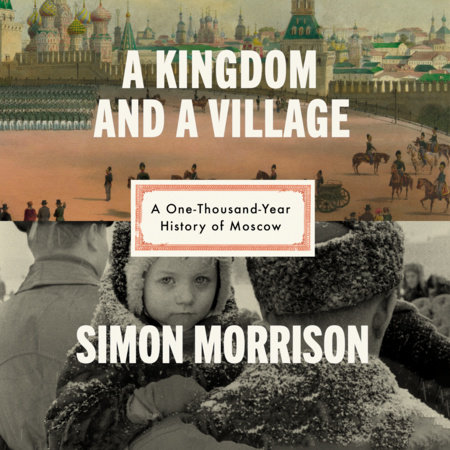
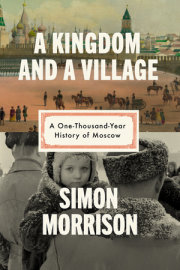
A Kingdom and a Village

A One-Thousand-Year History of Moscow

Read by Curt Ford
Listen to a clip from the audiobook
audio pause button
0:00
0:00
An erudite and entertaining history of Moscow, a city defined by its survival and reinvention, and whose rich history offers crucial insight into contemporary global politics

"A magisterial account of Moscow that reveals the city’s history and something of its soul through countless interwoven stories and colorful characters. . . . A gripping and enlightening journey.”
—Ben Rhodes, New York Times bestselling author of After the Fall


The city of Moscow stands at the center of a nation comprising eleven percent of the globe’s landmass, 11 time zones, and nearly 150 million people, some 13 million of whom live in the capital. In A Kingdom and a Village, acclaimed historian Simon Morrison offers a vividly rendered history of Russia’s heart and soul, tracing its transformation from a “big village”—the demeaning nickname the St. Peterburg nobility gave to its provincial neighbor—into a spectacular metropolis of vast geopolitical import.

That arc is the stuff of dramatic, violent, stranger-than-fiction historical narrative: the last century alone has featured invasions and costly battles, the destruction (and reconstruction) of sacred cultural and religious landmarks, and the collapse of the Soviet republic—not to mention the rise of an authoritarian leader who is a keen student of Russian history. Morrison reaches back further still, to the founding of the place we now know as Moscow as a fortress on a river nearly a millennium ago. In the centuries that followed, any number of external forces—from Tatar Mongols and Swedes to Napoleon and Hitler—set their sights on Moscow, reinforcing its self-conception as both a glittering prize and a site of perpetual defense and resurrection.

Drawing on a rich array of archival materials, from the birchbark scrawls that record the oldest layer of Russian civilization to the articles in European newspapers heralding the opening of the magnificent Bolshoi Theater, Morrison brings to life the bloody power struggles; cultural marvels; excruciating famines, droughts, storms, and fires that have shaped and reshaped the city and reinforced its essential character.

With A Kingdom and a Village, Morrison makes a persuasive, even impassioned case that to understand Moscow is not only to unlock the spellbinding mysteries of Russia’s past but also, critically, to grasp the grim logic of its present. It is a magisterial biography of a place—and an essential guide to a people and a nation.
1

The River

To mark the 800th anniversary of Moscow in 1947, the Soviet dictator, Iosif Stalin, ordered a team of archeologists in Kyiv to locate the grave of a prince named Yuri, the supposed founder of Moscow. In 1147, Yuri had reported his presence in a fort on a hill surrounded by a slow-moving river. A dirt and wood barrier failed to deter determined invaders. It was reinforced and expanded again and again over the centuries, until it became a symbol of sovereign power: the Kremlin, the official seat of the Russian and Soviet governments.

The archeologists’ goal was to find Yuri’s skull, which would guide the design of a statue of him across from Moscow City Hall. But nothing was found in the Church of the Savior on Berestov where Yuri was thought to have been buried, despite the promises of a plaque inside the chapel claiming “This is where he lies.” In 1989, three sarcophagi were found on the grounds along with a beer bottle containing an indecipherable note. One of them, it’s been hoped, contains the remains of Yuri, the others one of his sons and one of his wives. DNA tests have been inconclusive.

Nonetheless, the design competition for the statue went forward. The proposal submitted by Vera Mukhina depicted Yuri “in the magnificent ancient clothes of a Russian prince—no chain mail—in a long white cloak trimmed with gold stitching, held with a precious sparkling buckle.” He had soft features befitting the prince of a “capital of peace, goodness, art.” This design was rejected in favor of another by Sergey Orlov, who made Yuri a true Russian hero and a symbol of the nation’s might (his maternal Anglo-Saxon lineage aside). When the monument was belatedly unveiled, on June 6, 1954, one person yelled “Doesn’t look like him!” while another insisted “It does!” Communist hardliners argued that a statue of the prince, a feudal exploiter of the peasantry, didn’t belong in the middle of Soviet Moscow. They lost the argument.

Yuri girds for battle; his stallion raises a hoof. He is armored and helmeted with a heraldic shield boasting the coat of arms of Moscow: an image of St. George (Yuri’s patron saint) slaying a serpent. St. George symbolizes the combined power of the church and the state, which vanquish Russia’s enemies while punishing her people for their sins and disloyalty, represented by the serpent. “No matter how terrible the demon might be, power believes, and never doubts, that one day it will manage to defeat the monster and save us all,” medievalist Vladimir Sharov explains. Power looks after itself. Power exists for itself.

The prince sits high in his bronze saddle, pulling on his stallion’s reins with one of his long arms, pointing downward with the other, as if to say this is where it all began, where the walls went up and the moats were dug and princes, priests, and traders from the Silk Road gathered. Here is the spot near, if not the moment when, Moscow came into being as a fort on a hill along a river.

The river bears the same name as the city: Moscow or, in proper Russian pronunciation, Moskva. It’s shallow, murky, and freezes in winter, as do its various tributaries. The Neglinka, its largest tributary, runs underneath the center of Moscow and once served as a defensive moat before being encased in pipes in the eighteenth century. By that time, the Neglinka reeked of human and animal waste and needed to be buried. During severe droughts, the Moskva reluctantly withdrew from its banks and dried up in places. Between 1932 and 1937 an eighty-mile-long canal was dug by prisoners to provide for the city’s industrial and domestic water needs. It connected the Moscow neighborhood of Tushino to a network of inland waterways and seas in the north. The alleys in the oldest parts of the city follow the contours of streams that no longer exist, having been rerouted or buried.

The Moskva flows from west to east through Moscow, the surrounding region, Moskovskaya oblast’, and a much older city named Smolensk. It eventually merges with the Oka River and then the Volga, the longest river in Europe, spanning well over two thousand miles across boreal forests and desert basins to empty into the Caspian Sea. The Moskva was easily navigable by medieval canoes and sledges, so a ring-fenced settlement arose above a brackish bend. There were long, hard rains and snows, though in nature, as the cliché goes, there’s no such thing as bad weather. The forest drowsed in fall and rustled in spring; through the summer, crickets chirped and toads croaked in the marshes, and the meadow across the river hummed. The spirits of the water, wind, and wood had yet to clash with monks and priests and their belief in an almighty God who had made man in his image and granted him dominion over the birds and beasts.

Moscow existed long before Russia but for centuries had no influence, no role in affairs beyond its own wooden walls. The name itself denotes either a boggy place or black, turbid water; it might also, as tourist guides prefer, refer to female bears (from the Finno-Ugric words maska and ava, meaning bear and dam respectively). The Komi language suggests a derivation from moska, a cow, and va, which means either “river” or “wet.” Perhaps the Moskva River was a good spot for breeding cattle? A biblical explanation, popularized in the sixteenth century, claims that Moscow was named after Mosoch, a grandson of Noah who, according to the book of Genesis, succumbed with Noah to the seductions of wine. Mosoch arrived in the Russian lands and named the beautiful site he found overlooking a river after himself and his wife Kva. The combined names of their children became the name of a steep-banked stream, the Yauza. In this fanciful tale, Moscow is more than five thousand years old, but connections to turbid water and cows prove most convincing, because these have a root, mosk, in East Slavonic and relate, at heart, to the Russian word for “dank,” promozglïy.

The people who traveled and foraged along the river were called, in Old Norse and Old Swedish, Rus. Russian of course derives from Rus, a word also related to the Finnic Ruotsi and the Estonian Root’si, referring to Swedes, but the Rus were not Russian in the familiar sense. The original Rus seem to have been Scandinavian boatsmen, “the inhabitants of straits between islands.” A medieval illustration shows a dozen or so Rus tucked into a pair of sailboats on wheels, having rolled up to the walls of Constantinople from its northern shore. They look happy in their vessel. In winter, when the ice was thick enough, the boatsmen traveled on sledges piled up with goods. They also traveled by land over paths frozen hard as rock.

The origins of the word Slav, as in Slavic peoples or Slavic languages, is more obscure. Historians long ago cut the cord between Slav and slave, an invention of later times. The standard story is that Slav was pressed into service as slave because so many of the young women sold into bondage came from the East—most notably in 1382, when Asiatic horsemen descended from Genghis Khan sacked Moscow, flaying and burning thousands of people and dragging away thousands more. Etymological dictionaries also suggest a derivation from a Byzantine Greek word meaning “plunder,” which turns the Slavs into marauding pirates. Slav also sounds like slava, the Russian word for glory. But slav and slava might simply be homonyms. Linguistically slav better relates to slov, the Russian for “word.” In this conception, the Slavs were tribes who could understand one another, because they spoke the same or similar tongues. And there’s more: Slav/slov relates to the archaic verb “to hear/listen,” which establishes a neat binary between Slavs and nemtsi—literally “the dumb,” “those without speech,” or inarticulate. Nemtsi is a standard medieval word for “foreigners,” and in Russian is now the word for Germans. Lastly, there is an appealing correlation between the word Slav and the forgotten Indo-European word slauos. Who are the Slavs? They are what that word means: people.

The origins of these people are as cloudy as the Moskva itself, and what little is known is suspect. Moscow was a trading route before it became a hodgepodge of hovels and labyrinth of lanes. Pottery fragments reveal the presence or at least the passing-through of hunters and fishers since the Neolithic period, 7000–1700 BCE. Excavations along the Oka suggest the possible presence of East Slavic tribes (the Krivichi and Vyatichi) in the ninth or tenth century CE. Two coins—silver dirhams minted in 862 and 866 in the Iranian city of Merv—also ended up in the bog. Recently unearthed bracelets, pendants, crystals, and beads indicate sophisticated trading activity as far back as 1100, and a lead seal decorated with an image of the Mother of God and the archangel Michael suggests the presence in the area, before 1100, of the Eastern Orthodox Metropolitan of Kyiv. Other artifacts, including “pink slate spindle-whorls, beads and a lead weight from a pair of scales,” were not made in Moscow but brought up from Kyiv and as far south as the Black Sea.

Some 550 miles to the south of Moscow, Kyiv was the heart of what would become Kyivan Rus, a loose federation of Eastern Slavic peoples who existed between two empires from the late ninth century to the mid-thirteenth century. The Byzantine Empire stretched down into the Mediterranean, encompassing parts of the Balkans, Middle East, and northeast Africa. Its imperial center, Constantinople, enjoyed olive trees, a blue-green sea, and bright yellow sunlight. Byzantium was the total opposite of the fur, hide, iron, gray clouds, and smothering snows and frosts of the Rus. This realm has long been credited as the source of the Russian alphabet. The assumption is that Cyrillic came to Kyiv from Bulgaria and Serbia as part of a conscious effort to spread the Christian faith from Byzantium into the Slavic lands. Another argument has the Cyrillic alphabet spreading more naturally, through regular and routine contact between Slavs and Greeks in the Balkans. The alphabet is named after the apostle Cyril, who is believed to have invented (with his brother Methodius) a related alphabet: the Glagolitic, which is less Greek in origin than Eastern. It is more complicated, which might explain why it disappeared from the Slavic world and Cyrillic took hold. The Byzantine Empire also brought the Christian faith, Christian ethics, and literature in Cyrillic to the Slavic world. The language of the Church was quite unlike the language of everyday life—serious, solemn, formal. A “totally untutored East Slav” would have found his own tongue as transmitted by religious texts “strange, in places opaque,” as befits the mysteries of faith. Reconstructing the spoken language of the Rus is not possible.

To the north of Kyivan Rus, Scandinavia exerted its political, social, and economic influence. Varangians, adventure-seekers who hired themselves out as mercenaries, confronted the Slavs and other Finnic groups around Novgorod or, as it was originally called, Nevo Gardas. The Varangians did not otherwise establish a presence on the continent but left a larger mark on the Baltic shores, where they influenced the vernacular. Stor (large) in Swedish became storas (fat) in Lithuanian, and barn (child) morphed into berns. A sizable percentage of Estonian words are of Scandinavian origin, yet Slavic languages do not show the same influence.

The relationship among these three worlds is as contested as the land itself. Were Scandinavia and Rus merely peripheral to the power of Byzantium? Or did Rus fill the “transit zone” between two competing European influences—the north a realm of brawn and brains, the south one of spirit? Some would elevate the political status of Scandinavia and claim it defined European culture and politics for a time. The “Slavophile” argument instead emphasizes the mystical-mythical distinctiveness of Slavic lands and their populations, a kind of cult of the black (pagan) earth contra the white (Christian) beliefs imposed on it. This position embraces the primordial spirit world, prehistoric bloodlines, the great cathedral of the forest, and major rivers of Eastern Europe as arteries connecting a body of peoples. Nature was revered, the rhythms of the seasons celebrated. If it did not rain, if the sun did not come out, if blizzards submerged the tracks, if the frost did not relent and the thaw was late, people died.

These civilizations include writers. There survive inscriptions and graffiti in the churches of Rus along with scrapings on parchment (animal skins), wooden tablets, and birch bark. Some very early texts feature Roman and Greek letters in no discernible order, others are in almost indecipherable East Slavonic and Cyrillic scripts. Pre- or proto-Cyrillic scripts have not been found. The tales preserved in the earliest written chronicles are unreliable as fact at a time when the concept of fiction did not yet exist. These complicated but crucial documents sensationalize the good and especially the bad. Tediously copied out by monks and other paid scribes for use in medieval libraries, the chronicles describe princes displacing their brothers and uncles; the gradual, sometimes violent adaptation of a religion in a language few understood, much less spoke; fur, wax, and honey traders; theft; taxation; and—in passing—Prince Yuri. He invited a rival and kinsman to feast at his table in 1147, the year that marks the first recorded mention of a place called Moscow and the river curving through it.

That story is told in the Primary Chronicle (or Tale of Bygone Years, Povest’ vremmenïkh let), a twelfth-century compilation of Norse sagas, melodic tales of heroic deeds, the Bible, and Kyivan historical detritus. It had been attributed to Nestor (1056–1114), a monk of the Caves Monastery in Kyiv, but that ascription has been debunked. A monastic father superior named Sil’vestr claimed that he “wrote” the chronicle in 1116 for his ruler, the Grand Prince of Kyiv, but nothing that old survives. The earliest surviving transpositions, the Laurentian and Hypatian (Ipatiev) codices, date to the fourteenth and fifteenth centuries. Oral Scandinavian tales and a Greek text were also layered in.
A Kingdom and a Village is a magisterial account of Moscow that reveals the city’s history and something of its soul through countless interwoven stories and colorful characters. This book is a gripping and enlightening journey filled with war and peace; tyrants and revolutionaries; famine, pestilence and plague; music, literature and theater; Christianity and Communism; death and rebirth. At a time when Russia is once again trying to remake the borders of Europe and the nature of politics in the world, Simon Morrison gives us a new way to understand this vast and ever-changing country through this singularly compelling capital city.”
—Ben Rhodes, New York Times bestselling author of After the Fall

“A gem of a book, exploring the people, the fables, and the history of Moscow, one of the great cities of the world. With vivid writing, and an astonishing body of research, Simon Morrison creates a mesmerizing tale of how Moscow came to be. Read it slowly, wander through the Russian capital with him, and you will understand when he says: ‘Moscow is hard to love, but I love it.’”
—Jill Dougherty, author of My Russia

"Simon Morrison’s riveting biography of Moscow is breathtaking in its span, covering architecture, music, Russian leaders’ decisions and the ordinary people’s response, society, institutions, and much more. It is also Morrison’s beautifully written story of his personal relations with the country that began in 1990 during Mikhail Gorbachev’s Perestroika, when he visited Moscow for the first time. It is a love story that has continued to this day."
—Nina Khrushcheva, co-author of In Putin’s Footsteps

“A preeminent historian of Russian history and culture, Simon Morrison is the perfect biographer of Moscow, one of the world’s most fascinating and enigmatic cities.”
Shaun Walker, author of The Illegals

"Russia is more than just Moscow, but it has long been its beating heartat once bloody and life-givingand this book captures its progress from insignificant hamlet to modern megalopolis magnificently. Every page pulses with individuals' stories or historical insights, making this a wonderful biography of a city, its rulers and people."
Mark Galeotti, author of A Short History of Russia

"A marvellous book. It takes huge imaginative vision and a deep on-the-ground knowledge of Moscow, acquired over many years, to grasp the full dynamism of the city’s history. But Simon Morrison has pulled it off. His ambitious, erudite account is vivid and compelling, a wonderful conjuring up of Russia’s great capital in all its beauty, fire and fury'
—Helen Rappaport, author of The Rebel Romanov

"A revealing portrait of a city that has made and been made by an always difficult history….A winning account."
—Kirkus
© Anna Gaskell
SIMON MORRISON is a professor of music and Slavic languages and literatures at Princeton University. He is a regular contributor to The Times Literary Supplement and London Review of Books and has written for Time, The New York Review of Books, and The New York Times. He has received a Guggenheim Fellowship and holds a PhD from Princeton University. View titles by Simon Morrison

About

An erudite and entertaining history of Moscow, a city defined by its survival and reinvention, and whose rich history offers crucial insight into contemporary global politics

"A magisterial account of Moscow that reveals the city’s history and something of its soul through countless interwoven stories and colorful characters. . . . A gripping and enlightening journey.”
—Ben Rhodes, New York Times bestselling author of After the Fall


The city of Moscow stands at the center of a nation comprising eleven percent of the globe’s landmass, 11 time zones, and nearly 150 million people, some 13 million of whom live in the capital. In A Kingdom and a Village, acclaimed historian Simon Morrison offers a vividly rendered history of Russia’s heart and soul, tracing its transformation from a “big village”—the demeaning nickname the St. Peterburg nobility gave to its provincial neighbor—into a spectacular metropolis of vast geopolitical import.

That arc is the stuff of dramatic, violent, stranger-than-fiction historical narrative: the last century alone has featured invasions and costly battles, the destruction (and reconstruction) of sacred cultural and religious landmarks, and the collapse of the Soviet republic—not to mention the rise of an authoritarian leader who is a keen student of Russian history. Morrison reaches back further still, to the founding of the place we now know as Moscow as a fortress on a river nearly a millennium ago. In the centuries that followed, any number of external forces—from Tatar Mongols and Swedes to Napoleon and Hitler—set their sights on Moscow, reinforcing its self-conception as both a glittering prize and a site of perpetual defense and resurrection.

Drawing on a rich array of archival materials, from the birchbark scrawls that record the oldest layer of Russian civilization to the articles in European newspapers heralding the opening of the magnificent Bolshoi Theater, Morrison brings to life the bloody power struggles; cultural marvels; excruciating famines, droughts, storms, and fires that have shaped and reshaped the city and reinforced its essential character.

With A Kingdom and a Village, Morrison makes a persuasive, even impassioned case that to understand Moscow is not only to unlock the spellbinding mysteries of Russia’s past but also, critically, to grasp the grim logic of its present. It is a magisterial biography of a place—and an essential guide to a people and a nation.

Excerpt

1

The River

To mark the 800th anniversary of Moscow in 1947, the Soviet dictator, Iosif Stalin, ordered a team of archeologists in Kyiv to locate the grave of a prince named Yuri, the supposed founder of Moscow. In 1147, Yuri had reported his presence in a fort on a hill surrounded by a slow-moving river. A dirt and wood barrier failed to deter determined invaders. It was reinforced and expanded again and again over the centuries, until it became a symbol of sovereign power: the Kremlin, the official seat of the Russian and Soviet governments.

The archeologists’ goal was to find Yuri’s skull, which would guide the design of a statue of him across from Moscow City Hall. But nothing was found in the Church of the Savior on Berestov where Yuri was thought to have been buried, despite the promises of a plaque inside the chapel claiming “This is where he lies.” In 1989, three sarcophagi were found on the grounds along with a beer bottle containing an indecipherable note. One of them, it’s been hoped, contains the remains of Yuri, the others one of his sons and one of his wives. DNA tests have been inconclusive.

Nonetheless, the design competition for the statue went forward. The proposal submitted by Vera Mukhina depicted Yuri “in the magnificent ancient clothes of a Russian prince—no chain mail—in a long white cloak trimmed with gold stitching, held with a precious sparkling buckle.” He had soft features befitting the prince of a “capital of peace, goodness, art.” This design was rejected in favor of another by Sergey Orlov, who made Yuri a true Russian hero and a symbol of the nation’s might (his maternal Anglo-Saxon lineage aside). When the monument was belatedly unveiled, on June 6, 1954, one person yelled “Doesn’t look like him!” while another insisted “It does!” Communist hardliners argued that a statue of the prince, a feudal exploiter of the peasantry, didn’t belong in the middle of Soviet Moscow. They lost the argument.

Yuri girds for battle; his stallion raises a hoof. He is armored and helmeted with a heraldic shield boasting the coat of arms of Moscow: an image of St. George (Yuri’s patron saint) slaying a serpent. St. George symbolizes the combined power of the church and the state, which vanquish Russia’s enemies while punishing her people for their sins and disloyalty, represented by the serpent. “No matter how terrible the demon might be, power believes, and never doubts, that one day it will manage to defeat the monster and save us all,” medievalist Vladimir Sharov explains. Power looks after itself. Power exists for itself.

The prince sits high in his bronze saddle, pulling on his stallion’s reins with one of his long arms, pointing downward with the other, as if to say this is where it all began, where the walls went up and the moats were dug and princes, priests, and traders from the Silk Road gathered. Here is the spot near, if not the moment when, Moscow came into being as a fort on a hill along a river.

The river bears the same name as the city: Moscow or, in proper Russian pronunciation, Moskva. It’s shallow, murky, and freezes in winter, as do its various tributaries. The Neglinka, its largest tributary, runs underneath the center of Moscow and once served as a defensive moat before being encased in pipes in the eighteenth century. By that time, the Neglinka reeked of human and animal waste and needed to be buried. During severe droughts, the Moskva reluctantly withdrew from its banks and dried up in places. Between 1932 and 1937 an eighty-mile-long canal was dug by prisoners to provide for the city’s industrial and domestic water needs. It connected the Moscow neighborhood of Tushino to a network of inland waterways and seas in the north. The alleys in the oldest parts of the city follow the contours of streams that no longer exist, having been rerouted or buried.

The Moskva flows from west to east through Moscow, the surrounding region, Moskovskaya oblast’, and a much older city named Smolensk. It eventually merges with the Oka River and then the Volga, the longest river in Europe, spanning well over two thousand miles across boreal forests and desert basins to empty into the Caspian Sea. The Moskva was easily navigable by medieval canoes and sledges, so a ring-fenced settlement arose above a brackish bend. There were long, hard rains and snows, though in nature, as the cliché goes, there’s no such thing as bad weather. The forest drowsed in fall and rustled in spring; through the summer, crickets chirped and toads croaked in the marshes, and the meadow across the river hummed. The spirits of the water, wind, and wood had yet to clash with monks and priests and their belief in an almighty God who had made man in his image and granted him dominion over the birds and beasts.

Moscow existed long before Russia but for centuries had no influence, no role in affairs beyond its own wooden walls. The name itself denotes either a boggy place or black, turbid water; it might also, as tourist guides prefer, refer to female bears (from the Finno-Ugric words maska and ava, meaning bear and dam respectively). The Komi language suggests a derivation from moska, a cow, and va, which means either “river” or “wet.” Perhaps the Moskva River was a good spot for breeding cattle? A biblical explanation, popularized in the sixteenth century, claims that Moscow was named after Mosoch, a grandson of Noah who, according to the book of Genesis, succumbed with Noah to the seductions of wine. Mosoch arrived in the Russian lands and named the beautiful site he found overlooking a river after himself and his wife Kva. The combined names of their children became the name of a steep-banked stream, the Yauza. In this fanciful tale, Moscow is more than five thousand years old, but connections to turbid water and cows prove most convincing, because these have a root, mosk, in East Slavonic and relate, at heart, to the Russian word for “dank,” promozglïy.

The people who traveled and foraged along the river were called, in Old Norse and Old Swedish, Rus. Russian of course derives from Rus, a word also related to the Finnic Ruotsi and the Estonian Root’si, referring to Swedes, but the Rus were not Russian in the familiar sense. The original Rus seem to have been Scandinavian boatsmen, “the inhabitants of straits between islands.” A medieval illustration shows a dozen or so Rus tucked into a pair of sailboats on wheels, having rolled up to the walls of Constantinople from its northern shore. They look happy in their vessel. In winter, when the ice was thick enough, the boatsmen traveled on sledges piled up with goods. They also traveled by land over paths frozen hard as rock.

The origins of the word Slav, as in Slavic peoples or Slavic languages, is more obscure. Historians long ago cut the cord between Slav and slave, an invention of later times. The standard story is that Slav was pressed into service as slave because so many of the young women sold into bondage came from the East—most notably in 1382, when Asiatic horsemen descended from Genghis Khan sacked Moscow, flaying and burning thousands of people and dragging away thousands more. Etymological dictionaries also suggest a derivation from a Byzantine Greek word meaning “plunder,” which turns the Slavs into marauding pirates. Slav also sounds like slava, the Russian word for glory. But slav and slava might simply be homonyms. Linguistically slav better relates to slov, the Russian for “word.” In this conception, the Slavs were tribes who could understand one another, because they spoke the same or similar tongues. And there’s more: Slav/slov relates to the archaic verb “to hear/listen,” which establishes a neat binary between Slavs and nemtsi—literally “the dumb,” “those without speech,” or inarticulate. Nemtsi is a standard medieval word for “foreigners,” and in Russian is now the word for Germans. Lastly, there is an appealing correlation between the word Slav and the forgotten Indo-European word slauos. Who are the Slavs? They are what that word means: people.

The origins of these people are as cloudy as the Moskva itself, and what little is known is suspect. Moscow was a trading route before it became a hodgepodge of hovels and labyrinth of lanes. Pottery fragments reveal the presence or at least the passing-through of hunters and fishers since the Neolithic period, 7000–1700 BCE. Excavations along the Oka suggest the possible presence of East Slavic tribes (the Krivichi and Vyatichi) in the ninth or tenth century CE. Two coins—silver dirhams minted in 862 and 866 in the Iranian city of Merv—also ended up in the bog. Recently unearthed bracelets, pendants, crystals, and beads indicate sophisticated trading activity as far back as 1100, and a lead seal decorated with an image of the Mother of God and the archangel Michael suggests the presence in the area, before 1100, of the Eastern Orthodox Metropolitan of Kyiv. Other artifacts, including “pink slate spindle-whorls, beads and a lead weight from a pair of scales,” were not made in Moscow but brought up from Kyiv and as far south as the Black Sea.

Some 550 miles to the south of Moscow, Kyiv was the heart of what would become Kyivan Rus, a loose federation of Eastern Slavic peoples who existed between two empires from the late ninth century to the mid-thirteenth century. The Byzantine Empire stretched down into the Mediterranean, encompassing parts of the Balkans, Middle East, and northeast Africa. Its imperial center, Constantinople, enjoyed olive trees, a blue-green sea, and bright yellow sunlight. Byzantium was the total opposite of the fur, hide, iron, gray clouds, and smothering snows and frosts of the Rus. This realm has long been credited as the source of the Russian alphabet. The assumption is that Cyrillic came to Kyiv from Bulgaria and Serbia as part of a conscious effort to spread the Christian faith from Byzantium into the Slavic lands. Another argument has the Cyrillic alphabet spreading more naturally, through regular and routine contact between Slavs and Greeks in the Balkans. The alphabet is named after the apostle Cyril, who is believed to have invented (with his brother Methodius) a related alphabet: the Glagolitic, which is less Greek in origin than Eastern. It is more complicated, which might explain why it disappeared from the Slavic world and Cyrillic took hold. The Byzantine Empire also brought the Christian faith, Christian ethics, and literature in Cyrillic to the Slavic world. The language of the Church was quite unlike the language of everyday life—serious, solemn, formal. A “totally untutored East Slav” would have found his own tongue as transmitted by religious texts “strange, in places opaque,” as befits the mysteries of faith. Reconstructing the spoken language of the Rus is not possible.

To the north of Kyivan Rus, Scandinavia exerted its political, social, and economic influence. Varangians, adventure-seekers who hired themselves out as mercenaries, confronted the Slavs and other Finnic groups around Novgorod or, as it was originally called, Nevo Gardas. The Varangians did not otherwise establish a presence on the continent but left a larger mark on the Baltic shores, where they influenced the vernacular. Stor (large) in Swedish became storas (fat) in Lithuanian, and barn (child) morphed into berns. A sizable percentage of Estonian words are of Scandinavian origin, yet Slavic languages do not show the same influence.

The relationship among these three worlds is as contested as the land itself. Were Scandinavia and Rus merely peripheral to the power of Byzantium? Or did Rus fill the “transit zone” between two competing European influences—the north a realm of brawn and brains, the south one of spirit? Some would elevate the political status of Scandinavia and claim it defined European culture and politics for a time. The “Slavophile” argument instead emphasizes the mystical-mythical distinctiveness of Slavic lands and their populations, a kind of cult of the black (pagan) earth contra the white (Christian) beliefs imposed on it. This position embraces the primordial spirit world, prehistoric bloodlines, the great cathedral of the forest, and major rivers of Eastern Europe as arteries connecting a body of peoples. Nature was revered, the rhythms of the seasons celebrated. If it did not rain, if the sun did not come out, if blizzards submerged the tracks, if the frost did not relent and the thaw was late, people died.

These civilizations include writers. There survive inscriptions and graffiti in the churches of Rus along with scrapings on parchment (animal skins), wooden tablets, and birch bark. Some very early texts feature Roman and Greek letters in no discernible order, others are in almost indecipherable East Slavonic and Cyrillic scripts. Pre- or proto-Cyrillic scripts have not been found. The tales preserved in the earliest written chronicles are unreliable as fact at a time when the concept of fiction did not yet exist. These complicated but crucial documents sensationalize the good and especially the bad. Tediously copied out by monks and other paid scribes for use in medieval libraries, the chronicles describe princes displacing their brothers and uncles; the gradual, sometimes violent adaptation of a religion in a language few understood, much less spoke; fur, wax, and honey traders; theft; taxation; and—in passing—Prince Yuri. He invited a rival and kinsman to feast at his table in 1147, the year that marks the first recorded mention of a place called Moscow and the river curving through it.

That story is told in the Primary Chronicle (or Tale of Bygone Years, Povest’ vremmenïkh let), a twelfth-century compilation of Norse sagas, melodic tales of heroic deeds, the Bible, and Kyivan historical detritus. It had been attributed to Nestor (1056–1114), a monk of the Caves Monastery in Kyiv, but that ascription has been debunked. A monastic father superior named Sil’vestr claimed that he “wrote” the chronicle in 1116 for his ruler, the Grand Prince of Kyiv, but nothing that old survives. The earliest surviving transpositions, the Laurentian and Hypatian (Ipatiev) codices, date to the fourteenth and fifteenth centuries. Oral Scandinavian tales and a Greek text were also layered in.

Reviews

A Kingdom and a Village is a magisterial account of Moscow that reveals the city’s history and something of its soul through countless interwoven stories and colorful characters. This book is a gripping and enlightening journey filled with war and peace; tyrants and revolutionaries; famine, pestilence and plague; music, literature and theater; Christianity and Communism; death and rebirth. At a time when Russia is once again trying to remake the borders of Europe and the nature of politics in the world, Simon Morrison gives us a new way to understand this vast and ever-changing country through this singularly compelling capital city.”
—Ben Rhodes, New York Times bestselling author of After the Fall

“A gem of a book, exploring the people, the fables, and the history of Moscow, one of the great cities of the world. With vivid writing, and an astonishing body of research, Simon Morrison creates a mesmerizing tale of how Moscow came to be. Read it slowly, wander through the Russian capital with him, and you will understand when he says: ‘Moscow is hard to love, but I love it.’”
—Jill Dougherty, author of My Russia

"Simon Morrison’s riveting biography of Moscow is breathtaking in its span, covering architecture, music, Russian leaders’ decisions and the ordinary people’s response, society, institutions, and much more. It is also Morrison’s beautifully written story of his personal relations with the country that began in 1990 during Mikhail Gorbachev’s Perestroika, when he visited Moscow for the first time. It is a love story that has continued to this day."
—Nina Khrushcheva, co-author of In Putin’s Footsteps

“A preeminent historian of Russian history and culture, Simon Morrison is the perfect biographer of Moscow, one of the world’s most fascinating and enigmatic cities.”
Shaun Walker, author of The Illegals

"Russia is more than just Moscow, but it has long been its beating heartat once bloody and life-givingand this book captures its progress from insignificant hamlet to modern megalopolis magnificently. Every page pulses with individuals' stories or historical insights, making this a wonderful biography of a city, its rulers and people."
Mark Galeotti, author of A Short History of Russia

"A marvellous book. It takes huge imaginative vision and a deep on-the-ground knowledge of Moscow, acquired over many years, to grasp the full dynamism of the city’s history. But Simon Morrison has pulled it off. His ambitious, erudite account is vivid and compelling, a wonderful conjuring up of Russia’s great capital in all its beauty, fire and fury'
—Helen Rappaport, author of The Rebel Romanov

"A revealing portrait of a city that has made and been made by an always difficult history….A winning account."
—Kirkus

Author

© Anna Gaskell
SIMON MORRISON is a professor of music and Slavic languages and literatures at Princeton University. He is a regular contributor to The Times Literary Supplement and London Review of Books and has written for Time, The New York Review of Books, and The New York Times. He has received a Guggenheim Fellowship and holds a PhD from Princeton University. View titles by Simon Morrison
  • More Websites from
    Penguin Random House
  • Common Reads
  • Library Marketing