Download high-resolution image Look inside
Listen to a clip from the audiobook
audio pause button
0:00
0:00

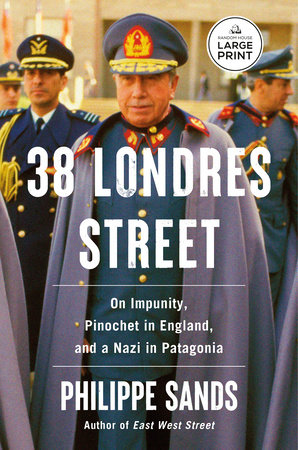
38 Londres Street

On Impunity, Pinochet in England, and a Nazi in Patagonia

Look inside
Listen to a clip from the audiobook
audio pause button
0:00
0:00
Large Print (Large Print - Tradepaper)
$37.00 US
| $50.00 CAN
On sale Nov 04, 2025 | 720 Pages | 9798217170135

See Additional Formats
THE NEW YORK TIMES BOOK REVIEW EDITORS' CHOICE • A KIRKUS BEST NONFICTION BOOK OF THE YEAR • In this intimate legal and historical detective story, the world-renowned lawyer and acclaimed author of East West Street traces the footsteps of two of the twentieth century’s most merciless criminals—accused of genocide and crimes against humanity—testing the limits of immunity and impunity after Nuremberg.

“Though nearly a decade in the making, this book could not arrive at a better time, because its subject is one of the most pressing themes of our era: impunity. . . . Sands has created an indelible and enthralling work of moral witness.” —Patrick Radden Keefe, author of Say Nothing


On the evening of October 16, 1998, Chilean dictator Augusto Pinochet was arrested at a medical clinic in London. After a brutal, seventeen-year reign marked by assassinations, disappearances, and torture—frequently tied to the infamous detention center at the heart of Santiago, Londres 38—Pinochet was being indicted for international crimes and extradition to Spain, opening the door to criminal charges that would follow him to the grave, in 2006.

Three decades earlier, on the evening of December 3, 1962, SS-Commander Walter Rauff was arrested in his home in Punta Arenas, at the southern tip of Chile. As the overseer of the development and use of gas vans in World War II, he was indicted for the mass murder of tens of thousands of Jews and faced extradition to West Germany.

Would these uncommon criminals be held accountable? Were their stories connected? The Nuremberg Trials—where Rauff’s crimes had first been read into the record, in 1945—opened the door to universal jurisdiction, and Pinochet's case would be the first effort to ensnare a former head of state.

In this unique blend of memoir, courtroom drama, and travelogue, Philippe Sands gives us a front row seat to the Pinochet trial—where he acted as a barrister for Human Rights Watch—and teases out the dictator’s unexpected connection to a leading Nazi who ended up managing a king crab cannery in Patagonia. A decade-long journey exposes the chilling truth behind the lives of two men and their intertwined destinies on 38 Londres Street.
Prologue

Santiago, August 1974

A Chevrolet refrigerated van trundled along La Alameda, which connected the Moneda Palace to the University. Near the ancient Church of San Francisco it turned right, to enter the Barrio París-Londres, constructed around the intersection of two streets, Calle Londres and Calle París. The neighbourhood, once the garden of an ancient hermitage, was home to poets, writers and artists.

The van moved over the cobblestones before coming to a stop before a low grey stone building, number 38. Referred to simply as Londres, elsewhere the street might have been Londonstrasse, or Rue de Londres, or Londres Street.

Men in civilian clothing opened the van’s rear doors and a group of men and women in blindfolds tumbled out and entered number 38. One was a twenty-year-old student of history, arrested for sub-version. He wasn’t sure where he was, but through a gap in the blindfold he glimpsed the black and white floor tiles that marked the entrance. A chessboard, the headquarters of the Socialist Party.

He was led up a few stone steps and into the building, separated from his companions and taken to a side room where he was in­structed to sit. Another person, a woman, sat next to him.

‘My name is León.’

‘My name is Hedy,’ the woman replied.

They waited. After a while, he was escorted to a staircase that wound up the back of the building, to the first floor. In another room, a guard ordered him to remove his clothing. Naked, he was made to lie on his back on the frame of an old bed, metal and cold. His wrists and ankles were tied to the frame. He was splayed, like a pig on a spit.

He heard low voices, and wondered if one had a German accent. As he lay, he made out the shape of an old typewriter, tall, elegant. He heard other voices and noticed a scent, cheap and familiar. The sounds approached, the scent sharpened. Flaño, a perfume that would come to induce a sense of anxiety and fear.

Later, when he was back in the room on the ground floor, a young man was carried in and deposited on the floor, in a heap. Alfonso, someone whispered, a philosophy student, in a dreadful condition. Shortly, a young woman was brought to him, another detainee. The two spoke a few words before the philosophy student was bundled out of the building, put in the back of a refrigerated van, and driven away.

He was never seen again.

London, October 1998


Twenty-four years later.

Four police officers gathered outside Room 801, on the eighth floor of a medical clinic on a street in the centre of London. An interpreter was present, late on that Friday evening in October. They entered the room, where an eighty-two-year-old man lay in bed, recovering from an operation on his back. Augusto Pinochet.

The interpreter, a lady with bouffant hair, informed him in Span­ish that he was under arrest and told him his rights. ‘You are charged with murder,’ she said, ‘by a Spanish judge who wishes to extradite you to Madrid to be put on trial for a genocide you perpetrated in Chile, for torturing people and making them disappear.’

Two weeks later, in Paris, I greeted my wife at the large wooden gates that marked the entrance to the Pantin cemetery, on the out­skirts of the city. This was where my grandfather was buried. We embraced. ‘I’ve just received an approach from Augusto Pinochet’s lawyers,’ I told her. ‘They would like me to argue that he is immune from the jurisdiction of the English courts and could not be extra­dited to Spain, for genocide or any other crimes.’

‘Will you do it?’ she asked in a firm voice. I reminded her of the ‘cab-rank principle’, the rule that required barristers to act like taxi drivers, to take every fare, to turn down none because of politics or personality.

‘Will you do it?’ she asked again.

You know the rule, so yes, that was my inclination.

‘Fine,’ she said in a tone that was both irritated and sweet, ‘but if you do it, I will divorce you.’

Hagenberg, Austria, June 2015


Seventeen years later.

I was on the upper floor of an ancient and dilapidated castle in northern Austria, making my way through the family archive of a long-dead Austrian couple. I found an old letter, written after the war, sent to Otto Wächter, on the run in Rome. The writer was a man named Walther Rauff, dispensing advice from Damascus in Syria:

Maintain an unshakable toughness, don’t be shy about the work you do, and don’t spend time harking back to better times. Accept the current situation and you can achieve a lot and climb back up the ladder . . . The main thing is to get out of Europe . . . and focus on the ‘reassembling of good forces for a later operation’.

Go to South America, Rauff told Wächter, who had once overseen the extermination of hundreds of thousands of Jews and Poles in Lviv, and then added: ‘I will pursue things along these lines.’

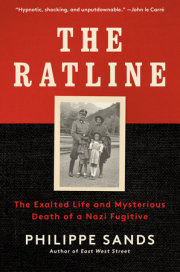
I learned that the writer of the letter was also an SS man on the run. He was notorious for his role in overseeing the policy to use vans to gas Jews and others to their deaths, and then to kill hundreds of thousands of people across Europe, to make them disappear. Indicted for these acts of mass killing, Herr Rauff avoided capture and made his way onto the Ratline. Years later, he ended up at the end of the world, in Patagonia in southern Chile, the manager of a king-crab cannery.

Rumours about his past followed him. So did rumours about his connection to General Pinochet. ‘Everybody knows,’ said a taxi driver in downtown Santiago.

PART I

ARREST


The certainty that there is no place on earth where crimes will go unpunished may be an effective means of preventing them.


Cesare Beccaria, 1764

LONDON, OCTOBER 1998


1


It was 17 October 1998, a Saturday afternoon, when I heard the news on the radio, waiting for the football results. It was my thirty-eighth birthday. The former Chilean dictator, General Augusto Pinochet, has been arrested in London, the BBC reported, at the request of a Spanish judge. This was interesting, as it wasn’t every day that a former head of state was detained. The details were sketchy, but it was said that the extradition request alleged crimes of genocide, tor­ture and disappearances committed during his years in power, from the day of the Coup that brought him to power on 11 September 1973 until he stepped down, in March 1990.

News of the arrest gave rise to anger, delight and disbelief. The Chilean government protested that Pinochet was a former President and Senator-for-Life with complete immunity. ‘A transgression of international norms,’ his son told a crowd throwing eggs at the British ambassador’s residence in Santiago. ‘An act of cowardice,’ claimed the Pinochet Foundation, guardian of his legacy. ‘He was sleeping when police arrived at his room in the clinic.’

Pinochet’s opponents, on the other hand, were thrilled. Finally, he can be questioned on the fate of our loved ones, said the president of the Families of the Disappeared. A ‘unique opportunity’ to answer for his regime’s human rights violations, said María Isabel Allende, daughter of President Salvador Allende, who died on the day of the Coup.

‘An earthquake,’ wrote Roberto Bolaño, a Chilean novelist living near Barcelona.

A matter for the courts, said the British government. ‘The idea that a brutal dictator should claim diplomatic immunity would be pretty gut-wrenching stuff’ for most people, said Peter Mandelson, a minister.

Former Prime Minister Margaret Thatcher declared the arrest to be outrageous, unlawful and inhumane, carried out ‘at dead of night’ on a sedated Pinochet. It put all former leaders at risk, inhibiting decisions that might cause a leader to ‘appear before a foreign court to answer for it’. Those who wield ‘absolute power’ would be less likely to relinquish it, ‘for fear of ending their days in a Spanish prison’. She was supported by Norman Lamont, a former Conservative minister who considered Pinochet to be a ‘good, brave and honourable soldier’.

I was a teenager at the time of the Coup and knew little about Pinochet. Over the next years, I didn’t visit Chile and the Chileans I came to know were mainly law students who took my classes, or academics exiled to Europe. I did, however, read books and see films about those times. In 1991 I saw a performance of Ariel Dorfman’s play Death and the Maiden at the Royal Court Theatre in London and I have not forgotten Juliet Stevenson’s portrayal of a woman who recognises her torturer, a memory she describes to her husband:

‘Weren’t you blindfolded and sick?’ [says the husband]

‘I can be sick and recognise a voice.’

‘A vague memory of someone’s voice is not proof of anything.’

‘It’s his voice. I recognised it as soon as he came in here last night.

The way he laughs. Certain phrases he uses.’

Around that time I came to know a Chilean law professor, Francisco Orrego Vicuña, with whom I later worked on environmental issues. I was not aware he’d served as Pinochet’s ambassador in London, until that detail emerged and scuppered his election to become a judge at the International Court of Justice. He was in decent com­pany: the writer Jorge Luis Borges was said to have lost his chance of a Nobel Prize for Literature because of the admiration he expressed for Pinochet.

2


Augusto Pinochet Ugarte was born in 1915 in Valparaíso, of Breton and Basque heritage. He joined the military and made his way up through the ranks. On the way, he taught in military academies in Chile and Ecuador, where he lived in the mid-1950s with his wife Lucía Hiriart. In 1970, Salvador Allende, the newly elected socialist President, appointed Pinochet as General Chief of Staff of the Army, serving under Carlos Prats, his friend and Commander-in-Chief. On 23 August 1973, after Prats resigned, Allende promoted Pino­chet to Commander-in-Chief. Eighteen days later, on 11 September, Pinochet played a leading role in the Coup that toppled Allende, who committed suicide in the Moneda Palace, the home of the presidency. The events are portrayed in Patricio Guzmán’s The Battle of Chile, a trilogy of remarkable documentary films.

Pinochet, a virulent anti-communist and Germanophile, was anointed as head of a four-man Military Junta, and later President of Chile. He was supported by large sections of the Chilean pop­ulation and, in the United States, by President Nixon and Henry Kissinger, who became Secretary of State a week after the Coup. They welcomed Pinochet’s government as a bulwark against Soviet influence and a means to promote free-market principles inspired by the ideas of the economist Milton Friedman and the ‘Chicago Boys’.

The Junta legislated to ‘remove Marxism from Chile’, dissolving leftist political parties and expropriating their assets. The Socialist Party building at Londres 38, in the heart of Santiago, was acquired and turned into a secret interrogation and torture centre, known as the Yucatán Barracks. Here, to avoid drawing attention, interro­gators and guards dressed as civilians, uniformed personnel were prohibited and unmarked vans and other regular vehicles moved prisoners in and out. The Junta took over private companies to op­erate and finance its secret activities and repression.

The Junta established a secret police force, the Dirección de Inteli­gencia Nacional, the DINA, to rein in opponents and run Londres 38 and other such places of torture and killing. As director, Pinochet ap­pointed Manuel Contreras, a trusted Army man from the School of Engineers in Tejas Verdes near San Antonio, west of Santiago on the Pacific coast, giving him unlimited powers to destroy leftists. Every morning, Contreras reported to Pinochet who, he claimed, person­ally approved each DINA operation. Pinochet himself was protected by the boinas negras, the black berets, an elite military group.

For four years the DINA detained, interrogated and tortured tens of thousands of Pinochet’s opponents. Many were killed, and by September 1977, when the DINA was dissolved, more than fifteen hundred people had disappeared. Imprisonment and assassination became routine in Chile, and also abroad. ‘A country occupied by the dictatorship, which was directly in line with the thinking of the Nazis,’ thought the poet Raúl Zurita.

Within a day of the Coup, Salvador Allende’s former ministers were sent to a newly constructed concentration camp on Dawson Island, in the Straits of Magellan, near Punta Arenas, in the south of the country.

Within a month, a Chilean Army death squad was engaged in a countrywide tour of assassinations. Ninety-seven people were killed in the operation that came to be known as the ‘Caravan of Death’.

Within a year, the DINA was operating dozens of detention cen-tres. At Londres 38, on average one prisoner disappeared every day. Nearby detention centres included the National Stadium; the Villa Grimaldi; the clandestine cells at Cuatro Álamos, part of the regular facilities at Tres Álamos; and the secret Simón Bolívar Barracks, op­erated by the DINA’s Lautaro Brigade. The DINA acquired a house on the Vía Naranja, in a wealthy suburb of Santiago, where chemists produced sarin gas in the basement as literary salons were held on the upper floor.

The DINA operated centres around the entire country. In San Antonio there was the Tejas Verdes barracks and a little further south the torture facilities at Santo Domingo. In the far south, in Punta Arenas, the Old Naval Hospital was taken over and came to be known as the ‘Palacio de las Sonrisas’ (‘Palace of Smiles’).

A year after the Coup, the Pinochet government and the DINA acted to commit murder outside Chile. In September 1974, General Prats was assassinated in Buenos Aires. A ‘most capable man,’ said Pinochet on hearing about the death of his old friend and predecessor as Commander-in-Chief. ‘I always felt affection for him.’

In October 1975, the exiled Christian Democrat leader Bernardo Leighton was the target of a failed assassination attempt, in Rome.

In November 1975, on Pinochet’s sixtieth birthday, the DINA established Operation Condor, a joint project with Argentina, Bo­livia, Chile, Paraguay and Uruguay. It would target leftist leaders and democrats across South America.

In July 1976, Carmelo Soria, a United Nations official with full immunity under international law, was abducted on a central Santi­ago street. Two days later, the body of the dual Chilean and Spanish national was found in the city’s Canal del Carmen.
Named a Best Book of 2025 So Far by The Economist

"Though nearly a decade in the making, this book could not arrive at a better time, because its subject is one of the most pressing themes of our era: impunity. Weaving together a globe-trotting legal thriller, a personal history, and a twin portrait of a pair of mass murderers—one a fugitive Nazi, the other a head of state—Sands has created an indelible and enthralling work of moral witness." —Patrick Radden Keefe, author of Say Nothing

“A remarkable book that reveals as never before the history of the former dictator’s detention in London—a chronicle that soon branches out into a whirlwind of other stories and events. . . . It is the relentless pursuit of this hidden and repulsive past that gives 38 Londres Street its startling originality, turning it into a tour de force that extends its reach far beyond what we typically envisage from a book about human rights. . . . I wondered how [Sands] would pull this off. He brilliantly succeeds. . . . Such a masterful work is the result of ten years of research and scores of interviews in several countries. . . . A constant back-and-forth in time and space that weaves together different strands of the past, both personal and collective, with each inquiry buttressed by striking sketches of those involved and the threads skillfully fashioned into a tapestry so that each event and investigation relates to all the others. This achieves a degree of mesmerizing subtlety in 38 Londres Street, as he proves that ‘everything is connected.’ . . . Exceptional.” —Ariel Dorfman, New York Review of Books

“Marvelous and absorbing. . . . Sands is also a consummate storyteller, gently teasing out his heavy themes and the accompanying legal intricacies through the unforgettable details he unearths and the many people—Rauff’s family, former military conscripts, British legal insiders—who open up to him. . . . There is a measure of hope in this book, but Sands shows that even in the face of overwhelming evidence, justice is never a foregone conclusion, especially when it comes to holding the powerful to account.” —Jennifer Szalai, The New York Times Book Review

“Sands’s research into this mystery [of the link between Rauff and Pinochet] becomes by far the most emotionally powerful strand of 38 Londres Street, which is no criticism of the rest. . . . He draws little distinction between Rauff’s victims on one continent and those on another, under one regime and another—a reminder why the international community has a duty, in his eyes, to prosecute torture and genocide across borders. It’s also a reminder that . . . ‘It is a fine thing to investigate for a personal reason.’ All three of Sands’s books on immunity are a stirring testament to this truth.” —Lily Meyer, The Washington Post

“A chilling transnational history of twentieth-century atrocity. What emerges is a profoundly humane examination of the legal, political, and ideological networks that make impunity possible, and a study of the moral clarity needed to confront power when it shields itself behind a uniform, a border, or a flag. . . . What makes Sands’s account of this legal drama so compelling is the way he weaves it into both the story of democratic reconstruction in post-dictatorial South America and the broader trajectory of his long-running investigations into atrocity and impunity.” —Andre Pagliarini, The New Republic

"38 Londres Street is many books, but especially two: on the one hand, an absorbing thriller where the fates of the bloodthirsty Chilean dictator Augusto Pinochet and the nazi war criminal Walter Rauff intertwine, as do the present and the past, fiction and reality, chance and necessity; on the other hand, a profound, lucid and indispensable reflection on justice and impunity in a world that aspires or should aspire to universal justice. This is not only the most ambitious book Philippe Sands has written, but also his best. An enthralling read." —Javier Cercas, author of The Imposter

"In 38 Londres Street Philippe Sands combines the tone of the thriller with an astute and dramatic account of a most complex and fascinating legal case. Since Sands was present in court, there is an urgency in the narrative and a sharp sense of what was at stake. The book also offers a vivid picture of the personalities involved, including Pinochet himself, his translator, the judges, the British government and the victims of Pinochet's crimes. In the background lies evil itself in the guise of a Nazi in exile, the sinister Walther Rauff. This is a brilliant and important book." —Colm Toibin, author of Long Island

"The pace of a thriller novel, meticulously recorded and filled with urgent moral and political questions, this is Philippe Sands at his very best." —Ian Rankin, author of Midnight and Blue

"An extraordinary achievement . . . I read with open mouth and thumping heart. Sands brilliantly traces the atrocious trail of blood that leads from the death camps of Nazi Germany to the torture rooms of Pinochet's Chile. 38 Londres Street takes its place as one of the most unforgettable and important records of the systematic pitiless cruelty of which tyrannies are capable." —Stephen Fry

"A true masterpiece. Utterly compelling, a staggering piece of research and beautifully written." —Henry Marsh, author of Do No Harm

"Sands is phenomenal. The research alone leaves one dazed with admiration." —Antony Beevor, author of The Second World War

"An odyssey of both international and personal significance. . . . Sands builds suspense like the best of mystery writers. 38 Londres Street is a masterful and timely mix of history, journalism, and memoir." Booklist (starred review)

“An extraordinary exposé of the collusion of Nazis with the Pinochet dictatorship in Chile. . . . An international law scholar and practitioner points to the loopholes that allowed a tyrant to evade prosecution.” Kirkus Reviews (starred review)

“Gripping . . . Sands evocatively studies the two mass murderers, with their similarly arrogant and unrepentant personalities, as avatars of a fascism undefeated and still festering in the West. With the extradition efforts against both men ultimately failing, the result is a disturbing indictment of an international legal system hampered in its ability to punish crimes against humanity.” Publishers Weekly (starred review)

“Reads like a detective novel, fast and compelling . . . The Pinochet case raised a controversial issue of enormous international significance.” —Jonathan Sumption, The Spectator

“[An] intriguing, beautifully observed and thoughtful book about immunity and impunity . . . Sands makes his legal arguments come alive.” —Roger Boyes, The Times (London)

“This remarkable, sweeping book completes Sands's trilogy about Nazi war crimes . . . Sands’s exhaustive research is as impressive as his storytelling.” —Paul Whitington, Sunday Independent

“Sands’s achievement is to excavate a deeper intimacy between the cases of Rauff and Pinochet . . . he follows each twist in the double narrative with an impressive combination of moral clarity and judicious detachment . . . But it is Sands’s expertise in international law, coupled with a natural storyteller's intuition for structure, that gives his latest book its understated power. His stories have all the more impact for their subtlety.” —Rafael Behr, The Guardian

“Sands is a storyteller and a scholar, capable of turning scraps into an enthralling collage . . . These questions of memory and impunity are forever timely.” —Henry Mance, Financial Times

“Well told . . . An account of how difficult it is to bring to book those guilty of the most appalling crimes.” —Philip Johnston, The Daily Telegraph

“The concluding part of Philippe Sands's extraordinary trilogy—part history, part moral investigation, part memoir—that documents the legal and personal battles to bring to account Nazi war criminals and their disciples . . . One of Sands’s strengths as a writer is that he resists the impulse to demonise . . . He achieves [a damning picture] with his understated doggedness.” —Andrew Anthony, The Observer
PHILIPPE SANDS is professor of law at the University of London, the Samuel Pisar Visiting Professor at Harvard Law School, and the author of East West Street. He is a frequent commentator on CNN and the BBC World Service, and a litigator before international courts. He is the former president of English PEN. In 2003, Sands was appointed a Queen’s Counsel. He lives in London, England. View titles by Philippe Sands

About

THE NEW YORK TIMES BOOK REVIEW EDITORS' CHOICE • A KIRKUS BEST NONFICTION BOOK OF THE YEAR • In this intimate legal and historical detective story, the world-renowned lawyer and acclaimed author of East West Street traces the footsteps of two of the twentieth century’s most merciless criminals—accused of genocide and crimes against humanity—testing the limits of immunity and impunity after Nuremberg.

“Though nearly a decade in the making, this book could not arrive at a better time, because its subject is one of the most pressing themes of our era: impunity. . . . Sands has created an indelible and enthralling work of moral witness.” —Patrick Radden Keefe, author of Say Nothing


On the evening of October 16, 1998, Chilean dictator Augusto Pinochet was arrested at a medical clinic in London. After a brutal, seventeen-year reign marked by assassinations, disappearances, and torture—frequently tied to the infamous detention center at the heart of Santiago, Londres 38—Pinochet was being indicted for international crimes and extradition to Spain, opening the door to criminal charges that would follow him to the grave, in 2006.

Three decades earlier, on the evening of December 3, 1962, SS-Commander Walter Rauff was arrested in his home in Punta Arenas, at the southern tip of Chile. As the overseer of the development and use of gas vans in World War II, he was indicted for the mass murder of tens of thousands of Jews and faced extradition to West Germany.

Would these uncommon criminals be held accountable? Were their stories connected? The Nuremberg Trials—where Rauff’s crimes had first been read into the record, in 1945—opened the door to universal jurisdiction, and Pinochet's case would be the first effort to ensnare a former head of state.

In this unique blend of memoir, courtroom drama, and travelogue, Philippe Sands gives us a front row seat to the Pinochet trial—where he acted as a barrister for Human Rights Watch—and teases out the dictator’s unexpected connection to a leading Nazi who ended up managing a king crab cannery in Patagonia. A decade-long journey exposes the chilling truth behind the lives of two men and their intertwined destinies on 38 Londres Street.

Excerpt

Prologue

Santiago, August 1974

A Chevrolet refrigerated van trundled along La Alameda, which connected the Moneda Palace to the University. Near the ancient Church of San Francisco it turned right, to enter the Barrio París-Londres, constructed around the intersection of two streets, Calle Londres and Calle París. The neighbourhood, once the garden of an ancient hermitage, was home to poets, writers and artists.

The van moved over the cobblestones before coming to a stop before a low grey stone building, number 38. Referred to simply as Londres, elsewhere the street might have been Londonstrasse, or Rue de Londres, or Londres Street.

Men in civilian clothing opened the van’s rear doors and a group of men and women in blindfolds tumbled out and entered number 38. One was a twenty-year-old student of history, arrested for sub-version. He wasn’t sure where he was, but through a gap in the blindfold he glimpsed the black and white floor tiles that marked the entrance. A chessboard, the headquarters of the Socialist Party.

He was led up a few stone steps and into the building, separated from his companions and taken to a side room where he was in­structed to sit. Another person, a woman, sat next to him.

‘My name is León.’

‘My name is Hedy,’ the woman replied.

They waited. After a while, he was escorted to a staircase that wound up the back of the building, to the first floor. In another room, a guard ordered him to remove his clothing. Naked, he was made to lie on his back on the frame of an old bed, metal and cold. His wrists and ankles were tied to the frame. He was splayed, like a pig on a spit.

He heard low voices, and wondered if one had a German accent. As he lay, he made out the shape of an old typewriter, tall, elegant. He heard other voices and noticed a scent, cheap and familiar. The sounds approached, the scent sharpened. Flaño, a perfume that would come to induce a sense of anxiety and fear.

Later, when he was back in the room on the ground floor, a young man was carried in and deposited on the floor, in a heap. Alfonso, someone whispered, a philosophy student, in a dreadful condition. Shortly, a young woman was brought to him, another detainee. The two spoke a few words before the philosophy student was bundled out of the building, put in the back of a refrigerated van, and driven away.

He was never seen again.

London, October 1998


Twenty-four years later.

Four police officers gathered outside Room 801, on the eighth floor of a medical clinic on a street in the centre of London. An interpreter was present, late on that Friday evening in October. They entered the room, where an eighty-two-year-old man lay in bed, recovering from an operation on his back. Augusto Pinochet.

The interpreter, a lady with bouffant hair, informed him in Span­ish that he was under arrest and told him his rights. ‘You are charged with murder,’ she said, ‘by a Spanish judge who wishes to extradite you to Madrid to be put on trial for a genocide you perpetrated in Chile, for torturing people and making them disappear.’

Two weeks later, in Paris, I greeted my wife at the large wooden gates that marked the entrance to the Pantin cemetery, on the out­skirts of the city. This was where my grandfather was buried. We embraced. ‘I’ve just received an approach from Augusto Pinochet’s lawyers,’ I told her. ‘They would like me to argue that he is immune from the jurisdiction of the English courts and could not be extra­dited to Spain, for genocide or any other crimes.’

‘Will you do it?’ she asked in a firm voice. I reminded her of the ‘cab-rank principle’, the rule that required barristers to act like taxi drivers, to take every fare, to turn down none because of politics or personality.

‘Will you do it?’ she asked again.

You know the rule, so yes, that was my inclination.

‘Fine,’ she said in a tone that was both irritated and sweet, ‘but if you do it, I will divorce you.’

Hagenberg, Austria, June 2015


Seventeen years later.

I was on the upper floor of an ancient and dilapidated castle in northern Austria, making my way through the family archive of a long-dead Austrian couple. I found an old letter, written after the war, sent to Otto Wächter, on the run in Rome. The writer was a man named Walther Rauff, dispensing advice from Damascus in Syria:

Maintain an unshakable toughness, don’t be shy about the work you do, and don’t spend time harking back to better times. Accept the current situation and you can achieve a lot and climb back up the ladder . . . The main thing is to get out of Europe . . . and focus on the ‘reassembling of good forces for a later operation’.

Go to South America, Rauff told Wächter, who had once overseen the extermination of hundreds of thousands of Jews and Poles in Lviv, and then added: ‘I will pursue things along these lines.’

I learned that the writer of the letter was also an SS man on the run. He was notorious for his role in overseeing the policy to use vans to gas Jews and others to their deaths, and then to kill hundreds of thousands of people across Europe, to make them disappear. Indicted for these acts of mass killing, Herr Rauff avoided capture and made his way onto the Ratline. Years later, he ended up at the end of the world, in Patagonia in southern Chile, the manager of a king-crab cannery.

Rumours about his past followed him. So did rumours about his connection to General Pinochet. ‘Everybody knows,’ said a taxi driver in downtown Santiago.

PART I

ARREST


The certainty that there is no place on earth where crimes will go unpunished may be an effective means of preventing them.


Cesare Beccaria, 1764

LONDON, OCTOBER 1998


1


It was 17 October 1998, a Saturday afternoon, when I heard the news on the radio, waiting for the football results. It was my thirty-eighth birthday. The former Chilean dictator, General Augusto Pinochet, has been arrested in London, the BBC reported, at the request of a Spanish judge. This was interesting, as it wasn’t every day that a former head of state was detained. The details were sketchy, but it was said that the extradition request alleged crimes of genocide, tor­ture and disappearances committed during his years in power, from the day of the Coup that brought him to power on 11 September 1973 until he stepped down, in March 1990.

News of the arrest gave rise to anger, delight and disbelief. The Chilean government protested that Pinochet was a former President and Senator-for-Life with complete immunity. ‘A transgression of international norms,’ his son told a crowd throwing eggs at the British ambassador’s residence in Santiago. ‘An act of cowardice,’ claimed the Pinochet Foundation, guardian of his legacy. ‘He was sleeping when police arrived at his room in the clinic.’

Pinochet’s opponents, on the other hand, were thrilled. Finally, he can be questioned on the fate of our loved ones, said the president of the Families of the Disappeared. A ‘unique opportunity’ to answer for his regime’s human rights violations, said María Isabel Allende, daughter of President Salvador Allende, who died on the day of the Coup.

‘An earthquake,’ wrote Roberto Bolaño, a Chilean novelist living near Barcelona.

A matter for the courts, said the British government. ‘The idea that a brutal dictator should claim diplomatic immunity would be pretty gut-wrenching stuff’ for most people, said Peter Mandelson, a minister.

Former Prime Minister Margaret Thatcher declared the arrest to be outrageous, unlawful and inhumane, carried out ‘at dead of night’ on a sedated Pinochet. It put all former leaders at risk, inhibiting decisions that might cause a leader to ‘appear before a foreign court to answer for it’. Those who wield ‘absolute power’ would be less likely to relinquish it, ‘for fear of ending their days in a Spanish prison’. She was supported by Norman Lamont, a former Conservative minister who considered Pinochet to be a ‘good, brave and honourable soldier’.

I was a teenager at the time of the Coup and knew little about Pinochet. Over the next years, I didn’t visit Chile and the Chileans I came to know were mainly law students who took my classes, or academics exiled to Europe. I did, however, read books and see films about those times. In 1991 I saw a performance of Ariel Dorfman’s play Death and the Maiden at the Royal Court Theatre in London and I have not forgotten Juliet Stevenson’s portrayal of a woman who recognises her torturer, a memory she describes to her husband:

‘Weren’t you blindfolded and sick?’ [says the husband]

‘I can be sick and recognise a voice.’

‘A vague memory of someone’s voice is not proof of anything.’

‘It’s his voice. I recognised it as soon as he came in here last night.

The way he laughs. Certain phrases he uses.’

Around that time I came to know a Chilean law professor, Francisco Orrego Vicuña, with whom I later worked on environmental issues. I was not aware he’d served as Pinochet’s ambassador in London, until that detail emerged and scuppered his election to become a judge at the International Court of Justice. He was in decent com­pany: the writer Jorge Luis Borges was said to have lost his chance of a Nobel Prize for Literature because of the admiration he expressed for Pinochet.

2


Augusto Pinochet Ugarte was born in 1915 in Valparaíso, of Breton and Basque heritage. He joined the military and made his way up through the ranks. On the way, he taught in military academies in Chile and Ecuador, where he lived in the mid-1950s with his wife Lucía Hiriart. In 1970, Salvador Allende, the newly elected socialist President, appointed Pinochet as General Chief of Staff of the Army, serving under Carlos Prats, his friend and Commander-in-Chief. On 23 August 1973, after Prats resigned, Allende promoted Pino­chet to Commander-in-Chief. Eighteen days later, on 11 September, Pinochet played a leading role in the Coup that toppled Allende, who committed suicide in the Moneda Palace, the home of the presidency. The events are portrayed in Patricio Guzmán’s The Battle of Chile, a trilogy of remarkable documentary films.

Pinochet, a virulent anti-communist and Germanophile, was anointed as head of a four-man Military Junta, and later President of Chile. He was supported by large sections of the Chilean pop­ulation and, in the United States, by President Nixon and Henry Kissinger, who became Secretary of State a week after the Coup. They welcomed Pinochet’s government as a bulwark against Soviet influence and a means to promote free-market principles inspired by the ideas of the economist Milton Friedman and the ‘Chicago Boys’.

The Junta legislated to ‘remove Marxism from Chile’, dissolving leftist political parties and expropriating their assets. The Socialist Party building at Londres 38, in the heart of Santiago, was acquired and turned into a secret interrogation and torture centre, known as the Yucatán Barracks. Here, to avoid drawing attention, interro­gators and guards dressed as civilians, uniformed personnel were prohibited and unmarked vans and other regular vehicles moved prisoners in and out. The Junta took over private companies to op­erate and finance its secret activities and repression.

The Junta established a secret police force, the Dirección de Inteli­gencia Nacional, the DINA, to rein in opponents and run Londres 38 and other such places of torture and killing. As director, Pinochet ap­pointed Manuel Contreras, a trusted Army man from the School of Engineers in Tejas Verdes near San Antonio, west of Santiago on the Pacific coast, giving him unlimited powers to destroy leftists. Every morning, Contreras reported to Pinochet who, he claimed, person­ally approved each DINA operation. Pinochet himself was protected by the boinas negras, the black berets, an elite military group.

For four years the DINA detained, interrogated and tortured tens of thousands of Pinochet’s opponents. Many were killed, and by September 1977, when the DINA was dissolved, more than fifteen hundred people had disappeared. Imprisonment and assassination became routine in Chile, and also abroad. ‘A country occupied by the dictatorship, which was directly in line with the thinking of the Nazis,’ thought the poet Raúl Zurita.

Within a day of the Coup, Salvador Allende’s former ministers were sent to a newly constructed concentration camp on Dawson Island, in the Straits of Magellan, near Punta Arenas, in the south of the country.

Within a month, a Chilean Army death squad was engaged in a countrywide tour of assassinations. Ninety-seven people were killed in the operation that came to be known as the ‘Caravan of Death’.

Within a year, the DINA was operating dozens of detention cen-tres. At Londres 38, on average one prisoner disappeared every day. Nearby detention centres included the National Stadium; the Villa Grimaldi; the clandestine cells at Cuatro Álamos, part of the regular facilities at Tres Álamos; and the secret Simón Bolívar Barracks, op­erated by the DINA’s Lautaro Brigade. The DINA acquired a house on the Vía Naranja, in a wealthy suburb of Santiago, where chemists produced sarin gas in the basement as literary salons were held on the upper floor.

The DINA operated centres around the entire country. In San Antonio there was the Tejas Verdes barracks and a little further south the torture facilities at Santo Domingo. In the far south, in Punta Arenas, the Old Naval Hospital was taken over and came to be known as the ‘Palacio de las Sonrisas’ (‘Palace of Smiles’).

A year after the Coup, the Pinochet government and the DINA acted to commit murder outside Chile. In September 1974, General Prats was assassinated in Buenos Aires. A ‘most capable man,’ said Pinochet on hearing about the death of his old friend and predecessor as Commander-in-Chief. ‘I always felt affection for him.’

In October 1975, the exiled Christian Democrat leader Bernardo Leighton was the target of a failed assassination attempt, in Rome.

In November 1975, on Pinochet’s sixtieth birthday, the DINA established Operation Condor, a joint project with Argentina, Bo­livia, Chile, Paraguay and Uruguay. It would target leftist leaders and democrats across South America.

In July 1976, Carmelo Soria, a United Nations official with full immunity under international law, was abducted on a central Santi­ago street. Two days later, the body of the dual Chilean and Spanish national was found in the city’s Canal del Carmen.

Reviews

Named a Best Book of 2025 So Far by The Economist

"Though nearly a decade in the making, this book could not arrive at a better time, because its subject is one of the most pressing themes of our era: impunity. Weaving together a globe-trotting legal thriller, a personal history, and a twin portrait of a pair of mass murderers—one a fugitive Nazi, the other a head of state—Sands has created an indelible and enthralling work of moral witness." —Patrick Radden Keefe, author of Say Nothing

“A remarkable book that reveals as never before the history of the former dictator’s detention in London—a chronicle that soon branches out into a whirlwind of other stories and events. . . . It is the relentless pursuit of this hidden and repulsive past that gives 38 Londres Street its startling originality, turning it into a tour de force that extends its reach far beyond what we typically envisage from a book about human rights. . . . I wondered how [Sands] would pull this off. He brilliantly succeeds. . . . Such a masterful work is the result of ten years of research and scores of interviews in several countries. . . . A constant back-and-forth in time and space that weaves together different strands of the past, both personal and collective, with each inquiry buttressed by striking sketches of those involved and the threads skillfully fashioned into a tapestry so that each event and investigation relates to all the others. This achieves a degree of mesmerizing subtlety in 38 Londres Street, as he proves that ‘everything is connected.’ . . . Exceptional.” —Ariel Dorfman, New York Review of Books

“Marvelous and absorbing. . . . Sands is also a consummate storyteller, gently teasing out his heavy themes and the accompanying legal intricacies through the unforgettable details he unearths and the many people—Rauff’s family, former military conscripts, British legal insiders—who open up to him. . . . There is a measure of hope in this book, but Sands shows that even in the face of overwhelming evidence, justice is never a foregone conclusion, especially when it comes to holding the powerful to account.” —Jennifer Szalai, The New York Times Book Review

“Sands’s research into this mystery [of the link between Rauff and Pinochet] becomes by far the most emotionally powerful strand of 38 Londres Street, which is no criticism of the rest. . . . He draws little distinction between Rauff’s victims on one continent and those on another, under one regime and another—a reminder why the international community has a duty, in his eyes, to prosecute torture and genocide across borders. It’s also a reminder that . . . ‘It is a fine thing to investigate for a personal reason.’ All three of Sands’s books on immunity are a stirring testament to this truth.” —Lily Meyer, The Washington Post

“A chilling transnational history of twentieth-century atrocity. What emerges is a profoundly humane examination of the legal, political, and ideological networks that make impunity possible, and a study of the moral clarity needed to confront power when it shields itself behind a uniform, a border, or a flag. . . . What makes Sands’s account of this legal drama so compelling is the way he weaves it into both the story of democratic reconstruction in post-dictatorial South America and the broader trajectory of his long-running investigations into atrocity and impunity.” —Andre Pagliarini, The New Republic

"38 Londres Street is many books, but especially two: on the one hand, an absorbing thriller where the fates of the bloodthirsty Chilean dictator Augusto Pinochet and the nazi war criminal Walter Rauff intertwine, as do the present and the past, fiction and reality, chance and necessity; on the other hand, a profound, lucid and indispensable reflection on justice and impunity in a world that aspires or should aspire to universal justice. This is not only the most ambitious book Philippe Sands has written, but also his best. An enthralling read." —Javier Cercas, author of The Imposter

"In 38 Londres Street Philippe Sands combines the tone of the thriller with an astute and dramatic account of a most complex and fascinating legal case. Since Sands was present in court, there is an urgency in the narrative and a sharp sense of what was at stake. The book also offers a vivid picture of the personalities involved, including Pinochet himself, his translator, the judges, the British government and the victims of Pinochet's crimes. In the background lies evil itself in the guise of a Nazi in exile, the sinister Walther Rauff. This is a brilliant and important book." —Colm Toibin, author of Long Island

"The pace of a thriller novel, meticulously recorded and filled with urgent moral and political questions, this is Philippe Sands at his very best." —Ian Rankin, author of Midnight and Blue

"An extraordinary achievement . . . I read with open mouth and thumping heart. Sands brilliantly traces the atrocious trail of blood that leads from the death camps of Nazi Germany to the torture rooms of Pinochet's Chile. 38 Londres Street takes its place as one of the most unforgettable and important records of the systematic pitiless cruelty of which tyrannies are capable." —Stephen Fry

"A true masterpiece. Utterly compelling, a staggering piece of research and beautifully written." —Henry Marsh, author of Do No Harm

"Sands is phenomenal. The research alone leaves one dazed with admiration." —Antony Beevor, author of The Second World War

"An odyssey of both international and personal significance. . . . Sands builds suspense like the best of mystery writers. 38 Londres Street is a masterful and timely mix of history, journalism, and memoir." Booklist (starred review)

“An extraordinary exposé of the collusion of Nazis with the Pinochet dictatorship in Chile. . . . An international law scholar and practitioner points to the loopholes that allowed a tyrant to evade prosecution.” Kirkus Reviews (starred review)

“Gripping . . . Sands evocatively studies the two mass murderers, with their similarly arrogant and unrepentant personalities, as avatars of a fascism undefeated and still festering in the West. With the extradition efforts against both men ultimately failing, the result is a disturbing indictment of an international legal system hampered in its ability to punish crimes against humanity.” Publishers Weekly (starred review)

“Reads like a detective novel, fast and compelling . . . The Pinochet case raised a controversial issue of enormous international significance.” —Jonathan Sumption, The Spectator

“[An] intriguing, beautifully observed and thoughtful book about immunity and impunity . . . Sands makes his legal arguments come alive.” —Roger Boyes, The Times (London)

“This remarkable, sweeping book completes Sands's trilogy about Nazi war crimes . . . Sands’s exhaustive research is as impressive as his storytelling.” —Paul Whitington, Sunday Independent

“Sands’s achievement is to excavate a deeper intimacy between the cases of Rauff and Pinochet . . . he follows each twist in the double narrative with an impressive combination of moral clarity and judicious detachment . . . But it is Sands’s expertise in international law, coupled with a natural storyteller's intuition for structure, that gives his latest book its understated power. His stories have all the more impact for their subtlety.” —Rafael Behr, The Guardian

“Sands is a storyteller and a scholar, capable of turning scraps into an enthralling collage . . . These questions of memory and impunity are forever timely.” —Henry Mance, Financial Times

“Well told . . . An account of how difficult it is to bring to book those guilty of the most appalling crimes.” —Philip Johnston, The Daily Telegraph

“The concluding part of Philippe Sands's extraordinary trilogy—part history, part moral investigation, part memoir—that documents the legal and personal battles to bring to account Nazi war criminals and their disciples . . . One of Sands’s strengths as a writer is that he resists the impulse to demonise . . . He achieves [a damning picture] with his understated doggedness.” —Andrew Anthony, The Observer

Author

PHILIPPE SANDS is professor of law at the University of London, the Samuel Pisar Visiting Professor at Harvard Law School, and the author of East West Street. He is a frequent commentator on CNN and the BBC World Service, and a litigator before international courts. He is the former president of English PEN. In 2003, Sands was appointed a Queen’s Counsel. He lives in London, England. View titles by Philippe Sands
  • More Websites from
    Penguin Random House
  • Common Reads
  • Library Marketing