Download high-resolution image
Listen to a clip from the audiobook
audio pause button
0:00
0:00

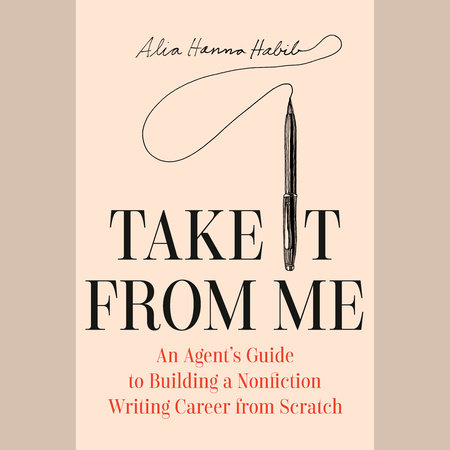
Take It from Me

An Agent's Guide to Building a Nonfiction Writing Career from Scratch

Author Alia Hanna Habib On Tour
Listen to a clip from the audiobook
audio pause button
0:00
0:00
Audiobook Download
On sale Jan 20, 2026 | 10 Hours and 51 Minutes | 9798217166060

See Additional Formats
From the literary agent behind some of today’s most successful authors comes a narrative guide geared specifically to the needs of aspiring and working nonfiction writers, demystifying the world of publishing and offering a practical roadmap to getting your book published.

“An invaluable resource.”—Clint Smith, author of How the Word is Passed

“I really, really wish I had this book when I was starting out.”—Robert Kolker, author of Hidden Valley Road


Alia Hanna Habib remembers what it was like to be on the outside of the publishing world, looking in. Arriving in New York, a first-generation college student with a love of reading and loads of ambition, she had no idea how to break into the business of books. Now, years later, in her career as an agent, she hears from prospective clients who, whether they’re experts at the top of their fields or wholly new to the writing game, consider finding success in publishing to be a mysterious and daunting endeavor. Ever determined to flout the stereotype of agent as gatekeeper, however, Habib is prepared to hand emerging writers the key.

Drawing on wisdom from her star-studded list of clients, including Hanif Abdurraqib, Judy Batalion, Merve Emre, Nikole Hannah-Jones, and Clint Smith, Habib provides context and clarity to each step of the publishing process, from the germination of a book idea to finding an agent to represent it, from crafting an engaging proposal to navigating the perils of publicity. Readers will find real-life samples of her authors' pitch letters and book proposals, as well as templates writers can use when querying agents or promoting their work on social media. She also incorporates the advice of trusted industry colleagues—attorneys, accountants, editors, publishers, publicists, and more—gifting readers with a full team of experts to answer all the questions they’ve had about the publishing world, but were too afraid, or didn’t know, to ask.

Essential for both the aspiring novice and the seasoned professional, Take It from Me is a guidebook writers will return to again and again. At times laugh-out-loud funny, at others brutally honest about her own experiences in publishing and in life, Habib offers a clear-eyed look at the challenges facing today’s aspiring nonfiction writers and then gives them the comprehensive, expert guidance they need to put those roadblocks in the rearview mirror.

*Includes a downloadable PDF containing the formula for earnout number, the publicity contacts spreadsheet template, and the appendices from the print book
Chapter 1

On Pitching, or Starting Small

Dorothy Brown is a professor of tax law. As she’d be the first to admit, it’s not the kind of profession that makes people line up to talk to you at cocktail parties. (The opposite is true for literary agents, and it has nothing to do with personal charm. I once spent a party watching a young man work up the courage to talk to me, only to discover it was so he could pitch me his book idea: What Cheese Are You? Lest you think I missed out on an amazing publishing opportunity, he wasn’t even able to tell me what cheese I am.) As a professor and now as a writer, Brown is determined to make her seemingly arcane body of research widely accessible. In doing so, she’s working against the tide of her own profession. To Brown’s great frustration, when fellow academics say “Your work is so accessible,” they may well mean it as an insult.

Brown’s research is on tax and race, a field she has essentially pioneered. Her long-term goal was to publish a trade book for a general-interest audience as opposed to an academic one targeted at fellow legal scholars, but her route to doing so wasn’t to pitch agents, at least not at first. Brown set her sights instead on publishing Op-Eds in The Washington Post and The New York Times. She did this with several larger aims in mind: to get her work read by both the general public and policymakers—hence the choice of newspapers read by them—and to make herself more appealing to publishers when it came time to sell a book. She pursued this goal with the doggedness of a tax professor—that is, with the systematic and relentless focus of someone who can spend hours at a time pouring over decades of tax data. She pitched The New York Times over a dozen times before succeeding. And she eventually did sell that book, The Whiteness of Wealth, to Crown, a division of Penguin Random House, and now has a second, Getting to Reparations, forthcoming from the same publisher. The publication of her work outside academic journals led her to be invited to testify before Congress three times and to privately brief multiple sitting congressional representatives.

If your end goal, like Dorothy’s, is to eventually land an agent and publish a nonfiction book, the first piece of advice I always give is to aggressively pursue publishing shorter work and to do so with as much upbeat imperviousness to rejection as your heart can muster. It is much, much easier to land an agent, and a book deal, if you have had work previously published. Pitching a nonfiction book to an agent when you’ve never published a word of prose is a bit like buying a lottery ticket. There’s no reason *not* to do it—buying lottery tickets is fun! And the ads are right when they say “You never know!” That said, while your odds of becoming a millionaire via the lotto are admittedly lower than landing an agent for a nonfiction book when you’ve never previously published anything, they’re still, speaking frankly, not great. I always feel like the bearer of bad news when I share this fact, a much less fun part of my job than telling someone we have an offer on the table for their book, which never fails to give me chills. Publishing articles and essays will not only make you more appealing to agents once you start pitching them. Agents—particularly those of us who represent nonfiction—regularly read national newspapers, magazines and literary journals, and a whole range of media besides (often, in fact, when we should be reading books). If there is a golden ticket in nonfiction book publishing, it is writing an original piece and having an agent see it and reach out to you—which is, in fact, how I found many of my clients.

I’m opening this chapter with Dorothy Brown’s story not only because it had a happy ending but because I think her thoughtful-step-by-thoughtful-step approach, and, above all, her attitude toward breaking into publishing, is a gift worth sharing. Unlike Brown, many writers would quit long before receiving that twelfth pass; how she thought about those passes enabled her to keep going forward. If an editor said no to a pitch, Brown didn’t assume it was because the idea was terrible or that she was a terrible writer. Brown decided that when she heard “no,” she was actually hearing “not yet” and intuited there could be a number of reasons an outlet passed on a piece that had nothing to do with the piece itself. (She also filed every rejected piece away in case it would someday be of use as part of a book chapter or another Op-Ed based on the ever-changing news cycle.) As Brown told me, and as I know to be true from years spent comforting understandably anxious clients, many writers can’t help but assume editors’ passes are due to “the substance and that’s not always what the no means. The no could mean one of thirty-two million things: isn’t a fit right now; we have something else on the topic; a former or current president just got indicted, and all of our focus is there.”

Dorothy correctly intuited the black-box nature of a newsroom and how unsolicited pitches fit into it. There’s a mistaken notion that editors (and by extension, agents) spend much of their time fielding pitches, but that is actually just a small part of what editors at media outlets do and how they think about what they publish. As Vann Newkirk, a senior editor at The Atlantic who works with many emerging writers, explained to me, being an editor is a “social job.” The bulk of an editor’s time is not spent sifting through over-the-transom pitches and giving deep thought as to which ones to take. Instead, the majority of his day is spent interacting with writers he is in the process of publishing: on Zooms, over coffee, on the phone, or improving their work on the page, and then working with the rest of his colleagues to figure out how the parts fit into the whole. Vanessa Mobley, an Opinion editor at The New York Times who oversees the guest essays team (that is, pieces by nonstaff writers), put this aspect of the job into context: Every week the opinion section has a meeting where the editors talk about ideas for guest essays. Individual editors often lobby to push a writer or an idea into the “report,” their term for the sum total of what the Opinion section of The New York Times publishes. Publication decisions are made not just by how much one editor likes a piece or an individual writer. Rather, any pass you receive is made in the context of a whole chain of decisions, calculations, and the ecosystem of other writers and pieces already commissioned that most likely have little to do with you or your talent. As Mobley’s description of her job makes clear, editors themselves are engaged in their own version of pitching. Especially at major outlets with sizable staff, editors who work directly with writers must get a sign-off from their bosses to commission a piece. The mechanics are slightly different from publication to publication, but the overall process is largely the same. At The New York Times Magazine, for example, writers work with a story editor on their articles. As Jake Silverstein, the editor-in-chief of The New York Times Magazine, explains, “Story editors are ones who have their primary relationship with the writer. They’re going to be the ones who developed the idea back and forth with the author.” The story editor, in turn, “brings the pitch to one of the four ‘top editors,’ the editorial director, and myself, to advocate for it. That’s the group that makes decisions to green-light or red-light a pitch.” At The New York Times Magazine, much like at the Opinion section, story editors attend a weekly meeting, bringing in pitches from freelance and contributing writers with whom they have been in conversation or developed an idea, as well as from the contracted writers whom they are assigned to edit. To mangle David Mamet, editors, like writers, Always Be Pitching.

I believe this external context is why there’s such a mismatch between how it feels to give a pass versus how it feels to get one. (It feels terrible! And personal, though in most cases, there’s nothing personal about it at all.) In order to get published, you need to submit excellent materials and put a lot of time and effort into writing them. Far less time and effort go into reviewing the initial pitch, even for the most thoughtful editors, in large part because of the volume of submissions an editor receives and because any editor worthy of the title spends a good part of their day improving the pieces they do want to publish and advocating for them with their higher-ups. I share this reality not to make the process feel impossible (it’s not—and the sample pitches at the end of this chapter will offer suggestions on how to improve and target your pitches so you have a higher success rate), but so that the weight of decisions rendered doesn’t feel so very weighty. It’s natural to think of editors as gods on high, the outlets that employ them as a kind of Olympus, but in many ways, editors are in a structural position much like your own—they too are fighting to get “their” pieces published. And just like you, it’s in their best interest to do so—the more good work they manage to bring in, the more traffic or attention they bring to a website or magazine, the more they are valued by their employer. More encouragingly to know, writers who get published regularly in the same publication are usually published by the same editor again and again, a win-win for both parties. That editor, particularly if they “discovered” the writer, is in turn invested in the writer’s work and career.

So I’d like to suggest the first of two ways to reframe how you think about the process of pitching articles and essays: It is not (just) the quest to add the name of another media outlet to your list of clips. Imagine instead that you are seeking an editorial reader who will understand and advocate for your work, who will improve it and help bring it to a wider audience. And when you get a no, it may just be a “not yet”—at least not with this person, at this moment.

The good news is that while it’s intimidating to pitch articles and essays, it is easier to publish one than it is to land an agent. The bar to entry is lower for editors seeking regular content for their publications and thus the demand for material by media outlets is much higher than the publishing industry could keep up with for book-length projects. Digital outlets in particular have not just a weekly or even a daily demand for new content but an hourly one. (This volume issue is also why it takes so excruciatingly long to hear back from editors when you pitch articles.) The height of the bar for publication varies not just by format and outlet but also by section of the publication. Per Jake Silverstein of The New York Times Magazine, it’s easier for a first-time freelancer or a new writer to break into the “front of the book” (FOB)—the beginning section of most print magazines where shorter pieces appear—than to get a commission to write a longer piece. This is in part a practical decision by the magazine, a bit like not planning a weekend trip with someone before you’ve gone on a first date. As Silverstein explains, “Sometimes we get pitches from freelancers who we haven’t worked with before for features where we think the proposal is interesting, but it’s a little too ambitious for us to assign to a first-time writer. Maybe it involves very expensive travel, or high-stakes investigative work. In those cases we probably won’t assign, because we haven’t worked with the writer before. We often encourage writers who are new to the magazine to pitch ideas that are a little easier to assign for their first features—profiles, domestic stories, that sort of thing.” At The New York Times Magazine, “The Letter of Recommendation” in the front of the book is often a proving ground for new writers. Rachel Syme, now a staff writer at The New Yorker and an ambitious and assiduous student of magazines, charted her path to publication through learning about and then pitching the smaller, FOB sections. Her first piece published in The New York Times was in fact a “Letter of Recommendation” in the magazine. Getting it published helped her establish a relationship with the magazine, and more important, with an editor who appreciated her work and would continue to publish her. FOB sections vary by outlet and change all the time; becoming a student of them will help you understand where and what to pitch.
One of Lit Hub’s Most Anticipated Books of the Year

“If you’re a nonfiction writer trying to get your book published, this book will no doubt be an essential resource.”Lit Hub

“Alia Hanna Habib is the best literary agent any writer could ask for and I feel immeasurably lucky to have her in my corner. Alia knows the publishing industry better than anyone. Her expertise, thoughtfulness, and brilliance have changed my life. Her debut book, Take It from Me, is a masterclass in showing aspiring writers how to approach and navigate the publishing process. It is an invaluable resource. If you are looking to publish your own nonfiction project, this will become the most important book in your library.”—Clint Smith, #1 New York Times bestselling author of How the Word is Passed

Take It from Me is a letter from a master agent. Alia Hanna Habib takes what nonfiction writers need and crave from agents—encouragement, tactical savvy—and delivers it on the page, making her precious skills and knowledge accessible to everyone.”—Jodi Kantor, co-author of She Said

“Aspiring authors couldn’t hope for a better guide to writing and publishing a non-fiction book. Take It from Me is a map, a tool-kit, and a trove of information that demystifies the publishing process written with humor, warmth, and smarts.”­—Betsy Lerner, author of The Forest for the Trees

“Nonfiction publishing is a world of strange customs and opaque folkways, where it can feel impossible for outsiders to understand how things work. Until now, when Alia Hanna Habib is here to shrewdly, wisely, and hilariously demystify the whole process and deliver all the inside dope. I can’t be the first to say this, but I really, really wish I had this book when I was starting out.”—Robert Kolker, #1 New York Times bestselling author of Hidden Valley Road

Take It from Me feels like a conversation with your smartest, most honest friend in publishing—funny, incisive, and all-in on helping your nonfiction dream take flight. Alia Hanna Habib doesn’t gate-keep—she invites you in, offering the most practical, no-nonsense roadmap I’ve seen for nonfiction writers. Straight talk, sharp insight, and a deep generosity of spirit. Essential reading.” ­—Adrienne Brodeur, bestselling author of Wild Game

“At times Take It from Me feels almost novelistic—with human drama, history, and the possibility of achieving something that, once mystical, now becomes reassuringly concrete. Habib is a warm, funny, inspiring guide through a process that is rarely treated with such scrutiny and respect.”—Rachel Aviv, New York Times bestselling author of Strangers to Ourselves

Readers who want to publish books of their own will flock to this volume, but even those without literary ambitions might be interested in Habib’s explanation of the process. . . . Essential.”—Library Journal, starred review

“A nitty-gritty, roll-up-your-sleeves how-to . . . Habib lifts the curtain on how agents decide what books to represent and how editors choose titles to acquire, as well as offering detailed explanations on everything from author advances to what to expect as publication day nears. For aspiring nonfiction authors, it’s a must.”Publishers Weekly

“With Habib's generous, kind, playful, and welcoming prose, this is a perfect book for anyone feeling interested in writing but intimidated by the institutions.”—Booklist

“A fascinating braid of personal guidance and practitioner interviews . . . Habib[’s] counsel, presented with the clear-eyed pragmatism (but none of the cynicism) of an industry veteran, stands out in a congested market of books on writing . . . even the published author, will . . . find value in these pages. . . . An invaluable resource for aspiring and professional writers alike.”—Kirkus
Alia Hanna Habib is a Vice President and literary agent at The Gernert Company, where she represents MacArthur Fellows, Pulitzer Prize-winning journalists, National Book Award finalists, and numerous New York Times bestselling authors. She lives in Brooklyn, NY. View titles by Alia Hanna Habib

Discussion Guide for Take It from Me

Provides questions, discussion topics, suggested reading lists, introductions and/or author Q&As, which are intended to enhance reading groups’ experiences.

(Please note: the guide displayed here is the most recently uploaded version; while unlikely, any page citation discrepancies between the guide and book is likely due to pagination differences between a book’s different formats.)

Introduction: What's in This Book, How to Use It, and Why I Wrote It ...ix

Chapter 1: On Pitching, or Starting Small ...3

Chapter 2: An Author's Education: On Studying Writing (in School, or Not) ...35

Chapter 2.5: What Is a Platform and How Do I Define Mine? ...71

Chapter 3: The Book Proposal, or Don't Be Boring ...85

Chapter 4: What Is an Agent For? ...139

Chapter 5: The Submission Process, or This Is Where It Hurts ...167

Chapter 6: The Publication Process ...194

Conclusion: What's Next? ...247

Appendix A: Contracts 101 ...251

Appendix B: Contracts 102 ...257

Appendix C: Foreign Rights 101 ...263

Acknowledgments ...271

Index ...
273

About

From the literary agent behind some of today’s most successful authors comes a narrative guide geared specifically to the needs of aspiring and working nonfiction writers, demystifying the world of publishing and offering a practical roadmap to getting your book published.

“An invaluable resource.”—Clint Smith, author of How the Word is Passed

“I really, really wish I had this book when I was starting out.”—Robert Kolker, author of Hidden Valley Road


Alia Hanna Habib remembers what it was like to be on the outside of the publishing world, looking in. Arriving in New York, a first-generation college student with a love of reading and loads of ambition, she had no idea how to break into the business of books. Now, years later, in her career as an agent, she hears from prospective clients who, whether they’re experts at the top of their fields or wholly new to the writing game, consider finding success in publishing to be a mysterious and daunting endeavor. Ever determined to flout the stereotype of agent as gatekeeper, however, Habib is prepared to hand emerging writers the key.

Drawing on wisdom from her star-studded list of clients, including Hanif Abdurraqib, Judy Batalion, Merve Emre, Nikole Hannah-Jones, and Clint Smith, Habib provides context and clarity to each step of the publishing process, from the germination of a book idea to finding an agent to represent it, from crafting an engaging proposal to navigating the perils of publicity. Readers will find real-life samples of her authors' pitch letters and book proposals, as well as templates writers can use when querying agents or promoting their work on social media. She also incorporates the advice of trusted industry colleagues—attorneys, accountants, editors, publishers, publicists, and more—gifting readers with a full team of experts to answer all the questions they’ve had about the publishing world, but were too afraid, or didn’t know, to ask.

Essential for both the aspiring novice and the seasoned professional, Take It from Me is a guidebook writers will return to again and again. At times laugh-out-loud funny, at others brutally honest about her own experiences in publishing and in life, Habib offers a clear-eyed look at the challenges facing today’s aspiring nonfiction writers and then gives them the comprehensive, expert guidance they need to put those roadblocks in the rearview mirror.

*Includes a downloadable PDF containing the formula for earnout number, the publicity contacts spreadsheet template, and the appendices from the print book

Excerpt

Chapter 1

On Pitching, or Starting Small

Dorothy Brown is a professor of tax law. As she’d be the first to admit, it’s not the kind of profession that makes people line up to talk to you at cocktail parties. (The opposite is true for literary agents, and it has nothing to do with personal charm. I once spent a party watching a young man work up the courage to talk to me, only to discover it was so he could pitch me his book idea: What Cheese Are You? Lest you think I missed out on an amazing publishing opportunity, he wasn’t even able to tell me what cheese I am.) As a professor and now as a writer, Brown is determined to make her seemingly arcane body of research widely accessible. In doing so, she’s working against the tide of her own profession. To Brown’s great frustration, when fellow academics say “Your work is so accessible,” they may well mean it as an insult.

Brown’s research is on tax and race, a field she has essentially pioneered. Her long-term goal was to publish a trade book for a general-interest audience as opposed to an academic one targeted at fellow legal scholars, but her route to doing so wasn’t to pitch agents, at least not at first. Brown set her sights instead on publishing Op-Eds in The Washington Post and The New York Times. She did this with several larger aims in mind: to get her work read by both the general public and policymakers—hence the choice of newspapers read by them—and to make herself more appealing to publishers when it came time to sell a book. She pursued this goal with the doggedness of a tax professor—that is, with the systematic and relentless focus of someone who can spend hours at a time pouring over decades of tax data. She pitched The New York Times over a dozen times before succeeding. And she eventually did sell that book, The Whiteness of Wealth, to Crown, a division of Penguin Random House, and now has a second, Getting to Reparations, forthcoming from the same publisher. The publication of her work outside academic journals led her to be invited to testify before Congress three times and to privately brief multiple sitting congressional representatives.

If your end goal, like Dorothy’s, is to eventually land an agent and publish a nonfiction book, the first piece of advice I always give is to aggressively pursue publishing shorter work and to do so with as much upbeat imperviousness to rejection as your heart can muster. It is much, much easier to land an agent, and a book deal, if you have had work previously published. Pitching a nonfiction book to an agent when you’ve never published a word of prose is a bit like buying a lottery ticket. There’s no reason *not* to do it—buying lottery tickets is fun! And the ads are right when they say “You never know!” That said, while your odds of becoming a millionaire via the lotto are admittedly lower than landing an agent for a nonfiction book when you’ve never previously published anything, they’re still, speaking frankly, not great. I always feel like the bearer of bad news when I share this fact, a much less fun part of my job than telling someone we have an offer on the table for their book, which never fails to give me chills. Publishing articles and essays will not only make you more appealing to agents once you start pitching them. Agents—particularly those of us who represent nonfiction—regularly read national newspapers, magazines and literary journals, and a whole range of media besides (often, in fact, when we should be reading books). If there is a golden ticket in nonfiction book publishing, it is writing an original piece and having an agent see it and reach out to you—which is, in fact, how I found many of my clients.

I’m opening this chapter with Dorothy Brown’s story not only because it had a happy ending but because I think her thoughtful-step-by-thoughtful-step approach, and, above all, her attitude toward breaking into publishing, is a gift worth sharing. Unlike Brown, many writers would quit long before receiving that twelfth pass; how she thought about those passes enabled her to keep going forward. If an editor said no to a pitch, Brown didn’t assume it was because the idea was terrible or that she was a terrible writer. Brown decided that when she heard “no,” she was actually hearing “not yet” and intuited there could be a number of reasons an outlet passed on a piece that had nothing to do with the piece itself. (She also filed every rejected piece away in case it would someday be of use as part of a book chapter or another Op-Ed based on the ever-changing news cycle.) As Brown told me, and as I know to be true from years spent comforting understandably anxious clients, many writers can’t help but assume editors’ passes are due to “the substance and that’s not always what the no means. The no could mean one of thirty-two million things: isn’t a fit right now; we have something else on the topic; a former or current president just got indicted, and all of our focus is there.”

Dorothy correctly intuited the black-box nature of a newsroom and how unsolicited pitches fit into it. There’s a mistaken notion that editors (and by extension, agents) spend much of their time fielding pitches, but that is actually just a small part of what editors at media outlets do and how they think about what they publish. As Vann Newkirk, a senior editor at The Atlantic who works with many emerging writers, explained to me, being an editor is a “social job.” The bulk of an editor’s time is not spent sifting through over-the-transom pitches and giving deep thought as to which ones to take. Instead, the majority of his day is spent interacting with writers he is in the process of publishing: on Zooms, over coffee, on the phone, or improving their work on the page, and then working with the rest of his colleagues to figure out how the parts fit into the whole. Vanessa Mobley, an Opinion editor at The New York Times who oversees the guest essays team (that is, pieces by nonstaff writers), put this aspect of the job into context: Every week the opinion section has a meeting where the editors talk about ideas for guest essays. Individual editors often lobby to push a writer or an idea into the “report,” their term for the sum total of what the Opinion section of The New York Times publishes. Publication decisions are made not just by how much one editor likes a piece or an individual writer. Rather, any pass you receive is made in the context of a whole chain of decisions, calculations, and the ecosystem of other writers and pieces already commissioned that most likely have little to do with you or your talent. As Mobley’s description of her job makes clear, editors themselves are engaged in their own version of pitching. Especially at major outlets with sizable staff, editors who work directly with writers must get a sign-off from their bosses to commission a piece. The mechanics are slightly different from publication to publication, but the overall process is largely the same. At The New York Times Magazine, for example, writers work with a story editor on their articles. As Jake Silverstein, the editor-in-chief of The New York Times Magazine, explains, “Story editors are ones who have their primary relationship with the writer. They’re going to be the ones who developed the idea back and forth with the author.” The story editor, in turn, “brings the pitch to one of the four ‘top editors,’ the editorial director, and myself, to advocate for it. That’s the group that makes decisions to green-light or red-light a pitch.” At The New York Times Magazine, much like at the Opinion section, story editors attend a weekly meeting, bringing in pitches from freelance and contributing writers with whom they have been in conversation or developed an idea, as well as from the contracted writers whom they are assigned to edit. To mangle David Mamet, editors, like writers, Always Be Pitching.

I believe this external context is why there’s such a mismatch between how it feels to give a pass versus how it feels to get one. (It feels terrible! And personal, though in most cases, there’s nothing personal about it at all.) In order to get published, you need to submit excellent materials and put a lot of time and effort into writing them. Far less time and effort go into reviewing the initial pitch, even for the most thoughtful editors, in large part because of the volume of submissions an editor receives and because any editor worthy of the title spends a good part of their day improving the pieces they do want to publish and advocating for them with their higher-ups. I share this reality not to make the process feel impossible (it’s not—and the sample pitches at the end of this chapter will offer suggestions on how to improve and target your pitches so you have a higher success rate), but so that the weight of decisions rendered doesn’t feel so very weighty. It’s natural to think of editors as gods on high, the outlets that employ them as a kind of Olympus, but in many ways, editors are in a structural position much like your own—they too are fighting to get “their” pieces published. And just like you, it’s in their best interest to do so—the more good work they manage to bring in, the more traffic or attention they bring to a website or magazine, the more they are valued by their employer. More encouragingly to know, writers who get published regularly in the same publication are usually published by the same editor again and again, a win-win for both parties. That editor, particularly if they “discovered” the writer, is in turn invested in the writer’s work and career.

So I’d like to suggest the first of two ways to reframe how you think about the process of pitching articles and essays: It is not (just) the quest to add the name of another media outlet to your list of clips. Imagine instead that you are seeking an editorial reader who will understand and advocate for your work, who will improve it and help bring it to a wider audience. And when you get a no, it may just be a “not yet”—at least not with this person, at this moment.

The good news is that while it’s intimidating to pitch articles and essays, it is easier to publish one than it is to land an agent. The bar to entry is lower for editors seeking regular content for their publications and thus the demand for material by media outlets is much higher than the publishing industry could keep up with for book-length projects. Digital outlets in particular have not just a weekly or even a daily demand for new content but an hourly one. (This volume issue is also why it takes so excruciatingly long to hear back from editors when you pitch articles.) The height of the bar for publication varies not just by format and outlet but also by section of the publication. Per Jake Silverstein of The New York Times Magazine, it’s easier for a first-time freelancer or a new writer to break into the “front of the book” (FOB)—the beginning section of most print magazines where shorter pieces appear—than to get a commission to write a longer piece. This is in part a practical decision by the magazine, a bit like not planning a weekend trip with someone before you’ve gone on a first date. As Silverstein explains, “Sometimes we get pitches from freelancers who we haven’t worked with before for features where we think the proposal is interesting, but it’s a little too ambitious for us to assign to a first-time writer. Maybe it involves very expensive travel, or high-stakes investigative work. In those cases we probably won’t assign, because we haven’t worked with the writer before. We often encourage writers who are new to the magazine to pitch ideas that are a little easier to assign for their first features—profiles, domestic stories, that sort of thing.” At The New York Times Magazine, “The Letter of Recommendation” in the front of the book is often a proving ground for new writers. Rachel Syme, now a staff writer at The New Yorker and an ambitious and assiduous student of magazines, charted her path to publication through learning about and then pitching the smaller, FOB sections. Her first piece published in The New York Times was in fact a “Letter of Recommendation” in the magazine. Getting it published helped her establish a relationship with the magazine, and more important, with an editor who appreciated her work and would continue to publish her. FOB sections vary by outlet and change all the time; becoming a student of them will help you understand where and what to pitch.

Reviews

One of Lit Hub’s Most Anticipated Books of the Year

“If you’re a nonfiction writer trying to get your book published, this book will no doubt be an essential resource.”Lit Hub

“Alia Hanna Habib is the best literary agent any writer could ask for and I feel immeasurably lucky to have her in my corner. Alia knows the publishing industry better than anyone. Her expertise, thoughtfulness, and brilliance have changed my life. Her debut book, Take It from Me, is a masterclass in showing aspiring writers how to approach and navigate the publishing process. It is an invaluable resource. If you are looking to publish your own nonfiction project, this will become the most important book in your library.”—Clint Smith, #1 New York Times bestselling author of How the Word is Passed

Take It from Me is a letter from a master agent. Alia Hanna Habib takes what nonfiction writers need and crave from agents—encouragement, tactical savvy—and delivers it on the page, making her precious skills and knowledge accessible to everyone.”—Jodi Kantor, co-author of She Said

“Aspiring authors couldn’t hope for a better guide to writing and publishing a non-fiction book. Take It from Me is a map, a tool-kit, and a trove of information that demystifies the publishing process written with humor, warmth, and smarts.”­—Betsy Lerner, author of The Forest for the Trees

“Nonfiction publishing is a world of strange customs and opaque folkways, where it can feel impossible for outsiders to understand how things work. Until now, when Alia Hanna Habib is here to shrewdly, wisely, and hilariously demystify the whole process and deliver all the inside dope. I can’t be the first to say this, but I really, really wish I had this book when I was starting out.”—Robert Kolker, #1 New York Times bestselling author of Hidden Valley Road

Take It from Me feels like a conversation with your smartest, most honest friend in publishing—funny, incisive, and all-in on helping your nonfiction dream take flight. Alia Hanna Habib doesn’t gate-keep—she invites you in, offering the most practical, no-nonsense roadmap I’ve seen for nonfiction writers. Straight talk, sharp insight, and a deep generosity of spirit. Essential reading.” ­—Adrienne Brodeur, bestselling author of Wild Game

“At times Take It from Me feels almost novelistic—with human drama, history, and the possibility of achieving something that, once mystical, now becomes reassuringly concrete. Habib is a warm, funny, inspiring guide through a process that is rarely treated with such scrutiny and respect.”—Rachel Aviv, New York Times bestselling author of Strangers to Ourselves

Readers who want to publish books of their own will flock to this volume, but even those without literary ambitions might be interested in Habib’s explanation of the process. . . . Essential.”—Library Journal, starred review

“A nitty-gritty, roll-up-your-sleeves how-to . . . Habib lifts the curtain on how agents decide what books to represent and how editors choose titles to acquire, as well as offering detailed explanations on everything from author advances to what to expect as publication day nears. For aspiring nonfiction authors, it’s a must.”Publishers Weekly

“With Habib's generous, kind, playful, and welcoming prose, this is a perfect book for anyone feeling interested in writing but intimidated by the institutions.”—Booklist

“A fascinating braid of personal guidance and practitioner interviews . . . Habib[’s] counsel, presented with the clear-eyed pragmatism (but none of the cynicism) of an industry veteran, stands out in a congested market of books on writing . . . even the published author, will . . . find value in these pages. . . . An invaluable resource for aspiring and professional writers alike.”—Kirkus

Author

Alia Hanna Habib is a Vice President and literary agent at The Gernert Company, where she represents MacArthur Fellows, Pulitzer Prize-winning journalists, National Book Award finalists, and numerous New York Times bestselling authors. She lives in Brooklyn, NY. View titles by Alia Hanna Habib

Guides

Discussion Guide for Take It from Me

Provides questions, discussion topics, suggested reading lists, introductions and/or author Q&As, which are intended to enhance reading groups’ experiences.

(Please note: the guide displayed here is the most recently uploaded version; while unlikely, any page citation discrepancies between the guide and book is likely due to pagination differences between a book’s different formats.)

Table of Contents

Introduction: What's in This Book, How to Use It, and Why I Wrote It ...ix

Chapter 1: On Pitching, or Starting Small ...3

Chapter 2: An Author's Education: On Studying Writing (in School, or Not) ...35

Chapter 2.5: What Is a Platform and How Do I Define Mine? ...71

Chapter 3: The Book Proposal, or Don't Be Boring ...85

Chapter 4: What Is an Agent For? ...139

Chapter 5: The Submission Process, or This Is Where It Hurts ...167

Chapter 6: The Publication Process ...194

Conclusion: What's Next? ...247

Appendix A: Contracts 101 ...251

Appendix B: Contracts 102 ...257

Appendix C: Foreign Rights 101 ...263

Acknowledgments ...271

Index ...
273
  • More Websites from
    Penguin Random House
  • Common Reads
  • Library Marketing