Download high-resolution image
Listen to a clip from the audiobook
audio pause button
0:00
0:00

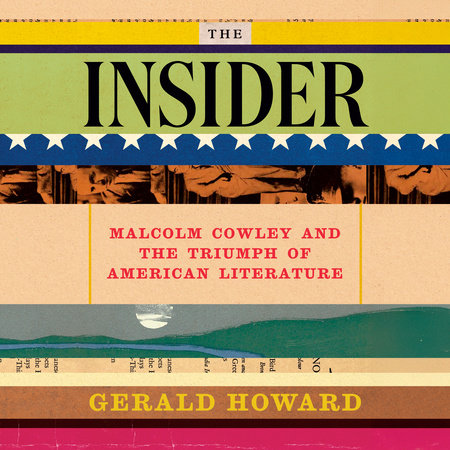
The Insider

Malcolm Cowley and the Triumph of American Literature

Listen to a clip from the audiobook
audio pause button
0:00
0:00
A finalist for the 2026 Andrew Carnegie Medal for Excellence in Nonfiction

A delightful and majestic reckoning with the ascent of American fiction in the twentieth century through the prism of the under-known man who had an astonishing amount to do with it


Malcolm Cowley is not a household name today, but the American literary canon would look very different without him. A prototypical “man of letters” of his generation—Harvard University, a volunteer in the French ambulance corps in World War I, a rite of passage in Paris after the war—he became one of the few truly influential critics of the 1920s and ’30s, along with his close New Republic colleague Edmund Wilson. Cowley’s early support of Hemingway, Fitzgerald, and their set—and indeed for framing this group in generational terms in the first place—secured his place in literary history.

Most people are lucky to be part of a single game-changing era in their careers; for Cowley, it happened again and again. After emerging from the political fray of the thirties badly damaged, he retreated behind the scenes as a tastemaker whose import has awaited Gerald Howard to be brought into full view. The process of canon formation is a murky business, and Cowley was a prime mover in it for the better part of four decades, through the Lost Generation, the Beat Generation, and the counterculture of the sixties. Without him, the odds would be much longer that the names William Faulkner, Jack Kerouac, and Ken Kesey, to name just three, would have ever echoed.

In The Insider, Gerald Howard gives an intimate accounting of the fever graph of a fascinating and multifaceted career in the literary trade that uses that career to tell a much bigger story of how American literature took the course that it did from the 1920s to the 1960s. It’s a story of an art form, and an industry, and a country experiencing wrenching change, and the people who made a home in the storm and in no small part shaped it. Howard’s own career as a literary weathermaker is justly acclaimed, and he has brought all his talents of head and heart to bear in crafting this extraordinary book. It’s a gift to booklovers and a major contribution to the cultural history of this country.
One.

BOY IN SUNLIGHT

Although he wrote two memoirs, Malcolm Cowley would never produce a full-scale autobiography. He did, however, regard the 1968 edition of his more or less complete poems, Blue Juniata: A Life, as his real autobiography, the poems being arranged not chronologically but in a fashion meant to convey a sense of his inner and outer life over the decades. He chose to begin that book with his pastoral poem "Boy in Sunlight." Written in 1967, the poem reads very much like an update of that old American chestnut, once obligatory in all most-loved-poems anthologies, John Greenleaf Whittier's 1855 "The Barefoot Boy." ("Blessings on thee, little man, / Barefoot boy, with cheek of tan!," etc.) In contrast to Whittier, Cowley strips away the conventional sentiment from his memory of himself on a boyhood ramble through the Pennsylvania countryside, fishing pole in hand. Instead, he substitutes a kind of precisionist imagery, fitting for a poet who'd bumped up against most of the major poets of the twentieth century in one fashion or another.

The "boy in sunlight," the younger Cowley, has caught four small trout and now carries them in an old lard bucket. He finds a sunny spot above a pool in a burnt-down former stand of hemlock and sits down to eat his lunch of corn pone and to doze, half asleep but still alert, "like a snake on the stone." He takes everything in, the buzzing insects, a hovering hawk, the blue mountain sky, and then a kind of transmigration between boy and landscape happens. "The land absorbs him into itself, / as he absorbs the land, the ravaged woods, the pale sky, / not to be seen, but as a way of seeing; / not to be judged, but as a way of judgment; / not even to remember, but stamped in the bone." Sixty-plus years after the event, he would recall this moment as "a rite of initiation: the countryside marked me as its own, as if a surveyor had scarred a witness tree."

Cowley's feeling for the countryside of the town of Belsano in Cambria County, Pennsylvania, where he was born and where he spent long summers on his family's farm until he went away to college at the age of seventeen, indelibly marked what he would call "the essential me." For his entire adult life, he lived and worked at the highest level of American literary society, a place he felt comfortable and confident in. But in his innermost self he would always at some level be that footloose, barefoot boy-literally barefoot, as he would take off his city shoes in the middle of May and not have to put them on until the middle of October. It was a place he could always retreat to in his mind, and not just as a poet. He would think of Cambria County as "the real beginning of the Midwest," which helped him identify with those Midwestern writers like Anderson, Hemingway, and Fitzgerald. And Belsano represented something primordial to Malcolm Cowley, a distinctly American kind of freedom and community that he would lament the waning and then extinction of as progress made its inexorable inroads into an older, fragile, rural way of life.

Country existence influenced his outer manner as well as his inner life. "Look at the hands if you get a chance," the poet John Peale Bishop wrote to his Princeton classmate Edmund Wilson in the twenties. "The plowboy of the western world who has been to Paris." Alfred Kazin recalled that "whenever you crossed Malcolm directly, he would sidle into his familiar role of the slow-moving and slow-talking country boy." Kazin thought that Cowley was, as the saying goes, country-boying him, and maybe he was, a bit. But the slow-talking aspect of Malcolm Cowley was not an act he put on to gull the fast-talking urban intellectuals. He spoke slowly because he thought carefully, revising his words in his head before he said them. His mental metabolism was just that much more measured and unhurried than theirs, and it marked him as different.

Belsano was a rural community of a few hundred people on the tablelands west of the Allegheny mountain range, seventy miles due west of Pittsburgh and sixteen miles north of Johnstown, site of the tragic flood of 1889 that claimed thousands of lives. Malcolm Cowley was born there on August 24, 1898, in the farmhouse owned by his father William Cowley's family. It was an exceptionally difficult birth for his mother, Josephine Hutmacher Cowley. His father had been called away to Norfolk, Virginia, to care for his brother David Cowley, who had volunteered for service in Cuba during the Spanish-American War and was thought to be dying of typhus. His pregnant mother was left alone in Belsano with his aunt Margaret, who seems to have been ignorant of the physical facts of life and certainly was of little help in an emergency. Josephine went into labor and the terrified Margaret locked herself in a closet while her sister moaned in agony for two harrowing days. Someone finally heard the moans and rode his horse (there were no telephones or "horseless carriages") some miles to the nearest coal mining camp to summon a company doctor. He arrived in a thunderstorm just in time to save both the mother and the newborn infant.

Malcolm Cowley's mother was so shaken by the whole episode that she vowed never to have another child, a promise she kept. How she and her husband managed this is unknown. They were ignorant of even the rudimentary methods of birth control of the time, and William Cowley's Swedenborgian faith regarded contraception of any kind as a sin against God's will. Their son believed that they abstained from sex for the next thirty-nine years of their marriage and that his mother may have directed all that pent-up celibate energy into her many offbeat ventures and activities.

The country Cowley was born in that August day was undergoing a world-shaping series of transformations. Military activity in the Spanish-American War, that "splendid little war," as John Hay dubbed it, had ceased, and the United States found itself in possession of overseas territory and launched on its path to global superpower status. Domestically the country was well on its way to its transformation from an agricultural to an industrial civilization and an economic juggernaut, dominated by all-powerful corporate trusts. That transformation created both previously unthinkable wealth and great domestic strife, as the gulf widened between hyper-prosperity at the top and exploited and immiserated farmers, laborers, and immigrants toward the bottom. The rise of a fervent populism and militant unionism, both sometimes prone to violence, created a counterreaction in progressivism, a movement of "the best people" to lessen and defang class strife with steady but incremental social, economic, and political reform. Few of these developments were evident in the sleepy life of Belsano, but they would shape the future of all of its inhabitants, including its newest arrival.

Josephine Cowley was thirty-four years of age when she had her only child. She'd been born Josephine Hutmacher in 1864 in Quincy, Illinois, on the east bank of the Mississippi River. She was the eldest daughter in a family of eleven children, five boys and six girls. Her father, Rudolph, had emigrated from Germany to avoid conscription into the Prussian army. Her mother, Rosa Josephina Stuckenberg, came from a family of German Catholic settlers in Louisville, Kentucky, and her children were raised Catholic. The family was prosperous. Rudolph ran a wholesale ice business whose source in Quincy Bay was prized for its purity; his chief customer was the Anheuser-Busch brewery in St. Louis, to which he shipped the ice on barges down the Mississippi. On the edge of town, he built a large brick house with a cupola, overlooking a cornfield, where he and Rosa raised their large family.

Josephine Hutmacher's education was truncated: five years in parochial school and one year of boarding at St. Mary's Academy in Nauvoo, sixty miles away. She learned from the nuns "to write a fine, legible hand," her son remembered, but "not how to punctuate." Then she was taken out of school and put to work by her mother as "a household slavey." Sentenced to unending domestic drudgery, she learned to sew, bake pies, launder and iron shirtwaists, and change diapers, and she performed these tasks and others year after year with no respite. Photos from this time show her to be a handsome young woman, with a nose that flared at the tip, a feature her son would inherit. She was not allowed to have suitors, and her mother constantly scolded her and made her feel unfit for a life outside the home. It was an oppressive existence with little prospect for happiness ahead, so when her younger sisters all got married and her older brothers left home to start their business careers, she did something bold for a single woman of the time: She left home. Like a character in one of the Naturalist novels that were beginning to be written by Dreiser and Crane, she struck out for the big city, in this case bustling Pittsburgh. She would find work as a seamstress for a dressmaking shop named Young Modiste. She was thirty-three and badly wanted to get married. And then Dr. William Cowley, a homeopathic physician of the same age and also conveniently in want of a mate, came along. They had vastly different backgrounds and Josephine was four inches taller than her prospective husband-they would never be photographed standing next to each other, only seated-but despite all that, they would marry.

The Cowleys were Scotch Irish Presbyterians who'd immigrated to Pittsburgh in the 1840s from the north of Ireland. They'd settled on Troy Hill, where their next-door neighbors were a family named the Carnegies. In fact, Malcolm Cowley's great-uncle William had been one of the original partners in the Carnegie Iron Works, but he died of fever during the Civil War in a Confederate prisoner-of-war camp and his share of the enterprise was sold. The idea that very great wealth had once been within their grasp may have given the Cowley family an exaggerated sense of stature that exceeded their actual worldly position. Cowley's grandfather David, who married his deceased brother's fiancée, threw over the family Presbyterianism to join a small Christian sect devoted to the writings of the eighteenth-century Swedish mystic Emanuel Swedenborg. He was a homeopathic physician, and his son William Cowley, Malcolm's father, followed him into that profession and was also a devout Swedenborgian.

Malcolm Cowley would describe his father, William, whom he called Popsie, as "an impractical, wholly lovable man." Both William Cowley's choice of profession and his religious affiliation placed him far outside the American mainstream. Homeopathy was an alternative form of medical practice that had been founded by a man named Samuel Hahnemann in Germany in the late eighteenth century. The central idea was that by giving a patient controlled amounts of drugs that would cause symptoms similar to the disease they suffered from, that disease could be cured. Today the word "quackery" is often used to characterize homeopathy, but it was fairly popular in the nineteenth century. And though some now see it as a forerunner of today's alternative medicine, it was regarded by the medical establishment-then and now-as unorthodox and unproven. It was certainly no path to prestige or prosperity.

Popsie's Swedenborgian religion was even more eccentric. While at no time did the Swedenborgian "New Church" have more than a few thousand adherents in this country, Swedenborg himself was taken seriously by many serious people as a religious figure; in Representative Men, Ralph Waldo Emerson wrote of this eighteenth-century Swedish mystic in the company of no less than Plato, Shakespeare, Napoleon, and Goethe, and called him "the Last Father of the Church . . . not likely to have a successor." Famous American Swedenborgians included John Chapman, aka Johnny Appleseed; Robert Frost, who was baptized in the Church; and Henry James Sr., the father of the writers William and Henry James. Church members would gather in small groups for hours to read Swedenborg's texts and discuss their meaning. Malcolm Cowley remembered having to sit through hours of this sort of thing on Sundays to please his father, fidgeting with extreme boredom, and being read the Bible before bedtime and at noon when not at school. The religion never took with him, disappointing his father. Josephine was baptized into the Swedenborgian Church of the New Jerusalem, but she, like her son, took no real interest in its doctrines or texts. The Cowley family, described by Cowley as "intellectuals of a sort, though impoverished," did, though, one of the reasons they rather looked down on his energetic and practical mother.

In Pittsburgh the Cowley family moved into the newly constructed three-story Wallace Building in the commercial East Liberty section, which Cowley described as "a generally prosperous, semi-suburban area." On the ground floor were shops, and above them were apartments and offices where music teachers and physicians not overly in demand, like William Cowley, practiced. It was an isolated place for the new family to live, as the area cleared out after business hours. Cowley remembered that after the janitor of the Wallace Building moved away with his two daughters, he had no other playmates. He would roam by himself around the East Liberty area and even farther afield, exploring vacant lots and sometimes getting into fights with local boys and returning home with a bloody nose.

Or he would read, that favorite activity of the only child with an active imagination. He learned at age six, and he never stopped. It was a big life change. "You learned to read and you weren't my boy any more. You lay on the floor reading a book, and I couldn't get a word out of you," his mother once told him. Josephine was in no way bookish, and he'd departed for a world she was unable to enter.

Another big change arrived when Cowley was nine years old. An economic panic had closed most of the Pittsburgh steel mills and Popsie's patients could no longer pay their bills-he was too diffident and kind to be much of a collector of overdue payments-and his income was cut in half. This was a period of serious financial difficulty and near-Dickensian shortages in the life of the family. He recalled, "The Cowleys were regarded as being quite strange, if harmless, and too poor to clothe themselves properly. In the Pittsburgh winters I didn't have an overcoat until I was fifteen." After three winters of this, his mother finally bought him a raincoat she found on sale.

Cowley grew up as a boy who had infrequent contact with his parents, who were content to allow him to go his own way with little or no supervision. Except for dinner he generally ate his meals alone, cooked for him by a local woman they paid a small amount for such domestic chores. In the summer that he was eleven, his mother was called back from Belsano to Pittsburgh by a family crisis and he was left alone in the country house for a whole month. He could charge groceries at the local general store, but he'd never learned how to cook. The upshot was that at the end of the month, he was suffering from sores on his legs, the result of malnutrition and scurvy. Cowley relates this story neutrally and without judgment, but the parental carelessness on display speaks for itself.
“Absorbing and fascinating . . . Howard is an engaging guide through the life and work of this influential champion of literature . . . Readers will find a trove of riches in The Insider.”Bookpage (starred review)

“Howard, a distinguished former editor at Doubleday, presents a captivating life of Cowley that combines biography and cultural history and captures the pivotal role Cowley played in shaping twentieth-century American letters . . . Written with clarity and affection, Howard’s study balances personal detail with intellectual history while serving as both tribute and reevaluation, reaffirming Cowley’s enduring significance as American literature’s most savvy insider.”Booklist

The Insider is the capstone to Gerald Howard’s career as a publishing powerhouse, leading us through the great movements of twentieth-century American literature. The Insider will go down as a classic work of American literary history.” —Debby Applegate

“Howard’s chronicle of the literary life of the American twentieth century brings back a time when novels, books of poetry, magazines, and even criticism mattered in the life of the nation. His writing sets a new standard for literary history.” —David Denby

“What a story Howard tells here and what a book he has written! Cowley’s life spanned most of the last century, and he was in the thick of things: World War I, Paris, the Jazz Age, radical politics, Kerouac and the Beats, Kesey and the sixties. Howard’s portrait brings a remarkable man and his times to life.” —Edwin Frank

“Sensitive, well-reported and probing.” — Dwight Garner, New York Times

The Insider brings to life—through the key figure of Cowley and with a remarkable amount of warmth and tenderness—a thrilling piece of social history.” —Vivian Gornick

“Howard is a rare bird: a brilliant editor and a writer who makes ideas dance on the page. The story of Cowley, a tastemaker who championed and sometimes revived the careers of American fiction writers from Hemingway and Faulkner to Kerouac and Kesey, has found the ideal storyteller.” —James Kaplan

"An old-fashioned literary biography of the critic and editor Malcolm Cowley by Gerald Howard, a great editor in his own right. Cowley had a hand in the careers of everyone from Hart Crane to Hemingway to—crucially—Faulkner, to Jack Kerouac to…Ken Kesey. This is, in many ways, a history of 20th century American literature. And delightful in every way." —Jo Klein

“In tracing the career of Cowley, Howard has created a fresco of American literary life featuring Crane, Faulkner, Kerouac, and scores of others. Howard’s portraits of all the players make this a living drama.” —Geoffrey O’Brien

“I was taken by the beauty of insights in Howard’s book on Cowley, by his range of reference, his command of the scene, and his understanding of the dynamics of the literary marketplace. This is literary history of a kind so rare.” —Jay Parini

“It’s all here, in this rich tour of twentieth-century literature, which came into its own shaped, championed, and salvaged by Cowley. The career was one of improbably lucky breaks, and the streak continues: Howard writes with a clarity and intimacy that would make his subject proud.” —Stacy Schiff

“The American story might have been told differently were it not for Malcolm Cowley, who participated in and defined the work of every literary generation in his lifetime, from the Lost Generation to the Beats and beyond. Now his career has been brought to the fore by a former colleague, a distinguished editor himself, whose knowledge of intellectual history and the dynamics of publishing are amplified by his affection for his subject in this vital account of literature’s American century.” —Amanda Vaill

“Howard has written a superb biography, unapologetic about Cowley’s Stalinist apologies, persuasive about his singular literary achievements, and filled with essential stories.” — Sean Wilentz

“With The Insider, Howard has performed a service to the republic of letters, restoring Cowley to his rightful eminence as a critic, editor, personal essayist, talent spotter, and redeemer of lost reputations.” —James Wolcott
© Susanne K. Williams
Gerald Howard retired in 2021 as executive editor and vice president of Doubleday Books. He received the 2009 Maxwell E. Perkins Award for Distinguished Achievement in the Field of Fiction, and has worked over the years with authors such as Paul Auster, Don DeLillo, David Foster Wallace, Debby Applegate, Hanya Yanagihara, Pat Barker, Sean Wilentz, and Bill Bryson. Howard’s essays and reviews have appeared in Bookforum, The New York Times Book Review, American Scholar, London Review of Books, n+1, Slate, and other publications. View titles by Gerald Howard

About

A finalist for the 2026 Andrew Carnegie Medal for Excellence in Nonfiction

A delightful and majestic reckoning with the ascent of American fiction in the twentieth century through the prism of the under-known man who had an astonishing amount to do with it


Malcolm Cowley is not a household name today, but the American literary canon would look very different without him. A prototypical “man of letters” of his generation—Harvard University, a volunteer in the French ambulance corps in World War I, a rite of passage in Paris after the war—he became one of the few truly influential critics of the 1920s and ’30s, along with his close New Republic colleague Edmund Wilson. Cowley’s early support of Hemingway, Fitzgerald, and their set—and indeed for framing this group in generational terms in the first place—secured his place in literary history.

Most people are lucky to be part of a single game-changing era in their careers; for Cowley, it happened again and again. After emerging from the political fray of the thirties badly damaged, he retreated behind the scenes as a tastemaker whose import has awaited Gerald Howard to be brought into full view. The process of canon formation is a murky business, and Cowley was a prime mover in it for the better part of four decades, through the Lost Generation, the Beat Generation, and the counterculture of the sixties. Without him, the odds would be much longer that the names William Faulkner, Jack Kerouac, and Ken Kesey, to name just three, would have ever echoed.

In The Insider, Gerald Howard gives an intimate accounting of the fever graph of a fascinating and multifaceted career in the literary trade that uses that career to tell a much bigger story of how American literature took the course that it did from the 1920s to the 1960s. It’s a story of an art form, and an industry, and a country experiencing wrenching change, and the people who made a home in the storm and in no small part shaped it. Howard’s own career as a literary weathermaker is justly acclaimed, and he has brought all his talents of head and heart to bear in crafting this extraordinary book. It’s a gift to booklovers and a major contribution to the cultural history of this country.

Excerpt

One.

BOY IN SUNLIGHT

Although he wrote two memoirs, Malcolm Cowley would never produce a full-scale autobiography. He did, however, regard the 1968 edition of his more or less complete poems, Blue Juniata: A Life, as his real autobiography, the poems being arranged not chronologically but in a fashion meant to convey a sense of his inner and outer life over the decades. He chose to begin that book with his pastoral poem "Boy in Sunlight." Written in 1967, the poem reads very much like an update of that old American chestnut, once obligatory in all most-loved-poems anthologies, John Greenleaf Whittier's 1855 "The Barefoot Boy." ("Blessings on thee, little man, / Barefoot boy, with cheek of tan!," etc.) In contrast to Whittier, Cowley strips away the conventional sentiment from his memory of himself on a boyhood ramble through the Pennsylvania countryside, fishing pole in hand. Instead, he substitutes a kind of precisionist imagery, fitting for a poet who'd bumped up against most of the major poets of the twentieth century in one fashion or another.

The "boy in sunlight," the younger Cowley, has caught four small trout and now carries them in an old lard bucket. He finds a sunny spot above a pool in a burnt-down former stand of hemlock and sits down to eat his lunch of corn pone and to doze, half asleep but still alert, "like a snake on the stone." He takes everything in, the buzzing insects, a hovering hawk, the blue mountain sky, and then a kind of transmigration between boy and landscape happens. "The land absorbs him into itself, / as he absorbs the land, the ravaged woods, the pale sky, / not to be seen, but as a way of seeing; / not to be judged, but as a way of judgment; / not even to remember, but stamped in the bone." Sixty-plus years after the event, he would recall this moment as "a rite of initiation: the countryside marked me as its own, as if a surveyor had scarred a witness tree."

Cowley's feeling for the countryside of the town of Belsano in Cambria County, Pennsylvania, where he was born and where he spent long summers on his family's farm until he went away to college at the age of seventeen, indelibly marked what he would call "the essential me." For his entire adult life, he lived and worked at the highest level of American literary society, a place he felt comfortable and confident in. But in his innermost self he would always at some level be that footloose, barefoot boy-literally barefoot, as he would take off his city shoes in the middle of May and not have to put them on until the middle of October. It was a place he could always retreat to in his mind, and not just as a poet. He would think of Cambria County as "the real beginning of the Midwest," which helped him identify with those Midwestern writers like Anderson, Hemingway, and Fitzgerald. And Belsano represented something primordial to Malcolm Cowley, a distinctly American kind of freedom and community that he would lament the waning and then extinction of as progress made its inexorable inroads into an older, fragile, rural way of life.

Country existence influenced his outer manner as well as his inner life. "Look at the hands if you get a chance," the poet John Peale Bishop wrote to his Princeton classmate Edmund Wilson in the twenties. "The plowboy of the western world who has been to Paris." Alfred Kazin recalled that "whenever you crossed Malcolm directly, he would sidle into his familiar role of the slow-moving and slow-talking country boy." Kazin thought that Cowley was, as the saying goes, country-boying him, and maybe he was, a bit. But the slow-talking aspect of Malcolm Cowley was not an act he put on to gull the fast-talking urban intellectuals. He spoke slowly because he thought carefully, revising his words in his head before he said them. His mental metabolism was just that much more measured and unhurried than theirs, and it marked him as different.

Belsano was a rural community of a few hundred people on the tablelands west of the Allegheny mountain range, seventy miles due west of Pittsburgh and sixteen miles north of Johnstown, site of the tragic flood of 1889 that claimed thousands of lives. Malcolm Cowley was born there on August 24, 1898, in the farmhouse owned by his father William Cowley's family. It was an exceptionally difficult birth for his mother, Josephine Hutmacher Cowley. His father had been called away to Norfolk, Virginia, to care for his brother David Cowley, who had volunteered for service in Cuba during the Spanish-American War and was thought to be dying of typhus. His pregnant mother was left alone in Belsano with his aunt Margaret, who seems to have been ignorant of the physical facts of life and certainly was of little help in an emergency. Josephine went into labor and the terrified Margaret locked herself in a closet while her sister moaned in agony for two harrowing days. Someone finally heard the moans and rode his horse (there were no telephones or "horseless carriages") some miles to the nearest coal mining camp to summon a company doctor. He arrived in a thunderstorm just in time to save both the mother and the newborn infant.

Malcolm Cowley's mother was so shaken by the whole episode that she vowed never to have another child, a promise she kept. How she and her husband managed this is unknown. They were ignorant of even the rudimentary methods of birth control of the time, and William Cowley's Swedenborgian faith regarded contraception of any kind as a sin against God's will. Their son believed that they abstained from sex for the next thirty-nine years of their marriage and that his mother may have directed all that pent-up celibate energy into her many offbeat ventures and activities.

The country Cowley was born in that August day was undergoing a world-shaping series of transformations. Military activity in the Spanish-American War, that "splendid little war," as John Hay dubbed it, had ceased, and the United States found itself in possession of overseas territory and launched on its path to global superpower status. Domestically the country was well on its way to its transformation from an agricultural to an industrial civilization and an economic juggernaut, dominated by all-powerful corporate trusts. That transformation created both previously unthinkable wealth and great domestic strife, as the gulf widened between hyper-prosperity at the top and exploited and immiserated farmers, laborers, and immigrants toward the bottom. The rise of a fervent populism and militant unionism, both sometimes prone to violence, created a counterreaction in progressivism, a movement of "the best people" to lessen and defang class strife with steady but incremental social, economic, and political reform. Few of these developments were evident in the sleepy life of Belsano, but they would shape the future of all of its inhabitants, including its newest arrival.

Josephine Cowley was thirty-four years of age when she had her only child. She'd been born Josephine Hutmacher in 1864 in Quincy, Illinois, on the east bank of the Mississippi River. She was the eldest daughter in a family of eleven children, five boys and six girls. Her father, Rudolph, had emigrated from Germany to avoid conscription into the Prussian army. Her mother, Rosa Josephina Stuckenberg, came from a family of German Catholic settlers in Louisville, Kentucky, and her children were raised Catholic. The family was prosperous. Rudolph ran a wholesale ice business whose source in Quincy Bay was prized for its purity; his chief customer was the Anheuser-Busch brewery in St. Louis, to which he shipped the ice on barges down the Mississippi. On the edge of town, he built a large brick house with a cupola, overlooking a cornfield, where he and Rosa raised their large family.

Josephine Hutmacher's education was truncated: five years in parochial school and one year of boarding at St. Mary's Academy in Nauvoo, sixty miles away. She learned from the nuns "to write a fine, legible hand," her son remembered, but "not how to punctuate." Then she was taken out of school and put to work by her mother as "a household slavey." Sentenced to unending domestic drudgery, she learned to sew, bake pies, launder and iron shirtwaists, and change diapers, and she performed these tasks and others year after year with no respite. Photos from this time show her to be a handsome young woman, with a nose that flared at the tip, a feature her son would inherit. She was not allowed to have suitors, and her mother constantly scolded her and made her feel unfit for a life outside the home. It was an oppressive existence with little prospect for happiness ahead, so when her younger sisters all got married and her older brothers left home to start their business careers, she did something bold for a single woman of the time: She left home. Like a character in one of the Naturalist novels that were beginning to be written by Dreiser and Crane, she struck out for the big city, in this case bustling Pittsburgh. She would find work as a seamstress for a dressmaking shop named Young Modiste. She was thirty-three and badly wanted to get married. And then Dr. William Cowley, a homeopathic physician of the same age and also conveniently in want of a mate, came along. They had vastly different backgrounds and Josephine was four inches taller than her prospective husband-they would never be photographed standing next to each other, only seated-but despite all that, they would marry.

The Cowleys were Scotch Irish Presbyterians who'd immigrated to Pittsburgh in the 1840s from the north of Ireland. They'd settled on Troy Hill, where their next-door neighbors were a family named the Carnegies. In fact, Malcolm Cowley's great-uncle William had been one of the original partners in the Carnegie Iron Works, but he died of fever during the Civil War in a Confederate prisoner-of-war camp and his share of the enterprise was sold. The idea that very great wealth had once been within their grasp may have given the Cowley family an exaggerated sense of stature that exceeded their actual worldly position. Cowley's grandfather David, who married his deceased brother's fiancée, threw over the family Presbyterianism to join a small Christian sect devoted to the writings of the eighteenth-century Swedish mystic Emanuel Swedenborg. He was a homeopathic physician, and his son William Cowley, Malcolm's father, followed him into that profession and was also a devout Swedenborgian.

Malcolm Cowley would describe his father, William, whom he called Popsie, as "an impractical, wholly lovable man." Both William Cowley's choice of profession and his religious affiliation placed him far outside the American mainstream. Homeopathy was an alternative form of medical practice that had been founded by a man named Samuel Hahnemann in Germany in the late eighteenth century. The central idea was that by giving a patient controlled amounts of drugs that would cause symptoms similar to the disease they suffered from, that disease could be cured. Today the word "quackery" is often used to characterize homeopathy, but it was fairly popular in the nineteenth century. And though some now see it as a forerunner of today's alternative medicine, it was regarded by the medical establishment-then and now-as unorthodox and unproven. It was certainly no path to prestige or prosperity.

Popsie's Swedenborgian religion was even more eccentric. While at no time did the Swedenborgian "New Church" have more than a few thousand adherents in this country, Swedenborg himself was taken seriously by many serious people as a religious figure; in Representative Men, Ralph Waldo Emerson wrote of this eighteenth-century Swedish mystic in the company of no less than Plato, Shakespeare, Napoleon, and Goethe, and called him "the Last Father of the Church . . . not likely to have a successor." Famous American Swedenborgians included John Chapman, aka Johnny Appleseed; Robert Frost, who was baptized in the Church; and Henry James Sr., the father of the writers William and Henry James. Church members would gather in small groups for hours to read Swedenborg's texts and discuss their meaning. Malcolm Cowley remembered having to sit through hours of this sort of thing on Sundays to please his father, fidgeting with extreme boredom, and being read the Bible before bedtime and at noon when not at school. The religion never took with him, disappointing his father. Josephine was baptized into the Swedenborgian Church of the New Jerusalem, but she, like her son, took no real interest in its doctrines or texts. The Cowley family, described by Cowley as "intellectuals of a sort, though impoverished," did, though, one of the reasons they rather looked down on his energetic and practical mother.

In Pittsburgh the Cowley family moved into the newly constructed three-story Wallace Building in the commercial East Liberty section, which Cowley described as "a generally prosperous, semi-suburban area." On the ground floor were shops, and above them were apartments and offices where music teachers and physicians not overly in demand, like William Cowley, practiced. It was an isolated place for the new family to live, as the area cleared out after business hours. Cowley remembered that after the janitor of the Wallace Building moved away with his two daughters, he had no other playmates. He would roam by himself around the East Liberty area and even farther afield, exploring vacant lots and sometimes getting into fights with local boys and returning home with a bloody nose.

Or he would read, that favorite activity of the only child with an active imagination. He learned at age six, and he never stopped. It was a big life change. "You learned to read and you weren't my boy any more. You lay on the floor reading a book, and I couldn't get a word out of you," his mother once told him. Josephine was in no way bookish, and he'd departed for a world she was unable to enter.

Another big change arrived when Cowley was nine years old. An economic panic had closed most of the Pittsburgh steel mills and Popsie's patients could no longer pay their bills-he was too diffident and kind to be much of a collector of overdue payments-and his income was cut in half. This was a period of serious financial difficulty and near-Dickensian shortages in the life of the family. He recalled, "The Cowleys were regarded as being quite strange, if harmless, and too poor to clothe themselves properly. In the Pittsburgh winters I didn't have an overcoat until I was fifteen." After three winters of this, his mother finally bought him a raincoat she found on sale.

Cowley grew up as a boy who had infrequent contact with his parents, who were content to allow him to go his own way with little or no supervision. Except for dinner he generally ate his meals alone, cooked for him by a local woman they paid a small amount for such domestic chores. In the summer that he was eleven, his mother was called back from Belsano to Pittsburgh by a family crisis and he was left alone in the country house for a whole month. He could charge groceries at the local general store, but he'd never learned how to cook. The upshot was that at the end of the month, he was suffering from sores on his legs, the result of malnutrition and scurvy. Cowley relates this story neutrally and without judgment, but the parental carelessness on display speaks for itself.

Reviews

“Absorbing and fascinating . . . Howard is an engaging guide through the life and work of this influential champion of literature . . . Readers will find a trove of riches in The Insider.”Bookpage (starred review)

“Howard, a distinguished former editor at Doubleday, presents a captivating life of Cowley that combines biography and cultural history and captures the pivotal role Cowley played in shaping twentieth-century American letters . . . Written with clarity and affection, Howard’s study balances personal detail with intellectual history while serving as both tribute and reevaluation, reaffirming Cowley’s enduring significance as American literature’s most savvy insider.”Booklist

The Insider is the capstone to Gerald Howard’s career as a publishing powerhouse, leading us through the great movements of twentieth-century American literature. The Insider will go down as a classic work of American literary history.” —Debby Applegate

“Howard’s chronicle of the literary life of the American twentieth century brings back a time when novels, books of poetry, magazines, and even criticism mattered in the life of the nation. His writing sets a new standard for literary history.” —David Denby

“What a story Howard tells here and what a book he has written! Cowley’s life spanned most of the last century, and he was in the thick of things: World War I, Paris, the Jazz Age, radical politics, Kerouac and the Beats, Kesey and the sixties. Howard’s portrait brings a remarkable man and his times to life.” —Edwin Frank

“Sensitive, well-reported and probing.” — Dwight Garner, New York Times

The Insider brings to life—through the key figure of Cowley and with a remarkable amount of warmth and tenderness—a thrilling piece of social history.” —Vivian Gornick

“Howard is a rare bird: a brilliant editor and a writer who makes ideas dance on the page. The story of Cowley, a tastemaker who championed and sometimes revived the careers of American fiction writers from Hemingway and Faulkner to Kerouac and Kesey, has found the ideal storyteller.” —James Kaplan

"An old-fashioned literary biography of the critic and editor Malcolm Cowley by Gerald Howard, a great editor in his own right. Cowley had a hand in the careers of everyone from Hart Crane to Hemingway to—crucially—Faulkner, to Jack Kerouac to…Ken Kesey. This is, in many ways, a history of 20th century American literature. And delightful in every way." —Jo Klein

“In tracing the career of Cowley, Howard has created a fresco of American literary life featuring Crane, Faulkner, Kerouac, and scores of others. Howard’s portraits of all the players make this a living drama.” —Geoffrey O’Brien

“I was taken by the beauty of insights in Howard’s book on Cowley, by his range of reference, his command of the scene, and his understanding of the dynamics of the literary marketplace. This is literary history of a kind so rare.” —Jay Parini

“It’s all here, in this rich tour of twentieth-century literature, which came into its own shaped, championed, and salvaged by Cowley. The career was one of improbably lucky breaks, and the streak continues: Howard writes with a clarity and intimacy that would make his subject proud.” —Stacy Schiff

“The American story might have been told differently were it not for Malcolm Cowley, who participated in and defined the work of every literary generation in his lifetime, from the Lost Generation to the Beats and beyond. Now his career has been brought to the fore by a former colleague, a distinguished editor himself, whose knowledge of intellectual history and the dynamics of publishing are amplified by his affection for his subject in this vital account of literature’s American century.” —Amanda Vaill

“Howard has written a superb biography, unapologetic about Cowley’s Stalinist apologies, persuasive about his singular literary achievements, and filled with essential stories.” — Sean Wilentz

“With The Insider, Howard has performed a service to the republic of letters, restoring Cowley to his rightful eminence as a critic, editor, personal essayist, talent spotter, and redeemer of lost reputations.” —James Wolcott

Author

© Susanne K. Williams
Gerald Howard retired in 2021 as executive editor and vice president of Doubleday Books. He received the 2009 Maxwell E. Perkins Award for Distinguished Achievement in the Field of Fiction, and has worked over the years with authors such as Paul Auster, Don DeLillo, David Foster Wallace, Debby Applegate, Hanya Yanagihara, Pat Barker, Sean Wilentz, and Bill Bryson. Howard’s essays and reviews have appeared in Bookforum, The New York Times Book Review, American Scholar, London Review of Books, n+1, Slate, and other publications. View titles by Gerald Howard
  • More Websites from
    Penguin Random House
  • Common Reads
  • Library Marketing