Download high-resolution image
Listen to a clip from the audiobook
audio pause button
0:00
0:00

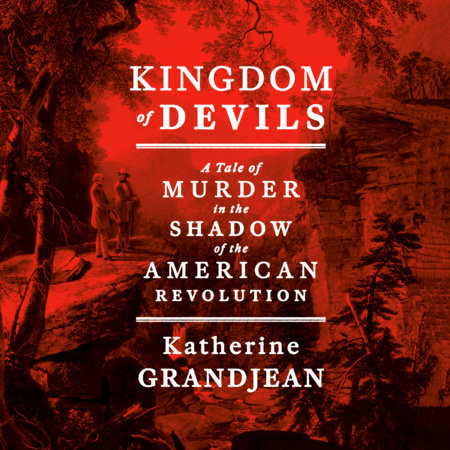
Kingdom of Devils

A Tale of Murder in the Shadow of the American Revolution

Read by Dawn Harvey
Listen to a clip from the audiobook
audio pause button
0:00
0:00
Audiobook Download
On sale Jun 09, 2026 | 9 Hours and 42 Minutes | 9798217160525
Grades 9-12 + AP/IB

See Additional Formats
The chilling true story of a brutal string of deaths on the post-Revolutionary frontier that reveal the violence at the heart of the young United States

In Cold Blood for the 1790s . . . Part true crime, part western, part ghost story, Kingdom of Devils plumbs the dark underbelly of the American West in the years following the Revolution.”—Jane Kamensky, president and CEO, Thomas Jefferson’s Monticello

Kentucky, 1798: A harrowing series of murders begins. The first body, discovered by cattle drovers, lies bloody at the bottom of a ridge. Then another—a dead boy staring up from a sinkhole. Bodies turn up along roadsides, stuffed into brush. They float to the surface of muddy brooks. For nine terrifying months, over hundreds of miles of Kentucky and Tennessee countryside, the terror unfolds. The killers—two men with hazy backgrounds—are brothers, named Wiley and Micajah Harp.

The Harps killed dozens, but why they did it has eluded folklorists and historians for generations. Almost every story imagines that their motive was pure bloodlust, but for historian Katherine Grandjean, that’s too simple. Instead, she uses the Harp murders to reveal the dark side of the young United States’ independence. These were uncertain and dangerous years—a time when the fledgling federal government could do little to protect its citizens. And if the American Revolution was liberating, it was also deeply destabilizing, politically and socially. Even as it built up some men, it stacked the deck against others, punishing them with volatile markets, lost safety nets, and shattered aspirations. Unspooling the mystery of what sent the Harps reeling exposes the hidden, violent legacies of the revolutionary era.

Bristling with tense, page-turning storytelling—and driven by a historian’s obsessive detective work—Kingdom of Devils recovers these long-forgotten murders as a haunting tale about the darkness at the heart of the American dream.


* This audiobook edition includes a downloadable PDF of images designed to complement your listening experience.
East Tennessee

Come all ye young men a warning take by me, Love your wives, and mind your work, and shun bad company; Quit gaming, and fine whores, Pay off your tavern scores, For they’ll be staring at your daring, When you can spend no more. —from “The Confession of Thomas Mount,” 1791


Chapter 1

Liberty and Property

Beaver Creek Knox County, Tennessee Fall 1797

On a brisk autumn day, Wiley Harp went into town. He strolled among the buildings, squat and wooden. Knoxville was square, all blocky lots, a giant chessboard teetering on the muddy edge of the Holston River. Close to the center of the board was the courthouse. It was one of the town’s grandest buildings, but even so, it was an ugly thing, already falling apart. It would later burn down, possibly at the hand of an arsonist. This was the place he was looking for.

Outside, clumps of men stood talking. There was laughter and shouting. Peddlers hawked whiskey, and tied-up horses twitched restlessly. On court days, when people gathered in the square, the town felt festive. A “promiscuous throng” clogged the streets. Women yelled from doorways, and others sang as “the crowd whooped and danced.” Wiley moved through them. His brother was by his side, along to help with his business. Clutching a piece of paper tightly in his hand, he stepped into the courthouse and waited his turn.

It was 1797, and the United States was filled with a jittery and boundless energy. Not long ago, America had fought for and won its independence from Britain. People had scattered; loyalists had fled. Old resentments were fading, or, at least, sinking beneath the surface like old shipwrecks—invisible, submerged. America had its eye on the future, even if it continued to nurse the bumps and bruises of the past. The new republic was finding its way, groping forward, but there were stumbles. Fallout from the Revolution was not entirely settled.

Years had elapsed since delegates gathered in an airless hall in Philadelphia—latching the windows shut for secrecy—and drafted the United States Constitution. If the republic had held together since then, it was largely attributable to the people’s affections for the first man to be elected president, the imposing war hero George Washington. Though his presidency had endured its rocky moments, Washington was largely beloved. Women tossed flowers at his feet. Men toasted him. In 1796, church bells rang in one New England town to celebrate his birthday, while men belted out, in song, “God Save Great Washington.”

But now the nation had a new president—its second. When John Adams gave his inaugural address earlier that year, he could feel the crowd lamenting Washington’s departure. “A Solemn Scene it was indeed,” he wrote later. The only happy one in the room seemed to be Washington himself. His “Countenance was as serene and unclouded as the day,” Adams remembered. “He Seem’d . . . to enjoy a Tryumph over me. Methought I heard him think Ay! I am fairly out and you fairly in! See which of Us will be happiest.”

Adams had reason to be anxious. With his arrival, the national mood shifted. His presidency would not be a time of optimism and confidence. It was, instead, a time of contraction. War threatened; markets tightened. “[Washington] is fortunate to get off just as the bubble is bursting,” Thomas Jefferson wrote upon Adams’s election, “leaving others to hold the bag.”

But at the courthouse in Knoxville that day, the mood was hopeful. The court was busy. Wiley waited his turn. When the justices beckoned, he stepped forward and announced his business with the court: He was there to register a deed.

He handed the document to the men on the bench.

Was it valid? they asked.

Standing behind him, his brother, Micajah, nodded, and swore, yes.

It was 1797, the year that Wiley Harp became a land owner. For the first time in his life, he owned property.

Wiley Harp was in his late twenties. He was a slight man of meager build, not quite short, though not nearly as tall as Micajah. Although he was the older brother, Wiley looked younger. He had blue eyes. His hair may have been a darkish auburn; it could look lighter or darker, even “reddish,” in different light. He was not bad looking; by some accounts, he was even “handsome” with a “pleasant agreeable appearance.” Nothing about him was especially distinguishable or unusual. He wanted the things that all young men wanted.

He was newly married. His wife was a pretty girl named Sarah—though she was invariably called by her nickname, “Sally.” She may have been a preacher’s daughter. (This was a piece of lore that would later attach to her, though it’s difficult to confirm.) By all accounts, she was a “fine girl,” the daughter of “a man of fine irreproachable character” who lived outside of Knoxville. Some people even remembered her father as a “gentleman.” All the descriptions of her agree: She came from a respectable family, and she was beautiful: “really pretty” and “delicate.” Wiley must have been pleased to marry such a woman.

They signed the marriage bond as June bloomed in 1797, promising that there was “no lawful objection why Willie Harp and Sarah Rice may not be joined together in the holy estate of matrimony.” The bond was dated in “the XXI year of our Independance.” It was the first year of his.

Two months later, he bought his land. It was not much, only one hundred acres. But since he had likely been renting (or squatting) before this, it was quite a moment. He and the seller drew up the deed on August 4, 1797, a rainy day. Wiley paid two hundred dollars. The land, a lush little plot on Beaver Creek, lay a bit northwest of Knoxville. It was a stone’s throw from Cherokee hunting lands. Just over the Clinch River, very close to Wiley Harp’s parcel, was Indian country.

Only a few years earlier, Wiley’s little patch of ground had seen carnage. Not far away stood the remains of Cavett’s Station, a fort that Cherokees had left in “smoking ruins,” the “mangled bodies” of the Cavett family strewn about, in 1793. As Americans speared westward, Cherokees had mercilessly tried to beat them back. Whole Cherokee towns, in turn, were put to “fire and slaughter.” “I am still among my people, living in gores of blood,” wrote Doublehead, a Cherokee warrior, in 1793. For seventeen years, from about 1776 to 1794, the wars had raged, with scores of people “shot, hacked, scalped, burned, and taken captive.”

These were the scenes that haunted the ridges near Knoxville. For now, the bloodletting seemed to have quieted. But the place where Wiley planned to settle with his new bride was still a murky borderland. Cherokees now felt comfortable enough to ramble into town for a little recreation (“they frequently resort among our inhabitants,” the governor wrote in 1796), and some American hopefuls were even fearless—or desperate—enough to begin putting up shanties inside Cherokee Nation, squatting. But the punishing years of the Cherokees’ “long war” cannot have felt very distant.

Nonetheless, as Wiley looked to set down roots, East Tennessee was booming. With the violence of the Indian wars subsiding, migrants were streaming into the region’s creeks and river valleys. “It is not unfrequent to see from two to three hundred people coming in a gang,” wrote an observer in Knoxville in 1795. The countryside seemed ready to burst. Georgia and the Carolinas appeared to be “emptying themselves into it.”

Knoxville in 1797 was a rough, young town, founded only a few years earlier. Barracks, attached to the fort that founder James White had built on high ground in 1786, were still standing and used now as a meeting place for the Assembly. By the time Wiley Harp arrived here to file his deed, there were about forty houses and businesses, arrayed in a grid. The town had a printing office, where the Knoxville Gazette was published. There were shops and markets. You could buy chocolate, coffee, gunpowder, stationery, window glass. You could buy Irish linens, hyson tea, pepper, and allspice. It had no church. But there were taverns, ordinaries, and tippling houses aplenty. In the north end, there was a graveyard.

The people had a reputation for rowdiness. “They are of a class that have nothing to lose,” wrote one visitor.17 To the wayfaring preachers who sometimes rambled through, they seemed godless. On Sundays, instead of going to church, they sang and danced and played cards. They swore. A merchant, visiting in 1798, was shocked. “Thinks I, is this that promised land?” he wrote. “Is this that noble Tennessee whose great fame has filled the mouths and fired the breaths of many?” There were good men in eastern Tennessee, he conceded. But there were “more bad ones.” A joke in town was that the devil, now too old to travel, had retired in Knoxville, where he hoped “to spend the remaining part of his days in tranquility, as he believes he is among his friends.”
“Historian Katherine Grandjean has researched this once-famous cold case with a detective’s tenacity and told it as a gripping story of violent young men and the havoc they wreaked in the unsettling early days of the American republic.”—Kathleen DuVal, Pulitzer Prize–winning author of Native Nations

“With her novelesque prose and high-resolution verbal portraits of her story’s remarkable-but-real characters, Katherine Grandjean pioneers a new genre: true crime set in the 1700s. And Kingdom of Devils shows that some crimes, like the Harp brothers’ twenty-seven murders in two years, can be solved only with a deep dive into their historical context.”—Woody Holton, author of Liberty Is Sweet

“Part true crime, part western, part ghost story, Kingdom of Devils plumbs the dark underbelly of the American West in the years following the Revolution, when, as Katherine Grandjean writes, ‘not even the ground beneath your feet was fixed.’ Pairing deep and inventive research with crackling prose, Grandjean has written In Cold Blood for the 1790s: a rare history that makes its times memorably vivid, and the hairs on the back of your neck stand up.”—Jane Kamensky, president and CEO, Thomas Jefferson’s Monticello

“Written with compassion, lucidity, and historical acumen, Katherine Grandjean’s thrilling Kingdom of Devils—about a once-famous, now-forgotten murder mystery—blows off the dust of the past, which isn’t quite past, to illumine what we forget at our peril.”—Brenda Wineapple, bestselling author of Keeping the Faith

“[An] exceptional true crime saga . . . Readers will find it an eerie tale of bloodshed and a chilling foreshadowing of similar crimes that continue to be perpetrated by ‘young men . . . pushed out of America’s social and economic order.’”Publishers Weekly (starred review)

“An investigation into the meaning of a brutal rampage in post-colonial Appalachia . . . [Grandjean] makes the era come alive with vivid descriptions of wilderness and towns, thumbnail sketches of colorful personalities, and stimulating tangents on post-revolutionary politics and popular culture. . . . An engagingly juicy evocation of life and death in the early Republic.”Kirkus Reviews
© courtesy of the author
Katherine Grandjean is an associate professor of history at Wellesley College, where her research explores early American and Native American history, environmental history, and violence in American history. Her first book is American Passage: The Communications Frontier in Early New England. She has been the recipient of several major research fellowships from the National Endowment for the Humanities, the American Antiquarian Society, and the American Council of Learned Societies, among others. View titles by Katherine Grandjean

About

The chilling true story of a brutal string of deaths on the post-Revolutionary frontier that reveal the violence at the heart of the young United States

In Cold Blood for the 1790s . . . Part true crime, part western, part ghost story, Kingdom of Devils plumbs the dark underbelly of the American West in the years following the Revolution.”—Jane Kamensky, president and CEO, Thomas Jefferson’s Monticello

Kentucky, 1798: A harrowing series of murders begins. The first body, discovered by cattle drovers, lies bloody at the bottom of a ridge. Then another—a dead boy staring up from a sinkhole. Bodies turn up along roadsides, stuffed into brush. They float to the surface of muddy brooks. For nine terrifying months, over hundreds of miles of Kentucky and Tennessee countryside, the terror unfolds. The killers—two men with hazy backgrounds—are brothers, named Wiley and Micajah Harp.

The Harps killed dozens, but why they did it has eluded folklorists and historians for generations. Almost every story imagines that their motive was pure bloodlust, but for historian Katherine Grandjean, that’s too simple. Instead, she uses the Harp murders to reveal the dark side of the young United States’ independence. These were uncertain and dangerous years—a time when the fledgling federal government could do little to protect its citizens. And if the American Revolution was liberating, it was also deeply destabilizing, politically and socially. Even as it built up some men, it stacked the deck against others, punishing them with volatile markets, lost safety nets, and shattered aspirations. Unspooling the mystery of what sent the Harps reeling exposes the hidden, violent legacies of the revolutionary era.

Bristling with tense, page-turning storytelling—and driven by a historian’s obsessive detective work—Kingdom of Devils recovers these long-forgotten murders as a haunting tale about the darkness at the heart of the American dream.


* This audiobook edition includes a downloadable PDF of images designed to complement your listening experience.

Excerpt

East Tennessee

Come all ye young men a warning take by me, Love your wives, and mind your work, and shun bad company; Quit gaming, and fine whores, Pay off your tavern scores, For they’ll be staring at your daring, When you can spend no more. —from “The Confession of Thomas Mount,” 1791


Chapter 1

Liberty and Property

Beaver Creek Knox County, Tennessee Fall 1797

On a brisk autumn day, Wiley Harp went into town. He strolled among the buildings, squat and wooden. Knoxville was square, all blocky lots, a giant chessboard teetering on the muddy edge of the Holston River. Close to the center of the board was the courthouse. It was one of the town’s grandest buildings, but even so, it was an ugly thing, already falling apart. It would later burn down, possibly at the hand of an arsonist. This was the place he was looking for.

Outside, clumps of men stood talking. There was laughter and shouting. Peddlers hawked whiskey, and tied-up horses twitched restlessly. On court days, when people gathered in the square, the town felt festive. A “promiscuous throng” clogged the streets. Women yelled from doorways, and others sang as “the crowd whooped and danced.” Wiley moved through them. His brother was by his side, along to help with his business. Clutching a piece of paper tightly in his hand, he stepped into the courthouse and waited his turn.

It was 1797, and the United States was filled with a jittery and boundless energy. Not long ago, America had fought for and won its independence from Britain. People had scattered; loyalists had fled. Old resentments were fading, or, at least, sinking beneath the surface like old shipwrecks—invisible, submerged. America had its eye on the future, even if it continued to nurse the bumps and bruises of the past. The new republic was finding its way, groping forward, but there were stumbles. Fallout from the Revolution was not entirely settled.

Years had elapsed since delegates gathered in an airless hall in Philadelphia—latching the windows shut for secrecy—and drafted the United States Constitution. If the republic had held together since then, it was largely attributable to the people’s affections for the first man to be elected president, the imposing war hero George Washington. Though his presidency had endured its rocky moments, Washington was largely beloved. Women tossed flowers at his feet. Men toasted him. In 1796, church bells rang in one New England town to celebrate his birthday, while men belted out, in song, “God Save Great Washington.”

But now the nation had a new president—its second. When John Adams gave his inaugural address earlier that year, he could feel the crowd lamenting Washington’s departure. “A Solemn Scene it was indeed,” he wrote later. The only happy one in the room seemed to be Washington himself. His “Countenance was as serene and unclouded as the day,” Adams remembered. “He Seem’d . . . to enjoy a Tryumph over me. Methought I heard him think Ay! I am fairly out and you fairly in! See which of Us will be happiest.”

Adams had reason to be anxious. With his arrival, the national mood shifted. His presidency would not be a time of optimism and confidence. It was, instead, a time of contraction. War threatened; markets tightened. “[Washington] is fortunate to get off just as the bubble is bursting,” Thomas Jefferson wrote upon Adams’s election, “leaving others to hold the bag.”

But at the courthouse in Knoxville that day, the mood was hopeful. The court was busy. Wiley waited his turn. When the justices beckoned, he stepped forward and announced his business with the court: He was there to register a deed.

He handed the document to the men on the bench.

Was it valid? they asked.

Standing behind him, his brother, Micajah, nodded, and swore, yes.

It was 1797, the year that Wiley Harp became a land owner. For the first time in his life, he owned property.

Wiley Harp was in his late twenties. He was a slight man of meager build, not quite short, though not nearly as tall as Micajah. Although he was the older brother, Wiley looked younger. He had blue eyes. His hair may have been a darkish auburn; it could look lighter or darker, even “reddish,” in different light. He was not bad looking; by some accounts, he was even “handsome” with a “pleasant agreeable appearance.” Nothing about him was especially distinguishable or unusual. He wanted the things that all young men wanted.

He was newly married. His wife was a pretty girl named Sarah—though she was invariably called by her nickname, “Sally.” She may have been a preacher’s daughter. (This was a piece of lore that would later attach to her, though it’s difficult to confirm.) By all accounts, she was a “fine girl,” the daughter of “a man of fine irreproachable character” who lived outside of Knoxville. Some people even remembered her father as a “gentleman.” All the descriptions of her agree: She came from a respectable family, and she was beautiful: “really pretty” and “delicate.” Wiley must have been pleased to marry such a woman.

They signed the marriage bond as June bloomed in 1797, promising that there was “no lawful objection why Willie Harp and Sarah Rice may not be joined together in the holy estate of matrimony.” The bond was dated in “the XXI year of our Independance.” It was the first year of his.

Two months later, he bought his land. It was not much, only one hundred acres. But since he had likely been renting (or squatting) before this, it was quite a moment. He and the seller drew up the deed on August 4, 1797, a rainy day. Wiley paid two hundred dollars. The land, a lush little plot on Beaver Creek, lay a bit northwest of Knoxville. It was a stone’s throw from Cherokee hunting lands. Just over the Clinch River, very close to Wiley Harp’s parcel, was Indian country.

Only a few years earlier, Wiley’s little patch of ground had seen carnage. Not far away stood the remains of Cavett’s Station, a fort that Cherokees had left in “smoking ruins,” the “mangled bodies” of the Cavett family strewn about, in 1793. As Americans speared westward, Cherokees had mercilessly tried to beat them back. Whole Cherokee towns, in turn, were put to “fire and slaughter.” “I am still among my people, living in gores of blood,” wrote Doublehead, a Cherokee warrior, in 1793. For seventeen years, from about 1776 to 1794, the wars had raged, with scores of people “shot, hacked, scalped, burned, and taken captive.”

These were the scenes that haunted the ridges near Knoxville. For now, the bloodletting seemed to have quieted. But the place where Wiley planned to settle with his new bride was still a murky borderland. Cherokees now felt comfortable enough to ramble into town for a little recreation (“they frequently resort among our inhabitants,” the governor wrote in 1796), and some American hopefuls were even fearless—or desperate—enough to begin putting up shanties inside Cherokee Nation, squatting. But the punishing years of the Cherokees’ “long war” cannot have felt very distant.

Nonetheless, as Wiley looked to set down roots, East Tennessee was booming. With the violence of the Indian wars subsiding, migrants were streaming into the region’s creeks and river valleys. “It is not unfrequent to see from two to three hundred people coming in a gang,” wrote an observer in Knoxville in 1795. The countryside seemed ready to burst. Georgia and the Carolinas appeared to be “emptying themselves into it.”

Knoxville in 1797 was a rough, young town, founded only a few years earlier. Barracks, attached to the fort that founder James White had built on high ground in 1786, were still standing and used now as a meeting place for the Assembly. By the time Wiley Harp arrived here to file his deed, there were about forty houses and businesses, arrayed in a grid. The town had a printing office, where the Knoxville Gazette was published. There were shops and markets. You could buy chocolate, coffee, gunpowder, stationery, window glass. You could buy Irish linens, hyson tea, pepper, and allspice. It had no church. But there were taverns, ordinaries, and tippling houses aplenty. In the north end, there was a graveyard.

The people had a reputation for rowdiness. “They are of a class that have nothing to lose,” wrote one visitor.17 To the wayfaring preachers who sometimes rambled through, they seemed godless. On Sundays, instead of going to church, they sang and danced and played cards. They swore. A merchant, visiting in 1798, was shocked. “Thinks I, is this that promised land?” he wrote. “Is this that noble Tennessee whose great fame has filled the mouths and fired the breaths of many?” There were good men in eastern Tennessee, he conceded. But there were “more bad ones.” A joke in town was that the devil, now too old to travel, had retired in Knoxville, where he hoped “to spend the remaining part of his days in tranquility, as he believes he is among his friends.”

Reviews

“Historian Katherine Grandjean has researched this once-famous cold case with a detective’s tenacity and told it as a gripping story of violent young men and the havoc they wreaked in the unsettling early days of the American republic.”—Kathleen DuVal, Pulitzer Prize–winning author of Native Nations

“With her novelesque prose and high-resolution verbal portraits of her story’s remarkable-but-real characters, Katherine Grandjean pioneers a new genre: true crime set in the 1700s. And Kingdom of Devils shows that some crimes, like the Harp brothers’ twenty-seven murders in two years, can be solved only with a deep dive into their historical context.”—Woody Holton, author of Liberty Is Sweet

“Part true crime, part western, part ghost story, Kingdom of Devils plumbs the dark underbelly of the American West in the years following the Revolution, when, as Katherine Grandjean writes, ‘not even the ground beneath your feet was fixed.’ Pairing deep and inventive research with crackling prose, Grandjean has written In Cold Blood for the 1790s: a rare history that makes its times memorably vivid, and the hairs on the back of your neck stand up.”—Jane Kamensky, president and CEO, Thomas Jefferson’s Monticello

“Written with compassion, lucidity, and historical acumen, Katherine Grandjean’s thrilling Kingdom of Devils—about a once-famous, now-forgotten murder mystery—blows off the dust of the past, which isn’t quite past, to illumine what we forget at our peril.”—Brenda Wineapple, bestselling author of Keeping the Faith

“[An] exceptional true crime saga . . . Readers will find it an eerie tale of bloodshed and a chilling foreshadowing of similar crimes that continue to be perpetrated by ‘young men . . . pushed out of America’s social and economic order.’”Publishers Weekly (starred review)

“An investigation into the meaning of a brutal rampage in post-colonial Appalachia . . . [Grandjean] makes the era come alive with vivid descriptions of wilderness and towns, thumbnail sketches of colorful personalities, and stimulating tangents on post-revolutionary politics and popular culture. . . . An engagingly juicy evocation of life and death in the early Republic.”Kirkus Reviews

Author

© courtesy of the author
Katherine Grandjean is an associate professor of history at Wellesley College, where her research explores early American and Native American history, environmental history, and violence in American history. Her first book is American Passage: The Communications Frontier in Early New England. She has been the recipient of several major research fellowships from the National Endowment for the Humanities, the American Antiquarian Society, and the American Council of Learned Societies, among others. View titles by Katherine Grandjean
  • More Websites from
    Penguin Random House
  • Common Reads
  • Library Marketing