Download high-resolution image Look inside
Listen to a clip from the audiobook
audio pause button
0:00
0:00

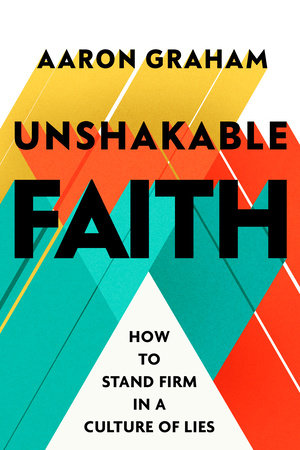
Unshakable Faith

How to Stand Firm in a Culture of Lies

Foreword by Jon Tyson
Look inside
Listen to a clip from the audiobook
audio pause button
0:00
0:00
Learn to recognize seven pervasive lies threatening Christian faith today—and discover how to maintain authentic faith without compromising conviction.

“A prophetic summons for the church in our time.”—Jon Tyson
“Feels like standing at the intersection of C. S. Lewis, John Perkins, and Tim Keller.”—Derwin L. Gray
“A road map for anyone who wants an authentic, resilient faith.”—Dharius Daniels

Many Christians feel it—but don’t know how to name it. Their faith isn’t gone, but it’s not as strong as it once was. Convictions feel harder to hold. Cultural pressure feels harder to resist. And slowly, almost imperceptibly, belief begins to drift.

You don’t want a watered-down faith. You want a faith that is real, resilient, and rooted in truth.

In Unshakable Faith, pastor and author Aaron Graham exposes the seven subtle lies reshaping Christianity from within. He shows how to build a faith that can withstand a culture of confusion without losing conviction or compassion.

Drawing from years of ministry in Washington, DC, one of the most influential and secular cities in the world, Graham brings clarity to the tension many believers feel every day: how to stay faithful to Jesus without retreating from culture or conforming to it.

He identifies the lies many Christians have come to accept:
  • Faith is private
  • Church is optional
  • The Bible is outdated
  • Enemies must be canceled

And he offers something more than critique: a way forward.

This book will help you:
  • Discern how cultural lies subtly reshape your beliefs
  • Rebuild your faith through time-tested Christian practices
  • Stand firm in truth without becoming rigid or combative
  • Engage culture with both conviction and Christlike love
  • Develop a faith that not only survives but thrives

Written with pastoral honesty and cultural insight, Unshakable Faith is both a warning and a roadmap for anyone who feels their faith slipping and for those determined to see it grow stronger than ever.

This isn’t a call to fear culture. And it isn’t a call to conform to it. It’s a call to become unshakable.
1

When Devotion Drifts

From Self-­Centered Faith to God-­Centered Worship

The best thing, where it is possible, is to keep the patient from the serious intention of praying altogether . . . the simplest is to turn their gaze away from Him towards themselves. —­The Screwtape Letters, Letter 4

In 2008, I had the privilege of sitting down with Dr. James Lawson, one of the chief architects of the Civil Rights Movement.

Dr. Lawson founded the Student Nonviolent Coordinating Committee (SNCC) and championed the nonviolent protesting technique to Martin Luther King, Jr. I hung on his every word.

As we talked, he shared something that has shaped my life since: “Injustice is always justified with a big lie. The prophetic task of the church is to discern the lie and expose it.”

He explained how he, Dr. King, Ella Baker, and others used to go into communities and conduct interviews to discern the root of racial injustice in our country. The first question they would ask was:

“What is the lie most people in this community believe?”

Gradually, they uncovered the big lie at the root of racial injustice: Some people’s lives are worth more than others.

But underneath that belief was a deeper distortion—­the age-­old tendency to place self at the center, above others and even above God.

Self-­centered faith leads to compromised worship.

Racial injustice is rooted in self-­centeredness—­a sinful belief that my life, my comfort, and my advancement matter more than yours. It’s the elevation of self over neighbor. And that’s why addressing it required more than policy change—­it required spiritual awakening.

So, Dr. Lawson and the others began asking a second critical question in those communities: “What is the spiritual solution to that lie?”

What they discovered was both theologically profound and nationally resonant. The antidote to the big lie of racial injustice was a foundational truth—­one rooted in Genesis 1 and reflected in the best ideals of the U.S. Constitution.

The truth: All people are created equal.

From the opening pages of Scripture, we see that every human being is made in the image of God—­the imago Dei—­and therefore carries equal worth, dignity, and value. This truth, enshrined in the Constitution, became the moral and spiritual imperative behind the Civil Rights Movement.

Pastors and organizers addressed the foundational lie by appealing to two powerful sources of authority: Scripture and the Constitution. And in doing so, they reminded the nation that true justice begins with true worship—­putting God, not self, at the center.

Sin runs rampant when lies pervade. Freedom and justice reign when we overcome lies with truth.

When we planted The District Church, we followed a similar playbook. We were not just starting a weekly service; we were seeking to build a church for the city. A church that would address the real, often unspoken, spiritual lies shaping people’s lives. So we hit the streets and asked more than two hundred people two simple but revealing questions:

1. What is the lie most people in our city believe?

2. What is the spiritual solution to that lie?

What we heard back was incredibly consistent. The lie wasn’t loud or obvious—­but it was everywhere. It went something like this:

You can change the world on your own.

The problem facing our church was not that people were opposed to community. But there was a pervasive sense that community was optional. That what really mattered was individual effort—earning the right degrees, building the perfect résumé, making the right connections. Then, and only then, could you make a difference.

At first, this way of thinking sounded noble. Ambitious. Even inspiring. But as we considered it more deeply, we realized the problem wasn’t just disconnection from others. The problem was a deeper spiritual drift—­one that placed the self, rather than God, at the center.

That’s the danger of unexamined cultural lies: they often sound like truth. But over time, they quietly reshape what we believe about purpose, success, and even God. And if we’re not careful, they begin to inform not only how we live but how we worship.

The Lie: It’s All About Me

The first and most foundational lie Christians are tempted to believe today is: It’s all about me.

We would never say it out loud. Few would ever claim to believe this lie directly. But it shows up—­in our decisions, our prayers, our priorities.

We choose churches based on how they meet our needs and make life easier or more convenient, rather than on how they help us better glorify God. We pray mainly about our personal goals, not God’s purposes. We prioritize convenience and comfort over sacrifice and obedience. And it’s so easy to embrace, because even though it is straight out of the world, it has been unquestionably accepted in the culture of most families and churches. When I believe it’s all about me, I will soon buy into the lie that I can change the world not just apart from community, but apart from God.

This idea that we can live independently from God isn’t new. It’s the very first lie ever told. Back in the Garden of Eden, the serpent said to Eve, “Did God really say, ‘You must not eat from any tree in the garden’?” Followed by, “You will not certainly die . . . your eyes will be opened, and you will be like God” (Genesis 3:1, 4–­5).

The devil’s strategy from the beginning is to make us think we can be like God and thus live independently from Him. The devil wants us to shift our gaze away from God and toward ourselves and our own plans. C. S. Lewis captures this tactic masterfully in The Screwtape Letters, where the senior demon Screwtape writes to his nephew Wormwood, saying: “The best thing, where it is possible, is to keep the patient [that’s us] from the serious intention of praying altogether . . . to turn their gaze away from Him towards themselves.”

Slowly, subtly, our faith becomes centered around our needs, our goals, and our comfort. We begin to treat God as a divine assistant rather than the Sovereign King. He becomes the One who blesses our dreams rather than the One who defines them.

This lie quietly shifts God from the center of the story to the margins. It recasts Him as a supporting character in our pursuit of success, rather than the Author and Perfecter of our faith.

This first lie is the one that most threatens our ability to live with unshakable faith in a secular age. It is also the most difficult one to discern. It’s the hardest to recognize, because it doesn’t feel wrong. It hides behind good things: self-­care, ambition, even calling. It sounds like wisdom, earns applause, and slips into our prayers unnoticed—­quietly shifting the focus from God to ourselves.

Unfortunately, this lie doesn’t just affect what we do. Over time, it reshapes who we are. It forms a distorted identity—­one that leads to spiritual disconnection and a faith that can’t endure life’s storms.

The Counterfeit Identity: The Self-­Centered Worshiper

The enemy’s goal isn’t just to tempt us into sin—­it’s to reshape our identity by distorting our worship. Worship determines what—­or who—­is at the center of our lives. When the center shifts from God to self, everything else begins to unravel.

While the lie that it’s all about me may not lead to open rebellion, it does something far more dangerous: It leads to subtle redefinition. We may still believe in God. We may still sing the songs. But slowly, we begin to believe that the purpose of faith is to serve our dreams, our goals, and our fulfillment. Our worship then becomes compromised as the object of our worship has quietly changed.

And that’s how a counterfeit identity is formed.

A counterfeit identity is a version of the self shaped more by cultural values and personal desires than by God’s truth. It may still use spiritual language. It may even look impressive on the outside. But it’s no longer rooted in surrender. It tells us that our value comes from what we accomplish, how we feel, or how others see us. It reframes “you were made for a purpose” into “your purpose is your personal fulfillment.”
“A road map for anyone who wants an authentic, resilient faith in an age of noise, nonsense, and nuance.”—Dharius Daniels, D.Min., lead pastor at Change Church and author of Relational Intelligence

“Aaron Graham’s voice is Gospel-centered, wise, and steady. His new book, Unshakable Faith, is a helpful guide for navigating the days we’ve been entrusted with and the culture in which we live.”—Annie F. Downs, New York Times bestselling author of That Sounds Fun

“Reading Unshakable Faith feels like standing at the intersection of C. S. Lewis, John Perkins, and Tim Keller. This is the kind of book that steadies anxious hearts, sharpens faithful minds, and helps followers of Jesus pursue holiness and speak with courage and kindness in a confusing age. Unshakable Faith is deeply needed for this generation.”—Derwin L. Gray, co-founder and lead pastor of Transformation Church and author of Lit Up with Love

Unshakable Faith is the most timely and relevant book addressing the personal, communal, and cultural challenges facing the church today. With courage and clarity, it exposes prevailing lies and inconsistencies, and it confronts them with compelling, timeless truths rooted in the Word of God and the power of the Holy Spirit.”—Ndidi Okonkwo Nwuneli, president and CEO of the ONE Campaign

“Aaron Graham nails it with Unshakable Faith, bringing a much-needed message of clarity and focus in a divisive age of echo chambers—where no one listens, everyone virtue signals, and a plethora of good things too often unintentionally end up superseding the most important thing. This is a book that needs to be widely read and, more important, put into practice by all those who call themselves Jesus followers.”—Larry Osborne, D. Min., author and pastor at North Coast Church

“Not only is Aaron Graham a friend whom I love and respect, but we also have the joy of serving the same city. Aaron is a deep well of wisdom. This book will stretch your faith and deepen it at the same time. Both timeless and timely, Unshakable Faith will help you rediscover faith with your fingerprint on it.”—Mark Batterson, New York Times bestselling author of The Circle Maker

“Aaron delivers one of the most insightful and balanced explorations of faith and truth in changing times. Unshakable Faith clarifies and reinforces kingdom culture, provokes a deep hunger for Jesus, and is a catalyst for revival in a non-intrusive yet compelling manner.”—Godman Akinlabi, global lead pastor at The Elevation Church in Lagos, Nigeria, and author of The Seven Commandments of Foolishness

“I wholeheartedly recommend this book to pastors and leaders across the world who, like myself, are seeking to preach the gospel with clarity, faithfulness, and relevance to today’s generation.”—Muriithi Wanjau, senior pastor of the Mavuno Church Movement

Unshakable Faith is a bold declaration of war against seven lies that can easily take our mind and spirit hostage. This powerful work belongs in the hands of anyone who desires a closer, more vibrant, spirit-filled walk with God.”—Adam C. Wright, Ph.D., president at Dallas Baptist University
Aaron Graham is the founder and lead pastor of The District Church, a thriving multicultural congregation in Washington, DC, representing more than 80 nations. For over fifteen years, he has pastored in the heart of the nation's capital, discipling a generation to follow Jesus with courage and conviction. Aaron earned a master's degree in public policy from Harvard's Kennedy School and a doctorate in missiology from Fuller Theological Seminary. His ministry has been shaped by formative experiences as a missionary kid in Liberia and Kuwait—where he was held hostage during the Persian Gulf War—and by years spent living among the urban poor and pastoring an African American church plant in Boston.

He and his wife, Amy, are passionate advocates for foster care, adoption, and affordable housing. Together they founded DC127, a movement uniting churches to reverse the foster care waitlist. Aaron also serves on the mayor's faith advisory board and provides spiritual counsel to senior leaders in government, education, and business. He and Amy live in Washington, DC, with their two teenagers, Elijah and Natalie.

About

Learn to recognize seven pervasive lies threatening Christian faith today—and discover how to maintain authentic faith without compromising conviction.

“A prophetic summons for the church in our time.”—Jon Tyson
“Feels like standing at the intersection of C. S. Lewis, John Perkins, and Tim Keller.”—Derwin L. Gray
“A road map for anyone who wants an authentic, resilient faith.”—Dharius Daniels

Many Christians feel it—but don’t know how to name it. Their faith isn’t gone, but it’s not as strong as it once was. Convictions feel harder to hold. Cultural pressure feels harder to resist. And slowly, almost imperceptibly, belief begins to drift.

You don’t want a watered-down faith. You want a faith that is real, resilient, and rooted in truth.

In Unshakable Faith, pastor and author Aaron Graham exposes the seven subtle lies reshaping Christianity from within. He shows how to build a faith that can withstand a culture of confusion without losing conviction or compassion.

Drawing from years of ministry in Washington, DC, one of the most influential and secular cities in the world, Graham brings clarity to the tension many believers feel every day: how to stay faithful to Jesus without retreating from culture or conforming to it.

He identifies the lies many Christians have come to accept:
  • Faith is private
  • Church is optional
  • The Bible is outdated
  • Enemies must be canceled

And he offers something more than critique: a way forward.

This book will help you:
  • Discern how cultural lies subtly reshape your beliefs
  • Rebuild your faith through time-tested Christian practices
  • Stand firm in truth without becoming rigid or combative
  • Engage culture with both conviction and Christlike love
  • Develop a faith that not only survives but thrives

Written with pastoral honesty and cultural insight, Unshakable Faith is both a warning and a roadmap for anyone who feels their faith slipping and for those determined to see it grow stronger than ever.

This isn’t a call to fear culture. And it isn’t a call to conform to it. It’s a call to become unshakable.

Excerpt

1

When Devotion Drifts

From Self-­Centered Faith to God-­Centered Worship

The best thing, where it is possible, is to keep the patient from the serious intention of praying altogether . . . the simplest is to turn their gaze away from Him towards themselves. —­The Screwtape Letters, Letter 4

In 2008, I had the privilege of sitting down with Dr. James Lawson, one of the chief architects of the Civil Rights Movement.

Dr. Lawson founded the Student Nonviolent Coordinating Committee (SNCC) and championed the nonviolent protesting technique to Martin Luther King, Jr. I hung on his every word.

As we talked, he shared something that has shaped my life since: “Injustice is always justified with a big lie. The prophetic task of the church is to discern the lie and expose it.”

He explained how he, Dr. King, Ella Baker, and others used to go into communities and conduct interviews to discern the root of racial injustice in our country. The first question they would ask was:

“What is the lie most people in this community believe?”

Gradually, they uncovered the big lie at the root of racial injustice: Some people’s lives are worth more than others.

But underneath that belief was a deeper distortion—­the age-­old tendency to place self at the center, above others and even above God.

Self-­centered faith leads to compromised worship.

Racial injustice is rooted in self-­centeredness—­a sinful belief that my life, my comfort, and my advancement matter more than yours. It’s the elevation of self over neighbor. And that’s why addressing it required more than policy change—­it required spiritual awakening.

So, Dr. Lawson and the others began asking a second critical question in those communities: “What is the spiritual solution to that lie?”

What they discovered was both theologically profound and nationally resonant. The antidote to the big lie of racial injustice was a foundational truth—­one rooted in Genesis 1 and reflected in the best ideals of the U.S. Constitution.

The truth: All people are created equal.

From the opening pages of Scripture, we see that every human being is made in the image of God—­the imago Dei—­and therefore carries equal worth, dignity, and value. This truth, enshrined in the Constitution, became the moral and spiritual imperative behind the Civil Rights Movement.

Pastors and organizers addressed the foundational lie by appealing to two powerful sources of authority: Scripture and the Constitution. And in doing so, they reminded the nation that true justice begins with true worship—­putting God, not self, at the center.

Sin runs rampant when lies pervade. Freedom and justice reign when we overcome lies with truth.

When we planted The District Church, we followed a similar playbook. We were not just starting a weekly service; we were seeking to build a church for the city. A church that would address the real, often unspoken, spiritual lies shaping people’s lives. So we hit the streets and asked more than two hundred people two simple but revealing questions:

1. What is the lie most people in our city believe?

2. What is the spiritual solution to that lie?

What we heard back was incredibly consistent. The lie wasn’t loud or obvious—­but it was everywhere. It went something like this:

You can change the world on your own.

The problem facing our church was not that people were opposed to community. But there was a pervasive sense that community was optional. That what really mattered was individual effort—earning the right degrees, building the perfect résumé, making the right connections. Then, and only then, could you make a difference.

At first, this way of thinking sounded noble. Ambitious. Even inspiring. But as we considered it more deeply, we realized the problem wasn’t just disconnection from others. The problem was a deeper spiritual drift—­one that placed the self, rather than God, at the center.

That’s the danger of unexamined cultural lies: they often sound like truth. But over time, they quietly reshape what we believe about purpose, success, and even God. And if we’re not careful, they begin to inform not only how we live but how we worship.

The Lie: It’s All About Me

The first and most foundational lie Christians are tempted to believe today is: It’s all about me.

We would never say it out loud. Few would ever claim to believe this lie directly. But it shows up—­in our decisions, our prayers, our priorities.

We choose churches based on how they meet our needs and make life easier or more convenient, rather than on how they help us better glorify God. We pray mainly about our personal goals, not God’s purposes. We prioritize convenience and comfort over sacrifice and obedience. And it’s so easy to embrace, because even though it is straight out of the world, it has been unquestionably accepted in the culture of most families and churches. When I believe it’s all about me, I will soon buy into the lie that I can change the world not just apart from community, but apart from God.

This idea that we can live independently from God isn’t new. It’s the very first lie ever told. Back in the Garden of Eden, the serpent said to Eve, “Did God really say, ‘You must not eat from any tree in the garden’?” Followed by, “You will not certainly die . . . your eyes will be opened, and you will be like God” (Genesis 3:1, 4–­5).

The devil’s strategy from the beginning is to make us think we can be like God and thus live independently from Him. The devil wants us to shift our gaze away from God and toward ourselves and our own plans. C. S. Lewis captures this tactic masterfully in The Screwtape Letters, where the senior demon Screwtape writes to his nephew Wormwood, saying: “The best thing, where it is possible, is to keep the patient [that’s us] from the serious intention of praying altogether . . . to turn their gaze away from Him towards themselves.”

Slowly, subtly, our faith becomes centered around our needs, our goals, and our comfort. We begin to treat God as a divine assistant rather than the Sovereign King. He becomes the One who blesses our dreams rather than the One who defines them.

This lie quietly shifts God from the center of the story to the margins. It recasts Him as a supporting character in our pursuit of success, rather than the Author and Perfecter of our faith.

This first lie is the one that most threatens our ability to live with unshakable faith in a secular age. It is also the most difficult one to discern. It’s the hardest to recognize, because it doesn’t feel wrong. It hides behind good things: self-­care, ambition, even calling. It sounds like wisdom, earns applause, and slips into our prayers unnoticed—­quietly shifting the focus from God to ourselves.

Unfortunately, this lie doesn’t just affect what we do. Over time, it reshapes who we are. It forms a distorted identity—­one that leads to spiritual disconnection and a faith that can’t endure life’s storms.

The Counterfeit Identity: The Self-­Centered Worshiper

The enemy’s goal isn’t just to tempt us into sin—­it’s to reshape our identity by distorting our worship. Worship determines what—­or who—­is at the center of our lives. When the center shifts from God to self, everything else begins to unravel.

While the lie that it’s all about me may not lead to open rebellion, it does something far more dangerous: It leads to subtle redefinition. We may still believe in God. We may still sing the songs. But slowly, we begin to believe that the purpose of faith is to serve our dreams, our goals, and our fulfillment. Our worship then becomes compromised as the object of our worship has quietly changed.

And that’s how a counterfeit identity is formed.

A counterfeit identity is a version of the self shaped more by cultural values and personal desires than by God’s truth. It may still use spiritual language. It may even look impressive on the outside. But it’s no longer rooted in surrender. It tells us that our value comes from what we accomplish, how we feel, or how others see us. It reframes “you were made for a purpose” into “your purpose is your personal fulfillment.”

Reviews

“A road map for anyone who wants an authentic, resilient faith in an age of noise, nonsense, and nuance.”—Dharius Daniels, D.Min., lead pastor at Change Church and author of Relational Intelligence

“Aaron Graham’s voice is Gospel-centered, wise, and steady. His new book, Unshakable Faith, is a helpful guide for navigating the days we’ve been entrusted with and the culture in which we live.”—Annie F. Downs, New York Times bestselling author of That Sounds Fun

“Reading Unshakable Faith feels like standing at the intersection of C. S. Lewis, John Perkins, and Tim Keller. This is the kind of book that steadies anxious hearts, sharpens faithful minds, and helps followers of Jesus pursue holiness and speak with courage and kindness in a confusing age. Unshakable Faith is deeply needed for this generation.”—Derwin L. Gray, co-founder and lead pastor of Transformation Church and author of Lit Up with Love

Unshakable Faith is the most timely and relevant book addressing the personal, communal, and cultural challenges facing the church today. With courage and clarity, it exposes prevailing lies and inconsistencies, and it confronts them with compelling, timeless truths rooted in the Word of God and the power of the Holy Spirit.”—Ndidi Okonkwo Nwuneli, president and CEO of the ONE Campaign

“Aaron Graham nails it with Unshakable Faith, bringing a much-needed message of clarity and focus in a divisive age of echo chambers—where no one listens, everyone virtue signals, and a plethora of good things too often unintentionally end up superseding the most important thing. This is a book that needs to be widely read and, more important, put into practice by all those who call themselves Jesus followers.”—Larry Osborne, D. Min., author and pastor at North Coast Church

“Not only is Aaron Graham a friend whom I love and respect, but we also have the joy of serving the same city. Aaron is a deep well of wisdom. This book will stretch your faith and deepen it at the same time. Both timeless and timely, Unshakable Faith will help you rediscover faith with your fingerprint on it.”—Mark Batterson, New York Times bestselling author of The Circle Maker

“Aaron delivers one of the most insightful and balanced explorations of faith and truth in changing times. Unshakable Faith clarifies and reinforces kingdom culture, provokes a deep hunger for Jesus, and is a catalyst for revival in a non-intrusive yet compelling manner.”—Godman Akinlabi, global lead pastor at The Elevation Church in Lagos, Nigeria, and author of The Seven Commandments of Foolishness

“I wholeheartedly recommend this book to pastors and leaders across the world who, like myself, are seeking to preach the gospel with clarity, faithfulness, and relevance to today’s generation.”—Muriithi Wanjau, senior pastor of the Mavuno Church Movement

Unshakable Faith is a bold declaration of war against seven lies that can easily take our mind and spirit hostage. This powerful work belongs in the hands of anyone who desires a closer, more vibrant, spirit-filled walk with God.”—Adam C. Wright, Ph.D., president at Dallas Baptist University

Author

Aaron Graham is the founder and lead pastor of The District Church, a thriving multicultural congregation in Washington, DC, representing more than 80 nations. For over fifteen years, he has pastored in the heart of the nation's capital, discipling a generation to follow Jesus with courage and conviction. Aaron earned a master's degree in public policy from Harvard's Kennedy School and a doctorate in missiology from Fuller Theological Seminary. His ministry has been shaped by formative experiences as a missionary kid in Liberia and Kuwait—where he was held hostage during the Persian Gulf War—and by years spent living among the urban poor and pastoring an African American church plant in Boston.

He and his wife, Amy, are passionate advocates for foster care, adoption, and affordable housing. Together they founded DC127, a movement uniting churches to reverse the foster care waitlist. Aaron also serves on the mayor's faith advisory board and provides spiritual counsel to senior leaders in government, education, and business. He and Amy live in Washington, DC, with their two teenagers, Elijah and Natalie.
  • More Websites from
    Penguin Random House
  • Common Reads
  • Library Marketing