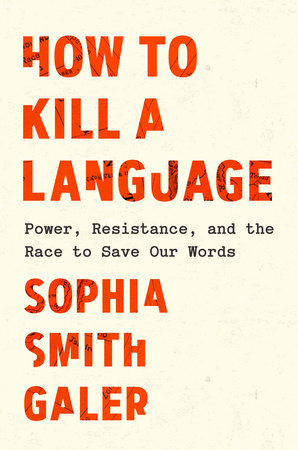
Download high-resolution image
Listen to a clip from the audiobook
audio pause button
0:00
0:00

How to Kill a Language

Power, Resistance, and the Race to Save Our Words

Listen to a clip from the audiobook
audio pause button
0:00
0:00
Ebook (EPUB)
On sale Jul 07, 2026 | 304 Pages | 9798217086986
Grades 9-12 + AP/IB

See Additional Formats
An urgent, globe-spanning exploration of languages at risk, from Kichwa to Ukrainian, that asks: What do we lose—culturally, politically, and personally—when a language is silenced?

“A vivid, hopeful portrait of how people around the world are staying connected to their linguistic roots.”—Gretchen McCulloch, author of Because Internet: Understanding the New Rules of Language

Languages can be killed in many ways: war, the climate crisis, nationalism, and even quiet choices made at the dinner table. Around the world, an unprecedented shift is drawing speakers toward national and global lingua francas. For some, that means losing the language of parents or grandparents; for many, it is a permanent farewell to systems that carry knowledge, culture, and belonging. With half of our 7,000 languages due to disappear this century, linguicide is one of the most pressing cultural emergencies of our age.

In How to Kill a Language, journalist Sophia Smith Galer travels across continents and generations to chart this phenomenon. In Ecuador, she sees firsthand how shame deters parents from passing Kichwa onto their children. In Oman, she learns about languages with roots older than Arabic but never officially recognized. And in Italy, she searches for her Nonna’s dialët, which is vanishing from diaspora communities and Italy itself. But languages can also be reclaimed: We meet the Karuk tribe of California, pioneering a grassroots language immersion program, and the storytellers challenging the criminalization of Kurdish. And in her discussion of Hebrew, Smith Galer reckons with the unintended consequences of raising a language seemingly from the grave.

Part investigation, part travelogue from a disappearing world, How to Kill a Language exposes the true costs of this mass extinction event. Brought to life by vivid storytelling and Smith Galer’s own experience with language loss, it’s a fierce rallying cry for a multilingual future.
Emigrate

The Story of Italian


qualunquismo: political disengagement, literally “whatever-ism”

The final chord was played, and Neil, my accompanist, kept his foot on the pedal, letting the notes hover in the air a moment longer. Then, total silence. He raised his eyes to mine and looked at me expectantly.

I turned toward the examiner, a man in his fifties with the same impenetrable facial expression they all seem to have. He was still writing, which meant I had a moment to gather my thoughts. Singing exams always made my throat dry up, as if someone had wrapped kitchen paper around my tongue. I took a sip of water and felt the adrenaline begin to smooth out. “I will now perform my folk song,” I said. “It is called ‘Vola colomba.’ ”

I was fourteen, and singing “Vola colomba” was the first time I had ever really needed to produce Italian. Exams like these punctuated my teenage years, back when I dreamed of becoming an opera singer. Vocal training was regular, disciplined, and demanded that I pronounce Italian, German, and French like a native. Mum would sit with me at the kitchen table, running through the lyrics of arias I’d been given to make sure I pronounced the Italian properly. I was regularly wrong; at school I had learned Spanish prosody, the stress and rhythm of a language, which in Iberia punches out like a ricochet. Italian words are more irregular, delivered with a wider pitch range that, like music, lilts words up and down expressively. The vowels are so similar between the languages that I’d frequently cross-contaminate my consonants, releasing the salivating hiss that creeps through the Spanish s like a pressure valve into a poor, unassuming Italian word, like la musica. “That’s Spanish!” Mum would wince, as if I’d scraped a fork across a plate. But I’d never had an Italian lesson. I didn’t know any better.

Moments like that were painful reminders of my distance from Italian, my accent betraying my total Englishness and now the other languages I was adopting, too, and I felt like a fraud. But at my nonna’s house in Holloway—where I had first learned “Vola colomba”—my Italianness went unquestioned. She had heard the song as a young woman; it had been written about Trieste, the Italian city split in two during the Second World War, and in it the singer tells a dove to fly down and speak to their beloved, who is praying desperately at church for their return.

“Diglielo tu che tornerò / Dille che non sarà più sola / E che mai più la lascerò”—tell her I’ll come home, that she won’t be alone anymore, and that I’ll never leave her again.

Nonna knows all the words to “Vola colomba” and sings it with a descant harmony in her high soprano voice, which she learned from singing with her siblings, none of whom had any formal musical training. Long after that singing exam, Nonna would grin at me from her sofa with a glint in her brown eyes, and I knew that this would probably be followed by a request to stand up and sing our song. For the first time in my life, we were speaking Italian together—it just happened to be sung. There is a video of me, Nonna, and her sister, Zia Elvira, singing it in Zia’s garden from more than a decade ago, with Zia and I on the same line and Nonna soaring above. It has entered family folklore. And even though it is about Trieste, none of us think of Trieste when we sing it. When I sing it, I think of my nonna; and when Nonna sings it, she thinks about her Italy, hundreds of miles away from Trieste, and the childhood of which she is the last remaining witness.

Tell her I will come home.

Tell her he needn’t be alone any more

And that I’ll never leave her again.

Emigration may well be one of the greatest causes of linguicide in the world. In just three generations, and sometimes even two, most emigrant families will lose the language that connected them to their place of origin. For Nonna, that’s an old brick farmhouse in the middle of nowhere in the mountains of Piacenza, in Emilia-Romagna. I have only been there once; there is no electricity, no running water, and no inside toilet. Nonna’s childhood in poverty—la miseria as it is called in Italian, which feels far more evocative—was worlds, and languages, away from my privileged upbringing in north London. It’s an upbringing her grandchildren would probably never have had, had she stayed. Such economic progress usually demanded the sacrifice of one mother tongue for another.

The Italian American poet and translator Joseph Tusiani said that from the day in which a son says “Mother” instead of “Mamma” and “sky” instead of “cielo,” there’s a “separazione spirituale che lo studioso di linguistica non può catalogare”—a spiritual separation that even the most studious linguist would struggle to explain. We understand that language is one of the ways in which we pass our identity and heritage down to our children, and yet many families seemingly let go of their heritage languages, perhaps by what they feel is choice or necessity. Language planning policies from governments, both at home and abroad, often fall suspiciously quiet when it comes to the continuity of emigrant languages.

When we talk about linguicide, we’re often talking about minority languages in their own countries; languages like Basque in Spain or Māori in New Zealand, which predate the nation-states they went on to precariously find themselves in. Stories like this dominate our understanding of how languages are erased. But the truth is that many countries are not only hostile to the competing indigenous languages that may belong there, but also to foreign languages that resettle, just like people do. In a couple of generations, emigrant families can go from being pockets of linguistic hyperdiversity to total monolingualism in a rapid language shift, the term given by linguists to the sublimation of one language into another.

This new reality is sometimes celebrated as integration. But not only does this ignore that bilingualism is just as effective a means of integration, it passes over the seismic personal cost of language loss in migrant families. The cost to the country is just as significant; according to one economist, the willful monolingualism of a country like the UK—a stereotype so famous, there is an entire Wikipedia entry about it—costs us £48 billion a year through lost business opportunities alone.

In this chapter I’ll use Italian—the emigrant language I’ve watched slip away from my family in the UK—as a test case to examine how emigrant language loss happens and who might be responsible. This was a responsibility that, growing up, I always assumed to be mine and my mum’s. When I was younger, I can remember complaining to Mum that she didn’t send me to Italian class after school, like Nonna did for her. “You didn’t want to learn Italian!” she still says today, as if my fate had been sealed long ago by my errant child self. I’m sure she’s telling the truth, even if I don’t recollect it. Given that Italian was never offered as a subject or a club at school, I’m not sure how much information I ever really had on it; my parents, similarly, were never told about the benefits of retaining heritage languages.

In one of their essays on linguicide, Tove Skutnabb-Kangas and Robert Phillipson talk about this—the mass loss of heritage languages in Western countries with high immigrant populations, where children can’t access lessons in the languages their parents and community speak at home. The linguists do not mince their words: the lack of “immigrant minority education in these countries” equates to “linguistic genocide, as defined by the UN,” they write. They do not blame people like my mum or my nonna for not passing Italian on. They blame our government.

“I love the language, that soft bastard Latin,” Lord Byron wrote in his poem Beppo. Italian, for him, “melts like kisses from a female mouth, / And sounds as if it should be writ on satin.” In contrast, English was “whistling, grunting guttural, / Which we’re obliged to hiss, and spit, and sputter all.” Hundreds of years later, Italian still holds a certain allure. The language learning platform Babbel ran a poll in 2024 searching for the world’s sexiest accent, and the six thousand people they surveyed placed Italian at the top of the list. Linguists over the years have speculated as to why Italian consistently holds this position; is it its purring, rolling r, its undulating pitch? Or is it because of our often positive association with Italy and the values we place on that culture—the food, the music, the way people look—as inseparable from its language?
“Fascinating . . . [Smith] Galer casts a bright light on the massive linguistic diversity that the world seems set to lose.”The New York Times

“Punchy and persuasive . . . [with] many moments of linguistic joy.”The Times (UK)

“[A] moving, beautiful and important book . . . The narrative grips from the outset. . . . The story she tells is profound and often tragic.”Financial Times

How to Kill a Language paints a vivid, hopeful portrait of how people around the world are staying connected to their linguistic roots against the odds. Sophia Smith Galer deftly balances the human detail with the bigger linguistic picture. Marvelously done.”—Gretchen McCulloch, author of Because Internet

“A rallying cry against linguistic extinction . . . This is a necessary book, with a message that English speakers need to hear.”The New Statesman

“Sophia Smith Galer shines an intimate light on a pressing issue. How to Kill a Language tours the world with a personal touch, revealing the powerfully human stakes behind language death and revitalization.”—Adam Aleksic, author of Algospeak

“Urgent and timely . . . How to Kill a Language could easily have become a counsel of despair. Instead, despite its clear-sighted views on the outlook for many languages, what animates it above all is the curiosity and pleasure of language learning—a curiosity that is its own form of hope.”The Telegraph

“An extremely moving, passionate plea to protect linguistic diversity. A language is more than a dictionary or a system of grammar: It is an archive, a culture, a symbol, and a mode of being. Sophia Smith Galer’s fascinating book digs down into what it really means to translate, document, conserve, comprehend, and colonize.”—Cal Flyn, author of Islands of Abandonment

How to Kill a Language hits the intersection of language and power as few other books have, with vivid reporting of how ‘linguicide’s broad scythe’ is cutting through communities worldwide.”—Ross Perlin, author of Language City

“A love letter to languages. These ten stories locate their languages in a context of personal heritage, identity, and culture in a way that is both intellectually rigorous and yet profoundly moving.”—David Crystal, author of How Language Works

“Beautiful, thought-provoking, and compelling.”—Susie Dent, author of Guilty by Definition

“How to Kill a Language both demystifies and sharply contextualizes linguicide by providing not only the reasons why languages die but also the stories of the speakers and communities whose languages are lost. I’m so glad this book exists: Language preservation and revitalization are causes sorely in need of a champion.”—David Peterson, author of The Art of Language Invention

“Essential . . . A relevant, necessary call to action.” —Library Journal, starred review

“A sobering, urgent call for action to save a thousand tongues while we can.”—Kirkus Reviews

“Heart-wrenching . . . a spirited reconsideration of language as a natural resource that must be protected.”—Publishers Weekly

© Jordan Rose
Sophia Smith Galer is an award-winning journalist who has reported for the BBC and VICE News around the world. She studied Spanish and Arabic at Durham University, and in 2022 British Vogue selected her as one of the 25 most influential women in the UK. View titles by Sophia Smith Galer

About

An urgent, globe-spanning exploration of languages at risk, from Kichwa to Ukrainian, that asks: What do we lose—culturally, politically, and personally—when a language is silenced?

“A vivid, hopeful portrait of how people around the world are staying connected to their linguistic roots.”—Gretchen McCulloch, author of Because Internet: Understanding the New Rules of Language

Languages can be killed in many ways: war, the climate crisis, nationalism, and even quiet choices made at the dinner table. Around the world, an unprecedented shift is drawing speakers toward national and global lingua francas. For some, that means losing the language of parents or grandparents; for many, it is a permanent farewell to systems that carry knowledge, culture, and belonging. With half of our 7,000 languages due to disappear this century, linguicide is one of the most pressing cultural emergencies of our age.

In How to Kill a Language, journalist Sophia Smith Galer travels across continents and generations to chart this phenomenon. In Ecuador, she sees firsthand how shame deters parents from passing Kichwa onto their children. In Oman, she learns about languages with roots older than Arabic but never officially recognized. And in Italy, she searches for her Nonna’s dialët, which is vanishing from diaspora communities and Italy itself. But languages can also be reclaimed: We meet the Karuk tribe of California, pioneering a grassroots language immersion program, and the storytellers challenging the criminalization of Kurdish. And in her discussion of Hebrew, Smith Galer reckons with the unintended consequences of raising a language seemingly from the grave.

Part investigation, part travelogue from a disappearing world, How to Kill a Language exposes the true costs of this mass extinction event. Brought to life by vivid storytelling and Smith Galer’s own experience with language loss, it’s a fierce rallying cry for a multilingual future.

Excerpt

Emigrate

The Story of Italian


qualunquismo: political disengagement, literally “whatever-ism”

The final chord was played, and Neil, my accompanist, kept his foot on the pedal, letting the notes hover in the air a moment longer. Then, total silence. He raised his eyes to mine and looked at me expectantly.

I turned toward the examiner, a man in his fifties with the same impenetrable facial expression they all seem to have. He was still writing, which meant I had a moment to gather my thoughts. Singing exams always made my throat dry up, as if someone had wrapped kitchen paper around my tongue. I took a sip of water and felt the adrenaline begin to smooth out. “I will now perform my folk song,” I said. “It is called ‘Vola colomba.’ ”

I was fourteen, and singing “Vola colomba” was the first time I had ever really needed to produce Italian. Exams like these punctuated my teenage years, back when I dreamed of becoming an opera singer. Vocal training was regular, disciplined, and demanded that I pronounce Italian, German, and French like a native. Mum would sit with me at the kitchen table, running through the lyrics of arias I’d been given to make sure I pronounced the Italian properly. I was regularly wrong; at school I had learned Spanish prosody, the stress and rhythm of a language, which in Iberia punches out like a ricochet. Italian words are more irregular, delivered with a wider pitch range that, like music, lilts words up and down expressively. The vowels are so similar between the languages that I’d frequently cross-contaminate my consonants, releasing the salivating hiss that creeps through the Spanish s like a pressure valve into a poor, unassuming Italian word, like la musica. “That’s Spanish!” Mum would wince, as if I’d scraped a fork across a plate. But I’d never had an Italian lesson. I didn’t know any better.

Moments like that were painful reminders of my distance from Italian, my accent betraying my total Englishness and now the other languages I was adopting, too, and I felt like a fraud. But at my nonna’s house in Holloway—where I had first learned “Vola colomba”—my Italianness went unquestioned. She had heard the song as a young woman; it had been written about Trieste, the Italian city split in two during the Second World War, and in it the singer tells a dove to fly down and speak to their beloved, who is praying desperately at church for their return.

“Diglielo tu che tornerò / Dille che non sarà più sola / E che mai più la lascerò”—tell her I’ll come home, that she won’t be alone anymore, and that I’ll never leave her again.

Nonna knows all the words to “Vola colomba” and sings it with a descant harmony in her high soprano voice, which she learned from singing with her siblings, none of whom had any formal musical training. Long after that singing exam, Nonna would grin at me from her sofa with a glint in her brown eyes, and I knew that this would probably be followed by a request to stand up and sing our song. For the first time in my life, we were speaking Italian together—it just happened to be sung. There is a video of me, Nonna, and her sister, Zia Elvira, singing it in Zia’s garden from more than a decade ago, with Zia and I on the same line and Nonna soaring above. It has entered family folklore. And even though it is about Trieste, none of us think of Trieste when we sing it. When I sing it, I think of my nonna; and when Nonna sings it, she thinks about her Italy, hundreds of miles away from Trieste, and the childhood of which she is the last remaining witness.

Tell her I will come home.

Tell her he needn’t be alone any more

And that I’ll never leave her again.

Emigration may well be one of the greatest causes of linguicide in the world. In just three generations, and sometimes even two, most emigrant families will lose the language that connected them to their place of origin. For Nonna, that’s an old brick farmhouse in the middle of nowhere in the mountains of Piacenza, in Emilia-Romagna. I have only been there once; there is no electricity, no running water, and no inside toilet. Nonna’s childhood in poverty—la miseria as it is called in Italian, which feels far more evocative—was worlds, and languages, away from my privileged upbringing in north London. It’s an upbringing her grandchildren would probably never have had, had she stayed. Such economic progress usually demanded the sacrifice of one mother tongue for another.

The Italian American poet and translator Joseph Tusiani said that from the day in which a son says “Mother” instead of “Mamma” and “sky” instead of “cielo,” there’s a “separazione spirituale che lo studioso di linguistica non può catalogare”—a spiritual separation that even the most studious linguist would struggle to explain. We understand that language is one of the ways in which we pass our identity and heritage down to our children, and yet many families seemingly let go of their heritage languages, perhaps by what they feel is choice or necessity. Language planning policies from governments, both at home and abroad, often fall suspiciously quiet when it comes to the continuity of emigrant languages.

When we talk about linguicide, we’re often talking about minority languages in their own countries; languages like Basque in Spain or Māori in New Zealand, which predate the nation-states they went on to precariously find themselves in. Stories like this dominate our understanding of how languages are erased. But the truth is that many countries are not only hostile to the competing indigenous languages that may belong there, but also to foreign languages that resettle, just like people do. In a couple of generations, emigrant families can go from being pockets of linguistic hyperdiversity to total monolingualism in a rapid language shift, the term given by linguists to the sublimation of one language into another.

This new reality is sometimes celebrated as integration. But not only does this ignore that bilingualism is just as effective a means of integration, it passes over the seismic personal cost of language loss in migrant families. The cost to the country is just as significant; according to one economist, the willful monolingualism of a country like the UK—a stereotype so famous, there is an entire Wikipedia entry about it—costs us £48 billion a year through lost business opportunities alone.

In this chapter I’ll use Italian—the emigrant language I’ve watched slip away from my family in the UK—as a test case to examine how emigrant language loss happens and who might be responsible. This was a responsibility that, growing up, I always assumed to be mine and my mum’s. When I was younger, I can remember complaining to Mum that she didn’t send me to Italian class after school, like Nonna did for her. “You didn’t want to learn Italian!” she still says today, as if my fate had been sealed long ago by my errant child self. I’m sure she’s telling the truth, even if I don’t recollect it. Given that Italian was never offered as a subject or a club at school, I’m not sure how much information I ever really had on it; my parents, similarly, were never told about the benefits of retaining heritage languages.

In one of their essays on linguicide, Tove Skutnabb-Kangas and Robert Phillipson talk about this—the mass loss of heritage languages in Western countries with high immigrant populations, where children can’t access lessons in the languages their parents and community speak at home. The linguists do not mince their words: the lack of “immigrant minority education in these countries” equates to “linguistic genocide, as defined by the UN,” they write. They do not blame people like my mum or my nonna for not passing Italian on. They blame our government.

“I love the language, that soft bastard Latin,” Lord Byron wrote in his poem Beppo. Italian, for him, “melts like kisses from a female mouth, / And sounds as if it should be writ on satin.” In contrast, English was “whistling, grunting guttural, / Which we’re obliged to hiss, and spit, and sputter all.” Hundreds of years later, Italian still holds a certain allure. The language learning platform Babbel ran a poll in 2024 searching for the world’s sexiest accent, and the six thousand people they surveyed placed Italian at the top of the list. Linguists over the years have speculated as to why Italian consistently holds this position; is it its purring, rolling r, its undulating pitch? Or is it because of our often positive association with Italy and the values we place on that culture—the food, the music, the way people look—as inseparable from its language?

Reviews

“Fascinating . . . [Smith] Galer casts a bright light on the massive linguistic diversity that the world seems set to lose.”The New York Times

“Punchy and persuasive . . . [with] many moments of linguistic joy.”The Times (UK)

“[A] moving, beautiful and important book . . . The narrative grips from the outset. . . . The story she tells is profound and often tragic.”Financial Times

How to Kill a Language paints a vivid, hopeful portrait of how people around the world are staying connected to their linguistic roots against the odds. Sophia Smith Galer deftly balances the human detail with the bigger linguistic picture. Marvelously done.”—Gretchen McCulloch, author of Because Internet

“A rallying cry against linguistic extinction . . . This is a necessary book, with a message that English speakers need to hear.”The New Statesman

“Sophia Smith Galer shines an intimate light on a pressing issue. How to Kill a Language tours the world with a personal touch, revealing the powerfully human stakes behind language death and revitalization.”—Adam Aleksic, author of Algospeak

“Urgent and timely . . . How to Kill a Language could easily have become a counsel of despair. Instead, despite its clear-sighted views on the outlook for many languages, what animates it above all is the curiosity and pleasure of language learning—a curiosity that is its own form of hope.”The Telegraph

“An extremely moving, passionate plea to protect linguistic diversity. A language is more than a dictionary or a system of grammar: It is an archive, a culture, a symbol, and a mode of being. Sophia Smith Galer’s fascinating book digs down into what it really means to translate, document, conserve, comprehend, and colonize.”—Cal Flyn, author of Islands of Abandonment

How to Kill a Language hits the intersection of language and power as few other books have, with vivid reporting of how ‘linguicide’s broad scythe’ is cutting through communities worldwide.”—Ross Perlin, author of Language City

“A love letter to languages. These ten stories locate their languages in a context of personal heritage, identity, and culture in a way that is both intellectually rigorous and yet profoundly moving.”—David Crystal, author of How Language Works

“Beautiful, thought-provoking, and compelling.”—Susie Dent, author of Guilty by Definition

“How to Kill a Language both demystifies and sharply contextualizes linguicide by providing not only the reasons why languages die but also the stories of the speakers and communities whose languages are lost. I’m so glad this book exists: Language preservation and revitalization are causes sorely in need of a champion.”—David Peterson, author of The Art of Language Invention

“Essential . . . A relevant, necessary call to action.” —Library Journal, starred review

“A sobering, urgent call for action to save a thousand tongues while we can.”—Kirkus Reviews

“Heart-wrenching . . . a spirited reconsideration of language as a natural resource that must be protected.”—Publishers Weekly

Author

© Jordan Rose
Sophia Smith Galer is an award-winning journalist who has reported for the BBC and VICE News around the world. She studied Spanish and Arabic at Durham University, and in 2022 British Vogue selected her as one of the 25 most influential women in the UK. View titles by Sophia Smith Galer
  • More Websites from
    Penguin Random House
  • Common Reads
  • Library Marketing