Download high-resolution image Look inside
Listen to a clip from the audiobook
audio pause button
0:00
0:00

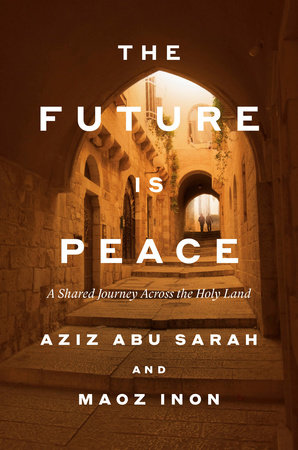
The Future Is Peace

A Shared Journey Across the Holy Land

Author Aziz Abu Sarah On Tour, Maoz Inon On Tour
Look inside
Listen to a clip from the audiobook
audio pause button
0:00
0:00
Two lifelong peace activists and guides to Israel/Palestine, both of whom have lost family in the conflict, take readers on a revealing life-changing journey across this holy, bloodstained land and discover the mythic, political, and personal history that divides but also binds them and their peoples.

“[A] short but immensely poignant account of a shared journey across Israel and the West Bank . . . raw with pain and rage and yet bravely insistent on the imperative of hope.”—The New York Times

“We do not see ourselves as Palestinians and Israelis, or as Jews and Arabs, but as human beings who believe in fostering a culture of dialogue, a culture of forgiveness, and a culture of peace. To those who see only division lines, we say: If you must divide us, let it be as those who believe in peace and equality and those who don’t ... yet.”

Palestinian Aziz Abu Sarah and Israeli Maoz Inon forged a bond of brotherhood when the world expected them to be enemies. Both have lost family to the conflict. Both have known the bitterness of righteous anger. Yet, they chose a different path.

In The Future Is Peace, Sarah and Inon take readers on a transformative weeklong journey across a sacred and bloodstained land. Facing competing narratives, they explore how compassion and unity can pull humanity back from the precipice of blind hatred. Throughout their travels, they have been constantly asked: In the face of so much loss, how can we ever find hope? Their answer is always the same. One cannot find hope. We must create it.

This book is a rebuttal to a broken world and a bold challenge to the belief that more violence can ever bring security. Told with unflinching honesty, their story is proof that peace is not a naive dream, but a courageous choice—for reconciliation to heal the wounds of revenge, for partnerships to change a destiny of war, and for empathy to save us from drowning in sorrow.

Pairing unapologetic candor and inspirational prose, Sarah and Inon are sending an urgent message that the people have the power to make change. Peace is inevitable. For Palestinians, for Israelis, and for the world that awaits their example, it is not just possible—it is the future.
Day 1

Origins and Aftermath

Western Negev

נגבמערבי النقب

Maoz

מָעוֹז

The last time I talked to my father was at 7:31 a.m. on October 7, 2023. I was still in bed that Saturday morning when I checked my phone and saw that my father had sent a message on WhatsApp. “Morning. Sitting in the safe room,” he had written an hour earlier. “We locked the house. Hearing missiles firing. Not sure what’s going on.”

I got up and went to the kitchen to make a cup of coffee. As crazy as that sounds, I wasn’t initially alarmed by his message. When I was fourteen my family had moved from Kibbutz Nir Am, the community inside the Gaza Envelope where I was born and raised, to Netiv HaAsara, the closest Israeli community to the Gaza Strip. The house my parents built there together was less than a quarter mile from the northern border fence. For the past twenty years, a steady soundtrack of rockets, sirens, and gunfire had been the reality for Israelis and Palestinians living close to the border. This kind of thing had become “normal.”

After seeing footage on social media of pickup trucks with masked gunmen driving through Sderot, a city five miles southeast of their home, I called my father. He answered right away and said they could hear air-raid sirens and gunfire, but that he and my mother were fine. He sounded calm, so we agreed to talk again in a little while. “I love you,” we both said, and ended the call. Within minutes, my phone was flooded with news alerts reporting that Hamas militants had crossed the border fence on motorized paragliders. I called my father back. This time, he did not answer.

As word spread of attacks on Israeli communities along the border with Gaza and clashes between Hamas and IDF (Israel Defense Forces) soldiers, my siblings and I gathered with our partners and children at my sister Maayan’s house in Avi’el, a village in northern Israel about halfway between Tel Aviv and Haifa. Our younger brother, Magen, who lives in London with his wife and children, booked a flight and was on his way home to join us. All morning our phones were buzzing with alerts, messages, and calls. We stayed glued to the news, and I kept refreshing the internet feed. As we desperately tried to piece together what was happening, we continued trying to contact our parents. Hour after hour, I kept hitting the redial button on my phone. Then a friend texted me the first name: a neighbor who had been killed. More texts soon followed, with the names of other neighbors and friends. The horror stories piled up. Every time we thought we had hit bottom, the ground crumbled beneath us again and we fell deeper into a pit of heartbreak and disbelief.

By then, we knew that Hamas had taken hostages to Gaza. Had our parents been taken as well? Was that why we hadn’t heard from them? Maybe they were wounded and unable to reach their phones. Even as we imagined the worst, we clung to the thinnest filament of hope that they were alive.

Just after four o’clock that afternoon, my brother-in-law Dani was able to get through to one of our parents’ neighbors from Netiv HaAsara, who was head of security for their community. All of us, including my sisters—Mor, Maayan, and Magal—huddled together with our children in a tight embrace as we watched Dani listening to the call. There was no mistaking the look on his face. In that moment we knew. Our parents, Yakovi and Bilha Inon, were dead.

The earth opened up beneath us and swallowed us whole.

We would learn much later that Hamas militants had entered the house, shot both our parents, and set their home on fire. Our father’s body was so badly burned, it would take fourteen days to identify his remains among the ashes and rubble of our childhood home. Of our mother, nothing remained.

We tried to find comfort in knowing that they were together when they died, but we were plunged into a bottomless abyss of sorrow and pain, drowning in our own tears and deafened by our own wails. In waking nightmares, I saw images of my beloved parents, their faces twisted in pain and calling out for help as they burned alive. I saw them crying, holding each other, pleading for mercy. One moment, I was suffocating. The next, I was shattered into a thousand pieces. And in the next, I was on fire. It was a cycle of grief that would repeat itself over and over again.

Just a week earlier I had attended a strategy meeting with the spokeswomen for the Parents Circle–Families Forum (PCFF), an organization of bereaved Palestinian and Israeli families. The group had recently been banned by the Ministry of Education from operating their peace education programs in Israeli schools. Numbly, I realized that now my own family would be joining the hundreds of families in the organization who had lost loved ones to the conflict.

We made the decision to begin observing shiva, the Jewish week of mourning, for our parents the next day. Thousands of people came to grieve with us. Many of them were still processing their own traumas. Stories of personal pain overlapped with conversations of national pain. So many of my childhood friends and their siblings, parents, and children had been killed. The enormity of the loss was paralyzing.

On Monday morning, my four siblings and I gathered again at Maayan’s house to prepare for the second day of shiva. Magen asked us to be unified in our message that our family was not seeking revenge. We knew that the voices dominating the media were calling for war and vengeance, and some were invoking our parents’ deaths to justify more killing. We did not want our tragedy and pain to be hijacked to justify another war, a war that would bring both Israelis and Palestinians to the edge of chaos.

That night, I couldn’t sleep. My entire body was in agonizing pain. I couldn’t tell if I was awake or dreaming, but through my tears I could see all of humanity crying with me. Our bodies were wounded and broken from war. The ground was stained red with blood. But as our tears fell down our faces and onto our bodies, they healed our wounds and made us whole again. Then our tears washed away the blood from the earth, purifying the ground. And on that ground, I could see a path—the path of peace and reconciliation.

I woke up shaking. In the dark, I reached for my phone and saw that I had a message. It began “Maoz, I’m so sorry to hear about your parents.” I had met Aziz only once before, but I knew his brother had been killed by Israeli soldiers and that he had served as chairman of the PCFF for four years. His words were more than a message of condolence; they shone a light into the darkness.

Aziz

عَزِيز

In the days after October 7, my phone rang nonstop with interview requests, and my social media feeds were flooded with threats and calls for war. I had never corresponded with Maoz directly, but we had mutual colleagues, and one of them texted the morning of October 8 to tell me his parents had been killed in the attack. My first instinct was to reach out to him. I understood too well the pain he was going through, but I hesitated before sending him a message. His parents had just been murdered by Hamas. Did he really want to hear from a Palestinian? I knew he might not be ready to hear from me, that he might never be ready. Still, I had learned from experience it was the right thing to do.

This wasn’t the first time I struggled with whether to reach out to someone I didn’t know to express solidarity in a time of sorrow. Ten years earlier, I had written to the widows of four rabbis who were killed in a shooting inside a synagogue in Jerusalem. The idea that someone, regardless of whether it was a Palestinian, had killed innocent people while they were praying in their holy place gave me a tight, nauseous feeling in my chest. I had never written a condolence letter to someone I hadn’t met before. I sat for hours trying to figure out how to begin. “Please accept my condolences” was too cold and impersonal. “I am sorry for your loss” didn’t seem to cut it, either.

I grew up in East Jerusalem during the First Intifada, which lasted for over five years in the late 1980s and early 1990s. I can still remember watching people on television throwing rocks in the street. I was seven years old, and this seemed like a fun thing to do. So I went out and threw stones at passing cars, not realizing my targets were supposed to be Israeli soldiers and settlers. The problem with stoning your neighbors, I soon learned, is that they know where you live, and they will come to your house and tell your mother.

Two years later, my older brother Tayseer was arrested by the Israeli military and accused of throwing rocks at Israeli soldiers. The interrogators beat and tortured him until he confessed to the charges. After sentencing, he was sent to an Israeli military prison. I was ten when he was released. I thought that, finally, life would return to normal. A couple of months later, Tayseer was rushed to the hospital, where he died from untreated trauma to his internal organs. Our lives would never be normal again.
“The achievement of Aziz Abu Sarah and Maoz Inon’s short but immensely poignant account of a shared journey across Israel and the West Bank is that it remains true to the horror while refusing to be defeated by it. It is raw with pain and rage and yet bravely insistent on the imperative of hope.”The New York Times

“If there is ever to be a sustainable settlement in the Middle East, it will come not from bombs and bogus peace boards but from ordinary people coming to respect each other and tolerate each other’s differences—and even finally to enjoy them. This moving book shows the essential first step on that path, as two courageous men stop hating each other and start talking together. If you’ve lost your faith in the future, read this beautiful book by two people who’ve found it.”—Brian Eno, musician and songwriter

“A book of hope in a time of despair. After unbearable personal suffering, Aziz and Maoz refuse to give up on a shared future in Israel Palestine. Here they show us how it can, and must, happen.”—Geraldine Brooks, Pulitzer Prize–winning author

“Aziz Abu Sarah and Maoz Inon are not only brilliant guides to the tortured geography of the Holy Land but also guides for how to retain our humanity, no matter how much pain we endure. They remind us that, despite oppression, violence, and even genocide, Israeli Jews and Palestinians can live together equally, with justice and in peace.”—Peter Beinart, author of Being Jewish After the Destruction of Gaza

The Future Is Peace is a remarkable book that brilliantly captures ‘the inescapable network of mutuality,’ accessed so powerfully by Martin Luther King Jr. It’s a passionate book, carefully constructed and heartbreakingly true. The message is both simple and immense: We are all helixed together by our humanity. As a guide to the torn heart, it also allows a vision of repair.”—Colum McCann, bestselling author of Let the Great World Spin

“Hopeful and inspirational, The Future Is Peace is a walk through the land and history of Israel and Palestine that shows how two peace activists—an Israeli and a Palestinian—respect each other’s narratives and dare to dream magically of peace amid the reality of conflict.”—Simon Sebag Montefiore, bestselling author and historian
Aziz Abu Sarah is Co-CEO of InterAct International, a nonprofit dedicated to Middle East Peace. He is a peacebuilder, entrepreneur, National Geographic Explorer, TED Fellow, and renowned speaker and trainer on conflict resolution and responsible travel. Aziz is the co-founder of MEJDI Tours, a travel company on a mission to transform tourism into a global force of citizen diplomacy. He has won numerous awards, including from the United Nations, Institute of International Education, and The Explorers Club. Aziz is consistently named one of the world’s 500 most influential Muslims by the Royal Islamic Strategic Studies Centre in Jordan. He has written opinion pieces for The New York Times, The Washington Post, Al-Quds, and Haaretz. View titles by Aziz Abu Sarah
Maoz Inon is Co-CEO of InterAct International, a nonprofit dedicated to Middle East Peace. He is an Israeli peace activist and entrepreneur. He was honored with the prestigious Franco-German Human Rights Prize and the Shared Living Award from Abraham Initiatives. He has spoken on Capitol Hill, at U.S. universities, and the European Parliament. He has written pieces for The Washington Post, Al Jazeera, Haaretz, and more. He has founded several peace-focused initiatives within Israel and the Middle East, including the Jesus Trail, Fauzi Azar Inn, and Abraham Hostel & Tour brands. View titles by Maoz Inon

First-Year Reading (FYR) Guide for The Future Is Peace

Designed specifically to be used by faculty or program facilitators for college First-Year Common Reading programs.

(Please note: the guide displayed here is the most recently uploaded version; while unlikely, any page citation discrepancies between the guide and book is likely due to pagination differences between a book’s different formats.)

About

Two lifelong peace activists and guides to Israel/Palestine, both of whom have lost family in the conflict, take readers on a revealing life-changing journey across this holy, bloodstained land and discover the mythic, political, and personal history that divides but also binds them and their peoples.

“[A] short but immensely poignant account of a shared journey across Israel and the West Bank . . . raw with pain and rage and yet bravely insistent on the imperative of hope.”—The New York Times

“We do not see ourselves as Palestinians and Israelis, or as Jews and Arabs, but as human beings who believe in fostering a culture of dialogue, a culture of forgiveness, and a culture of peace. To those who see only division lines, we say: If you must divide us, let it be as those who believe in peace and equality and those who don’t ... yet.”

Palestinian Aziz Abu Sarah and Israeli Maoz Inon forged a bond of brotherhood when the world expected them to be enemies. Both have lost family to the conflict. Both have known the bitterness of righteous anger. Yet, they chose a different path.

In The Future Is Peace, Sarah and Inon take readers on a transformative weeklong journey across a sacred and bloodstained land. Facing competing narratives, they explore how compassion and unity can pull humanity back from the precipice of blind hatred. Throughout their travels, they have been constantly asked: In the face of so much loss, how can we ever find hope? Their answer is always the same. One cannot find hope. We must create it.

This book is a rebuttal to a broken world and a bold challenge to the belief that more violence can ever bring security. Told with unflinching honesty, their story is proof that peace is not a naive dream, but a courageous choice—for reconciliation to heal the wounds of revenge, for partnerships to change a destiny of war, and for empathy to save us from drowning in sorrow.

Pairing unapologetic candor and inspirational prose, Sarah and Inon are sending an urgent message that the people have the power to make change. Peace is inevitable. For Palestinians, for Israelis, and for the world that awaits their example, it is not just possible—it is the future.

Excerpt

Day 1

Origins and Aftermath

Western Negev

נגבמערבי النقب

Maoz

מָעוֹז

The last time I talked to my father was at 7:31 a.m. on October 7, 2023. I was still in bed that Saturday morning when I checked my phone and saw that my father had sent a message on WhatsApp. “Morning. Sitting in the safe room,” he had written an hour earlier. “We locked the house. Hearing missiles firing. Not sure what’s going on.”

I got up and went to the kitchen to make a cup of coffee. As crazy as that sounds, I wasn’t initially alarmed by his message. When I was fourteen my family had moved from Kibbutz Nir Am, the community inside the Gaza Envelope where I was born and raised, to Netiv HaAsara, the closest Israeli community to the Gaza Strip. The house my parents built there together was less than a quarter mile from the northern border fence. For the past twenty years, a steady soundtrack of rockets, sirens, and gunfire had been the reality for Israelis and Palestinians living close to the border. This kind of thing had become “normal.”

After seeing footage on social media of pickup trucks with masked gunmen driving through Sderot, a city five miles southeast of their home, I called my father. He answered right away and said they could hear air-raid sirens and gunfire, but that he and my mother were fine. He sounded calm, so we agreed to talk again in a little while. “I love you,” we both said, and ended the call. Within minutes, my phone was flooded with news alerts reporting that Hamas militants had crossed the border fence on motorized paragliders. I called my father back. This time, he did not answer.

As word spread of attacks on Israeli communities along the border with Gaza and clashes between Hamas and IDF (Israel Defense Forces) soldiers, my siblings and I gathered with our partners and children at my sister Maayan’s house in Avi’el, a village in northern Israel about halfway between Tel Aviv and Haifa. Our younger brother, Magen, who lives in London with his wife and children, booked a flight and was on his way home to join us. All morning our phones were buzzing with alerts, messages, and calls. We stayed glued to the news, and I kept refreshing the internet feed. As we desperately tried to piece together what was happening, we continued trying to contact our parents. Hour after hour, I kept hitting the redial button on my phone. Then a friend texted me the first name: a neighbor who had been killed. More texts soon followed, with the names of other neighbors and friends. The horror stories piled up. Every time we thought we had hit bottom, the ground crumbled beneath us again and we fell deeper into a pit of heartbreak and disbelief.

By then, we knew that Hamas had taken hostages to Gaza. Had our parents been taken as well? Was that why we hadn’t heard from them? Maybe they were wounded and unable to reach their phones. Even as we imagined the worst, we clung to the thinnest filament of hope that they were alive.

Just after four o’clock that afternoon, my brother-in-law Dani was able to get through to one of our parents’ neighbors from Netiv HaAsara, who was head of security for their community. All of us, including my sisters—Mor, Maayan, and Magal—huddled together with our children in a tight embrace as we watched Dani listening to the call. There was no mistaking the look on his face. In that moment we knew. Our parents, Yakovi and Bilha Inon, were dead.

The earth opened up beneath us and swallowed us whole.

We would learn much later that Hamas militants had entered the house, shot both our parents, and set their home on fire. Our father’s body was so badly burned, it would take fourteen days to identify his remains among the ashes and rubble of our childhood home. Of our mother, nothing remained.

We tried to find comfort in knowing that they were together when they died, but we were plunged into a bottomless abyss of sorrow and pain, drowning in our own tears and deafened by our own wails. In waking nightmares, I saw images of my beloved parents, their faces twisted in pain and calling out for help as they burned alive. I saw them crying, holding each other, pleading for mercy. One moment, I was suffocating. The next, I was shattered into a thousand pieces. And in the next, I was on fire. It was a cycle of grief that would repeat itself over and over again.

Just a week earlier I had attended a strategy meeting with the spokeswomen for the Parents Circle–Families Forum (PCFF), an organization of bereaved Palestinian and Israeli families. The group had recently been banned by the Ministry of Education from operating their peace education programs in Israeli schools. Numbly, I realized that now my own family would be joining the hundreds of families in the organization who had lost loved ones to the conflict.

We made the decision to begin observing shiva, the Jewish week of mourning, for our parents the next day. Thousands of people came to grieve with us. Many of them were still processing their own traumas. Stories of personal pain overlapped with conversations of national pain. So many of my childhood friends and their siblings, parents, and children had been killed. The enormity of the loss was paralyzing.

On Monday morning, my four siblings and I gathered again at Maayan’s house to prepare for the second day of shiva. Magen asked us to be unified in our message that our family was not seeking revenge. We knew that the voices dominating the media were calling for war and vengeance, and some were invoking our parents’ deaths to justify more killing. We did not want our tragedy and pain to be hijacked to justify another war, a war that would bring both Israelis and Palestinians to the edge of chaos.

That night, I couldn’t sleep. My entire body was in agonizing pain. I couldn’t tell if I was awake or dreaming, but through my tears I could see all of humanity crying with me. Our bodies were wounded and broken from war. The ground was stained red with blood. But as our tears fell down our faces and onto our bodies, they healed our wounds and made us whole again. Then our tears washed away the blood from the earth, purifying the ground. And on that ground, I could see a path—the path of peace and reconciliation.

I woke up shaking. In the dark, I reached for my phone and saw that I had a message. It began “Maoz, I’m so sorry to hear about your parents.” I had met Aziz only once before, but I knew his brother had been killed by Israeli soldiers and that he had served as chairman of the PCFF for four years. His words were more than a message of condolence; they shone a light into the darkness.

Aziz

عَزِيز

In the days after October 7, my phone rang nonstop with interview requests, and my social media feeds were flooded with threats and calls for war. I had never corresponded with Maoz directly, but we had mutual colleagues, and one of them texted the morning of October 8 to tell me his parents had been killed in the attack. My first instinct was to reach out to him. I understood too well the pain he was going through, but I hesitated before sending him a message. His parents had just been murdered by Hamas. Did he really want to hear from a Palestinian? I knew he might not be ready to hear from me, that he might never be ready. Still, I had learned from experience it was the right thing to do.

This wasn’t the first time I struggled with whether to reach out to someone I didn’t know to express solidarity in a time of sorrow. Ten years earlier, I had written to the widows of four rabbis who were killed in a shooting inside a synagogue in Jerusalem. The idea that someone, regardless of whether it was a Palestinian, had killed innocent people while they were praying in their holy place gave me a tight, nauseous feeling in my chest. I had never written a condolence letter to someone I hadn’t met before. I sat for hours trying to figure out how to begin. “Please accept my condolences” was too cold and impersonal. “I am sorry for your loss” didn’t seem to cut it, either.

I grew up in East Jerusalem during the First Intifada, which lasted for over five years in the late 1980s and early 1990s. I can still remember watching people on television throwing rocks in the street. I was seven years old, and this seemed like a fun thing to do. So I went out and threw stones at passing cars, not realizing my targets were supposed to be Israeli soldiers and settlers. The problem with stoning your neighbors, I soon learned, is that they know where you live, and they will come to your house and tell your mother.

Two years later, my older brother Tayseer was arrested by the Israeli military and accused of throwing rocks at Israeli soldiers. The interrogators beat and tortured him until he confessed to the charges. After sentencing, he was sent to an Israeli military prison. I was ten when he was released. I thought that, finally, life would return to normal. A couple of months later, Tayseer was rushed to the hospital, where he died from untreated trauma to his internal organs. Our lives would never be normal again.

Reviews

“The achievement of Aziz Abu Sarah and Maoz Inon’s short but immensely poignant account of a shared journey across Israel and the West Bank is that it remains true to the horror while refusing to be defeated by it. It is raw with pain and rage and yet bravely insistent on the imperative of hope.”The New York Times

“If there is ever to be a sustainable settlement in the Middle East, it will come not from bombs and bogus peace boards but from ordinary people coming to respect each other and tolerate each other’s differences—and even finally to enjoy them. This moving book shows the essential first step on that path, as two courageous men stop hating each other and start talking together. If you’ve lost your faith in the future, read this beautiful book by two people who’ve found it.”—Brian Eno, musician and songwriter

“A book of hope in a time of despair. After unbearable personal suffering, Aziz and Maoz refuse to give up on a shared future in Israel Palestine. Here they show us how it can, and must, happen.”—Geraldine Brooks, Pulitzer Prize–winning author

“Aziz Abu Sarah and Maoz Inon are not only brilliant guides to the tortured geography of the Holy Land but also guides for how to retain our humanity, no matter how much pain we endure. They remind us that, despite oppression, violence, and even genocide, Israeli Jews and Palestinians can live together equally, with justice and in peace.”—Peter Beinart, author of Being Jewish After the Destruction of Gaza

The Future Is Peace is a remarkable book that brilliantly captures ‘the inescapable network of mutuality,’ accessed so powerfully by Martin Luther King Jr. It’s a passionate book, carefully constructed and heartbreakingly true. The message is both simple and immense: We are all helixed together by our humanity. As a guide to the torn heart, it also allows a vision of repair.”—Colum McCann, bestselling author of Let the Great World Spin

“Hopeful and inspirational, The Future Is Peace is a walk through the land and history of Israel and Palestine that shows how two peace activists—an Israeli and a Palestinian—respect each other’s narratives and dare to dream magically of peace amid the reality of conflict.”—Simon Sebag Montefiore, bestselling author and historian

Author

Aziz Abu Sarah is Co-CEO of InterAct International, a nonprofit dedicated to Middle East Peace. He is a peacebuilder, entrepreneur, National Geographic Explorer, TED Fellow, and renowned speaker and trainer on conflict resolution and responsible travel. Aziz is the co-founder of MEJDI Tours, a travel company on a mission to transform tourism into a global force of citizen diplomacy. He has won numerous awards, including from the United Nations, Institute of International Education, and The Explorers Club. Aziz is consistently named one of the world’s 500 most influential Muslims by the Royal Islamic Strategic Studies Centre in Jordan. He has written opinion pieces for The New York Times, The Washington Post, Al-Quds, and Haaretz. View titles by Aziz Abu Sarah
Maoz Inon is Co-CEO of InterAct International, a nonprofit dedicated to Middle East Peace. He is an Israeli peace activist and entrepreneur. He was honored with the prestigious Franco-German Human Rights Prize and the Shared Living Award from Abraham Initiatives. He has spoken on Capitol Hill, at U.S. universities, and the European Parliament. He has written pieces for The Washington Post, Al Jazeera, Haaretz, and more. He has founded several peace-focused initiatives within Israel and the Middle East, including the Jesus Trail, Fauzi Azar Inn, and Abraham Hostel & Tour brands. View titles by Maoz Inon

Guides

First-Year Reading (FYR) Guide for The Future Is Peace

Designed specifically to be used by faculty or program facilitators for college First-Year Common Reading programs.

(Please note: the guide displayed here is the most recently uploaded version; while unlikely, any page citation discrepancies between the guide and book is likely due to pagination differences between a book’s different formats.)

  • More Websites from
    Penguin Random House
  • Common Reads
  • Library Marketing