Download high-resolution image Look inside
Listen to a clip from the audiobook
audio pause button
0:00
0:00

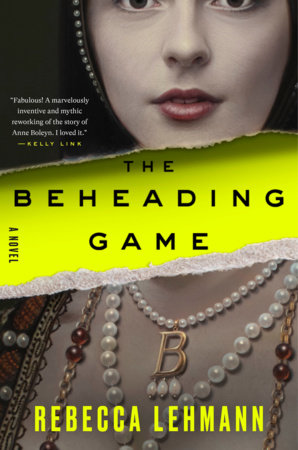
The Beheading Game

A Novel

Author Rebecca Lehmann On Tour
Look inside
Listen to a clip from the audiobook
audio pause button
0:00
0:00
Hardcover
$29.00 US
| $39.99 CAN
On sale Mar 24, 2026 | 320 Pages | 9798217086481
Grades 9-12 + AP/IB

See Additional Formats
Disgraced. Beheaded. And out for revenge . . .

We all know what happened to Henry VIII’s second wife, Anne Boleyn. But what if she woke up the day after her execution and took it upon herself to seek justice?

“Fabulous! A marvelously inventive and mythic reworking of the story of Anne Boleyn. I loved it.”—Kelly Link, author of The Book of Love


“Nobody was surprised at Anne’s conviction. The world loves to put a woman in her place.”


The Beheading Game begins in the hours after Anne Boleyn’s beheading, when she wakes to find herself unceremoniously laid to rest in a makeshift coffin, her head wrapped in linen at her knees. Discarded by King Henry VIII for being unable to give him a male heir and reviled by Cromwell for being too smart for her own good, she was ultimately executed based on trumped-up charges of adultery, incest, and high treason.

Anne escapes the Tower of London, sews her head back on, then sets out on a quest to kill Henry VIII before he can marry her own lady-in-waiting Jane Seymour. The stakes are high—if Jane gives birth to a rival heir, Anne’s daughter, Elizabeth, will lose her claim to the throne. Traveling the streets of London in the guise of a commoner, with the help of a prostitute who becomes a trusted friend (and perhaps something more), Anne soon realizes how little she knew about life in the real world.

A fantastical journey through the wilds of England and Tudor history, filled with danger and magic and steeped in Arthurian legend, The Beheading Game is a prescient reminder that “mouthy” women have always been punished. Now, thanks to debut novelist Rebecca Lehmann, nearly five hundred years after Anne Boleyn’s death, one of history’s most maligned women finally has the chance to tell her story.
Chapter One

The Arrow Chest

Anne opened her eyes to darkness. And wood. Her face was pressed into the wood. And the left side of her body. She realized fabric as well. A thin fabric that covered her. Linen, she thought, from the smell of it—­like wet grass—­and the way the air moved through it. Just slightly, for the air here was very still. The linen was wet and sticky. She remembered once wrapping linen around the neck of a stag, whose flank she’d pierced with an arrow, whose throat she’d slit with an ivory-­hilted dagger. When the beast had stopped convulsing, she’d draped the gash with linen and played at dressing Christ’s wounds. That had been before, when she was young. Her brother, George, had stood beside her, laughing at her joke. She did and didn’t remember the two men, servants, who held the dying hart by its horns while she cut its throat. They could have been any men, low class, assigned to serve her.

She understood she could move her hands. Movement came to her fingers slowly, in twitches, one finger, then another. She curled them in and out, made fists. She understood now that her arm could move too. Her left arm was pinned beneath her, but her right arm was free. She moved it so her hand, through the linen covering, touched the wood. She felt around, up, down. Wood below, wood before, wood above. Perhaps the wood before her extended to a height of three feet, joined at the corners to the wood above and the wood below. A box, then. She must be in a box. She rapped against the wood once, twice, three times, but no one answered. She rapped the wood above and the wood below. Little hollow knocks.

The back of her head was pressed into flesh. Whose flesh? Was someone else in the wooden box? She blinked her eyes open again, tried to open them wider. Her lids were hard to part. Something crusted their corners shut. Probably the same sticky wetness that she felt on the linen. In front of one eye, a piece of straw. And the linen, wrapped around her, right over her mouth. Its tightness made her want to scream, like being trapped in a bedsheet. She didn’t like it. She tried to scream but could draw no air. Or, rather, she could draw air; she could feel her chest rising and falling, but the air was not coming through her nose or mouth. She understood her mouth was shut. She understood her nose was clogged. She opened her mouth, which was dry, and pushed her dry tongue out to touch the sticky linen. It tasted like metal. Her fingers were light. No jewels. Perhaps she had been robbed. Perhaps she had been struck over the head and wrapped in fabric and thrown in a crate, to be ransomed.

She used her free hand to feel her body. All around her, linen, en­casing her, like a caul. Through the linen, she felt something round and hard. It was at her knees. And large. Her hand went to her stomach, to feel for the roundness that had been there. Her baby. No. She’d lost the baby months ago. She remembered Henry’s face when he confronted her in her chambers, in her sickbed. In her birthing bed? No, the child had come early and still. A boy, it had been a boy. The hatred then, in Henry’s face. “I see God will not give me male children,” he’d said. And his eyes, cold with retribution. No more sympathy. No more love. No more most-­cherished one. No more consort. He’d limped around her chamber, stopping before the window, his injured leg bulky with the physician’s dressing.

To dress a wound was to show care, after all. Who had shown Anne care? She remembered stepping to the stage. The stage was draped in black. And the straw, strewn underfoot, for absorption. No, she remembered being helped to the stage by her ladies, who stood behind her. They must have brought the linen with them. She remembered the good blue of the sky, the blue like a baby boy’s eyes. Good Christian people, she’d declared. She’d wanted to say my. My good Christian people. No. They weren’t her people anymore. Good Christian people. I am come hither. That one lock of hair that kept slipping out of her cap, that she kept tucking in. Who had shown Anne care? The executioner, dressed so finely she mistook him for a gentleman, who’d let her finish her prayers, who’d danced behind her, moving so quietly from one side of her blindfolded and kneeling form to the other. Who’d misdirected: “Boy, fetch me my sword.” She’d turned her head to the sound of his voice, searching for him. Je vous cherche; I look for you. But he’d already danced, silent-­footed, to her other side; he already held his sword. As he swung, she searched, unseeing, unaware, in the other direction, no time to flinch, to botch the stroke. And then. And then a terrible pain. And then darkness.

How had he moved so quietly on the scaffold? He must have cushioned his shoes, or slipped out of them. So there had been care there. But then what? The good blue of the sky and the dancing swordsman, and now she was here. She understood she was in a box. She understood, then, that the flesh at the back of her head was her own knees. She under­stood that the round, hard object at her knees was her own head. She felt the back of her head with her free hand as well as she could, because her body was wrapped in one shroud of the linen, and her head in another. How carefully her ladies must have wrapped her body. “Let no man touch me,” she’d instructed them. Noli me tangere, she thought, touch me not, recalling the love poem Thomas Wyatt had written for her. For wasn’t Thomas Wyatt in some other chamber of the Tower, accused, like the others, of lying with her? Whoso list to hunt, I know where is an hind, he’d written, like so many men who’d wanted to conquer her, or any woman, who’d viewed her as a trinket, a trophy, a deer to master and slay, a mount.

So she was awake. Was she alive? Was she a ghost? Was this perdition? She understood her first task was to undo the linen, to untangle herself from the tidy work of her ladies. She shifted her body’s weight off her left side so that she could shimmy her left arm out from under herself. She shimmied and wiggled until her arm was free, until she could press her left hand over her right hand, against her stomach, above her head. Good Christian people, I am come hither to die. She felt for a gap in the linen. There must be a place where the fabric ended, where it had been gathered and tucked in, a loose end. She felt in front of her. Smooth. She did not want to feel above, at her neck. She did not want to know the loss there. She moved her right hand behind herself. There, at her back, a small bulge of tucked fabric, running the length of her body. With her right hand she grabbed a fistful of linen and pulled. It loosened. She pulled again. She wiggled. The linen came loose from around her back. She pulled the sheet of it over and, with small kicks, uncovered her legs, then wiggled her arms and torso free from the shroud.

There was the matter, then, of her head. First, next, then, last. She remembered the lesson in sequencing from her childhood. For example, to bake a pie, first, gather the ingredients. Next, make the crust. Then, cook the filling. Last, bake the pie. (Though she’d never baked a pie. She had servants for that.) To grow a garden, first, till the earth. Next, plant seeds. Then, tend the plants. Last, harvest the crop. (She’d never tended plants either.) To become and stay queen, first, go to court. Next, catch the king’s eye. Then, marry him (this step took a while). Last, bear a son. She had been so determined, so confident that she’d bear a son. Henry was a virile man in his early forties when they finally consummated their long courtship. How could the child he fathered not have been a boy? But there instead was wee Elizabeth, squalling in her arms. She knew the names people called Elizabeth. The bastard. The brat. The little pig. Her Elizabeth, though she hadn’t gotten to keep her long before she was taken, sent off to her own household, to be raised by noble ladies and maids. That was the way of things. Ma chère. Mon coeur. Elizabeth.

First, next, then, last. First, learn you are in your own grave. Next, unwrap your headless body from its shroud. Then, unwrap your head. Easy enough. She had two hands free now. She felt the back of her head. She could feel her cap, which had come askew, through the linen. She could feel the place, under the left side of her head, where the linen fabric was tucked. She pulled gently. She could feel the fabric sliding out beneath her cheek, beneath her ear, ruffling her loose strands of hair, knocking her cap off entirely. She could feel the fabric sticking at the nape of her neck, congealed there by her own blood. Panicking, she yanked. The fabric came loose, peeling with it the scabbed blood, a bit of the skin beneath. She winced. She understood then that she could still feel pain. “Why the delay?” she’d said to Kingston, the Tower constable, when her execution had been forestalled a day. “He is a good swordsman and I have but little neck.” She certainly had but little neck now. She pushed the linen down so that her face was uncovered. She felt the features of her face. All there, all intact. It must have been one blow, then. Swift. Clean.
“Anne Boleyn is dead; long live Anne Boleyn. In Lehmann’s playful revisionist history, Henry VIII’s second wife wakes up in a box after her execution, sews her head back on with a needle and thread and gets down to the business of assuring her daughter Elizabeth’s ascendance to the throne (or, if you want to put a finer point on it, revenge).”The New York Times

“Fabulous! A marvelously inventive and mythic reworking of the story of Anne Boleyn. I loved it.”—Kelly Link, author of The Book of Love

“Magic, romance, revenge, and an utterly irresistible heroine—this book is an instant classic.”—Lev Grossman, author of The Bright Sword

The Beheading Game is magical on every level. I was gripped from the first page. Lehmann does more than imagine—she rewrites a fascinating piece of history and in doing so claims a future in which anything is possible.”—Anna Solomon, author of The Book of V.

“In The Beheading Game, Rebecca Lehmann’s fierce and audacious imagination soars, bringing us Anne Boleyn as we have never dared to see or imagine her before. Sister, mother, wife, avenger: In Lehmann’s brilliant hands, ferocious, feminist Anne turns from hunted to hunter, from disdained to loved, a transformation that is pure poetry. Anne’s search for justice could awaken the dead and will awaken every reader from the very first page. If you have ever wanted better for Anne Boleyn, this unlikely love story is for you.”—V. V. Ganeshananthan, author of Brotherless Night and Love Marriage

“Lyrical and audacious, The Beheading Game pulls no punches in reimagining this well-known story. In turns vulnerable, furious, triumphant, and moving, I never wanted to let go of the deeply human Anne that Lehmann conjures.”—Kat Dunn, nationally bestselling author of Hungerstone

“This book is pure, stylish, audacious fun-the kind that makes you sit there thinking, ‘How is this working so well?’ . . . The premise is wild, but the writing is so confident and lucid that I never once questioned it. . . . not just clever, but genuinely moving in the way it looks at women’s survival, class, and loyalty.”—Bibliolifestyle

“Fans of Wolf Hall will enjoy Lehmann’s versions of the many common characters, from Henry and Cromwell to Thomas Wyatt and Jane Seymour; though this book has a wild ghost-story premise, it ends up being just as convincing, and the prose has an ungaudy lyricism, a lucidity, and a timeless quality that stands up to Mantel’s. . . . Brilliantly imagined, stylishly written, satisfyingly plotted, full of delicious surprises: all in all, hella fun.”Kirkus Reviews, starred review

“Lehmann offers deep character work, portraying Anne’s early self-righteous naivete and discovery of her political savvy, and she successfully pairs a thrilling plot with a complex reflection on the limits of women’s power. Readers will be delighted.”Publishers Weekly
© Andrea D'Agosto
Rebecca Lehmann is an award-winning poet and essayist. She has an MFA in poetry from the Iowa Writers’ Workshop, where she was a Maytag Fellow. She is the author of three collections of poetry: Between the Crackups; Ringer, winner of the AWP Donald Hall Prize (selected by Ross Gay); and The Sweating Sickness. Her writing has appeared in American Poetry Review, The Kenyon Review, NPR’s The Slowdown, and the Academy of American Poets’ Poem-a-Day. She lives in Indiana with her family, where she is an associate professor of English and Gender and Women’s Studies at Saint Mary’s College. View titles by Rebecca Lehmann

About

Disgraced. Beheaded. And out for revenge . . .

We all know what happened to Henry VIII’s second wife, Anne Boleyn. But what if she woke up the day after her execution and took it upon herself to seek justice?

“Fabulous! A marvelously inventive and mythic reworking of the story of Anne Boleyn. I loved it.”—Kelly Link, author of The Book of Love


“Nobody was surprised at Anne’s conviction. The world loves to put a woman in her place.”


The Beheading Game begins in the hours after Anne Boleyn’s beheading, when she wakes to find herself unceremoniously laid to rest in a makeshift coffin, her head wrapped in linen at her knees. Discarded by King Henry VIII for being unable to give him a male heir and reviled by Cromwell for being too smart for her own good, she was ultimately executed based on trumped-up charges of adultery, incest, and high treason.

Anne escapes the Tower of London, sews her head back on, then sets out on a quest to kill Henry VIII before he can marry her own lady-in-waiting Jane Seymour. The stakes are high—if Jane gives birth to a rival heir, Anne’s daughter, Elizabeth, will lose her claim to the throne. Traveling the streets of London in the guise of a commoner, with the help of a prostitute who becomes a trusted friend (and perhaps something more), Anne soon realizes how little she knew about life in the real world.

A fantastical journey through the wilds of England and Tudor history, filled with danger and magic and steeped in Arthurian legend, The Beheading Game is a prescient reminder that “mouthy” women have always been punished. Now, thanks to debut novelist Rebecca Lehmann, nearly five hundred years after Anne Boleyn’s death, one of history’s most maligned women finally has the chance to tell her story.

Excerpt

Chapter One

The Arrow Chest

Anne opened her eyes to darkness. And wood. Her face was pressed into the wood. And the left side of her body. She realized fabric as well. A thin fabric that covered her. Linen, she thought, from the smell of it—­like wet grass—­and the way the air moved through it. Just slightly, for the air here was very still. The linen was wet and sticky. She remembered once wrapping linen around the neck of a stag, whose flank she’d pierced with an arrow, whose throat she’d slit with an ivory-­hilted dagger. When the beast had stopped convulsing, she’d draped the gash with linen and played at dressing Christ’s wounds. That had been before, when she was young. Her brother, George, had stood beside her, laughing at her joke. She did and didn’t remember the two men, servants, who held the dying hart by its horns while she cut its throat. They could have been any men, low class, assigned to serve her.

She understood she could move her hands. Movement came to her fingers slowly, in twitches, one finger, then another. She curled them in and out, made fists. She understood now that her arm could move too. Her left arm was pinned beneath her, but her right arm was free. She moved it so her hand, through the linen covering, touched the wood. She felt around, up, down. Wood below, wood before, wood above. Perhaps the wood before her extended to a height of three feet, joined at the corners to the wood above and the wood below. A box, then. She must be in a box. She rapped against the wood once, twice, three times, but no one answered. She rapped the wood above and the wood below. Little hollow knocks.

The back of her head was pressed into flesh. Whose flesh? Was someone else in the wooden box? She blinked her eyes open again, tried to open them wider. Her lids were hard to part. Something crusted their corners shut. Probably the same sticky wetness that she felt on the linen. In front of one eye, a piece of straw. And the linen, wrapped around her, right over her mouth. Its tightness made her want to scream, like being trapped in a bedsheet. She didn’t like it. She tried to scream but could draw no air. Or, rather, she could draw air; she could feel her chest rising and falling, but the air was not coming through her nose or mouth. She understood her mouth was shut. She understood her nose was clogged. She opened her mouth, which was dry, and pushed her dry tongue out to touch the sticky linen. It tasted like metal. Her fingers were light. No jewels. Perhaps she had been robbed. Perhaps she had been struck over the head and wrapped in fabric and thrown in a crate, to be ransomed.

She used her free hand to feel her body. All around her, linen, en­casing her, like a caul. Through the linen, she felt something round and hard. It was at her knees. And large. Her hand went to her stomach, to feel for the roundness that had been there. Her baby. No. She’d lost the baby months ago. She remembered Henry’s face when he confronted her in her chambers, in her sickbed. In her birthing bed? No, the child had come early and still. A boy, it had been a boy. The hatred then, in Henry’s face. “I see God will not give me male children,” he’d said. And his eyes, cold with retribution. No more sympathy. No more love. No more most-­cherished one. No more consort. He’d limped around her chamber, stopping before the window, his injured leg bulky with the physician’s dressing.

To dress a wound was to show care, after all. Who had shown Anne care? She remembered stepping to the stage. The stage was draped in black. And the straw, strewn underfoot, for absorption. No, she remembered being helped to the stage by her ladies, who stood behind her. They must have brought the linen with them. She remembered the good blue of the sky, the blue like a baby boy’s eyes. Good Christian people, she’d declared. She’d wanted to say my. My good Christian people. No. They weren’t her people anymore. Good Christian people. I am come hither. That one lock of hair that kept slipping out of her cap, that she kept tucking in. Who had shown Anne care? The executioner, dressed so finely she mistook him for a gentleman, who’d let her finish her prayers, who’d danced behind her, moving so quietly from one side of her blindfolded and kneeling form to the other. Who’d misdirected: “Boy, fetch me my sword.” She’d turned her head to the sound of his voice, searching for him. Je vous cherche; I look for you. But he’d already danced, silent-­footed, to her other side; he already held his sword. As he swung, she searched, unseeing, unaware, in the other direction, no time to flinch, to botch the stroke. And then. And then a terrible pain. And then darkness.

How had he moved so quietly on the scaffold? He must have cushioned his shoes, or slipped out of them. So there had been care there. But then what? The good blue of the sky and the dancing swordsman, and now she was here. She understood she was in a box. She understood, then, that the flesh at the back of her head was her own knees. She under­stood that the round, hard object at her knees was her own head. She felt the back of her head with her free hand as well as she could, because her body was wrapped in one shroud of the linen, and her head in another. How carefully her ladies must have wrapped her body. “Let no man touch me,” she’d instructed them. Noli me tangere, she thought, touch me not, recalling the love poem Thomas Wyatt had written for her. For wasn’t Thomas Wyatt in some other chamber of the Tower, accused, like the others, of lying with her? Whoso list to hunt, I know where is an hind, he’d written, like so many men who’d wanted to conquer her, or any woman, who’d viewed her as a trinket, a trophy, a deer to master and slay, a mount.

So she was awake. Was she alive? Was she a ghost? Was this perdition? She understood her first task was to undo the linen, to untangle herself from the tidy work of her ladies. She shifted her body’s weight off her left side so that she could shimmy her left arm out from under herself. She shimmied and wiggled until her arm was free, until she could press her left hand over her right hand, against her stomach, above her head. Good Christian people, I am come hither to die. She felt for a gap in the linen. There must be a place where the fabric ended, where it had been gathered and tucked in, a loose end. She felt in front of her. Smooth. She did not want to feel above, at her neck. She did not want to know the loss there. She moved her right hand behind herself. There, at her back, a small bulge of tucked fabric, running the length of her body. With her right hand she grabbed a fistful of linen and pulled. It loosened. She pulled again. She wiggled. The linen came loose from around her back. She pulled the sheet of it over and, with small kicks, uncovered her legs, then wiggled her arms and torso free from the shroud.

There was the matter, then, of her head. First, next, then, last. She remembered the lesson in sequencing from her childhood. For example, to bake a pie, first, gather the ingredients. Next, make the crust. Then, cook the filling. Last, bake the pie. (Though she’d never baked a pie. She had servants for that.) To grow a garden, first, till the earth. Next, plant seeds. Then, tend the plants. Last, harvest the crop. (She’d never tended plants either.) To become and stay queen, first, go to court. Next, catch the king’s eye. Then, marry him (this step took a while). Last, bear a son. She had been so determined, so confident that she’d bear a son. Henry was a virile man in his early forties when they finally consummated their long courtship. How could the child he fathered not have been a boy? But there instead was wee Elizabeth, squalling in her arms. She knew the names people called Elizabeth. The bastard. The brat. The little pig. Her Elizabeth, though she hadn’t gotten to keep her long before she was taken, sent off to her own household, to be raised by noble ladies and maids. That was the way of things. Ma chère. Mon coeur. Elizabeth.

First, next, then, last. First, learn you are in your own grave. Next, unwrap your headless body from its shroud. Then, unwrap your head. Easy enough. She had two hands free now. She felt the back of her head. She could feel her cap, which had come askew, through the linen. She could feel the place, under the left side of her head, where the linen fabric was tucked. She pulled gently. She could feel the fabric sliding out beneath her cheek, beneath her ear, ruffling her loose strands of hair, knocking her cap off entirely. She could feel the fabric sticking at the nape of her neck, congealed there by her own blood. Panicking, she yanked. The fabric came loose, peeling with it the scabbed blood, a bit of the skin beneath. She winced. She understood then that she could still feel pain. “Why the delay?” she’d said to Kingston, the Tower constable, when her execution had been forestalled a day. “He is a good swordsman and I have but little neck.” She certainly had but little neck now. She pushed the linen down so that her face was uncovered. She felt the features of her face. All there, all intact. It must have been one blow, then. Swift. Clean.

Reviews

“Anne Boleyn is dead; long live Anne Boleyn. In Lehmann’s playful revisionist history, Henry VIII’s second wife wakes up in a box after her execution, sews her head back on with a needle and thread and gets down to the business of assuring her daughter Elizabeth’s ascendance to the throne (or, if you want to put a finer point on it, revenge).”The New York Times

“Fabulous! A marvelously inventive and mythic reworking of the story of Anne Boleyn. I loved it.”—Kelly Link, author of The Book of Love

“Magic, romance, revenge, and an utterly irresistible heroine—this book is an instant classic.”—Lev Grossman, author of The Bright Sword

The Beheading Game is magical on every level. I was gripped from the first page. Lehmann does more than imagine—she rewrites a fascinating piece of history and in doing so claims a future in which anything is possible.”—Anna Solomon, author of The Book of V.

“In The Beheading Game, Rebecca Lehmann’s fierce and audacious imagination soars, bringing us Anne Boleyn as we have never dared to see or imagine her before. Sister, mother, wife, avenger: In Lehmann’s brilliant hands, ferocious, feminist Anne turns from hunted to hunter, from disdained to loved, a transformation that is pure poetry. Anne’s search for justice could awaken the dead and will awaken every reader from the very first page. If you have ever wanted better for Anne Boleyn, this unlikely love story is for you.”—V. V. Ganeshananthan, author of Brotherless Night and Love Marriage

“Lyrical and audacious, The Beheading Game pulls no punches in reimagining this well-known story. In turns vulnerable, furious, triumphant, and moving, I never wanted to let go of the deeply human Anne that Lehmann conjures.”—Kat Dunn, nationally bestselling author of Hungerstone

“This book is pure, stylish, audacious fun-the kind that makes you sit there thinking, ‘How is this working so well?’ . . . The premise is wild, but the writing is so confident and lucid that I never once questioned it. . . . not just clever, but genuinely moving in the way it looks at women’s survival, class, and loyalty.”—Bibliolifestyle

“Fans of Wolf Hall will enjoy Lehmann’s versions of the many common characters, from Henry and Cromwell to Thomas Wyatt and Jane Seymour; though this book has a wild ghost-story premise, it ends up being just as convincing, and the prose has an ungaudy lyricism, a lucidity, and a timeless quality that stands up to Mantel’s. . . . Brilliantly imagined, stylishly written, satisfyingly plotted, full of delicious surprises: all in all, hella fun.”Kirkus Reviews, starred review

“Lehmann offers deep character work, portraying Anne’s early self-righteous naivete and discovery of her political savvy, and she successfully pairs a thrilling plot with a complex reflection on the limits of women’s power. Readers will be delighted.”Publishers Weekly

Author

© Andrea D'Agosto
Rebecca Lehmann is an award-winning poet and essayist. She has an MFA in poetry from the Iowa Writers’ Workshop, where she was a Maytag Fellow. She is the author of three collections of poetry: Between the Crackups; Ringer, winner of the AWP Donald Hall Prize (selected by Ross Gay); and The Sweating Sickness. Her writing has appeared in American Poetry Review, The Kenyon Review, NPR’s The Slowdown, and the Academy of American Poets’ Poem-a-Day. She lives in Indiana with her family, where she is an associate professor of English and Gender and Women’s Studies at Saint Mary’s College. View titles by Rebecca Lehmann
  • More Websites from
    Penguin Random House
  • Common Reads
  • Library Marketing