Download high-resolution image
Listen to a clip from the audiobook
audio pause button
0:00
0:00

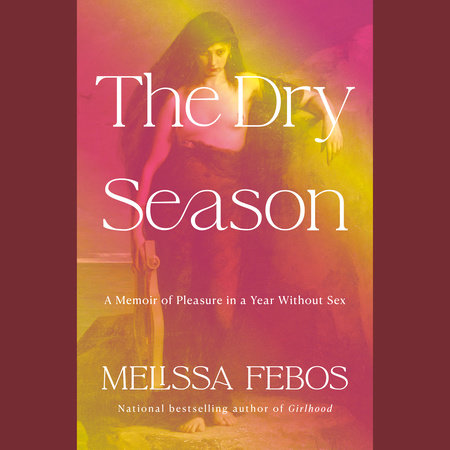
The Dry Season

A Memoir of Pleasure in a Year Without Sex

Author Melissa Febos On Tour
Read by Melissa Febos On Tour
Listen to a clip from the audiobook
audio pause button
0:00
0:00
From Melissa Febos, the national bestselling author of Girlhood, comes an examination of the solitude, freedoms, and feminist heroes she discovered during a year of celibacy and a wise and transformative look at relationships and self-knowledge.

“Only Melissa Febos could convince us of the ecstasy of abstinence. She never fails in her candor and precision.”—Katherine May, author of Wintering


In the wake of a catastrophic two-year relationship, Melissa Febos decided to take a break: For three months she would abstain from dating, relationships, and sex. Her friends were amused. Did she really think three months was a long time? But to Febos, it was. Ever since her teens, she had been in one relationship after another with men and women. As she puts it, she could trace a “daisy chain of romances” from her adolescence to her midthirties. Finally, she would carve out time to focus on herself and examine the patterns that had produced her midlife disaster. Over those first few months, she gleaned insights into her past and awoke to the joys of being single. She decided to extend her celibacy, not knowing it would become the most fulfilling and sensual year of her life. No longer defined by her romantic pursuits, she learned to relish the delights of solitude, the thrill of living on her own terms, the distinct pleasures unmediated by lovers, and the freedom to pursue her ideals without distraction or guilt. Bringing her own experiences into conversation with those of women throughout history—from eleventh-century mystic Hildegard von Bingen, Virginia Woolf, and Octavia Butler to the Shakers and Sappho—Febos situates her story within a newfound lineage of role models who unapologetically pursued their ambitions and ideals.

By abstaining from all forms of romantic entanglement, Febos began to see her life and her self-worth in a radical, new way. Her year of divestment transformed her relationships with friends and peers, her spirituality, her creative practice, and, most of all, her relationship to herself. Blending intimate personal narrative and incisive cultural criticism, The Dry Season tells a story that’s as much about celibacy as its inverse: pleasure, desire, fulfillment. Infused with fearless honesty and keen intellect, it’s the memoir of a woman learning to live at the center of her own story, and a much-needed catalyst for a new conversation around sex and love.
It is raining. Drops spatter against the plane’s windows as we descend through the clouds and prepare for landing. The woman is seated four rows behind me, but I spotted her before we boarded: tousled hair in a wool beanie, leather boots belonging to the category worn only by lesbians and Dickensian orphans, giant backpack. I felt myself begin to glow with a chemistry visible only to the object of my attention. I do not understand the biological protocol that enacts once it is triggered, but I do know that more often than not the end result is sex, and if my past is any indication, some sort of romantic entanglement.

Just a few months earlier, I would have lurched at the call. But I am six months celibate and have made a promise to myself. In those first months, I was more vulnerable to the familiar siren song of a cute dyke, and while a few nearly pulled me back in, I’d managed to stay the course. The woman at the fancy book party. The film director. All the loose ends with whom I’d cut off contact months ago. But here I am, turning my profile to the angle mathematically most likely for her to see me, rolling my shirt cuffs up to bare a few inches of forearm tattoos, dangling my hand with its short unvarnished nails into the aisle.

Like most femmes, I am an expert at signaling my queerness through physical clues legible only to other queers. I can communicate my sexual identity through the set of my shoulders, if need be. I sit in the cramped airplane seat with my legs comfortably spread, my elbows on both armrests, exuding a physical entitlement to the space I occupy. So much of heterosexual attraction is contingent on the minimization and infantilization of the female body: crossed legs, tilted heads, widened eyes, slackened mouths. A disregard for this affect suggests that a woman’s desires lie elsewhere.

This is why it’s easy to mistake some women who have gone through menopause for lesbians: they have both stopped giving a fuck what men think of them. This secret language, in all its permutations, drove and defined over two decades of my life. I’ve largely abstained from it over the last six months. But now I think: we are on a flight to London and unlikely to come any closer to one another than we are now. There is little danger of a full relapse. There is no harm in indulging the pleasure of the dance.

We land at London Gatwick and the attractive stranger gathers her belongings, runs a hand through her messy hair, and, yes, glances in my direction, before she rises to her feet and steps into the aisle. Goodbye, stranger, I think with some relief.

To my great surprise, these recent months have been the happiest of my life. It wasn’t happiness, exactly, that I sought when I decided to spend this time celibate. I had just gotten so tired. I met my first girlfriend when I was fifteen years old, and spent the next twenty years in relationships. I was a serial monogamist, the ends of many of my affairs overlapping slightly with the beginnings of the ones that followed, forming a daisy chain of romances. There were a few brief periods of singleness, but I was never alone, really. There was always a cohort of flirtations. A string of dates. A lover from my past ready to step into the present. After a few weeks or months, I’d found my next forever.

Our culture tells us that such abundance is a privilege, and in many ways it is. Sometimes, I felt proud, though I knew it was artificial. Whatever our accepted story about attraction, I understood that the magnet in me drew its charge from dubious qualities. Once I reached my thirties, I started having moments of unease when I contemplated my pattern. I was just a relationship person, I consoled myself. I had spent my happiest times partnered, I thought, without considering the givenness of that, having spent most of my life partnered. I was reassured by the fact that I never felt afraid to be alone. I did not consider how one might not ever feel the thing she had successfully outrun.

Then I spent two years in a ravaging vortex of a relationship. When I finally emerged, I thought, I should take a break. After this revelation I promptly got into five brief entanglements. Each had a frantic tinge, like the last handful of popcorn you cram into your mouth after you decide to stop eating it. I realized that my resolution would have to be more intentional. I drew more specific boundaries: no sex, no dates, no nothing. At the age of thirty-­five it was time to meet myself unmediated by romantic and erotic obsession.

In only six months, my life has opened up like a mansion half of whose rooms had been locked. There is so much more space in which to live. From the long mornings at my desk to evenings of reading myself to sleep, or nights spent dancing—­the summer heat luscious and exhausting, each morning marked by my aching feet, the pleasurable wince as I brew coffee in the morning. I have luxuriated in the solitude and the companionship of true friends.

I am sometimes lonely, but that, too, is novel, a weather system that moves through me and, after a day, or sometimes just an hour in the late afternoon as the light shifts toward evening, it moves on. I anticipated that I would miss the thrill of seduction, the rituals of pursuit catalyzed by attraction, but that urge has also come and gone, never surging strong or long enough to compel me from observation to animation. Until today, that is.

The customs line is interminable, the booths woefully understaffed for the number of incoming passengers, but I’m distracted by the inching undulation of the line as it snakes forward, delivering my crush and me past each other by mere feet at regular intervals. Both of us studiously rotate between staring at our phones, squinting ahead at the front of the line, and posing in such subtle affectations that no casual observer would discern anything other than boredom and frustration in either of our comportments.

It must seem arrogant of me to assume that my airplane crush reciprocates my attention, but trust me that when you’ve been performing this choreography for more than twenty years, you know when your partner feels the music and when she doesn’t. The first decade was spent being humiliatingly mistaken a good portion of the time, while I cultivated this precise radar, but in the years since it hasn’t led me astray. The thrill, of course, resides in the slender possibility that this time, this time, I might be wrong.

She reaches the booth ten or fifteen people ahead of me and despite devoting a valorous twelve minutes to backpack reorganization and another three to shoelace tightening, she is left no other option but to continue on her journey. My disappointment as she disappears into the airport is matched by the return of relief. The spell is broken. I have not violated my abstinence. I dig my passport out of my jacket’s interior pocket and shuffle forward, happily bored, mistaken once more in my certainty that temptation has passed.

Soon after I got clean and sober at twenty-­three, my sponsor told me I couldn’t steal anymore. She probably would have told me this sooner, if she’d known that I was still stealing things—­mostly books from the Barnes & Noble in Union Square and bags of food from the self-­serve bins at the overpriced health food store on University Avenue, but I’d never mentioned it, until I happened to be on the phone with her as I walked to my building’s laundry room and found that someone had left a stack of quarters on the table by the change machine. I can take them, right? I asked her. Absolutely not! she said. We don’t steal.

At the time, I wondered why I had even mentioned it, but now I understand. I wanted to stop. When she told me that I must, I felt awash in relief. I used to get a terrible wave of dread right before I stole, as if someone else was making me do it. Once I saw an opportunity, I felt compelled to do it, but the act was stressful to a degree never matched by the benefits of my loot. I wasn’t addicted to stealing; it was a habit I had gotten into as an addict who wanted to spend every cent that crossed my palm on drugs. Necessity had been replaced by the inertia of habit. It hadn’t occurred to me that I could give myself permission to stop.

Incredibly, after I have navigated the swarmed airport, retrieved my suitcase from baggage claim, ridden the shuttle to the adjacent train station, deciphered the cryptic train tables and British accents, purchased my ticket from a reluctant kiosk, and arrived at the correct platform, there she is, the woman from the plane. She glances up, probably sensing my stunned stare, sees me, looks momentarily stunned herself, then looks away.

We don’t make eye contact again, but stand a few yards apart on the platform, waiting for our train. I hold very still, as if it will quell the tumult inside me. I have fleeting, stupid thoughts, like maybe it is fate and who am I to defy the Fates? Or maybe in a foreign country it doesn’t count as violating my abstinence. I think of Saint Augustine, though I find him simpering, and the pears he stole as a teen with his ne’er-­do-­well friends. “Doing this pleased us all the more because it was forbidden,” he wrote in his Confessions. “Such was my heart, O God, such was my heart—­which thou didst pity even in that bottomless pit.” I think of how when I was a child, my appetites were so great that my parents used to sometimes refer to me as a bottomless pit. “I loved my own undoing,” wrote Augustine, and I know what he meant, the ecstasy of yielding to the forbidden.

The train finally pulls up to the platform, whipping my hair around my face. We board the same car from different doors. Again, I settle four or five rows ahead of her. My body feels rubbery with exhaustion—­I hardly slept on the plane—­but buzzy, animated by the prospect that something is going to happen. The only question is whether what happens will be what has happened before, or if I have the power to change it. To do something different.
TIME “The 100 Must-Read Books of 2025” | Vulture "The Best Books of 2025"

“Philosophically rich and deeply sensual.”
—Wall Street Journal

“Febos’s work is not only provocative, it’s absolutely necessary.”
Los Angeles Times

“The Dry Season is a propulsive, thoughtful memoir about the author’s yearlong hiatus from dating, romance, and sex. . . . In a culture obsessed with love and sex, where being single is pathologized and looked down upon, this story of solo self-discovery is revolutionary.”
—Oprah Daily

"Presenting a model for celibacy that is self-guided rather than socially imposed and compassionate rather than punitive; this book should be required reading for anyone who’s ever been told to 'just take a break from relationships.'”
—Vogue

“Profound”
—San Francisco Chronicle

“The honesty and humor with which Febos writes her story resonates with anyone who has been through a difficult breakup or struggled to understand why the narratives they spin about their relationships don’t always ring true. Analytical, resourceful, and clarifying, The Dry Season is a direct meditation on the complicated connections between love, self-worth, and fulfillment.”
—Los Angeles Review of Books

“The memoir is highly erotic. . . . Febos deftly balances three competing threads: an inventory of past partners, the arc of her personal celibacy journey, and the role celibacy has played throughout history. . . . Her reflections are delivered with characteristic honesty and meticulous self-examination. Few writers are so skilled. . . . This book — which focuses on the difficult work of unstitching yourself from the behaviors that previously defined you — isn’t about sex; it’s a study of how sex can, like anything pleasurable, shape a person’s whole identity.”
—Vulture
“The Best Books of 2025”

“Gorgeous, profound, and profoundly satisfying. . . . [A] delicious memoir of sensulaity and desire. . . . Juicy and thoughtful and lovely. . . . This is Febos at her best.”
—LitHub

"Written with candor, brio and compassion for herself and others. . . . In her crystalline memoir The Dry Season, Melissa Febos gives up sex and finds her sublime purpose, and it’s her most triumphant work to date.”
—BookPage [starred]


“Melissa Febos is a writer of singular wisdom and compassion, and The Dry Season is an utterly consuming and deeply generous book—an illuminating exploration of solitude and partnership, intimacy and manipulation, the stories we tell ourselves about the choices we make and how we might unlearn those stories to see ourselves more clearly. Reading this book, I felt an ecstatic, nerve-tingling gratitude, like it was written just for me—finding such crisp, incisive language for emotional knots I’ve felt caught inside for years—but part of the joy of this feeling was knowing how many people will feel the same way: that this book was written just for them.”
Leslie Jamison, author of Splinters

“The Dry Season
is brilliant and powerful meditation upon addiction, desire, seduction, and the undervalued (and all-too-unexplored) power of a woman laying claim to a period of celibacy for spiritual and personal reasons. Febos is both unflinching and compassionate as she inventories all that she has done for love, and what she will never do again. A deeply important book, and I saw myself and many women whom I love and admire on every page.”
—Elizabeth Gilbert, author of Eat, Pray, Love

“With intensity and precision, Febos writes through a year without sex—and emerges with revelations about intimacy, addiction, power, and self-respect. The Dry Season is not a memoir of lack, but of radical clarity.”
—Esther Perel

“Melissa Febos is straight-up one of the most essential memoirists today, each of her books a deeply profound exploration of the mind and the body and the complex relationship between them. . . . It’s a testament to Febos’s incredible skill that a book centered on celibacy features some of the most erotic writing she’s ever put to paper. . . . Of course, The Dry Season is not just about celibacy; it’s a treatise on listening to and trusting our corporeal instincts, on finding authentic forms of pleasure independent from hegemonic scripts. It’s a book that is itself a pleasure.”
—Electric Lit


“Melissa Febos’s The Dry Season will be called a book about abstinence, about celibacy, but it’s so much more than that. This is a book about obsession, compulsion, about self and self-lessness, about sex and love and art and faith and the capacity of each to swallow us whole, to obliterate us, make us anew alit with our history instead of engulfed by it. Febos talks back to time as she unravels it, inviting everyone into the conversation from Hadewijch to Hildegard, Foucault to Lorde, St. Augustine to Annie Dillard. The Dry Season is about reenchanting oneself with the world. It’s the best book yet by one of contemporary non-fiction’s lodestars.”
— Kaveh Akbar, author of Martyr!

“Only Melissa Febos could write a memoir of her sexual abstinence and make it like a game of Clue. How to catch a thief when the thief is yourself? And the thief of yourself, too? A profound, distilled, untying of a complex knot—Febos riddles out the ways we might subjugate ourselves even with the ways we imagine we are liberated.”
—Alexander Chee, author of How to Write an Autobiographical Novel

“Reading The Dry Season is like having a nourishing conversation with a smart, wry, and ever-probing friend—a conversation so full of wisdom and pleasure that you don’t want it to end. But the book is more than that. Under its nominal topic and entertaining inventory lies a commitment to the lifelong project of “how to get free”—which, as Febos makes clear, is distinct from the more familiar one of “whose fault it was.” The example of Febos’s commitment throughout these pages is inspiring and rare; we’re lucky and better off for it.”
Maggie Nelson, author of The Argonauts

“Deftly illuminates how and why one’s sense of self is subject to change, mutilate, or surrender when in relation to another and asks what happens when that stops. The result is profound—Febos embraces the ability to be alone and in love with oneself. The Dry Season is essential reading.”
A.M. Homes, author of The Unfolding

“Only Melissa Febos could convince us of the ecstasy of abstinence. She never fails in her candor and precision.”
—Katherine May, author of Wintering

“As I read, Febos’s celibacy challenge went from feeling like a humblebrag to a deeply relatable effort. And as she settled into her solitude, her observations began to resonate. She details parts of singlehood that I, too, have treasured—and which I’ve heard extolled again and again in my reporting on romance, even from people whose celibate season resulted from a dearth, not an excess, of options.”
—The Atlantic


“Writing within the mystic tradition, Febos’s The Dry Season is a stunning translation of her faith in art and in the self.”
—The Brooklyn Rail

“An emotionally explosive memoir that looks honestly at our desire for pleasure and fulfillment in our lives.”
—Chicago Review of Books

“Melissa Febos draws us into the depths of obsession and desire, delivering an unflinching yet generous reflection on the formative moments that shape our relationships. This is no ordinary excavation; it’s a director’s cut of our darkest impulses, a mirror held up to our psyche. This is a dictionary of vulnerability, a guide to understanding the why behind our desires, not just the what. The Dry Season is a testament to the power of self-awareness, a way forward for those brave enough to look back”
Samra Habib, author of We Have Always Been Here

"A consummate builder of words and conveyer of ideas, Febos's keen writing about sex, gender, and addiction is in a class of its own."
—Booklist

“In The Dry Season, Febos plumbs the restless depths of her own seeking by entwining her compulsive self-discovery with curiosity about a wide range of writers. . . . Earnest. . . . Some might deride attention to personal experience and sexual pleasure while our democracy disintegrates around us, but sex and love are energies that turn us toward each other in an era whose ravages are designed to create lasting isolation.”
—Washington Post

“Thought-provoking. . . . Mixing personal narrative with cultural criticism, the author of Girlhood explores how celibacy radicalized her, giving her permission to put all of her focus on herself, her work, and the platonic relationships that deserved more of her attention.”
—TIME

“Blistering prose, the kind that you might want to get tattooed on your arm. . . . Melissa invigorates her own stories with references from religion and art, literary theory and philosophy, in a way that feels enriching rather than academic, all the while maintaining a clear eye in her depictions of other people and herself.”
—The Maris Review

“An astonishingly rich and affirming analysis, through the subject of celibacy, of what it means to love and be loved - what real intimacy requires, what it urges and what it generates. The Dry Season is the best kind of writing: curious, erudite, funny and deeply humane. I’m so grateful to be living in a world that has Melissa Febos’s writing in it”
Sophie Gilbert, author of Girl on Girl

“In The Dry Season, Febos interweaves her own narrative with research and reflections on desire that will keep you thinking well beyond the last page.”
—Bustle

“Panoramic yet whisper-close, so funny, exquisitely alive—radiant with ideas new and ancient like stars in a clear night sky”
—Jeremy Atherton Lin, author of Deep House

“[Febos’s] celibacy was not an escape but a deep inquiry into desire, intimacy, and autonomy—a way to interrogate how socialized narratives of love and devotion had shaped her identity as a queer woman. . . . Ultimately, the memoir asks readers to consider what our lives might look like if we stopped orienting them around the desire to be desired.”
—Harper’s Bazaar

“The Dry Season
is a masterclass.”
—Women’s Media Center

“A seamless feminist how-to rooted in the ancient histories of women who’ve found their way before us. Febos’s writing and research, paired with her bare, zero-percent-flowery confessions make her the high-brow/low-brow, cool genius nerd hero we love. I needed this book without knowing it. . . . Febos’s books reliably bring me to my knees at least once, if not for the whole stretch. . . . Read The Dry Season knowing you’ll lock eyes with it and it’ll work its way into your heart likety-split. . . . Compelling. . . . She’s calling us all in to the joy she’s found, and The Dry Season is a map to get there.”
—The Stranger

“This story is about understanding, reclaiming, and celebrating pleasure, rendered sublimely and with wit. A gorgeous and thought-provoking memoir about how celibacy can teach us about love.”
—Kirkus Reviews
[starred]

“Bold . . . As fascinating as it is liberating, this is not to be missed.”
Publishers Weekly [starred]
© Beowulf Sheehan
MELISSA FEBOS is the nationally bestselling author of four books, including Girlhood—which won the National Book Critics Circle Award in Criticism, and Body Work: The Radical Power of Personal Narrative. She has been awarded prizes and fellowships from the Guggenheim Foundation, LAMBDA Literary, the National Endowment for the Arts, the British Library, the Black Mountain Institute, the Bogliasco Foundation, and others. Her work has appeared in The Paris Review, The New Yorker, The New York Times Magazine, The Best American Essays, Vogue, The Sewanee Review, New York Review of Books, and elsewhere. Febos is a full professor at the University of Iowa and lives in Iowa City with her wife, the poet Donika Kelly. View titles by Melissa Febos

About

From Melissa Febos, the national bestselling author of Girlhood, comes an examination of the solitude, freedoms, and feminist heroes she discovered during a year of celibacy and a wise and transformative look at relationships and self-knowledge.

“Only Melissa Febos could convince us of the ecstasy of abstinence. She never fails in her candor and precision.”—Katherine May, author of Wintering


In the wake of a catastrophic two-year relationship, Melissa Febos decided to take a break: For three months she would abstain from dating, relationships, and sex. Her friends were amused. Did she really think three months was a long time? But to Febos, it was. Ever since her teens, she had been in one relationship after another with men and women. As she puts it, she could trace a “daisy chain of romances” from her adolescence to her midthirties. Finally, she would carve out time to focus on herself and examine the patterns that had produced her midlife disaster. Over those first few months, she gleaned insights into her past and awoke to the joys of being single. She decided to extend her celibacy, not knowing it would become the most fulfilling and sensual year of her life. No longer defined by her romantic pursuits, she learned to relish the delights of solitude, the thrill of living on her own terms, the distinct pleasures unmediated by lovers, and the freedom to pursue her ideals without distraction or guilt. Bringing her own experiences into conversation with those of women throughout history—from eleventh-century mystic Hildegard von Bingen, Virginia Woolf, and Octavia Butler to the Shakers and Sappho—Febos situates her story within a newfound lineage of role models who unapologetically pursued their ambitions and ideals.

By abstaining from all forms of romantic entanglement, Febos began to see her life and her self-worth in a radical, new way. Her year of divestment transformed her relationships with friends and peers, her spirituality, her creative practice, and, most of all, her relationship to herself. Blending intimate personal narrative and incisive cultural criticism, The Dry Season tells a story that’s as much about celibacy as its inverse: pleasure, desire, fulfillment. Infused with fearless honesty and keen intellect, it’s the memoir of a woman learning to live at the center of her own story, and a much-needed catalyst for a new conversation around sex and love.

Excerpt

It is raining. Drops spatter against the plane’s windows as we descend through the clouds and prepare for landing. The woman is seated four rows behind me, but I spotted her before we boarded: tousled hair in a wool beanie, leather boots belonging to the category worn only by lesbians and Dickensian orphans, giant backpack. I felt myself begin to glow with a chemistry visible only to the object of my attention. I do not understand the biological protocol that enacts once it is triggered, but I do know that more often than not the end result is sex, and if my past is any indication, some sort of romantic entanglement.

Just a few months earlier, I would have lurched at the call. But I am six months celibate and have made a promise to myself. In those first months, I was more vulnerable to the familiar siren song of a cute dyke, and while a few nearly pulled me back in, I’d managed to stay the course. The woman at the fancy book party. The film director. All the loose ends with whom I’d cut off contact months ago. But here I am, turning my profile to the angle mathematically most likely for her to see me, rolling my shirt cuffs up to bare a few inches of forearm tattoos, dangling my hand with its short unvarnished nails into the aisle.

Like most femmes, I am an expert at signaling my queerness through physical clues legible only to other queers. I can communicate my sexual identity through the set of my shoulders, if need be. I sit in the cramped airplane seat with my legs comfortably spread, my elbows on both armrests, exuding a physical entitlement to the space I occupy. So much of heterosexual attraction is contingent on the minimization and infantilization of the female body: crossed legs, tilted heads, widened eyes, slackened mouths. A disregard for this affect suggests that a woman’s desires lie elsewhere.

This is why it’s easy to mistake some women who have gone through menopause for lesbians: they have both stopped giving a fuck what men think of them. This secret language, in all its permutations, drove and defined over two decades of my life. I’ve largely abstained from it over the last six months. But now I think: we are on a flight to London and unlikely to come any closer to one another than we are now. There is little danger of a full relapse. There is no harm in indulging the pleasure of the dance.

We land at London Gatwick and the attractive stranger gathers her belongings, runs a hand through her messy hair, and, yes, glances in my direction, before she rises to her feet and steps into the aisle. Goodbye, stranger, I think with some relief.

To my great surprise, these recent months have been the happiest of my life. It wasn’t happiness, exactly, that I sought when I decided to spend this time celibate. I had just gotten so tired. I met my first girlfriend when I was fifteen years old, and spent the next twenty years in relationships. I was a serial monogamist, the ends of many of my affairs overlapping slightly with the beginnings of the ones that followed, forming a daisy chain of romances. There were a few brief periods of singleness, but I was never alone, really. There was always a cohort of flirtations. A string of dates. A lover from my past ready to step into the present. After a few weeks or months, I’d found my next forever.

Our culture tells us that such abundance is a privilege, and in many ways it is. Sometimes, I felt proud, though I knew it was artificial. Whatever our accepted story about attraction, I understood that the magnet in me drew its charge from dubious qualities. Once I reached my thirties, I started having moments of unease when I contemplated my pattern. I was just a relationship person, I consoled myself. I had spent my happiest times partnered, I thought, without considering the givenness of that, having spent most of my life partnered. I was reassured by the fact that I never felt afraid to be alone. I did not consider how one might not ever feel the thing she had successfully outrun.

Then I spent two years in a ravaging vortex of a relationship. When I finally emerged, I thought, I should take a break. After this revelation I promptly got into five brief entanglements. Each had a frantic tinge, like the last handful of popcorn you cram into your mouth after you decide to stop eating it. I realized that my resolution would have to be more intentional. I drew more specific boundaries: no sex, no dates, no nothing. At the age of thirty-­five it was time to meet myself unmediated by romantic and erotic obsession.

In only six months, my life has opened up like a mansion half of whose rooms had been locked. There is so much more space in which to live. From the long mornings at my desk to evenings of reading myself to sleep, or nights spent dancing—­the summer heat luscious and exhausting, each morning marked by my aching feet, the pleasurable wince as I brew coffee in the morning. I have luxuriated in the solitude and the companionship of true friends.

I am sometimes lonely, but that, too, is novel, a weather system that moves through me and, after a day, or sometimes just an hour in the late afternoon as the light shifts toward evening, it moves on. I anticipated that I would miss the thrill of seduction, the rituals of pursuit catalyzed by attraction, but that urge has also come and gone, never surging strong or long enough to compel me from observation to animation. Until today, that is.

The customs line is interminable, the booths woefully understaffed for the number of incoming passengers, but I’m distracted by the inching undulation of the line as it snakes forward, delivering my crush and me past each other by mere feet at regular intervals. Both of us studiously rotate between staring at our phones, squinting ahead at the front of the line, and posing in such subtle affectations that no casual observer would discern anything other than boredom and frustration in either of our comportments.

It must seem arrogant of me to assume that my airplane crush reciprocates my attention, but trust me that when you’ve been performing this choreography for more than twenty years, you know when your partner feels the music and when she doesn’t. The first decade was spent being humiliatingly mistaken a good portion of the time, while I cultivated this precise radar, but in the years since it hasn’t led me astray. The thrill, of course, resides in the slender possibility that this time, this time, I might be wrong.

She reaches the booth ten or fifteen people ahead of me and despite devoting a valorous twelve minutes to backpack reorganization and another three to shoelace tightening, she is left no other option but to continue on her journey. My disappointment as she disappears into the airport is matched by the return of relief. The spell is broken. I have not violated my abstinence. I dig my passport out of my jacket’s interior pocket and shuffle forward, happily bored, mistaken once more in my certainty that temptation has passed.

Soon after I got clean and sober at twenty-­three, my sponsor told me I couldn’t steal anymore. She probably would have told me this sooner, if she’d known that I was still stealing things—­mostly books from the Barnes & Noble in Union Square and bags of food from the self-­serve bins at the overpriced health food store on University Avenue, but I’d never mentioned it, until I happened to be on the phone with her as I walked to my building’s laundry room and found that someone had left a stack of quarters on the table by the change machine. I can take them, right? I asked her. Absolutely not! she said. We don’t steal.

At the time, I wondered why I had even mentioned it, but now I understand. I wanted to stop. When she told me that I must, I felt awash in relief. I used to get a terrible wave of dread right before I stole, as if someone else was making me do it. Once I saw an opportunity, I felt compelled to do it, but the act was stressful to a degree never matched by the benefits of my loot. I wasn’t addicted to stealing; it was a habit I had gotten into as an addict who wanted to spend every cent that crossed my palm on drugs. Necessity had been replaced by the inertia of habit. It hadn’t occurred to me that I could give myself permission to stop.

Incredibly, after I have navigated the swarmed airport, retrieved my suitcase from baggage claim, ridden the shuttle to the adjacent train station, deciphered the cryptic train tables and British accents, purchased my ticket from a reluctant kiosk, and arrived at the correct platform, there she is, the woman from the plane. She glances up, probably sensing my stunned stare, sees me, looks momentarily stunned herself, then looks away.

We don’t make eye contact again, but stand a few yards apart on the platform, waiting for our train. I hold very still, as if it will quell the tumult inside me. I have fleeting, stupid thoughts, like maybe it is fate and who am I to defy the Fates? Or maybe in a foreign country it doesn’t count as violating my abstinence. I think of Saint Augustine, though I find him simpering, and the pears he stole as a teen with his ne’er-­do-­well friends. “Doing this pleased us all the more because it was forbidden,” he wrote in his Confessions. “Such was my heart, O God, such was my heart—­which thou didst pity even in that bottomless pit.” I think of how when I was a child, my appetites were so great that my parents used to sometimes refer to me as a bottomless pit. “I loved my own undoing,” wrote Augustine, and I know what he meant, the ecstasy of yielding to the forbidden.

The train finally pulls up to the platform, whipping my hair around my face. We board the same car from different doors. Again, I settle four or five rows ahead of her. My body feels rubbery with exhaustion—­I hardly slept on the plane—­but buzzy, animated by the prospect that something is going to happen. The only question is whether what happens will be what has happened before, or if I have the power to change it. To do something different.

Reviews

TIME “The 100 Must-Read Books of 2025” | Vulture "The Best Books of 2025"

“Philosophically rich and deeply sensual.”
—Wall Street Journal

“Febos’s work is not only provocative, it’s absolutely necessary.”
Los Angeles Times

“The Dry Season is a propulsive, thoughtful memoir about the author’s yearlong hiatus from dating, romance, and sex. . . . In a culture obsessed with love and sex, where being single is pathologized and looked down upon, this story of solo self-discovery is revolutionary.”
—Oprah Daily

"Presenting a model for celibacy that is self-guided rather than socially imposed and compassionate rather than punitive; this book should be required reading for anyone who’s ever been told to 'just take a break from relationships.'”
—Vogue

“Profound”
—San Francisco Chronicle

“The honesty and humor with which Febos writes her story resonates with anyone who has been through a difficult breakup or struggled to understand why the narratives they spin about their relationships don’t always ring true. Analytical, resourceful, and clarifying, The Dry Season is a direct meditation on the complicated connections between love, self-worth, and fulfillment.”
—Los Angeles Review of Books

“The memoir is highly erotic. . . . Febos deftly balances three competing threads: an inventory of past partners, the arc of her personal celibacy journey, and the role celibacy has played throughout history. . . . Her reflections are delivered with characteristic honesty and meticulous self-examination. Few writers are so skilled. . . . This book — which focuses on the difficult work of unstitching yourself from the behaviors that previously defined you — isn’t about sex; it’s a study of how sex can, like anything pleasurable, shape a person’s whole identity.”
—Vulture
“The Best Books of 2025”

“Gorgeous, profound, and profoundly satisfying. . . . [A] delicious memoir of sensulaity and desire. . . . Juicy and thoughtful and lovely. . . . This is Febos at her best.”
—LitHub

"Written with candor, brio and compassion for herself and others. . . . In her crystalline memoir The Dry Season, Melissa Febos gives up sex and finds her sublime purpose, and it’s her most triumphant work to date.”
—BookPage [starred]


“Melissa Febos is a writer of singular wisdom and compassion, and The Dry Season is an utterly consuming and deeply generous book—an illuminating exploration of solitude and partnership, intimacy and manipulation, the stories we tell ourselves about the choices we make and how we might unlearn those stories to see ourselves more clearly. Reading this book, I felt an ecstatic, nerve-tingling gratitude, like it was written just for me—finding such crisp, incisive language for emotional knots I’ve felt caught inside for years—but part of the joy of this feeling was knowing how many people will feel the same way: that this book was written just for them.”
Leslie Jamison, author of Splinters

“The Dry Season
is brilliant and powerful meditation upon addiction, desire, seduction, and the undervalued (and all-too-unexplored) power of a woman laying claim to a period of celibacy for spiritual and personal reasons. Febos is both unflinching and compassionate as she inventories all that she has done for love, and what she will never do again. A deeply important book, and I saw myself and many women whom I love and admire on every page.”
—Elizabeth Gilbert, author of Eat, Pray, Love

“With intensity and precision, Febos writes through a year without sex—and emerges with revelations about intimacy, addiction, power, and self-respect. The Dry Season is not a memoir of lack, but of radical clarity.”
—Esther Perel

“Melissa Febos is straight-up one of the most essential memoirists today, each of her books a deeply profound exploration of the mind and the body and the complex relationship between them. . . . It’s a testament to Febos’s incredible skill that a book centered on celibacy features some of the most erotic writing she’s ever put to paper. . . . Of course, The Dry Season is not just about celibacy; it’s a treatise on listening to and trusting our corporeal instincts, on finding authentic forms of pleasure independent from hegemonic scripts. It’s a book that is itself a pleasure.”
—Electric Lit


“Melissa Febos’s The Dry Season will be called a book about abstinence, about celibacy, but it’s so much more than that. This is a book about obsession, compulsion, about self and self-lessness, about sex and love and art and faith and the capacity of each to swallow us whole, to obliterate us, make us anew alit with our history instead of engulfed by it. Febos talks back to time as she unravels it, inviting everyone into the conversation from Hadewijch to Hildegard, Foucault to Lorde, St. Augustine to Annie Dillard. The Dry Season is about reenchanting oneself with the world. It’s the best book yet by one of contemporary non-fiction’s lodestars.”
— Kaveh Akbar, author of Martyr!

“Only Melissa Febos could write a memoir of her sexual abstinence and make it like a game of Clue. How to catch a thief when the thief is yourself? And the thief of yourself, too? A profound, distilled, untying of a complex knot—Febos riddles out the ways we might subjugate ourselves even with the ways we imagine we are liberated.”
—Alexander Chee, author of How to Write an Autobiographical Novel

“Reading The Dry Season is like having a nourishing conversation with a smart, wry, and ever-probing friend—a conversation so full of wisdom and pleasure that you don’t want it to end. But the book is more than that. Under its nominal topic and entertaining inventory lies a commitment to the lifelong project of “how to get free”—which, as Febos makes clear, is distinct from the more familiar one of “whose fault it was.” The example of Febos’s commitment throughout these pages is inspiring and rare; we’re lucky and better off for it.”
Maggie Nelson, author of The Argonauts

“Deftly illuminates how and why one’s sense of self is subject to change, mutilate, or surrender when in relation to another and asks what happens when that stops. The result is profound—Febos embraces the ability to be alone and in love with oneself. The Dry Season is essential reading.”
A.M. Homes, author of The Unfolding

“Only Melissa Febos could convince us of the ecstasy of abstinence. She never fails in her candor and precision.”
—Katherine May, author of Wintering

“As I read, Febos’s celibacy challenge went from feeling like a humblebrag to a deeply relatable effort. And as she settled into her solitude, her observations began to resonate. She details parts of singlehood that I, too, have treasured—and which I’ve heard extolled again and again in my reporting on romance, even from people whose celibate season resulted from a dearth, not an excess, of options.”
—The Atlantic


“Writing within the mystic tradition, Febos’s The Dry Season is a stunning translation of her faith in art and in the self.”
—The Brooklyn Rail

“An emotionally explosive memoir that looks honestly at our desire for pleasure and fulfillment in our lives.”
—Chicago Review of Books

“Melissa Febos draws us into the depths of obsession and desire, delivering an unflinching yet generous reflection on the formative moments that shape our relationships. This is no ordinary excavation; it’s a director’s cut of our darkest impulses, a mirror held up to our psyche. This is a dictionary of vulnerability, a guide to understanding the why behind our desires, not just the what. The Dry Season is a testament to the power of self-awareness, a way forward for those brave enough to look back”
Samra Habib, author of We Have Always Been Here

"A consummate builder of words and conveyer of ideas, Febos's keen writing about sex, gender, and addiction is in a class of its own."
—Booklist

“In The Dry Season, Febos plumbs the restless depths of her own seeking by entwining her compulsive self-discovery with curiosity about a wide range of writers. . . . Earnest. . . . Some might deride attention to personal experience and sexual pleasure while our democracy disintegrates around us, but sex and love are energies that turn us toward each other in an era whose ravages are designed to create lasting isolation.”
—Washington Post

“Thought-provoking. . . . Mixing personal narrative with cultural criticism, the author of Girlhood explores how celibacy radicalized her, giving her permission to put all of her focus on herself, her work, and the platonic relationships that deserved more of her attention.”
—TIME

“Blistering prose, the kind that you might want to get tattooed on your arm. . . . Melissa invigorates her own stories with references from religion and art, literary theory and philosophy, in a way that feels enriching rather than academic, all the while maintaining a clear eye in her depictions of other people and herself.”
—The Maris Review

“An astonishingly rich and affirming analysis, through the subject of celibacy, of what it means to love and be loved - what real intimacy requires, what it urges and what it generates. The Dry Season is the best kind of writing: curious, erudite, funny and deeply humane. I’m so grateful to be living in a world that has Melissa Febos’s writing in it”
Sophie Gilbert, author of Girl on Girl

“In The Dry Season, Febos interweaves her own narrative with research and reflections on desire that will keep you thinking well beyond the last page.”
—Bustle

“Panoramic yet whisper-close, so funny, exquisitely alive—radiant with ideas new and ancient like stars in a clear night sky”
—Jeremy Atherton Lin, author of Deep House

“[Febos’s] celibacy was not an escape but a deep inquiry into desire, intimacy, and autonomy—a way to interrogate how socialized narratives of love and devotion had shaped her identity as a queer woman. . . . Ultimately, the memoir asks readers to consider what our lives might look like if we stopped orienting them around the desire to be desired.”
—Harper’s Bazaar

“The Dry Season
is a masterclass.”
—Women’s Media Center

“A seamless feminist how-to rooted in the ancient histories of women who’ve found their way before us. Febos’s writing and research, paired with her bare, zero-percent-flowery confessions make her the high-brow/low-brow, cool genius nerd hero we love. I needed this book without knowing it. . . . Febos’s books reliably bring me to my knees at least once, if not for the whole stretch. . . . Read The Dry Season knowing you’ll lock eyes with it and it’ll work its way into your heart likety-split. . . . Compelling. . . . She’s calling us all in to the joy she’s found, and The Dry Season is a map to get there.”
—The Stranger

“This story is about understanding, reclaiming, and celebrating pleasure, rendered sublimely and with wit. A gorgeous and thought-provoking memoir about how celibacy can teach us about love.”
—Kirkus Reviews
[starred]

“Bold . . . As fascinating as it is liberating, this is not to be missed.”
Publishers Weekly [starred]

Author

© Beowulf Sheehan
MELISSA FEBOS is the nationally bestselling author of four books, including Girlhood—which won the National Book Critics Circle Award in Criticism, and Body Work: The Radical Power of Personal Narrative. She has been awarded prizes and fellowships from the Guggenheim Foundation, LAMBDA Literary, the National Endowment for the Arts, the British Library, the Black Mountain Institute, the Bogliasco Foundation, and others. Her work has appeared in The Paris Review, The New Yorker, The New York Times Magazine, The Best American Essays, Vogue, The Sewanee Review, New York Review of Books, and elsewhere. Febos is a full professor at the University of Iowa and lives in Iowa City with her wife, the poet Donika Kelly. View titles by Melissa Febos
  • More Websites from
    Penguin Random House
  • Common Reads
  • Library Marketing