Download high-resolution image
Listen to a clip from the audiobook
audio pause button
0:00
0:00

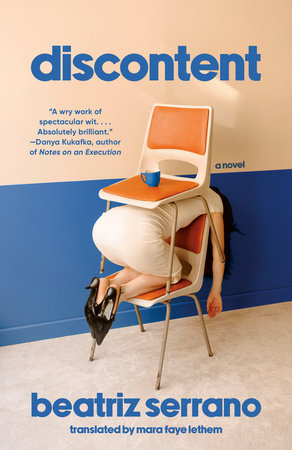
Discontent

A Novel

Translated by Mara Faye Lethem
Listen to a clip from the audiobook
audio pause button
0:00
0:00
THE NEW YORK TIMES BOOK REVIEW EDITORS' CHOICE • From a dazzling new international voice, an audacious, darkly funny novel about a young woman whose carefully crafted office persona threatens to crack when she’s forced to attend her company’s annual retreat

"A wry work of spectacular wit. . . . Beatriz Serrano writes with a caustic flare for detail, exploring the small humiliations of the everyday corporate office with charm and utter hilarity. Absolutely brilliant." —Danya Kukafka, author of Notes on an Execution


On the surface, Marisa's life looks enviable. She lives in a beautiful apartment in the center of Madrid, she has a hot neighbor who is always around to sleep with her, and she’s quickly risen through the ranks at a successful advertising agency. And yet she’s drowning in a dark hole of existential dread induced by the banality of corporate life. Marisa hates her job and everyone at it. She spends her working hours locked in her office hiding from her coworkers, bingeing YouTube videos, and getting high on tranquilizers. When she has the time, she escapes to her favorite museum where she contemplates the meaning of life while staring at Hieronymus Bosch paintings, or trying to get hit by a car so she can go on disability.

But Marisa's dubious success, which is largely built on lies and work she's stolen from other people, is in danger of being exposed when she's forced to go on her company’s team-building retreat. Isolated in the Segovia forests, haunted by the deeply buried memory of a former coworker, and surrounded by psychopathic bosses, overzealous coworkers, flirty retreat staff, and an excess of drugs, Marisa finds herself acting on her wildest impulses and is pushed to the brink of a complete spiral.
I

For a brief moment in 2016, the internet’s obsession was the physical and mental well-being of an English YouTuber named Marina Joyce. Joyce who was girlish and princesslike, with long blond ringlets and huge blue eyes, uploaded innocent videos where she tried on pastel-colored clothes, opened gifts sent to her by different brands, or ate sweets she thought were exotic because they came from Asia. And because the internet’s blurring of boundaries often means you can’t discern whether you are viewing erotic content or family content (or, perhaps, both at the same time), a widely disparate community followed her—from little girls who wanted to wear the same pink dresses to bald men in their fifties who probably masturbated to videos of her eating ice cream.

But after a while, her followers began detecting subtle changes in her behavior. In one of her videos, Marina Joyce was at a party, smiling at the camera and showing off her outfit, but something in the way she walked around (languid and listless) or the way she responded to questions (taking about three seconds too long to grasp them) set off all the alarms. This gave rise to a conspiracy theory, according to which Joyce had been kidnapped by her boyfriend or by a cult (it was unclear which) and was being abused and forced to upload videos against her will.

The evidence shown by these internet detectives consisted of short video edits where, if you paid attention, you could hear a subtle and whispered “help me” that, apparently, she would have added in the editing. There were also videos of Joyce seemingly looking at the back of the room, somewhere behind her camera, in order to get the approval of her captor while she answered questions from her followers. Fans also showed screenshots where her limbs appeared to have bruises, scratches, or small wounds. This was irrefutable evidence. Marina Joyce continued to act friendly and cheerful, but behind the smiles, she often looked sleepy, dazed, or drugged. Some screenshots, which ended up on forums or posted to Twitter accounts dedicated exclusively to the exciting case, showed subliminal messages she was supposedly using to draw people’s attention. These messages were hidden among the beautiful white lacquered shelves covered in brand gifts that were always in the background of her videos. Her followers, and those who had followed the trending hashtag #SaveMarinaJoyce, ended up calling the Metropolitan Police to rescue her. The Met went to her house but found nothing suspicious and left.

I’m thinking about Marina Joyce in the cold meeting room I’ve reserved for a call with the accounts team to talk about the Christmas campaign. I’m also thinking that, if the police were alerted by a loved one and arrived here right now, they wouldn’t find anything suspicious either—just a woman in an office, like Marina was just a woman in a room. Only my true fans would notice unsettling changes in my behavior meeting after meeting, day after day, video after video. They would discuss it online in forums and post long explanatory threads on Twitter. Perhaps I’d even be a trending topic for a few hours. The same woman who used to have fun behind her camera now seems sleepy, dazed, and even drugged.

And none of their assumptions would be wrong. It’s the end of August, and I only come into the office to lower my air-conditioning bill. It’s Monday again and I haven’t made progress on any Christmas projects, but I know I’ve logged enough videocall time to convince the accounts team I’ve got several things underway. I set my laptop, a cup of water, and a notebook on a large table that I’ve strategically positioned so natural light illuminates my face. If I’ve learned anything from YouTubers, it’s how to direct the camera in a meeting. I like to reserve this room because it has a neutral background. After this meeting, I could record my reaction to videos of cats gagging when they smell broccoli or a tutorial on the perfect makeup for both a job interview and a first date. Before logging in, I try to imagine how I would greet my followers, but I can’t think of anything that doesn’t make me sound like an idiot.

The accounts team logs in right on time, and the stupid dance of platitudes that precedes every meeting at every company around the world begins. “How are you girls?” “Are you in Madrid or . . . ?” “Working from the beach isn’t really working.” “Super busy, can’t complain.” “Life is good.” “Tons of work, which is great.” “You can already see my tan.” “I’m available for you guys 24/7.” “Are your kids there? Tell them I say hi, they’re so cute!” I smile, I participate, I make up stuff. I talk about summer plans I don’t have with people who don’t exist. A few days in Marbella at my friend Pitu’s house. A quick trip to San Sebastián with my man. Although I don’t know if it’s too early to call him “my man,” I declare mysteriously. Yes, I tell them, he’s Basque, I’ve always liked guys who could be lumberjacks. And they all laugh. Simple jokes, clichés served up as a refreshing alcohol-free aperitif to prolong meetings without really getting to work.

Someone takes the lead—“OK, girls, let’s get started”—and the meeting officially begins. They talk about deadlines, brainstorming, giving this or that a try, WOW factor, making a story go viral, and some even mention the word “disruption.” They talk about what the client is expecting from us this year—always “a lot” but never anything specific—and how this Christmas campaign is more important than ever. In each of the four years I’ve been at this office, I’ve been told that this Christmas campaign is more important than ever. I nod with my brow furrowed and say, “Can you repeat that, Monica?” while I doodle a penis with little arms in my Moleskine. “Do we have any more briefings on the lipstick?” I ask, then let them fight among themselves for ten more minutes over who will call the client to ask for information I don’t really need.

We’ve been clowning around for forty minutes. The game is easy if you know how to do it. Work is just a role you play and I’ve mastered it perfectly. I know the jokes that always break the ice. I know what to ask to seem attentive and interested. And I know what to say to make the time flow faster, without actually doing anything, until it’s time to go home at six.

While they talk to each other, I open Twitter and watch a video of a pet raccoon eating a birthday cake. The cake has three candles, but the raccoon seems afraid of the flame, so a human helps blow them out for him; then the raccoon starts eating the cake with his tiny hands. I retweet it. I google if it’s possible to have a raccoon in an apartment in Madrid. Then I google how long raccoons live. When I read that a wild raccoon can live between two and three years, I feel unexpectedly disappointed.

“When do you think you could show us something, Marisa?” asks one of them.

I close the raccoon tab and look at the meeting again. Specifically, I look at myself in the little square on the right side of the screen and confirm that, indeed, this light would be great for recording a video on my beauty routine.

“In four weeks,” I say.

“Four weeks? In three weeks it’ll be late September already, and the client wants to see something now so they can close their budgets,” replies another.

I feel like answering that I couldn’t care less, as would any human being lucky enough to live off their ancestors’ earnings; instead, I turn the pages of my notebook with great ceremony. I mumble, “Let me check a few things.” I draw another tiny penis. “Give me two weeks,” I finally say, and everyone is happy. The trick is to always offer a decoy date and then give them the one you had prepared in advance, like someone running a shell game or the way vendors at the Rastro flea market make you think you’re getting a bargain.

We say goodbye with smiles and many thanks and a few calls of “Keep up the great work!” I log out of Zoom. My throat is so dry I can barely swallow. When I see my lonely reflection on the screen, I think again of Marina Joyce. If someone had turned up the volume during our call, they too would’ve heard a little voice saying “help me” and would’ve called the police.

I’m thirty-two, and I’ve been working in advertising for eight years, the last four at this agency. I started out as an intern, then they hired me as a copywriter, and now I’m in a middle management position with employees working under me and an absurd English diploma that allows me to show off on LinkedIn and make small talk on Tinder. The truth is I don’t know how to do anything and I don’t know how I got here. I suppose it was by perfecting the office game until everybody believed I was a great professional.

My job is to be nice and sell snake oil. I read the brief for a shitty product that’s just like every other shitty product—a red lipstick; a perfume with floral notes; a vacuum cleaner with a tiny, triangular add-on that you can use on the corners of your house. Then I think about the nonsense that worries ordinary people, no matter how much they think they’re the smartest sheep in the flock—being ugly, smelling bad at the end of the day, having a dirty house. The market generates needs, and it’s my job to translate them into the language of ordinary mortals. I’m selling not red lipstick, but the idea of making an impact, of being beautiful, of leaving a mark on the collar of a handsome man’s shirt. I’m not selling a perfume, but the idea of being remembered for your smell, of leaving an impression, of not being a gray, boring person who spends two hours of their life every day getting to and from work. I sell the possibility that today, yes, today, with the help of that floral perfume, something extraordinary will happen to you. I’m not selling the umpteenth vacuum cleaner that no one needs; I’m selling the idea of having a nice, clean house, of being able to take a photo of that cute little corner you decorated Pinterest-style, uploading it on Instagram, and getting a lot of likes. Then I pitch a creative idea that’s like all the other creative ideas, the ones that came before and the ones that will come afterward. The lipstick effect. The smell of memories. Your dream house. They buy my idea, they pay us, I get congratulated, and we start all over again.

I’ve been doing the same thing for eight years, and I know it doesn’t help anyone. I know the world would be a better place if jobs like mine didn’t exist. I know I take advantage of people’s insecurities and their desire to thrive in a society where no one can improve. And I know this because even I, after an eight-hour day full of elevator conversations that drive me to low-stakes suicidal ideation (like stapling my hand to get out of a meeting that makes me understand the true meaning of the word “infinite,” or pouring boiling water from the office kettle onto myself so I can spend five to ten days at home with my feet up), still believe that the solution to all my problems will be a floral Zara dress made in Bangladesh that has followed me on every website I’ve visited today, and that, in all certainty, will be worn by millions of women on the street next season. I still believe that dress will turn me into a different woman, a happy, carefree, springtime version of myself. I know that when you buy something, what you’re paying for is the promise of a better life. I know I’m also taking advantage of and accepting money from mediocre clients who think the greatest act of creativity is adding one more row to an Excel spreadsheet.

My work is measured by something as vague as its “impact.” “Impact” can mean making something go viral. Or creating a catchy tune. Or winning one of those prestigious advertising awards that only matter to advertisers and the client who spent a fortune on some ad with a model who just really wants a hamburger and a hug. OK, if you’re in every metro station in the city, it might be more likely that people will ask for your product at the perfume counters in the Corte Inglés department stores, but I don’t think “The scent of memories” has a greater impact on their purchasing decisions than “A scent to remember.” I’m good at selling ideas to clients. I make them believe they’re unique, their product is wonderful, and this campaign will make a difference. I suck up to them, laugh at their jokes, flirt with them. My clients work for brands that don’t want to take risks because they don’t have to. When they take a stance on something, it’s because everyone else already has, and therefore they feel it’s safe to do so. Feminism, sustainability, inclusion, diversity . . . bullshit. Some brand hawking anti-cellulite and anti-aging creams wants to get away from the negativity associated with its product and empower women. So the campaign’s approach will no longer be to make women think they’re old or fat and they need a cream, but that they deserve that cream no matter how they look.

I turn the air-conditioning on full blast in the meeting room and write an email to the advertising students I’ll have next year in the master’s program at a private university that hired me thanks to the English diploma I listed on LinkedIn.

Dear future students:

In order to establish some organizational parameters for the course we’ll begin in September, I would like to give you an experimental assignment intended to gauge the skills of the class and establish our teamwork methodology.

The assignment is as follows: Think about how you would organize a large cosmetics company’s Christmas campaign. I want you to think about both strategy (campaign launch times, deadlines, timing, calendar approach, etc.) and specific creative ideas for four types of products: perfume, lipstick, skin care product for 40+ women, and an eye shadow kit. The deadline for this exercise is three days from now.

Thank you all.
"[A] darkly comic debut. . . . Wry and incisive. . . . A new view into the psyche of the disillusioned work force." Hilary Leichter, The New York Times Book Review

"Putting a twist on “Fake it till you make it,” Serrano’s narrator Marisa creates a new mantra for herself: “Fake it till they leave you alone" . . . . Laugh-out-loud hilarious. . . . The story’s climax is deliciously stunning as her fantasies become reality. This debut gem is a fast page-turner that most readers will finish in a few sittings." —Library Journal (starred)

"Tremendously entertaining." The Guardian

“Beneath the novel’s breezy “Office Space”-style nihilism. . . Serrano — via a seamless translation by Lethem — locates the profound loneliness of her protagonist, who seems to live almost entirely behind screens or via surface encounters. Discontent is one of this year’s loveliest small surprises: a melancholy and tartly funny little bonbon of a book with a (literal) knockout ending." Leah Greenblatt, The New York Times Book Review (Favorite Hidden Gems of 2025)

"Hilarious – full of one liners and pithy observations. I rooted for Marisa from the start." Daily Mail

"Fun, caustic and mercilessly observed, Discontent announces an impressive new comic talent in European fiction." —The Telegraph

"A wry work of spectacular wit, Discontent skewers every novel of workplace ennui that has come before it. Beatriz Serrano writes with a caustic flare for detail, exploring the small humiliations of the everyday corporate office with charm and utter hilarity. Absolutely brilliant." —Danya Kukafka, author of Notes on an Execution

"Office Space for literary weirdos. Discontent is brimming with witticisms and scathing observations about our modern-day malaise. While Serrano's narrator is drowning in existential dread, her debut novel never feels weighed down. Electric, lively, and brilliantly constructed by a new writer of immense talent." Jean Kyoung Frazier, author of Pizza Girl

"This intelligent, engaging novel perfectly captures the discontent of our contemporary minds, managing all the while to be totally hilarious." —Ayşegül Savaş, author of The Anthropologists

“Our heroine compulsively watches YouTube, pops Ativan, quotes both Britney Spears and Proust, dreads work small talk, and, at one point, Googles 'how to be creative.' I adored her. Discontent is a razor-sharp debut with a riveting climax.” —Anna Dorn, author of Perfume and Pain

“An acidic reflection on the existential crisis of a generation that thought it had guaranteed success. . . . Humor in abundance, a punk ending that blows the reader's mind and markedly agile writing, which hides necessary and hard reasoning." Glamour (Spain)

“[Discontent] is not only an x-ray as clear as it is painful of a job market that is often willing to steal the souls of those who inhabit it, but also one of the most outstanding literary debuts of 2023.” Harper’s Bazaar (Spain)

“A faithful portrait of millennial disenchantment.”Vogue (Spain)

Discontent [is] a generational phenomenon that has crossed borders.” Esquire (Spain)
Beatriz Serrano is a writer and a journalist who has written for publications such as BuzzFeed, Vanity Fair, GQ, Harper’s Bazaar, El País, SModa and Vogue. Along with writer Guillermo Alonso, she currently co-directs the podcast "Arsenic Caviar", which won the Ondas Prize for best conversational podcast. Discontent is her first novel. She lives in Madrid.

About

THE NEW YORK TIMES BOOK REVIEW EDITORS' CHOICE • From a dazzling new international voice, an audacious, darkly funny novel about a young woman whose carefully crafted office persona threatens to crack when she’s forced to attend her company’s annual retreat

"A wry work of spectacular wit. . . . Beatriz Serrano writes with a caustic flare for detail, exploring the small humiliations of the everyday corporate office with charm and utter hilarity. Absolutely brilliant." —Danya Kukafka, author of Notes on an Execution


On the surface, Marisa's life looks enviable. She lives in a beautiful apartment in the center of Madrid, she has a hot neighbor who is always around to sleep with her, and she’s quickly risen through the ranks at a successful advertising agency. And yet she’s drowning in a dark hole of existential dread induced by the banality of corporate life. Marisa hates her job and everyone at it. She spends her working hours locked in her office hiding from her coworkers, bingeing YouTube videos, and getting high on tranquilizers. When she has the time, she escapes to her favorite museum where she contemplates the meaning of life while staring at Hieronymus Bosch paintings, or trying to get hit by a car so she can go on disability.

But Marisa's dubious success, which is largely built on lies and work she's stolen from other people, is in danger of being exposed when she's forced to go on her company’s team-building retreat. Isolated in the Segovia forests, haunted by the deeply buried memory of a former coworker, and surrounded by psychopathic bosses, overzealous coworkers, flirty retreat staff, and an excess of drugs, Marisa finds herself acting on her wildest impulses and is pushed to the brink of a complete spiral.

Excerpt

I

For a brief moment in 2016, the internet’s obsession was the physical and mental well-being of an English YouTuber named Marina Joyce. Joyce who was girlish and princesslike, with long blond ringlets and huge blue eyes, uploaded innocent videos where she tried on pastel-colored clothes, opened gifts sent to her by different brands, or ate sweets she thought were exotic because they came from Asia. And because the internet’s blurring of boundaries often means you can’t discern whether you are viewing erotic content or family content (or, perhaps, both at the same time), a widely disparate community followed her—from little girls who wanted to wear the same pink dresses to bald men in their fifties who probably masturbated to videos of her eating ice cream.

But after a while, her followers began detecting subtle changes in her behavior. In one of her videos, Marina Joyce was at a party, smiling at the camera and showing off her outfit, but something in the way she walked around (languid and listless) or the way she responded to questions (taking about three seconds too long to grasp them) set off all the alarms. This gave rise to a conspiracy theory, according to which Joyce had been kidnapped by her boyfriend or by a cult (it was unclear which) and was being abused and forced to upload videos against her will.

The evidence shown by these internet detectives consisted of short video edits where, if you paid attention, you could hear a subtle and whispered “help me” that, apparently, she would have added in the editing. There were also videos of Joyce seemingly looking at the back of the room, somewhere behind her camera, in order to get the approval of her captor while she answered questions from her followers. Fans also showed screenshots where her limbs appeared to have bruises, scratches, or small wounds. This was irrefutable evidence. Marina Joyce continued to act friendly and cheerful, but behind the smiles, she often looked sleepy, dazed, or drugged. Some screenshots, which ended up on forums or posted to Twitter accounts dedicated exclusively to the exciting case, showed subliminal messages she was supposedly using to draw people’s attention. These messages were hidden among the beautiful white lacquered shelves covered in brand gifts that were always in the background of her videos. Her followers, and those who had followed the trending hashtag #SaveMarinaJoyce, ended up calling the Metropolitan Police to rescue her. The Met went to her house but found nothing suspicious and left.

I’m thinking about Marina Joyce in the cold meeting room I’ve reserved for a call with the accounts team to talk about the Christmas campaign. I’m also thinking that, if the police were alerted by a loved one and arrived here right now, they wouldn’t find anything suspicious either—just a woman in an office, like Marina was just a woman in a room. Only my true fans would notice unsettling changes in my behavior meeting after meeting, day after day, video after video. They would discuss it online in forums and post long explanatory threads on Twitter. Perhaps I’d even be a trending topic for a few hours. The same woman who used to have fun behind her camera now seems sleepy, dazed, and even drugged.

And none of their assumptions would be wrong. It’s the end of August, and I only come into the office to lower my air-conditioning bill. It’s Monday again and I haven’t made progress on any Christmas projects, but I know I’ve logged enough videocall time to convince the accounts team I’ve got several things underway. I set my laptop, a cup of water, and a notebook on a large table that I’ve strategically positioned so natural light illuminates my face. If I’ve learned anything from YouTubers, it’s how to direct the camera in a meeting. I like to reserve this room because it has a neutral background. After this meeting, I could record my reaction to videos of cats gagging when they smell broccoli or a tutorial on the perfect makeup for both a job interview and a first date. Before logging in, I try to imagine how I would greet my followers, but I can’t think of anything that doesn’t make me sound like an idiot.

The accounts team logs in right on time, and the stupid dance of platitudes that precedes every meeting at every company around the world begins. “How are you girls?” “Are you in Madrid or . . . ?” “Working from the beach isn’t really working.” “Super busy, can’t complain.” “Life is good.” “Tons of work, which is great.” “You can already see my tan.” “I’m available for you guys 24/7.” “Are your kids there? Tell them I say hi, they’re so cute!” I smile, I participate, I make up stuff. I talk about summer plans I don’t have with people who don’t exist. A few days in Marbella at my friend Pitu’s house. A quick trip to San Sebastián with my man. Although I don’t know if it’s too early to call him “my man,” I declare mysteriously. Yes, I tell them, he’s Basque, I’ve always liked guys who could be lumberjacks. And they all laugh. Simple jokes, clichés served up as a refreshing alcohol-free aperitif to prolong meetings without really getting to work.

Someone takes the lead—“OK, girls, let’s get started”—and the meeting officially begins. They talk about deadlines, brainstorming, giving this or that a try, WOW factor, making a story go viral, and some even mention the word “disruption.” They talk about what the client is expecting from us this year—always “a lot” but never anything specific—and how this Christmas campaign is more important than ever. In each of the four years I’ve been at this office, I’ve been told that this Christmas campaign is more important than ever. I nod with my brow furrowed and say, “Can you repeat that, Monica?” while I doodle a penis with little arms in my Moleskine. “Do we have any more briefings on the lipstick?” I ask, then let them fight among themselves for ten more minutes over who will call the client to ask for information I don’t really need.

We’ve been clowning around for forty minutes. The game is easy if you know how to do it. Work is just a role you play and I’ve mastered it perfectly. I know the jokes that always break the ice. I know what to ask to seem attentive and interested. And I know what to say to make the time flow faster, without actually doing anything, until it’s time to go home at six.

While they talk to each other, I open Twitter and watch a video of a pet raccoon eating a birthday cake. The cake has three candles, but the raccoon seems afraid of the flame, so a human helps blow them out for him; then the raccoon starts eating the cake with his tiny hands. I retweet it. I google if it’s possible to have a raccoon in an apartment in Madrid. Then I google how long raccoons live. When I read that a wild raccoon can live between two and three years, I feel unexpectedly disappointed.

“When do you think you could show us something, Marisa?” asks one of them.

I close the raccoon tab and look at the meeting again. Specifically, I look at myself in the little square on the right side of the screen and confirm that, indeed, this light would be great for recording a video on my beauty routine.

“In four weeks,” I say.

“Four weeks? In three weeks it’ll be late September already, and the client wants to see something now so they can close their budgets,” replies another.

I feel like answering that I couldn’t care less, as would any human being lucky enough to live off their ancestors’ earnings; instead, I turn the pages of my notebook with great ceremony. I mumble, “Let me check a few things.” I draw another tiny penis. “Give me two weeks,” I finally say, and everyone is happy. The trick is to always offer a decoy date and then give them the one you had prepared in advance, like someone running a shell game or the way vendors at the Rastro flea market make you think you’re getting a bargain.

We say goodbye with smiles and many thanks and a few calls of “Keep up the great work!” I log out of Zoom. My throat is so dry I can barely swallow. When I see my lonely reflection on the screen, I think again of Marina Joyce. If someone had turned up the volume during our call, they too would’ve heard a little voice saying “help me” and would’ve called the police.

I’m thirty-two, and I’ve been working in advertising for eight years, the last four at this agency. I started out as an intern, then they hired me as a copywriter, and now I’m in a middle management position with employees working under me and an absurd English diploma that allows me to show off on LinkedIn and make small talk on Tinder. The truth is I don’t know how to do anything and I don’t know how I got here. I suppose it was by perfecting the office game until everybody believed I was a great professional.

My job is to be nice and sell snake oil. I read the brief for a shitty product that’s just like every other shitty product—a red lipstick; a perfume with floral notes; a vacuum cleaner with a tiny, triangular add-on that you can use on the corners of your house. Then I think about the nonsense that worries ordinary people, no matter how much they think they’re the smartest sheep in the flock—being ugly, smelling bad at the end of the day, having a dirty house. The market generates needs, and it’s my job to translate them into the language of ordinary mortals. I’m selling not red lipstick, but the idea of making an impact, of being beautiful, of leaving a mark on the collar of a handsome man’s shirt. I’m not selling a perfume, but the idea of being remembered for your smell, of leaving an impression, of not being a gray, boring person who spends two hours of their life every day getting to and from work. I sell the possibility that today, yes, today, with the help of that floral perfume, something extraordinary will happen to you. I’m not selling the umpteenth vacuum cleaner that no one needs; I’m selling the idea of having a nice, clean house, of being able to take a photo of that cute little corner you decorated Pinterest-style, uploading it on Instagram, and getting a lot of likes. Then I pitch a creative idea that’s like all the other creative ideas, the ones that came before and the ones that will come afterward. The lipstick effect. The smell of memories. Your dream house. They buy my idea, they pay us, I get congratulated, and we start all over again.

I’ve been doing the same thing for eight years, and I know it doesn’t help anyone. I know the world would be a better place if jobs like mine didn’t exist. I know I take advantage of people’s insecurities and their desire to thrive in a society where no one can improve. And I know this because even I, after an eight-hour day full of elevator conversations that drive me to low-stakes suicidal ideation (like stapling my hand to get out of a meeting that makes me understand the true meaning of the word “infinite,” or pouring boiling water from the office kettle onto myself so I can spend five to ten days at home with my feet up), still believe that the solution to all my problems will be a floral Zara dress made in Bangladesh that has followed me on every website I’ve visited today, and that, in all certainty, will be worn by millions of women on the street next season. I still believe that dress will turn me into a different woman, a happy, carefree, springtime version of myself. I know that when you buy something, what you’re paying for is the promise of a better life. I know I’m also taking advantage of and accepting money from mediocre clients who think the greatest act of creativity is adding one more row to an Excel spreadsheet.

My work is measured by something as vague as its “impact.” “Impact” can mean making something go viral. Or creating a catchy tune. Or winning one of those prestigious advertising awards that only matter to advertisers and the client who spent a fortune on some ad with a model who just really wants a hamburger and a hug. OK, if you’re in every metro station in the city, it might be more likely that people will ask for your product at the perfume counters in the Corte Inglés department stores, but I don’t think “The scent of memories” has a greater impact on their purchasing decisions than “A scent to remember.” I’m good at selling ideas to clients. I make them believe they’re unique, their product is wonderful, and this campaign will make a difference. I suck up to them, laugh at their jokes, flirt with them. My clients work for brands that don’t want to take risks because they don’t have to. When they take a stance on something, it’s because everyone else already has, and therefore they feel it’s safe to do so. Feminism, sustainability, inclusion, diversity . . . bullshit. Some brand hawking anti-cellulite and anti-aging creams wants to get away from the negativity associated with its product and empower women. So the campaign’s approach will no longer be to make women think they’re old or fat and they need a cream, but that they deserve that cream no matter how they look.

I turn the air-conditioning on full blast in the meeting room and write an email to the advertising students I’ll have next year in the master’s program at a private university that hired me thanks to the English diploma I listed on LinkedIn.

Dear future students:

In order to establish some organizational parameters for the course we’ll begin in September, I would like to give you an experimental assignment intended to gauge the skills of the class and establish our teamwork methodology.

The assignment is as follows: Think about how you would organize a large cosmetics company’s Christmas campaign. I want you to think about both strategy (campaign launch times, deadlines, timing, calendar approach, etc.) and specific creative ideas for four types of products: perfume, lipstick, skin care product for 40+ women, and an eye shadow kit. The deadline for this exercise is three days from now.

Thank you all.

Reviews

"[A] darkly comic debut. . . . Wry and incisive. . . . A new view into the psyche of the disillusioned work force." Hilary Leichter, The New York Times Book Review

"Putting a twist on “Fake it till you make it,” Serrano’s narrator Marisa creates a new mantra for herself: “Fake it till they leave you alone" . . . . Laugh-out-loud hilarious. . . . The story’s climax is deliciously stunning as her fantasies become reality. This debut gem is a fast page-turner that most readers will finish in a few sittings." —Library Journal (starred)

"Tremendously entertaining." The Guardian

“Beneath the novel’s breezy “Office Space”-style nihilism. . . Serrano — via a seamless translation by Lethem — locates the profound loneliness of her protagonist, who seems to live almost entirely behind screens or via surface encounters. Discontent is one of this year’s loveliest small surprises: a melancholy and tartly funny little bonbon of a book with a (literal) knockout ending." Leah Greenblatt, The New York Times Book Review (Favorite Hidden Gems of 2025)

"Hilarious – full of one liners and pithy observations. I rooted for Marisa from the start." Daily Mail

"Fun, caustic and mercilessly observed, Discontent announces an impressive new comic talent in European fiction." —The Telegraph

"A wry work of spectacular wit, Discontent skewers every novel of workplace ennui that has come before it. Beatriz Serrano writes with a caustic flare for detail, exploring the small humiliations of the everyday corporate office with charm and utter hilarity. Absolutely brilliant." —Danya Kukafka, author of Notes on an Execution

"Office Space for literary weirdos. Discontent is brimming with witticisms and scathing observations about our modern-day malaise. While Serrano's narrator is drowning in existential dread, her debut novel never feels weighed down. Electric, lively, and brilliantly constructed by a new writer of immense talent." Jean Kyoung Frazier, author of Pizza Girl

"This intelligent, engaging novel perfectly captures the discontent of our contemporary minds, managing all the while to be totally hilarious." —Ayşegül Savaş, author of The Anthropologists

“Our heroine compulsively watches YouTube, pops Ativan, quotes both Britney Spears and Proust, dreads work small talk, and, at one point, Googles 'how to be creative.' I adored her. Discontent is a razor-sharp debut with a riveting climax.” —Anna Dorn, author of Perfume and Pain

“An acidic reflection on the existential crisis of a generation that thought it had guaranteed success. . . . Humor in abundance, a punk ending that blows the reader's mind and markedly agile writing, which hides necessary and hard reasoning." Glamour (Spain)

“[Discontent] is not only an x-ray as clear as it is painful of a job market that is often willing to steal the souls of those who inhabit it, but also one of the most outstanding literary debuts of 2023.” Harper’s Bazaar (Spain)

“A faithful portrait of millennial disenchantment.”Vogue (Spain)

Discontent [is] a generational phenomenon that has crossed borders.” Esquire (Spain)

Author

Beatriz Serrano is a writer and a journalist who has written for publications such as BuzzFeed, Vanity Fair, GQ, Harper’s Bazaar, El País, SModa and Vogue. Along with writer Guillermo Alonso, she currently co-directs the podcast "Arsenic Caviar", which won the Ondas Prize for best conversational podcast. Discontent is her first novel. She lives in Madrid.
  • More Websites from
    Penguin Random House
  • Common Reads
  • Library Marketing