Close Modal
Download high-resolution image Look inside
Listen to a clip from the audiobook
audio pause button
0:00
0:00

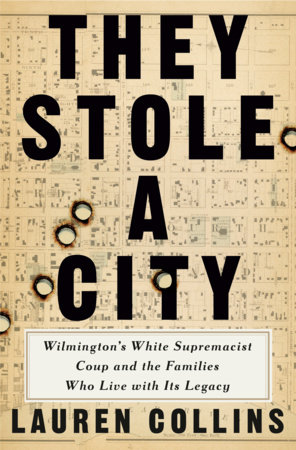
They Stole a City

Wilmington's White Supremacist Coup and the Families Who Live with Its Legacy

Look inside
Listen to a clip from the audiobook
audio pause button
0:00
0:00
“This is the kind of book that can change and shape public dis­course about racism, history and white supremacy.” —Bookpage

In this ambitious and groundbreaking history, Lauren Collins weaves together stories of four Wilmington, North Carolina, families over 125 years to create a full accounting of the long-term effects of the 1898 white supremacist massacre and coup and its critical role in subverting American democracy


After the Civil War, Reconstruction ushered in an era of political equality and economic opportunity for Black people, and it lasted longer in Wilmington than almost anywhere else. In 1898, Wilmington was a bastion of Black success: Black cultural life flourished, while a thriving Black middle class brimmed with lawyers, educators, and elected officials. The city became a symbol of Black hope—only for all of it to come to a violent end on November 10, 1898.

In this epic, multigenerational narrative, Lauren Collins traces the fates of four Wilmington families: the Howes, the Halseys, the Moores, and the Bellamy/MacRaes, all of whom were present on the day when a mob of white supremacists launched a murderous coup to “take the city.” After issuing a “White Declaration of Independence,” white men gunned down scores of Black men, chasing their families into hiding. Then they marched to city hall, where they overthrew the democratically elected, multiracial local government at gunpoint in what is thought to be the only successful coup d’état on American soil. No one knows exactly how many Black citizens they murdered—surely dozens, likely hundreds—while driving thousands of survivors and their white allies out of town. Folklore among both Black and white Wilmingtonians holds that the Cape Fear River ran red. While the effects of this episode of racial terrorism would ricochet through the next century of our nation’s history, no one was ever prosecuted or punished, and many of the details have been largely—and deliberately—forgotten.

In collaboration with living descendants of Black and white families, Collins seeks to create a more complete understanding of 1898 than can be drawn solely from the archives. She follows these four families and their descendants through the eras of segregation and Jim Crow, the Great Migration, the Civil Rights movement, and school desegregation, all the way up to the Black Lives Matter and racial justice protests in 2020, emphasizing the lasting and consequential effects of 1898 on the city and people of Wilmington.

Weaving together each generation’s reckoning with their past and how it has imprinted on their present, They Stole a City is an ambitious and revelatory examination of American racial terror as it has played out in one Southern city, written in the conviction that the story of the 1898 Wilmington massacre and coup is, in fact, a story about America in 2025.
Most accounts of 1898 begin with Reconstruction or, more often, with 1894 and the creation of the racially diverse Fusion movement. They conclude in late 1898, with the McKinley administration’s refusal to send troops to Wilmington or to extend any other form of aid, emboldening white terrorists nationwide. At the outer limit, they continue to 1900. That year, the passage of voting restrictions, accompanied by a grandfather clause exempting anyone whose forebear could vote before 1867 from disenfranchisement— that is, almost all white men—achieved the white supremacists’ goal of evicting Black people from political life. It seemed to me that 1898 had been put into a historical container that couldn’t hold its copious antecedents, its complex consequences spilling into the coming centuries in messy, unpredictable streaks. The event begged to be examined in its longitudinal fullness. I stuck a note card to the shelf above my desk: “American coup—and then what?”

In addition to extending the timeline of 1898 into both the past and the future, I have enlarged the human scope of inquiry, focusing on families rather than individual players. Twenty thousand people lived in Wilmington in 1898. They passed their experiences down to their children, who transmitted them to their own, and so on: hundreds of thousands of lives, interrupted, consolidated, dispersed, concentrated, thwarted, redirected, punctuated, complicated, elevated, degraded, enriched, ruined, marked, transformed. Families are both the incubators and the life-support machines of memory. The North Carolina legislature’s recent efforts to disenfranchise Black voters through gerrymandering and voter identification laws are nothing if not the grandchildren of the grandfather clause. Tracing the intergenerational transmission of racial terror is critical because it allows us to see who made its instigators and survivors the people that they were, and to assess how their legacies shape the choices that their descendants make today.

Wilmington’s Black population declined moderately in the immediate wake of 1898, as did the number of Black- owned businesses. White supremacists thereafter dominated political life in Wilmington and much of North Carolina, which did not elect another Black person to national office until 1992, when I was twelve. Statistics are enlightening, but insufficient for understanding this heritage. The qualitative fallout of 1898 is no less important for being more difficult to measure. We know that Black people lost life in 1898. Did they lose love? Lose touch? Lose hope, or muster strength? What did white people tally in pride, confidence, entitlement, shame?

To answer these questions, I have chosen principally to follow four Wilmington families, the Bellamy/MacRaes, the Moores, the Howes, and the Halseys. The first two are white families who contributed to the violence and its afterlife. The latter two are Black families who came through it. Their trajectories have diverged and sometimes overlapped in the 125 years since their forebears moved through the same dusty streets on one November day. Each family has developed its own strategies for explaining and remembering their ancestors’ actions in 1898. Some of them have chosen to stay quiet for understandable reasons, but others have made courageous efforts over the course of many years to tell these stories. In collaboration with these living descendants, I have sought to create a more complete account of 1898 than that which can be understood solely from the archive.

1898 is often presented as “hidden history.” It is true that the story was long subject to powerful taboos, but in recent years, public awareness has increased due to the work of filmmakers, scholars, writers, and musicians, along with a surge of interest in the subject of racial violence after the murder of George Floyd and the January 6 Capitol attack. Even if many people remain ignorant of 1898 and its seminal role in undemocratizing American democracy, its legacy is closer to a cipher than a secret. There are so many people, after all, whose relatives murdered or were murdered; whose fortunes prospered or failed; who do know what happened, because of the antique gun that they keep in a closet, or the New York address on their birth certificate, because of deathbed unburdening they’ve never forgotten, or how the ramifications of 1898 factored into their parents’ 1960s divorce.

The historian Glenda Gilmore has written, “Murder’s best work is done after the fact, when terror lives on in memory.” This book argues that the damage of the Wilmington massacre and coup, already great, far exceeds the number of people murdered on November 10, 1898. It demonstrates that the white supremacists began their work long before 1898, and continued it long after with Jim Crow and the violently botched desegregation of schools in the 1950s and ’60s; the devastating closure of Williston Senior High School, Wilmington’s bastion of Black education, in 1968; and the wrongful convictions, in 1971, of the Wilmington Ten for arson and conspiracy. 1898 lives on in Wilmington today in persistently low rates of Black voter participation, homeownership, and business ownership. Among white people, intergenerational wealth, the monopolization of public memory, and an enduring sense of chauvinism—a locally tinctured strain of white nationalism—must be counted among the massacre and coup’s consequences. Only with a full, encompassing inventory of 1898’s harm can we seek appropriate repair.

1898 was a premeditated takeover that enabled the ongoing needs of white supremacy, not the spontaneous folly of a few local racists. Treating it as an idiosyncratic moment in an ever- distant past renders it spectacle to be wondered at from safe remove. In fact, as a case study in the sabotage of American democracy by revanchist politicians, aggrieved moguls, and a bullying right-wing media, it presents unignorable lessons for today. To avoid repeating 1898, we must acknowledge it for what it was: a successful effort by white supremacists to wrest power from Black people who had amassed significant amounts of it—murder’s worst work, the crime of 128 years and counting.
“They Stole A City [is] a powerful new book... [Collins] shows how the massacre couldn't be contained to its particular time period... its effects continued to reverberate across generations.” —Jennifer Szalai, The New York Times

“The only coup d'etat to succeed on U.S. soil is, at most, a distant historical afterthought these days . . . Collins' new chronicle of the infamous event . . . fills in some serious gaps in the American collective memory and explains how its perpetrators cultivated the disorienting silence that persists in the historical record today.” —NPR.org

“An excellent new history out this summer that considers how the past lives in the present . . . Collins’s history is deeply researched and astonishing in its breadth . . . Her willingness to explore how a great injustice reverberates in both the perpetrators’ and the victims’ lives, as well as the lives of their descendants, pushes past what many people imagine a history might be. For Collins, revisiting shameful events in the past is important not for the meaningless exercise of self-flagellation but because one cannot understand one’s present day without this understanding.” —Kaitlyn Greenidge, Harper's Bazaar

“A scathing history of an infamous act of racial violence . . . Collins’ narrative takes [the 1898 coup and massacre], with ‘dozens and perhaps hundreds of Black citizens’ killed, and extends it to a larger legacy of racial oppression . . . An urgent work of reportage and historical research that lays bare structural racism past and present.”Kirkus (starred review)

“With moral clarity and narrative precision, Lauren Collins has crafted a searing account of the 1898 Wilmington massacre that is as analytically rigorous as it is emotionally resonant. By centering the interwoven lives of four families, They Stole a City exposes the calculated architecture of white supremacist violence while illuminating the enduring strategies of Black resistance, survival, and community-making. Collins refuses the comfort of historical distance, instead insisting on the intimate and structural continuities between past and present. The result is a work that not only deepens our understanding of a singular American atrocity, but also sharpens our recognition of the forces that continue to threaten democratic life. This is essential reading for anyone committed to reckoning honestly with history—and to confronting its living legacies.” —LeRhonda S. Manigault-Bryant, author of Talking to the Dead: Religion, Music, and Lived Memory among Gullah/Geechee People.

“With startling directness and vivid prose based on original and deep research, journalist Lauren Collins retells the story of Wilmington, North Carolina’s darkest period. This sweeping saga featuring four families across generations lays bare a long, horrid history of racial oppression and political violence, revealing not only how anti-democratic, white supremacist forces organized and leveraged brutality, but also how targeted individuals defended their humanity and communities. They Stole a City is an immersive yet sensitive account that reminds Americans we need not look to twentieth-century Europe for examples of electoral corruption and autocratic consolidation reinforced by racist ideology, roving thugs, economic elites, and immoral politicians. This is an urgent, unsettling history that we need now.” —Tiya Miles, author of All That She Carried: The Journey of Ashley’s Sack, a Black Family Keepsake

“Collins eloquently renders spellbinding tales of the 1898 Wilmington racial massacre and the families whose lives it changed forever. Her meticulous research juxtaposes its bloody history with profound interpretations of the legacies that shaped such diverse figures as Michael Jordan and Lara Trump. They Stole a City proves that past is always present. An indispensable read for all of us in these times.” —Glenda Gilmore, Peter V. and C. Vann Woodward Professor of History Emerita at Yale University

“Lauren Collins has written a deeply reported history and released it into this moment when history is dying, erased by lies and conspiracy, so that when reading I couldn't tell if this is a story of one city’s lynch mob in 1898 or an entire nation’s lynch mob in 2026. They Stole A City is at its core an investigation into one American mob, which makes it an investigation of all American mobs. This story happened 128 years ago. This story is happening now.” —Wright Thompson, senior writer for ESPN and the New York Times bestselling author of The Barn, Pappyland, and The Cost of These Dreams

“The brilliance of They Stole a City is not just that Lauren Collins grounds her sweeping, incendiary history of an infamous historical episode in the intimate lived experiences of four North Carolina families, but that she captures the 'prolific afterlife' of the massacre and coup in Wilmington, demonstrating in vivid, poignant, often painful detail the extent to which the past continues to shape and echo in our present day. An extraordinary book.” —Patrick Radden Keefe, New York Times bestselling author of five books, including Empire of Pain

They Stole a City is a brilliant rendering of a history buried in a shallow grave. Lauren Collins has not only measured the weight of a specific and tragic chapter of our past, she has charted the Wilmington Massacre’s bearing upon the present. The origins of our current crisis become more legible in these pages – as do the forces that would just as soon steal a nation.” —Jelani Cobb, Dean of Columbia’s Graduate School of Journalism, winner of the Peabody Award in 2020 and finalist for the Pulitzer Prize, and author of Three or More Is a Riot

“Lauren Collins's 1898 Wilmington race-riot masterpiece ends with Donald Trump's second coming, thus bookending Reconstruction's democratic promise with our hard-fought diversity, equity, and inclusion dangerously mocked. They Stole a City is required reading.” —David Levering Lewis, two-time winner of the Pulitzer Prize for W.E.B. Du Bois: A Biography 1868-1963

© Cedric Terrell
Lauren Collins was born in Wilmington, North Carolina in 1980. She is a staff writer at The New Yorker and the author of “When in French: Love in a Second Language,” which the New York Times named of its 100 Notable Books of 2016. She lives in Paris with her family. View titles by Lauren Collins

About

“This is the kind of book that can change and shape public dis­course about racism, history and white supremacy.” —Bookpage

In this ambitious and groundbreaking history, Lauren Collins weaves together stories of four Wilmington, North Carolina, families over 125 years to create a full accounting of the long-term effects of the 1898 white supremacist massacre and coup and its critical role in subverting American democracy


After the Civil War, Reconstruction ushered in an era of political equality and economic opportunity for Black people, and it lasted longer in Wilmington than almost anywhere else. In 1898, Wilmington was a bastion of Black success: Black cultural life flourished, while a thriving Black middle class brimmed with lawyers, educators, and elected officials. The city became a symbol of Black hope—only for all of it to come to a violent end on November 10, 1898.

In this epic, multigenerational narrative, Lauren Collins traces the fates of four Wilmington families: the Howes, the Halseys, the Moores, and the Bellamy/MacRaes, all of whom were present on the day when a mob of white supremacists launched a murderous coup to “take the city.” After issuing a “White Declaration of Independence,” white men gunned down scores of Black men, chasing their families into hiding. Then they marched to city hall, where they overthrew the democratically elected, multiracial local government at gunpoint in what is thought to be the only successful coup d’état on American soil. No one knows exactly how many Black citizens they murdered—surely dozens, likely hundreds—while driving thousands of survivors and their white allies out of town. Folklore among both Black and white Wilmingtonians holds that the Cape Fear River ran red. While the effects of this episode of racial terrorism would ricochet through the next century of our nation’s history, no one was ever prosecuted or punished, and many of the details have been largely—and deliberately—forgotten.

In collaboration with living descendants of Black and white families, Collins seeks to create a more complete understanding of 1898 than can be drawn solely from the archives. She follows these four families and their descendants through the eras of segregation and Jim Crow, the Great Migration, the Civil Rights movement, and school desegregation, all the way up to the Black Lives Matter and racial justice protests in 2020, emphasizing the lasting and consequential effects of 1898 on the city and people of Wilmington.

Weaving together each generation’s reckoning with their past and how it has imprinted on their present, They Stole a City is an ambitious and revelatory examination of American racial terror as it has played out in one Southern city, written in the conviction that the story of the 1898 Wilmington massacre and coup is, in fact, a story about America in 2025.

Excerpt

Most accounts of 1898 begin with Reconstruction or, more often, with 1894 and the creation of the racially diverse Fusion movement. They conclude in late 1898, with the McKinley administration’s refusal to send troops to Wilmington or to extend any other form of aid, emboldening white terrorists nationwide. At the outer limit, they continue to 1900. That year, the passage of voting restrictions, accompanied by a grandfather clause exempting anyone whose forebear could vote before 1867 from disenfranchisement— that is, almost all white men—achieved the white supremacists’ goal of evicting Black people from political life. It seemed to me that 1898 had been put into a historical container that couldn’t hold its copious antecedents, its complex consequences spilling into the coming centuries in messy, unpredictable streaks. The event begged to be examined in its longitudinal fullness. I stuck a note card to the shelf above my desk: “American coup—and then what?”

In addition to extending the timeline of 1898 into both the past and the future, I have enlarged the human scope of inquiry, focusing on families rather than individual players. Twenty thousand people lived in Wilmington in 1898. They passed their experiences down to their children, who transmitted them to their own, and so on: hundreds of thousands of lives, interrupted, consolidated, dispersed, concentrated, thwarted, redirected, punctuated, complicated, elevated, degraded, enriched, ruined, marked, transformed. Families are both the incubators and the life-support machines of memory. The North Carolina legislature’s recent efforts to disenfranchise Black voters through gerrymandering and voter identification laws are nothing if not the grandchildren of the grandfather clause. Tracing the intergenerational transmission of racial terror is critical because it allows us to see who made its instigators and survivors the people that they were, and to assess how their legacies shape the choices that their descendants make today.

Wilmington’s Black population declined moderately in the immediate wake of 1898, as did the number of Black- owned businesses. White supremacists thereafter dominated political life in Wilmington and much of North Carolina, which did not elect another Black person to national office until 1992, when I was twelve. Statistics are enlightening, but insufficient for understanding this heritage. The qualitative fallout of 1898 is no less important for being more difficult to measure. We know that Black people lost life in 1898. Did they lose love? Lose touch? Lose hope, or muster strength? What did white people tally in pride, confidence, entitlement, shame?

To answer these questions, I have chosen principally to follow four Wilmington families, the Bellamy/MacRaes, the Moores, the Howes, and the Halseys. The first two are white families who contributed to the violence and its afterlife. The latter two are Black families who came through it. Their trajectories have diverged and sometimes overlapped in the 125 years since their forebears moved through the same dusty streets on one November day. Each family has developed its own strategies for explaining and remembering their ancestors’ actions in 1898. Some of them have chosen to stay quiet for understandable reasons, but others have made courageous efforts over the course of many years to tell these stories. In collaboration with these living descendants, I have sought to create a more complete account of 1898 than that which can be understood solely from the archive.

1898 is often presented as “hidden history.” It is true that the story was long subject to powerful taboos, but in recent years, public awareness has increased due to the work of filmmakers, scholars, writers, and musicians, along with a surge of interest in the subject of racial violence after the murder of George Floyd and the January 6 Capitol attack. Even if many people remain ignorant of 1898 and its seminal role in undemocratizing American democracy, its legacy is closer to a cipher than a secret. There are so many people, after all, whose relatives murdered or were murdered; whose fortunes prospered or failed; who do know what happened, because of the antique gun that they keep in a closet, or the New York address on their birth certificate, because of deathbed unburdening they’ve never forgotten, or how the ramifications of 1898 factored into their parents’ 1960s divorce.

The historian Glenda Gilmore has written, “Murder’s best work is done after the fact, when terror lives on in memory.” This book argues that the damage of the Wilmington massacre and coup, already great, far exceeds the number of people murdered on November 10, 1898. It demonstrates that the white supremacists began their work long before 1898, and continued it long after with Jim Crow and the violently botched desegregation of schools in the 1950s and ’60s; the devastating closure of Williston Senior High School, Wilmington’s bastion of Black education, in 1968; and the wrongful convictions, in 1971, of the Wilmington Ten for arson and conspiracy. 1898 lives on in Wilmington today in persistently low rates of Black voter participation, homeownership, and business ownership. Among white people, intergenerational wealth, the monopolization of public memory, and an enduring sense of chauvinism—a locally tinctured strain of white nationalism—must be counted among the massacre and coup’s consequences. Only with a full, encompassing inventory of 1898’s harm can we seek appropriate repair.

1898 was a premeditated takeover that enabled the ongoing needs of white supremacy, not the spontaneous folly of a few local racists. Treating it as an idiosyncratic moment in an ever- distant past renders it spectacle to be wondered at from safe remove. In fact, as a case study in the sabotage of American democracy by revanchist politicians, aggrieved moguls, and a bullying right-wing media, it presents unignorable lessons for today. To avoid repeating 1898, we must acknowledge it for what it was: a successful effort by white supremacists to wrest power from Black people who had amassed significant amounts of it—murder’s worst work, the crime of 128 years and counting.

Reviews

“They Stole A City [is] a powerful new book... [Collins] shows how the massacre couldn't be contained to its particular time period... its effects continued to reverberate across generations.” —Jennifer Szalai, The New York Times

“The only coup d'etat to succeed on U.S. soil is, at most, a distant historical afterthought these days . . . Collins' new chronicle of the infamous event . . . fills in some serious gaps in the American collective memory and explains how its perpetrators cultivated the disorienting silence that persists in the historical record today.” —NPR.org

“An excellent new history out this summer that considers how the past lives in the present . . . Collins’s history is deeply researched and astonishing in its breadth . . . Her willingness to explore how a great injustice reverberates in both the perpetrators’ and the victims’ lives, as well as the lives of their descendants, pushes past what many people imagine a history might be. For Collins, revisiting shameful events in the past is important not for the meaningless exercise of self-flagellation but because one cannot understand one’s present day without this understanding.” —Kaitlyn Greenidge, Harper's Bazaar

“A scathing history of an infamous act of racial violence . . . Collins’ narrative takes [the 1898 coup and massacre], with ‘dozens and perhaps hundreds of Black citizens’ killed, and extends it to a larger legacy of racial oppression . . . An urgent work of reportage and historical research that lays bare structural racism past and present.”Kirkus (starred review)

“With moral clarity and narrative precision, Lauren Collins has crafted a searing account of the 1898 Wilmington massacre that is as analytically rigorous as it is emotionally resonant. By centering the interwoven lives of four families, They Stole a City exposes the calculated architecture of white supremacist violence while illuminating the enduring strategies of Black resistance, survival, and community-making. Collins refuses the comfort of historical distance, instead insisting on the intimate and structural continuities between past and present. The result is a work that not only deepens our understanding of a singular American atrocity, but also sharpens our recognition of the forces that continue to threaten democratic life. This is essential reading for anyone committed to reckoning honestly with history—and to confronting its living legacies.” —LeRhonda S. Manigault-Bryant, author of Talking to the Dead: Religion, Music, and Lived Memory among Gullah/Geechee People.

“With startling directness and vivid prose based on original and deep research, journalist Lauren Collins retells the story of Wilmington, North Carolina’s darkest period. This sweeping saga featuring four families across generations lays bare a long, horrid history of racial oppression and political violence, revealing not only how anti-democratic, white supremacist forces organized and leveraged brutality, but also how targeted individuals defended their humanity and communities. They Stole a City is an immersive yet sensitive account that reminds Americans we need not look to twentieth-century Europe for examples of electoral corruption and autocratic consolidation reinforced by racist ideology, roving thugs, economic elites, and immoral politicians. This is an urgent, unsettling history that we need now.” —Tiya Miles, author of All That She Carried: The Journey of Ashley’s Sack, a Black Family Keepsake

“Collins eloquently renders spellbinding tales of the 1898 Wilmington racial massacre and the families whose lives it changed forever. Her meticulous research juxtaposes its bloody history with profound interpretations of the legacies that shaped such diverse figures as Michael Jordan and Lara Trump. They Stole a City proves that past is always present. An indispensable read for all of us in these times.” —Glenda Gilmore, Peter V. and C. Vann Woodward Professor of History Emerita at Yale University

“Lauren Collins has written a deeply reported history and released it into this moment when history is dying, erased by lies and conspiracy, so that when reading I couldn't tell if this is a story of one city’s lynch mob in 1898 or an entire nation’s lynch mob in 2026. They Stole A City is at its core an investigation into one American mob, which makes it an investigation of all American mobs. This story happened 128 years ago. This story is happening now.” —Wright Thompson, senior writer for ESPN and the New York Times bestselling author of The Barn, Pappyland, and The Cost of These Dreams

“The brilliance of They Stole a City is not just that Lauren Collins grounds her sweeping, incendiary history of an infamous historical episode in the intimate lived experiences of four North Carolina families, but that she captures the 'prolific afterlife' of the massacre and coup in Wilmington, demonstrating in vivid, poignant, often painful detail the extent to which the past continues to shape and echo in our present day. An extraordinary book.” —Patrick Radden Keefe, New York Times bestselling author of five books, including Empire of Pain

They Stole a City is a brilliant rendering of a history buried in a shallow grave. Lauren Collins has not only measured the weight of a specific and tragic chapter of our past, she has charted the Wilmington Massacre’s bearing upon the present. The origins of our current crisis become more legible in these pages – as do the forces that would just as soon steal a nation.” —Jelani Cobb, Dean of Columbia’s Graduate School of Journalism, winner of the Peabody Award in 2020 and finalist for the Pulitzer Prize, and author of Three or More Is a Riot

“Lauren Collins's 1898 Wilmington race-riot masterpiece ends with Donald Trump's second coming, thus bookending Reconstruction's democratic promise with our hard-fought diversity, equity, and inclusion dangerously mocked. They Stole a City is required reading.” —David Levering Lewis, two-time winner of the Pulitzer Prize for W.E.B. Du Bois: A Biography 1868-1963

Author

© Cedric Terrell
Lauren Collins was born in Wilmington, North Carolina in 1980. She is a staff writer at The New Yorker and the author of “When in French: Love in a Second Language,” which the New York Times named of its 100 Notable Books of 2016. She lives in Paris with her family. View titles by Lauren Collins
  • More Websites from
    Penguin Random House
  • Common Reads
  • Library Marketing