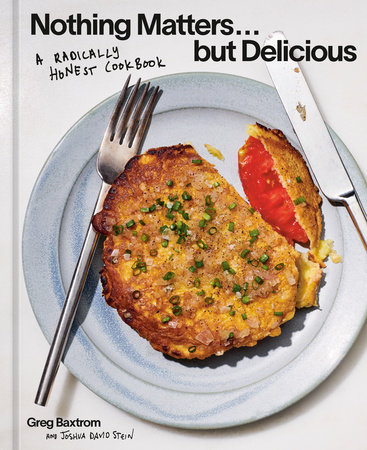
Nothing Matters but Delicious

A Radically Honest Cookbook

Learn how to make restaurant-quality dishes at home with this accessible, achievable, and delicious collection of 75 recipes from the award-winning chef and owner of Olmsted, Patti Ann's, and Five Acres.

“Trust Greg’s ability to guide you through these dishes, and you’ll quickly become the dinner‑party hero among your friends and family.”—Grant Achatz, chef and restaurateur

Much of the fancy technique you see at restaurants doesn’t really matter. You can get the nearly same effect with infinitely less work, and it’s more fun and you might actually do it. Many of tropes of fine dining cookbook recipes—the hyperspecificity, the rigidity of the recipes—they don’t matter either. Nothing Matters . . . but Delicious.

In this cookbook-like-no-other, award-winning chef and restaurateur Greg Baxtrom invites you into his energetic kitchen, sharing his honest and encouraging methodologies for exquisite dishes. Nothing Matters . . . but Delicious gives home cooks of all abilities the confidence and techniques to never quit on their culinary journey.

Filled with sidebars containing helpful tips and lessons, like how to recover from cooking mistakes, and photographs and infographics to assist you every step of the way, readers will delight in this guide to culinary perfection. Recipes flow from easy to complex, with beginner recipes like Simple Ribeye with Roasted Root Vegetables and Easy Peasy Mac & Cheesy to the more complicated Bouillabaisse and Indoor S’more.

With a slew of broken-down tips and easy-to-digest guidance, Nothing Matters . . . but Delicious has something for everyone.
Introduction

I’ve lived my adult life in two unequal parts. But both are equally important to understand who I am, what this book is about, why I wrote it the way I did, and why it can be helpful to you. First chef; then alcoholic.

For the first thirty-four years of Gregory Millard Baxtrom, all I wanted was to be a chef. Not just a run-of-the-mill chef, but one of the greatest chefs in the world. I was a greyhound chasing a rabbit. Single-minded, fast, and panting. I wanted my face in the Mount Rushmore of the gastronomic world, beside Carême and Keller, between Bocuse and Boulud. Life was a flat-out sprint to culinary achievement, a grind for which I had been conditioned since birth.

I grew up in a rural farming community outside Chicago called Frankfort. It was a small town: a main street with a granary on one end, a real Midwestern dive bar with a blinking neon light, and a music shop with dusty guitars in the window. The town was small but the farms were huge, vast fields of corn that surrounded the five-acre plot where my family lived. My parents—Patti Ann and Mike—were quiet but tough Chicago people from the South Side. Mom was a schoolteacher; Dad worked his way up from cleaning restaurants at night to becoming a successful carpenter. He lived by a simple motto: “Do a job big or small; do it right or not at all,” a couplet that I’ve adopted and taken to heart throughout my life.

Our family, though loving, was not one for half measures, not a cradle of quitting or a soft foam pit of “Well, I tried.” Self-reliance, perseverance, and toughness were the Baxtrom family heirlooms, passed down to me, my older sister, Katie, and my younger brother, Kevin. Autumns raking. Winters shoveling snow. Summers chopping wood. Spring weeding. The Baxtrom stance, like many of our farmer neighbors, was head down and hands in motion. We didn’t complain. We didn’t object. We never quit. I, who was named after my dad’s brother who had passed away after a car accident at only twenty-two years old, felt I had a special obligation to be the golden child. I was a Boy Scout, literally—do it right or not at all—then an Eagle Scout, for all Frankfort to see, in my blue neckerchief, vowing, on my honor to do my best, to do my duty, to God and my country.

Since Mom and Dad worked late and we kids—all tall—ran crosscountry, dinner was a communal effort that was dispersed among the family. Whoever came home first started something, and whoever could finished it. We all ate together around our small wooden table. Even as a seven- or eight-year-old tasked with making popcorn for movie night, I had an aptitude for cooking. From popcorn I graduated to frozen Salisbury steak, then grilled chicken, then pasta. When I got my first job the day I turned fifteen, it was behind the fry station at the local Wendy’s. No, I didn’t vow to devote my life to the pursuit of Michelin stars over saucy nuggets on the weekend shift. But at Wendy’s, the inner workings of a professional kitchen first fascinated me. I loved the rapidity of the orders in and out; was hypnotized by the monotony of dropping a basket of fries into a vat of oil; loved that, all things being equal and the menu never changing, you could still try to make the best fried chicken sandwiches you could. That was my job, small as it was, and I wanted to do it right.

When I graduated high school, I headed off to Kendall College, a culinary and hospitality management school in Chicago. There, perhaps as a legacy of Scouts learning, I found I picked up techniques quickly. Personally, I found that in the rigor of a kitchen, with the certainties provided by hierarchy and an entire culture predicated on not complaining, I excelled. Cooking, for me, was the perfect balance of the mechanical with the human. You had to be like a robot, work like a robot, stay cool like a robot, all while utilizing your human senses: taste, touch, smell. That ability of soldiering through discomfort and pain, honed through childhood, began to pay off. I was the star pupil. During my first externship, a three-month stage at a small hotel called Auberge de la Valloire in a speck of a town in southeastern France called Épinouze, I worked through a nasty bout of mono. I was almost delirious with fatigue on the line but didn’t miss a beat. My girlfriend at the time and I constituted the entire kitchen staff, and we didn’t miss a plate. Not even mono could dampen the high I felt at having toughed it out.

When I returned to Chicago, I started to hear whispers about a local chef who had studied at Thomas Keller’s The French Laundry, and was doing crazy things blocks away. I remember huddling around a computer in the college’s computer room with a few other students looking at pictures on a forum called egullet of that chef, Grant Achatz, messing around at someone’s (turned out future Alinea co-owner Nick Kokonas’s) house. He hung a peeled grape, still on the vine, dipped it in peanut butter and wrapped it in a piece of toast. My mind was blown. It reminded me of dishes I had seen in the elBulli cookbook, which at $300 was the most expensive thing I owned. Later that year, when I was assigned a class project to design my own restaurant, I took inspiration from The French Laundry. Since I knew Grant had worked there, I arranged an interview with him so I could learn how a tasting menu worked. But when I arrived at the newly opened restaurant, he evidently hadn’t gotten the email about the interview, and thought I was there looking for a stage. I didn’t correct him. Soon enough, I was ushered back into the kitchen to make lavender balloons. At the end of that trial, Grant came up to me and asked, “When are you coming back?” I responded, “Whenever you want me to.” I came back the next day, and I started to work at Alinea the day after that, two weeks after it opened.

For the next four years, that crucible of high pressure and even higher technique—not to mention culinary imagination—was my home, 14 hours a day, 5 days a week. I would have stayed forever, but even Alinea couldn’t contain my ambition. Although I was always told we were the best restaurant in the world, I had to find out for myself. When I told Grant I was leaving, he understood. “Greg,” he told me, “you’re either going to realize you hated this place or that you loved it.”

My next stop was a stage at Mugaritz, Andoni Luis Aduriz’s avantgarde restaurant in San Sebastián, Spain. Although I didn’t speak Spanish, again, I was the golden boy, with a digital translator next to my cutting board and a few key kitchen terms—fuego, marcha, salmonete—written out phonetically. After nearly five months, toward the end of the stage, my girlfriend, a pharmacist named Meghan I had met in Chicago, flew out to meet me. I proposed to her, she said yes. The future was bright for us. By this time, I had gotten a job offer at Thomas Keller’s Per Se in New York. So we moved to New York, despite neither of us knowing anything about the big city.

Well, she moved to New York. I moved to a New York kitchen, which is different. I barely saw the city outside of it. Although Keller and his chefs de cuisine, first Jonathan Benno and then Eli Kaimeh, maintained blisteringly high standards (a sign reading “Sense of Urgency” still hangs on the kitchen threshold), again I thrived; again my penchant for hard work and gutting it out helped me excel. After a year and a half, and with assistance from Grant, another chef, Dan Barber, called me up and invited me to work at Blue Hill at Stone Barns, a two-star Michelin restaurant on a former Rockefeller family estate two hours north of the city.

At Blue Hill, the pattern repeated and, as far as I was concerned, there was no problem. Millions of hours, few days off. Head down. Hands in motion. Do it right or not at all. From Dan, a largely self-taught chef, I learned a reverence for simple ingredients. Early on, as Dan and I were walking in the fields surrounding the restaurant, he stopped suddenly and pulled a beautiful Hakurei turnip out of the ground. He held it up to me and said, triumphantly, “You can’t get that at Per Se!” I laughed—his enthusiasm for ingredients was infectious.

I quickly worked my way to the top of the kitchen hierarchy at Blue Hill, and in 2013, feeling like I had learned all I could, I decided to leave. When an opportunity arose to work with the legendary restaurateur Danny Meyer and his chef, Floyd Cardoz, at North End Grill in downtown Manhattan, I took the job. Meanwhile, my personal life, such as it was, remained an afterthought. Meghan and I got divorced. She moved back to Chicago, and yet that hardly registered. As far as I was concerned, my life was going exactly to plan.

In 2016, at the age of thirty-one, I finally fulfilled my lifelong dream: I opened Olmsted, my own fine-dining restaurant, in Brooklyn, and probably the reason you’re reading this book. Olmsted was the culmination of everything I had learned in the best kitchens in America, suffused with my own personal Midwest expression. We opened in the summer of 2016, with a garden humming with life, crawfish, quail, and critical buzz. Almost immediately, accolades poured in: Esquire’s Best New Restaurant, GQ’s Restaurant of the Year, and raves from Eater and the New York Times. I made it, I thought.
“Vulnerable and generous, this cookbook is a pure expression of Greg. The work of a true expert, these recipes bring joy and tremendous flavor in equal measure.”—Chef Michael Solomonov

“I recognized Greg’s formidable talent in the kitchen in the earliest days of Alinea. Years and several restaurants later, his skills now extend far beyond his own dining rooms and into yours. Trust his ability to guide you through these dishes, and you’ll quickly become the dinner‑party hero among your friends and family.”—Grant Achatz, chef and restaurateur
Greg Baxtrom is the chef-owner of the acclaimed restaurants Olmsted, Patti Ann’s Family Restaurant and Bakery, and Five Acres. Prior to opening Olmsted, Greg worked in some of the world's most exciting kitchens, including Alinea, Blue Hill at Stone Barns, Per Se, and Lysverket in Norway. Olmsted showcases a seasonal and creative vegetable-forward menu that highlights produce from the lush backyard garden, as well as local farmers and purveyors. The restaurant was named one of Esquire's Best New Restaurants in America; Bon Appetit's 50 Best New Restaurants in America; Food & Wine's Restaurant of the Year; The New York Times' 10 Best Restaurants; among others.

Joshua David Stein is an editor, author, and journalist. He is the co-author of numerous books including My America: Restaurants from a Young Black Chef; Notes from a Young Black Chef; The Nom Wah Cookbook; Vino: The Essential Guide to Real Italian Wine; and Il Buco: Stories & Recipes as well as many children’s books about food. He is the author of the cookbooks Cooking for Your Kids and Stranger Things: The Official Cookbook, the editor of a collection of essays called To Me He Was Just Dad: Growing up with Famous Fathers, and previously the editor-at-large at Fatherly. He regularly contributes to Esquire, Men’s Health, New York, Eater, Grub Street, and more. Stein lives in Brooklyn, New York, with his two sons, Achilles and Augustus.

About

Learn how to make restaurant-quality dishes at home with this accessible, achievable, and delicious collection of 75 recipes from the award-winning chef and owner of Olmsted, Patti Ann's, and Five Acres.

“Trust Greg’s ability to guide you through these dishes, and you’ll quickly become the dinner‑party hero among your friends and family.”—Grant Achatz, chef and restaurateur

Much of the fancy technique you see at restaurants doesn’t really matter. You can get the nearly same effect with infinitely less work, and it’s more fun and you might actually do it. Many of tropes of fine dining cookbook recipes—the hyperspecificity, the rigidity of the recipes—they don’t matter either. Nothing Matters . . . but Delicious.

In this cookbook-like-no-other, award-winning chef and restaurateur Greg Baxtrom invites you into his energetic kitchen, sharing his honest and encouraging methodologies for exquisite dishes. Nothing Matters . . . but Delicious gives home cooks of all abilities the confidence and techniques to never quit on their culinary journey.

Filled with sidebars containing helpful tips and lessons, like how to recover from cooking mistakes, and photographs and infographics to assist you every step of the way, readers will delight in this guide to culinary perfection. Recipes flow from easy to complex, with beginner recipes like Simple Ribeye with Roasted Root Vegetables and Easy Peasy Mac & Cheesy to the more complicated Bouillabaisse and Indoor S’more.

With a slew of broken-down tips and easy-to-digest guidance, Nothing Matters . . . but Delicious has something for everyone.

Excerpt

Introduction

I’ve lived my adult life in two unequal parts. But both are equally important to understand who I am, what this book is about, why I wrote it the way I did, and why it can be helpful to you. First chef; then alcoholic.

For the first thirty-four years of Gregory Millard Baxtrom, all I wanted was to be a chef. Not just a run-of-the-mill chef, but one of the greatest chefs in the world. I was a greyhound chasing a rabbit. Single-minded, fast, and panting. I wanted my face in the Mount Rushmore of the gastronomic world, beside Carême and Keller, between Bocuse and Boulud. Life was a flat-out sprint to culinary achievement, a grind for which I had been conditioned since birth.

I grew up in a rural farming community outside Chicago called Frankfort. It was a small town: a main street with a granary on one end, a real Midwestern dive bar with a blinking neon light, and a music shop with dusty guitars in the window. The town was small but the farms were huge, vast fields of corn that surrounded the five-acre plot where my family lived. My parents—Patti Ann and Mike—were quiet but tough Chicago people from the South Side. Mom was a schoolteacher; Dad worked his way up from cleaning restaurants at night to becoming a successful carpenter. He lived by a simple motto: “Do a job big or small; do it right or not at all,” a couplet that I’ve adopted and taken to heart throughout my life.

Our family, though loving, was not one for half measures, not a cradle of quitting or a soft foam pit of “Well, I tried.” Self-reliance, perseverance, and toughness were the Baxtrom family heirlooms, passed down to me, my older sister, Katie, and my younger brother, Kevin. Autumns raking. Winters shoveling snow. Summers chopping wood. Spring weeding. The Baxtrom stance, like many of our farmer neighbors, was head down and hands in motion. We didn’t complain. We didn’t object. We never quit. I, who was named after my dad’s brother who had passed away after a car accident at only twenty-two years old, felt I had a special obligation to be the golden child. I was a Boy Scout, literally—do it right or not at all—then an Eagle Scout, for all Frankfort to see, in my blue neckerchief, vowing, on my honor to do my best, to do my duty, to God and my country.

Since Mom and Dad worked late and we kids—all tall—ran crosscountry, dinner was a communal effort that was dispersed among the family. Whoever came home first started something, and whoever could finished it. We all ate together around our small wooden table. Even as a seven- or eight-year-old tasked with making popcorn for movie night, I had an aptitude for cooking. From popcorn I graduated to frozen Salisbury steak, then grilled chicken, then pasta. When I got my first job the day I turned fifteen, it was behind the fry station at the local Wendy’s. No, I didn’t vow to devote my life to the pursuit of Michelin stars over saucy nuggets on the weekend shift. But at Wendy’s, the inner workings of a professional kitchen first fascinated me. I loved the rapidity of the orders in and out; was hypnotized by the monotony of dropping a basket of fries into a vat of oil; loved that, all things being equal and the menu never changing, you could still try to make the best fried chicken sandwiches you could. That was my job, small as it was, and I wanted to do it right.

When I graduated high school, I headed off to Kendall College, a culinary and hospitality management school in Chicago. There, perhaps as a legacy of Scouts learning, I found I picked up techniques quickly. Personally, I found that in the rigor of a kitchen, with the certainties provided by hierarchy and an entire culture predicated on not complaining, I excelled. Cooking, for me, was the perfect balance of the mechanical with the human. You had to be like a robot, work like a robot, stay cool like a robot, all while utilizing your human senses: taste, touch, smell. That ability of soldiering through discomfort and pain, honed through childhood, began to pay off. I was the star pupil. During my first externship, a three-month stage at a small hotel called Auberge de la Valloire in a speck of a town in southeastern France called Épinouze, I worked through a nasty bout of mono. I was almost delirious with fatigue on the line but didn’t miss a beat. My girlfriend at the time and I constituted the entire kitchen staff, and we didn’t miss a plate. Not even mono could dampen the high I felt at having toughed it out.

When I returned to Chicago, I started to hear whispers about a local chef who had studied at Thomas Keller’s The French Laundry, and was doing crazy things blocks away. I remember huddling around a computer in the college’s computer room with a few other students looking at pictures on a forum called egullet of that chef, Grant Achatz, messing around at someone’s (turned out future Alinea co-owner Nick Kokonas’s) house. He hung a peeled grape, still on the vine, dipped it in peanut butter and wrapped it in a piece of toast. My mind was blown. It reminded me of dishes I had seen in the elBulli cookbook, which at $300 was the most expensive thing I owned. Later that year, when I was assigned a class project to design my own restaurant, I took inspiration from The French Laundry. Since I knew Grant had worked there, I arranged an interview with him so I could learn how a tasting menu worked. But when I arrived at the newly opened restaurant, he evidently hadn’t gotten the email about the interview, and thought I was there looking for a stage. I didn’t correct him. Soon enough, I was ushered back into the kitchen to make lavender balloons. At the end of that trial, Grant came up to me and asked, “When are you coming back?” I responded, “Whenever you want me to.” I came back the next day, and I started to work at Alinea the day after that, two weeks after it opened.

For the next four years, that crucible of high pressure and even higher technique—not to mention culinary imagination—was my home, 14 hours a day, 5 days a week. I would have stayed forever, but even Alinea couldn’t contain my ambition. Although I was always told we were the best restaurant in the world, I had to find out for myself. When I told Grant I was leaving, he understood. “Greg,” he told me, “you’re either going to realize you hated this place or that you loved it.”

My next stop was a stage at Mugaritz, Andoni Luis Aduriz’s avantgarde restaurant in San Sebastián, Spain. Although I didn’t speak Spanish, again, I was the golden boy, with a digital translator next to my cutting board and a few key kitchen terms—fuego, marcha, salmonete—written out phonetically. After nearly five months, toward the end of the stage, my girlfriend, a pharmacist named Meghan I had met in Chicago, flew out to meet me. I proposed to her, she said yes. The future was bright for us. By this time, I had gotten a job offer at Thomas Keller’s Per Se in New York. So we moved to New York, despite neither of us knowing anything about the big city.

Well, she moved to New York. I moved to a New York kitchen, which is different. I barely saw the city outside of it. Although Keller and his chefs de cuisine, first Jonathan Benno and then Eli Kaimeh, maintained blisteringly high standards (a sign reading “Sense of Urgency” still hangs on the kitchen threshold), again I thrived; again my penchant for hard work and gutting it out helped me excel. After a year and a half, and with assistance from Grant, another chef, Dan Barber, called me up and invited me to work at Blue Hill at Stone Barns, a two-star Michelin restaurant on a former Rockefeller family estate two hours north of the city.

At Blue Hill, the pattern repeated and, as far as I was concerned, there was no problem. Millions of hours, few days off. Head down. Hands in motion. Do it right or not at all. From Dan, a largely self-taught chef, I learned a reverence for simple ingredients. Early on, as Dan and I were walking in the fields surrounding the restaurant, he stopped suddenly and pulled a beautiful Hakurei turnip out of the ground. He held it up to me and said, triumphantly, “You can’t get that at Per Se!” I laughed—his enthusiasm for ingredients was infectious.

I quickly worked my way to the top of the kitchen hierarchy at Blue Hill, and in 2013, feeling like I had learned all I could, I decided to leave. When an opportunity arose to work with the legendary restaurateur Danny Meyer and his chef, Floyd Cardoz, at North End Grill in downtown Manhattan, I took the job. Meanwhile, my personal life, such as it was, remained an afterthought. Meghan and I got divorced. She moved back to Chicago, and yet that hardly registered. As far as I was concerned, my life was going exactly to plan.

In 2016, at the age of thirty-one, I finally fulfilled my lifelong dream: I opened Olmsted, my own fine-dining restaurant, in Brooklyn, and probably the reason you’re reading this book. Olmsted was the culmination of everything I had learned in the best kitchens in America, suffused with my own personal Midwest expression. We opened in the summer of 2016, with a garden humming with life, crawfish, quail, and critical buzz. Almost immediately, accolades poured in: Esquire’s Best New Restaurant, GQ’s Restaurant of the Year, and raves from Eater and the New York Times. I made it, I thought.

Reviews

“Vulnerable and generous, this cookbook is a pure expression of Greg. The work of a true expert, these recipes bring joy and tremendous flavor in equal measure.”—Chef Michael Solomonov

“I recognized Greg’s formidable talent in the kitchen in the earliest days of Alinea. Years and several restaurants later, his skills now extend far beyond his own dining rooms and into yours. Trust his ability to guide you through these dishes, and you’ll quickly become the dinner‑party hero among your friends and family.”—Grant Achatz, chef and restaurateur

Author

Greg Baxtrom is the chef-owner of the acclaimed restaurants Olmsted, Patti Ann’s Family Restaurant and Bakery, and Five Acres. Prior to opening Olmsted, Greg worked in some of the world's most exciting kitchens, including Alinea, Blue Hill at Stone Barns, Per Se, and Lysverket in Norway. Olmsted showcases a seasonal and creative vegetable-forward menu that highlights produce from the lush backyard garden, as well as local farmers and purveyors. The restaurant was named one of Esquire's Best New Restaurants in America; Bon Appetit's 50 Best New Restaurants in America; Food & Wine's Restaurant of the Year; The New York Times' 10 Best Restaurants; among others.

Joshua David Stein is an editor, author, and journalist. He is the co-author of numerous books including My America: Restaurants from a Young Black Chef; Notes from a Young Black Chef; The Nom Wah Cookbook; Vino: The Essential Guide to Real Italian Wine; and Il Buco: Stories & Recipes as well as many children’s books about food. He is the author of the cookbooks Cooking for Your Kids and Stranger Things: The Official Cookbook, the editor of a collection of essays called To Me He Was Just Dad: Growing up with Famous Fathers, and previously the editor-at-large at Fatherly. He regularly contributes to Esquire, Men’s Health, New York, Eater, Grub Street, and more. Stein lives in Brooklyn, New York, with his two sons, Achilles and Augustus.
  • More Websites from
    Penguin Random House
  • Common Reads
  • Library Marketing