A Parish Chronicle

Introduction by Salvatore Scibona
Translated by Philip Roughton
From Iceland’s Nobel laureate, an essayistic tale of the unlikely miracles that return a church—fated to disappear over & again throughout time—to the same hillside

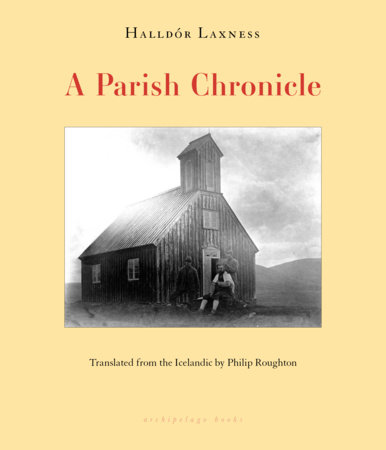
1882. In the still of morning, Ólafur sharpens his scythe on the bone-dry pavestones that separate his farmhouse from the rest of Mosfell Valley, where life revolves around sheep. The sound of his hammer rings out like a high-pitched bell over the tussocky fields. Across the valley, perched on a hill that hoards more sunshine than others, stands Mosfell Church. Nearby, the parish priest’s maid Gunna pours her “slosh,” a weak cup of coffee. Further afield in Reykjavík (“down south” as the locals say) the general assembly decides to revisit an old plan to cut costs by consolidating small parishes, and calls for the demolition of Mosfell. Yet today a church stands on that same hillside—its sharp steeple silhouetted against the clouds, its crown bell hanging to the left of the altar. In A Parish Chronicle, celebrated novelist Halldór Laxness combs through the minutest details of history—from the location of the ancient burial mound of national hero Egill Skallagrímsson down to the latter part of the 19th century, when weak-sighted Ólafur and bawdy farmhand Gunna will each play an unlikely role in the parish’s stubborn survival. An intimate ode to the way of life in Laxness’s home valley, and a shrewd commentary on how history bends to the quirks of certain individuals—A Parish Chronicle abounds with life.
"In Laxness, the boundary collapses between inward and outward. Nowhere is this more on display than in the novel A Parish Chronicle . . . Surely one of the reasons A Parish Chronicle feels like a high-fidelity representation of Laxness’s soul is because he grew up [in Mosfell Valley] and knows the history in the marrow of his bones . . . I can think of no better introduction to the entire oeuvre of Laxness." —Will Chancellor, The Brooklyn Rail

"A seamless mix of folklore and quotidian details . . . Readers will be transported." —Publishers Weekly

“This is a better novel (richer, deeper) than anything else you're likely to meet this year. Its people are as real as you or me— as are its shorebirds and its blizzards and its dreams and its cows.”— Brad Leithauser on Salka Valka, Wall Street Journal

“A gripping wonder, and Laxness’s most sustained piece of narrative drama . . . Even in moments of high drama, [Philip Roughton] moves along with calm assurance, tossing off Laxness’s inventive and always spot-on descriptions as though they were commonplace, as when, on a cliff, the puffins ‘squatted with the dignity of church officials in front of their burrows.’ He captures Laxness’s singular dour-droll tone with uncanny grace . . . Despite [Laxness’s] mischievous show of ease, he is giving his book everything he has in the hope that it will exceed him.”—Salvatore Scibona on Salka Valka, The New Yorker

“[Laxness's] novels from the 1930s—Salka Valka in particular—brim with life, humor, devastation. Laxness detonates some sentences like little bombs . . . Others he lets expand and accumulate to reveal an almost Dickensian delight in people and their idiosyncrasies . . . I find his descriptions of the natural world incomparably moving . . . The novel is a singular work of social realism.”Ruth Margalit, New York Review of Books

“Laxness somehow blends epic form with the day-to-day realism of loan negotiations and herring and haircuts. He is a humorist and a visionary, a critical eye and an open heart. Salka Valka is a marvel, a pleasure, and a masterpiece.”— Rivka Galchen on Salka Valka

“A brooding novel of boreal discontentments by the Nobel Prize–winning Icelandic writer. Sigurlína Jónsdóttir has always been down on her luck. She decides to leave the frozen north coast of Iceland with her 11-year-old daughter, Salvör Valgerður, or Salka, whose father is unknown to her—and to Sigurlína, a sometime prostitute, as well. They get just a few miles south to a ramshackle fishing village, where they discover the manifold class divisions of early-20th-century Iceland . . . There’s a poetry to Laxness’s depiction of a frayed mother-daughter relationship . . . [Salka Valka is] full of his trademark intersections of politics and religion.”—Kirkus Reviews

“Laxness’ small-town tale depicts a world where life is difficult, but the novel never sinks into deep gloom; there’s a variety of resilient spirit here – with Salka Valka’s particularly pronounced and strong . . . a very fine novel, and a wonderful character-portrait of a remarkable figure.”—Michael Orthofer on Salka Valka, Complete Review

“Laxness is a beacon in twentieth-century literature, a writer of splendid originality, wit, and feeling.”—Alice Munro

“Laxness brought the Icelandic novel out from the sagas’ shadow…to read Laxness is also to understand why he haunts Iceland—he writes the unearthly prose of a poet cased in the perfection of a shell of plot, wit, and clarity.”—The Guardian

“Science fiction. Table, fable, allegory. Philosophical novel. Dream novel. Visionary novel. Literature of fantasy. Wisdom lit. Spoof. Sexual turn-on. Convention dictates that we slot many of the last centuries′ perdurable literary achievements into one or another of these categories. The only novel I know that fits into all of them is Halldór Laxness′s wildly original, morose, uproarious Under the Glacier.” —Susan Sontag

“More than any other novel I know, Iceland′s Bell recreates a world Pieter Brueghel would have felt right at home, not merely in its fascination with bumblers (petty thieves, purblind watchmen) and grotesques (faceless lepers, hanging corpses), but also in its unearthly ability to find beauty in a landscape of destitution, wisdom in a congress of fools.” —The New York Times Book Review

“One quality that makes Laxness’s novels so morally uplifting is their air of tender but urgent gratitude. While his tone can vary widely from book to book…the reader consistently feels that the books are conceived in a spirit of homage; they are some of the world’s most substantial thank-you notes.”—Brad Leithauser, The New York Review of Books

“Laxness habitually combines the magical and the mundane, writing with grace and a quiet humor that takes awhile to notice but, once detected, feels ever present…[A]ll his narratives…have a strange and mesmerizing power, moving almost imperceptibly at first, then with glacial force.”—Richard Rayner, LA Times

“One of the world’s most unusual, skilled and visionary novelists.”— Jane Smiley

Halldór Laxness (1902-1998) is the undisputed master of modern Icelandic fiction. He was awarded the Nobel Prize in Literature in 1955 "for his vivid epic power which has renewed the great narrative art of Iceland." His body of work includes novels, essays, poems, plays, stories, and memoirs: more than sixty books in all. His works available in English include Independent People, The Fish Can Sing, World Light, Under the Glacier, Iceland's Bell, and Paradise Reclaimed.

Philip Roughton has translated the work of Halldór Laxness, Jón Kalman Stefánsson, Kristín Marja Baldursdóttir and many others. He has twice been awarded the American-Scandinavian Foundation Translation Prize for his rendering of Laxness's work, in 2001 for Iceland's Bell and again in 2015 for Wayward Heroes. He also received the 2016 Oxford-Weidenfeld Prize for his translation of Jón Kalman Stefánsson's The Heart of Man. He lives in Iceland.

Translator Residence: Akureyri, Iceland

Salvatore Scibona is the recipient of a Mildred and Harold Strauss Living award from the American Academy of Arts and Letters. His first novel, The End, was a finalist for the National Book Award and winner of the Young Lions Fiction Award. His second novel, The Volunteer, was called a “masterpiece” by the New York Times and won the Ohioana Book Award. His books have been published in ten languages. His work has won a Guggenheim Fellowship, a Pushcart Prize, an O. Henry Award, and a Whiting Award; and the New Yorker named him one of its "20 Under 40" fiction writers. He is the Sue Ann and John Weinberg Director of the Cullman Center for Scholars and Writers at the New York Public Library.

About

From Iceland’s Nobel laureate, an essayistic tale of the unlikely miracles that return a church—fated to disappear over & again throughout time—to the same hillside

1882. In the still of morning, Ólafur sharpens his scythe on the bone-dry pavestones that separate his farmhouse from the rest of Mosfell Valley, where life revolves around sheep. The sound of his hammer rings out like a high-pitched bell over the tussocky fields. Across the valley, perched on a hill that hoards more sunshine than others, stands Mosfell Church. Nearby, the parish priest’s maid Gunna pours her “slosh,” a weak cup of coffee. Further afield in Reykjavík (“down south” as the locals say) the general assembly decides to revisit an old plan to cut costs by consolidating small parishes, and calls for the demolition of Mosfell. Yet today a church stands on that same hillside—its sharp steeple silhouetted against the clouds, its crown bell hanging to the left of the altar. In A Parish Chronicle, celebrated novelist Halldór Laxness combs through the minutest details of history—from the location of the ancient burial mound of national hero Egill Skallagrímsson down to the latter part of the 19th century, when weak-sighted Ólafur and bawdy farmhand Gunna will each play an unlikely role in the parish’s stubborn survival. An intimate ode to the way of life in Laxness’s home valley, and a shrewd commentary on how history bends to the quirks of certain individuals—A Parish Chronicle abounds with life.

Reviews

"In Laxness, the boundary collapses between inward and outward. Nowhere is this more on display than in the novel A Parish Chronicle . . . Surely one of the reasons A Parish Chronicle feels like a high-fidelity representation of Laxness’s soul is because he grew up [in Mosfell Valley] and knows the history in the marrow of his bones . . . I can think of no better introduction to the entire oeuvre of Laxness." —Will Chancellor, The Brooklyn Rail

"A seamless mix of folklore and quotidian details . . . Readers will be transported." —Publishers Weekly

“This is a better novel (richer, deeper) than anything else you're likely to meet this year. Its people are as real as you or me— as are its shorebirds and its blizzards and its dreams and its cows.”— Brad Leithauser on Salka Valka, Wall Street Journal

“A gripping wonder, and Laxness’s most sustained piece of narrative drama . . . Even in moments of high drama, [Philip Roughton] moves along with calm assurance, tossing off Laxness’s inventive and always spot-on descriptions as though they were commonplace, as when, on a cliff, the puffins ‘squatted with the dignity of church officials in front of their burrows.’ He captures Laxness’s singular dour-droll tone with uncanny grace . . . Despite [Laxness’s] mischievous show of ease, he is giving his book everything he has in the hope that it will exceed him.”—Salvatore Scibona on Salka Valka, The New Yorker

“[Laxness's] novels from the 1930s—Salka Valka in particular—brim with life, humor, devastation. Laxness detonates some sentences like little bombs . . . Others he lets expand and accumulate to reveal an almost Dickensian delight in people and their idiosyncrasies . . . I find his descriptions of the natural world incomparably moving . . . The novel is a singular work of social realism.”Ruth Margalit, New York Review of Books

“Laxness somehow blends epic form with the day-to-day realism of loan negotiations and herring and haircuts. He is a humorist and a visionary, a critical eye and an open heart. Salka Valka is a marvel, a pleasure, and a masterpiece.”— Rivka Galchen on Salka Valka

“A brooding novel of boreal discontentments by the Nobel Prize–winning Icelandic writer. Sigurlína Jónsdóttir has always been down on her luck. She decides to leave the frozen north coast of Iceland with her 11-year-old daughter, Salvör Valgerður, or Salka, whose father is unknown to her—and to Sigurlína, a sometime prostitute, as well. They get just a few miles south to a ramshackle fishing village, where they discover the manifold class divisions of early-20th-century Iceland . . . There’s a poetry to Laxness’s depiction of a frayed mother-daughter relationship . . . [Salka Valka is] full of his trademark intersections of politics and religion.”—Kirkus Reviews

“Laxness’ small-town tale depicts a world where life is difficult, but the novel never sinks into deep gloom; there’s a variety of resilient spirit here – with Salka Valka’s particularly pronounced and strong . . . a very fine novel, and a wonderful character-portrait of a remarkable figure.”—Michael Orthofer on Salka Valka, Complete Review

“Laxness is a beacon in twentieth-century literature, a writer of splendid originality, wit, and feeling.”—Alice Munro

“Laxness brought the Icelandic novel out from the sagas’ shadow…to read Laxness is also to understand why he haunts Iceland—he writes the unearthly prose of a poet cased in the perfection of a shell of plot, wit, and clarity.”—The Guardian

“Science fiction. Table, fable, allegory. Philosophical novel. Dream novel. Visionary novel. Literature of fantasy. Wisdom lit. Spoof. Sexual turn-on. Convention dictates that we slot many of the last centuries′ perdurable literary achievements into one or another of these categories. The only novel I know that fits into all of them is Halldór Laxness′s wildly original, morose, uproarious Under the Glacier.” —Susan Sontag

“More than any other novel I know, Iceland′s Bell recreates a world Pieter Brueghel would have felt right at home, not merely in its fascination with bumblers (petty thieves, purblind watchmen) and grotesques (faceless lepers, hanging corpses), but also in its unearthly ability to find beauty in a landscape of destitution, wisdom in a congress of fools.” —The New York Times Book Review

“One quality that makes Laxness’s novels so morally uplifting is their air of tender but urgent gratitude. While his tone can vary widely from book to book…the reader consistently feels that the books are conceived in a spirit of homage; they are some of the world’s most substantial thank-you notes.”—Brad Leithauser, The New York Review of Books

“Laxness habitually combines the magical and the mundane, writing with grace and a quiet humor that takes awhile to notice but, once detected, feels ever present…[A]ll his narratives…have a strange and mesmerizing power, moving almost imperceptibly at first, then with glacial force.”—Richard Rayner, LA Times

“One of the world’s most unusual, skilled and visionary novelists.”— Jane Smiley

Author

Halldór Laxness (1902-1998) is the undisputed master of modern Icelandic fiction. He was awarded the Nobel Prize in Literature in 1955 "for his vivid epic power which has renewed the great narrative art of Iceland." His body of work includes novels, essays, poems, plays, stories, and memoirs: more than sixty books in all. His works available in English include Independent People, The Fish Can Sing, World Light, Under the Glacier, Iceland's Bell, and Paradise Reclaimed.

Philip Roughton has translated the work of Halldór Laxness, Jón Kalman Stefánsson, Kristín Marja Baldursdóttir and many others. He has twice been awarded the American-Scandinavian Foundation Translation Prize for his rendering of Laxness's work, in 2001 for Iceland's Bell and again in 2015 for Wayward Heroes. He also received the 2016 Oxford-Weidenfeld Prize for his translation of Jón Kalman Stefánsson's The Heart of Man. He lives in Iceland.

Translator Residence: Akureyri, Iceland

Salvatore Scibona is the recipient of a Mildred and Harold Strauss Living award from the American Academy of Arts and Letters. His first novel, The End, was a finalist for the National Book Award and winner of the Young Lions Fiction Award. His second novel, The Volunteer, was called a “masterpiece” by the New York Times and won the Ohioana Book Award. His books have been published in ten languages. His work has won a Guggenheim Fellowship, a Pushcart Prize, an O. Henry Award, and a Whiting Award; and the New Yorker named him one of its "20 Under 40" fiction writers. He is the Sue Ann and John Weinberg Director of the Cullman Center for Scholars and Writers at the New York Public Library.
  • More Websites from
    Penguin Random House
  • Common Reads
  • Library Marketing