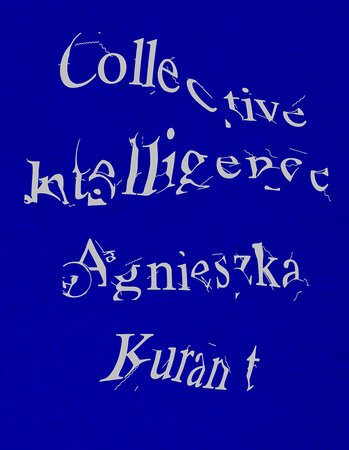
Agnieszka Kurant Collective Intelligence

Conceptual artist Agnieszka Kurant’s work alongside newly commissioned texts by renowned thinkers across science, philosophy, technology, anthropology, and economics.

Collective Intelligence is an innovative monograph that documents the last ten years of Polish-born conceptual artist Agnieszka Kurant’s interdisciplinary practice. It includes newly commissioned texts by renowned thinkers in science, philosophy, art, technology, anthropology, and economics.

Kurant’s experimental work investigates collective and nonhuman intelligences and their impact on transformations of the human, the future of labor and creativity, and the exploitations within digital capitalism. Questioning the ideology of individualism, Kurant proposes that we rethink human and more-than-human worlds from a perspective of plural subjectivity, and, through this fundamental shift in perspective, posits the possibility of alternative political imaginaries. Her work probes the replacement of individual authorship with collective intelligence—a phenomenon observed in slime molds, termite colonies, social movements, cities, the internet, and inside our brains.

In her collaborative practice, the artist investigates artificial intelligence, emergence, cybernetics, automation, artificial life, mining industries, and energy circuits to explore our collective evolution and the shifting status of objects in relation to agency, value, circulation, and redistribution. Through crowdsourcing the production of her artworks to thousands of humans and nonhumans, Kurant creates unstable, hybrid forms that constantly evolve. Her works, oscillating between biological, digital, and geological, embody the crumbling distinctions between what is natural and artificial, real and synthetic, and life and nonlife.

Dispersed throughout the book, the Phenomena section adopts a quasi-encyclopedic format to highlight and expand on Kurant’s research on collective intelligence.

Contributors
Monika Bakke, Philip Ball, Shumon Basar, Franco “Bifo” Berardi, Nicolas Bourriaud, Rosi Braidotti, Carolyn Christov-Bakargiev, Kate Crawford, Diedrich Diederichsen, Graham Harman, Stefan Helmreich, Caroline A. Jones, Nora Khan, Esther Leslie, Jussi Parikka, Matteo Pasquinelli, Tobias Rees, Jessica Riskin Elvia Wilk

Copublished with Berggruen Institute, Ed and Dillon Cohen, and the Blessing Way Foundation

Chapter 1: Errorism
  • Interview with Agnieszka Kurant by Stefanie Hessler and Jenny Jaskey Carolyn Christov-Bakargiev, Agnieszka Kurant’s Procreant Urge of the World
Chapter 2: Emergence or Uncomputables
  • Stefan Helmreich, MNPQRSTV
  • Philip Ball Emergence and Collective Intelligence
  • Jessica Riskin, Frolicsome Engines: From Prehistory of Artificial Intelligence to Emergence
Chapter 3: Phantom Capital
  • Elvia Wilk, Dark Speech: On Secrecy, Language, and Alchemical Conversion
  • Diedrich Diederichsen, Value, Profit and Sense(s)
  • Kate Crawford: Fauxtomation: On Labor And Collective Intelligence
Chapter 4: Machine and Organism
  • Caroline A. Jones, Swarming Symbionts: Thinking with/in Living Collectives
  • Matteo Pasquinelli, The Self-Organization of the Social Mind
  • Jussi Parikka, Zoepolitics and AI
Chapter 5: Nonorganic Life
  • Nicolas Bourriaud, Molecular Anthropology
  • Esther Leslie, Liquid Crystal Misbehaviors
  • Monika Bakke, Lapidary Inclusions of Possible Futures
Chapter 6: Intelligences
  • Nora N. Khan, Narrating the World
  • Tobias Rees, after the human. after HNT. Agnieszka Kurant’s philosophical investigations Graham Harman, Monumental Intelligence
Chapter 7: Social Brain Plasticity
  • Shumon Basar, WE [2.0]
  • Franco “Bifo” Berardi, Postscript on the Neuroplastic Dilemma
  • Rosi Braidotti, “We” Are in This Together, but We Are Not One and the Same

About

Conceptual artist Agnieszka Kurant’s work alongside newly commissioned texts by renowned thinkers across science, philosophy, technology, anthropology, and economics.

Collective Intelligence is an innovative monograph that documents the last ten years of Polish-born conceptual artist Agnieszka Kurant’s interdisciplinary practice. It includes newly commissioned texts by renowned thinkers in science, philosophy, art, technology, anthropology, and economics.

Kurant’s experimental work investigates collective and nonhuman intelligences and their impact on transformations of the human, the future of labor and creativity, and the exploitations within digital capitalism. Questioning the ideology of individualism, Kurant proposes that we rethink human and more-than-human worlds from a perspective of plural subjectivity, and, through this fundamental shift in perspective, posits the possibility of alternative political imaginaries. Her work probes the replacement of individual authorship with collective intelligence—a phenomenon observed in slime molds, termite colonies, social movements, cities, the internet, and inside our brains.

In her collaborative practice, the artist investigates artificial intelligence, emergence, cybernetics, automation, artificial life, mining industries, and energy circuits to explore our collective evolution and the shifting status of objects in relation to agency, value, circulation, and redistribution. Through crowdsourcing the production of her artworks to thousands of humans and nonhumans, Kurant creates unstable, hybrid forms that constantly evolve. Her works, oscillating between biological, digital, and geological, embody the crumbling distinctions between what is natural and artificial, real and synthetic, and life and nonlife.

Dispersed throughout the book, the Phenomena section adopts a quasi-encyclopedic format to highlight and expand on Kurant’s research on collective intelligence.

Contributors
Monika Bakke, Philip Ball, Shumon Basar, Franco “Bifo” Berardi, Nicolas Bourriaud, Rosi Braidotti, Carolyn Christov-Bakargiev, Kate Crawford, Diedrich Diederichsen, Graham Harman, Stefan Helmreich, Caroline A. Jones, Nora Khan, Esther Leslie, Jussi Parikka, Matteo Pasquinelli, Tobias Rees, Jessica Riskin Elvia Wilk

Copublished with Berggruen Institute, Ed and Dillon Cohen, and the Blessing Way Foundation

Table of Contents

Chapter 1: Errorism
  • Interview with Agnieszka Kurant by Stefanie Hessler and Jenny Jaskey Carolyn Christov-Bakargiev, Agnieszka Kurant’s Procreant Urge of the World
Chapter 2: Emergence or Uncomputables
  • Stefan Helmreich, MNPQRSTV
  • Philip Ball Emergence and Collective Intelligence
  • Jessica Riskin, Frolicsome Engines: From Prehistory of Artificial Intelligence to Emergence
Chapter 3: Phantom Capital
  • Elvia Wilk, Dark Speech: On Secrecy, Language, and Alchemical Conversion
  • Diedrich Diederichsen, Value, Profit and Sense(s)
  • Kate Crawford: Fauxtomation: On Labor And Collective Intelligence
Chapter 4: Machine and Organism
  • Caroline A. Jones, Swarming Symbionts: Thinking with/in Living Collectives
  • Matteo Pasquinelli, The Self-Organization of the Social Mind
  • Jussi Parikka, Zoepolitics and AI
Chapter 5: Nonorganic Life
  • Nicolas Bourriaud, Molecular Anthropology
  • Esther Leslie, Liquid Crystal Misbehaviors
  • Monika Bakke, Lapidary Inclusions of Possible Futures
Chapter 6: Intelligences
  • Nora N. Khan, Narrating the World
  • Tobias Rees, after the human. after HNT. Agnieszka Kurant’s philosophical investigations Graham Harman, Monumental Intelligence
Chapter 7: Social Brain Plasticity
  • Shumon Basar, WE [2.0]
  • Franco “Bifo” Berardi, Postscript on the Neuroplastic Dilemma
  • Rosi Braidotti, “We” Are in This Together, but We Are Not One and the Same
  • More Websites from
    Penguin Random House
  • Common Reads
  • Library Marketing