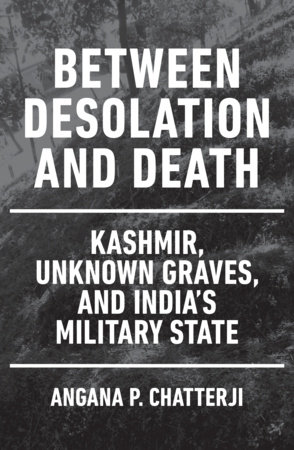
A definitive chronicle of massified death and desolation in Kashmir, one of the world’s most militarized conflict zones.
Pioneering investigations led by Angana Chatterji, Parvez Imroz and Khurram Parvez across India-administered Kashmir during 2007 and 2011 revealed thousands of unknown graves. The findings linked bodies found in the graves with enforced disappearances and extrajudicial executions. It prompted acknowledgment by state institutions, even as the intensity of targeting halted the inquiry.
The landscape of death outlines the relations between occupier and subjugated. The graves are living monuments, pervasive, like the walls of an internment camp for the prisoner within. Alongside, people live in terror, as gravediggers and civilians search for justice. Tracing the archaeology of desolation and death following 1989 and its performative relation to the post-2019 settlerism of the Narendra Modi government and Hindu nationalists, this singular memoir of Kashmir’s present records suppressed knowledge that is exhumed and must be held to account.
Angana P. Chatterji is Founding Chair, Political Conflict, Gender and People’s Rights Initiative, Center for Race and Gender, University of California, Berkeley. An anthropologist and feminist historian of the present, she is also a Research Fellow at the Center for Human Rights and International Justice, Stanford University. Variously acclaimed for her work, Chatterji’s investigations with colleagues into Kashmir’s unknown mass graves exposed their existence. Works include Majoritarian State: How Hindu Nationalism is Changing India; Kashmir: The Case for Freedom; Conflicted Democracies and Gendered Violence; Contesting Nation: Gendered Violence in South Asia; and Violent Gods: Hindu Nationalism in India’s Present.
A definitive chronicle of massified death and desolation in Kashmir, one of the world’s most militarized conflict zones.
Pioneering investigations led by Angana Chatterji, Parvez Imroz and Khurram Parvez across India-administered Kashmir during 2007 and 2011 revealed thousands of unknown graves. The findings linked bodies found in the graves with enforced disappearances and extrajudicial executions. It prompted acknowledgment by state institutions, even as the intensity of targeting halted the inquiry.
The landscape of death outlines the relations between occupier and subjugated. The graves are living monuments, pervasive, like the walls of an internment camp for the prisoner within. Alongside, people live in terror, as gravediggers and civilians search for justice. Tracing the archaeology of desolation and death following 1989 and its performative relation to the post-2019 settlerism of the Narendra Modi government and Hindu nationalists, this singular memoir of Kashmir’s present records suppressed knowledge that is exhumed and must be held to account.
Author
Angana P. Chatterji is Founding Chair, Political Conflict, Gender and People’s Rights Initiative, Center for Race and Gender, University of California, Berkeley. An anthropologist and feminist historian of the present, she is also a Research Fellow at the Center for Human Rights and International Justice, Stanford University. Variously acclaimed for her work, Chatterji’s investigations with colleagues into Kashmir’s unknown mass graves exposed their existence. Works include Majoritarian State: How Hindu Nationalism is Changing India; Kashmir: The Case for Freedom; Conflicted Democracies and Gendered Violence; Contesting Nation: Gendered Violence in South Asia; and Violent Gods: Hindu Nationalism in India’s Present.