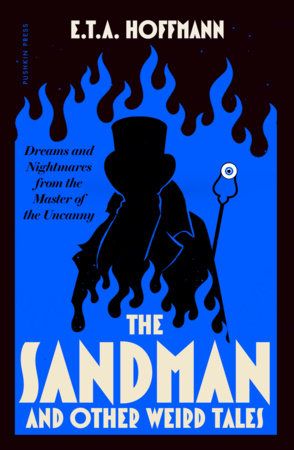
The Sandman

And Other Weird Tales

Paperback
$16.95 US
| $22.95 CAN
On sale Sep 01, 2026 | 208 Pages | 9781805680666

See Additional Formats
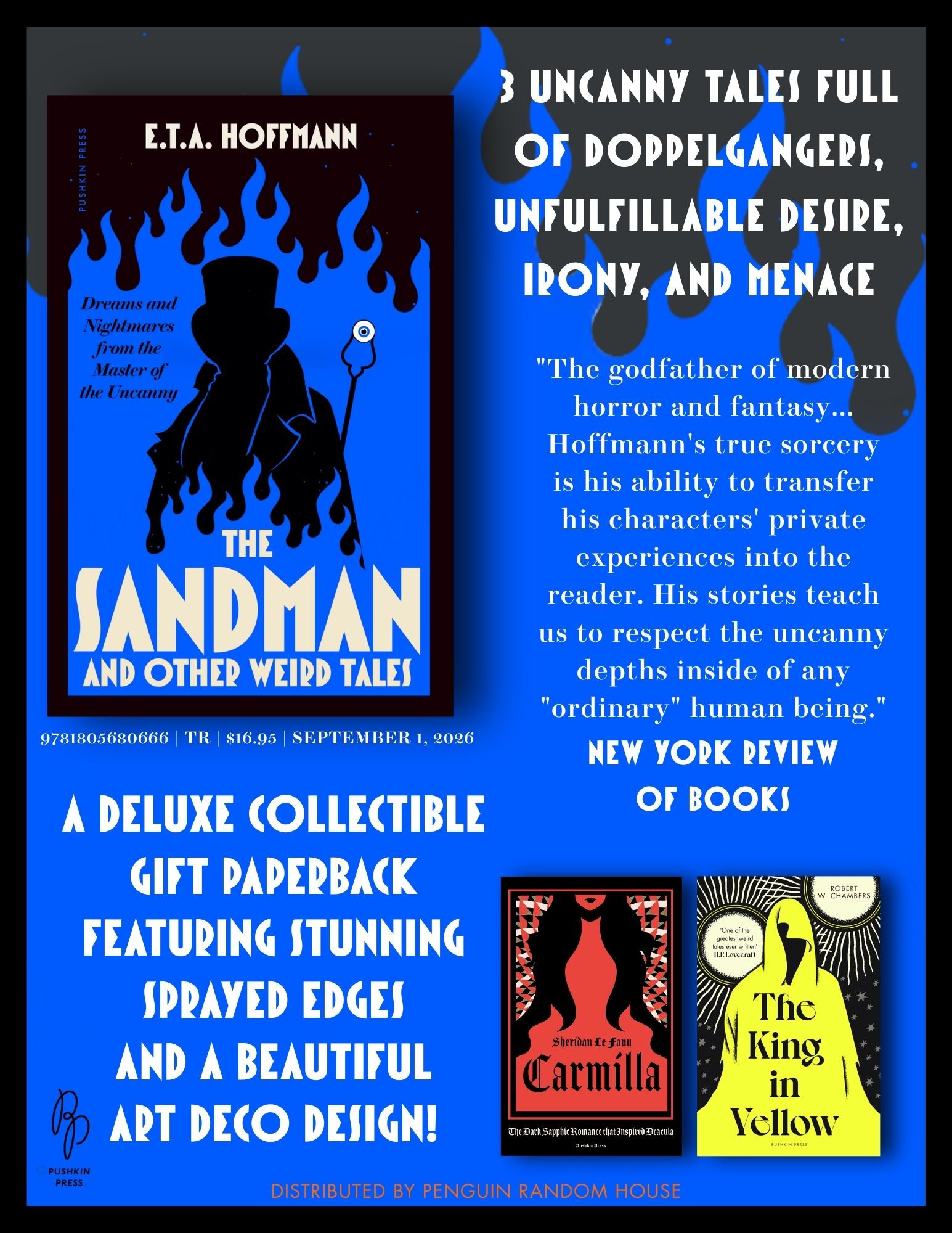
3 uncanny tales from “the godfather of modern horror and fantasy” (New York Review of Books) full of doppelgangers, unfulfillable desire, irony, and menace.

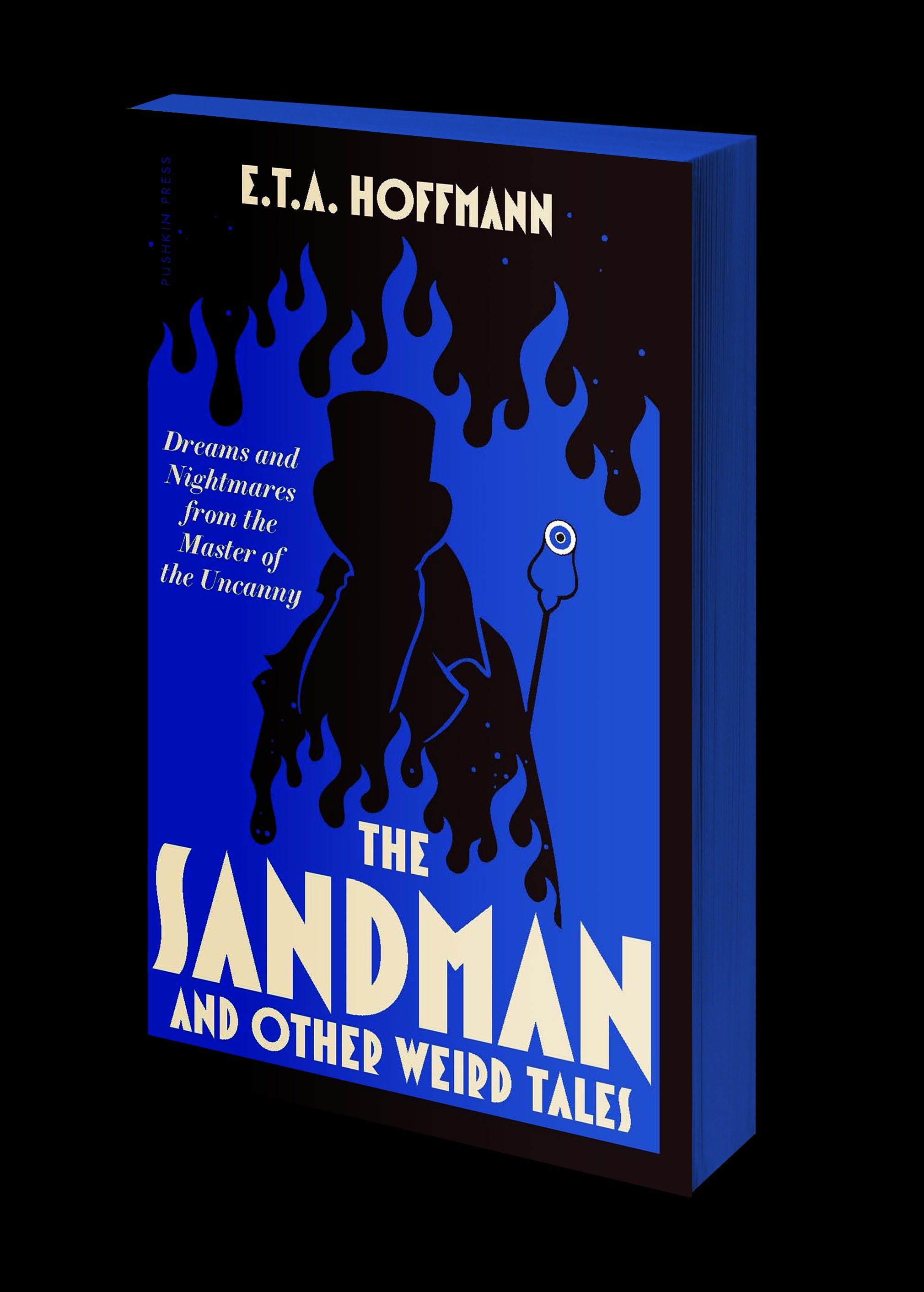
A deluxe collectible gift paperback featuring stunning sprayed edges and a beautiful art deco design!


Still celebrated as the foundational texts of modern fantasy and horror, these 3 unsettling tales of nightmares, madness, and otherworldly power represent renowned German author E.T.A. Hoffmann at his very best.

In “The Sandman”, young Nathanael grows up terrified of a legendary figure who will steal his eyes if he's caught out of bed at night - but it's only when Nathanael has grown to adulthood, seemingly settled and happy, that the full, terrifying truth unfolds. A living doll, a series of doppelgangers, and the seeds of madness combine in this classic story of self-destruction.

This obsession returns in “The Cremona Violin,” where suppressed passion and possessive control prove a fatal mix as an overbearing father grapples with his musically talented daughter who could die of heart failure if she unleashes the full power of her extraordinary voice.

The collection concludes with Hoffman’s arguable masterpiece, “The Golden Pot,” a novella-length tale, disturbing, exciting, and dream-like that introduces the bumbling Anselmus, whose romantic tribulations are complicated by a witch's curse and the fact that he's in love with a girl who also happens to be a snake.

Inspiring countless unearthly classics, from The Nutcracker to the works of Poe and Kafka, Hoffmann's doppelgangers, unattainable love objects, and sinister puppet masters have lived on, becoming key figures in the modern imagination.
On ascension-day, about three o’clock in the afternoon, there came a young man running through the Schwarzthor, or Black Gate, out of Dresden, and right into a basket of apples and cakes, which an old and very ugly woman was there exposing to sale. The crash was prodi-gious; all that escaped being squelched to pieces was scattered away, and the street-urchins joyfully divided the booty which this quick gentleman had thrown them. At the murder-shriek which the crone set up, her gossips, leaving their cake and brandy tables, encircled the young man, and with plebeian vio-lence stormfully scolded him: so that, for shame and vexation, he uttered no word, but merely held out his small, and by no means particularly well-filled purse, which the crone eagerly clutched, and stuck into her pocket. The firm ring now opened; but as the young man started off, the crone called after him: “Ay, run, run thy ways, thou Devil’s bird! To the Crystal run! to the Crystal!” The squealing, creaking voice of the woman had something unearthly in it: so that the promenaders paused in amazement, and the laugh, which at first had been universal, instantly died away. The Student Anselmus, for the young man was no other, felt himself, though he did not in the least understand these singular phrases, nevertheless seized with a certain involuntary horror; and he quickened his steps still more, to escape the curious looks of the multitude, which were all turned towards him. As he worked his way through the crowd of well-dressed people, he heard them murmuring on all sides: “Poor young fellow! Ha! what a cursed beldam it is!” The mysterious words of the crone had oddly enough given this ludicrous adventure a sort of tragic turn; and the youth, before unobserved, was now looked after with a certain sym-pathy. The ladies, for his fine shape and handsome face, which the glow of inward anger was rendering still more expressive, forgave him this awkward step, as well as the dress he wore, though it was utterly at variance with all mode. His pike-grey frock was shaped as if the tailor had known the modern form only by hearsay; and his well-kept black satin lower habiliments gave the whole a certain pedagogic air, to which the gait and gesture of the wearer did not at all correspond.

The Student had almost reached the end of the alley which leads out to the Linke Bath; but his breath could stand such a rate no longer. From running, he took to walking; but scarcely did he yet dare to lift an eye from the ground; for he still saw apples and cakes dancing round him; and every kind look from this or that fair damsel was to him but the reflex of the mocking laughter at the Schwarzthor. In this mood, he had got to the entrance of the Bath: one group of holiday people after the other were moving in. Music of wind-instruments resounded from the place, and the din of merry guests was growing louder and louder. The poor Student Anselmus was almost on the point of weeping; for he too had expected, Ascension-day having always been a family-festival with him, to participate in the felicities of the Linkean paradise; nay, he had purposed even to go the length of a half portion of coffee with rum, and a whole bottle of double beer; and that he might carouse at his ease, had put more money in his purse than was entirely convenient or advisable. And now, by this fatal step into the apple-basket, all that he had about him had been swept away. Of coffee, of double or single beer, of music, of looking at the bright damsels; in a word, of all his fancied enjoyments, there was now nothing more to be said. He glided slowly past; and at last turned down the Elbe road, which at that time happened to be quite solitary.

Beneath an elder-tree, which had grown out through the wall, he found a kind green resting-place: here he sat down, and filled a pipe from the Sanitätsknaster, or Health-tobacco-box, of which his friend the Conrector Paulmann had lately made him a present. Close before him, rolled and chafed the gold-dyed waves of the fair Elbe-stream: behind this rose lordly Dresden, stretching, bold and proud, its light towers into the airy sky; which again, farther off, bent itself down towards flowery meads and fresh springing woods; and in the dim distance, a range of azure peaks gave notice of remote Bohemia. But, heedless of this, the Student Anselmus, looking gloomily before him, blew forth his smoky clouds into the air. His chagrin at length became audible, and he said: “Of a truth, I am born to losses and crosses for my life long! That in boyhood, at Odds or Evens, I could never once guess the right way; that my bread and butter always fell on the buttered side; of all these sorrows I will not speak: but is it not a frightful destiny, that now, when, in spite of Satan, I have become a student, I must still be a jolthead as before? Do I ever put a new coat on, without the first day smearing it with tallow, or on some ill-fastened nail or other, tearing a cursed hole in it? Do I ever bow to any Councillor or any lady, without pitching the hat out of my hands, or even sliding away on the smooth pavement, and shamefully oversetting? Had I not, every market-day, while in Halle, a regular sum of from three to four groschen to pay for broken pottery, the Devil putting it into my head to walk straight forward, like a leming-rat? Have I ever once got to my college, or any place I was appointed to, at the right time? What availed it that I set out half an hour before, and planted myself at the door, with the knocker in my hand? Just as the clock is going to strike, souse! some Devil pours a wash-basin down on me, or I bolt against some fellow coming out, and get myself engaged in endless quarrels till the time is clean gone.

“Ah! well-a-day! whither are ye fled, ye blissful dreams of coming fortune, when I proudly thought that here I might even reach the height of Privy Secretary? And has not my evil star estranged from me my best patrons? I learn, for instance, that the Councillor, to whom I have a letter, cannot suffer cropt hair; with immensity of trouble, the barber fastens me a little cue to my hindhead; but at the first bow, his unblessed knot gives way, and a little shock, running snuffing about me, frisks off to the Privy Councillor with the cue in its mouth. I spring after it in terror; and stumble against the table, where he has been working while at breakfast; and cups, plates, ink-glass, sand-box, rush jingling to the floor, and a flood of chocolate and ink overflows the Relation he has just been writing. ‘Is the Devil in the man?’ bellows the furious Privy Councillor, and shoves me out of the room.

“What avails it that Conrector Paulmann gave me hopes of a writership: will my malignant fate allow it, which everywhere pursues me? Today even! Do but think of it! I was purposing to hold my good old Ascension-day with right cheerfulness of soul: I would stretch a point for once; I might have gone, as well as any other guest, into Linke’s Bath, and called out proudly: ‘Marqueur! a bottle of double-beer; best sort, if you please!’ I might have sat till far in the evening; and, moreover, close by this or that fine party of well-dressed ladies. I know it, I feel it! heart would have come into me, I should have been quite another man; nay, I might have carried it so far, that when one or other of them asked: ‘ What o’clock may it be?’ or ‘What is it they are playing?’ I should have started up with light grace, and without overturning my glass, or stumbling over the bench, but in a curved posture, moving one step and a half forward, I should have answered: ‘Give me leave, mademoiselle! it is the overture of the Donanweibchen’; or, ‘It is just going to strike six.’ Could any mortal in the world have taken it ill of me? No! I say; the girls would have looked over, smiling so roguishly; as they always do when I pluck up heart to show them that I too understand the light tone of society, and know how ladies should be spoken to. And now the Devil himself leads me into that cursed apple-basket, and now must I sit moping in solitude, with nothing but a poor pipe of——” Here the Student Anselmus was interrupted in his soliloquy by a strange rustling and whisking, which rose close by him in the grass, but soon glided up into the twigs and leaves of the elder-tree that stretched out over his head. It was as if the evening wind were shaking the leaves; as if little birds were twittering among the branches, moving their little wings in capricious flutter to and fro. Then he heard a whispering and lisping; and it seemed as if the blossoms were sounding like little crystal bells. Anselmus listened and listened. Ere long, the whispering, and lisping, and tinkling, he himself knew not how, grew to faint and half-scattered words:

“’Twixt this way, ’twixt that; ’twixt branches, ’twixt blos-soms, come shoot, come twist and twirl we! Sisterkin, sisterkin! up to the shine; up, down, through and through, quick! Sun-rays yellow; evening-wind whispering; dew-drops pattering; blossoms all singing: sing we with branches and blossoms! Stars soon glitter; must down: ’twixt this way, ’twixt that, come shoot, come twist, come twirl we, sisterkin!”

And so it went along, in confused and confusing speech. The Student Anselmus thought: “Well, it is but the evening-wind, which to-night truly is whispering distinctly enough.” But at that moment there sounded over his head, as it were, a triple harmony of clear crystal bells: he looked up, and perceived three little Snakes, glittering with green and gold, twisted round the branches, and stretching out their heads to the evening sun. Then, again, began a whispering and twittering in the same words as before, and the little Snakes went gliding and caressing up and down through the twigs; and while they moved so rapidly, it was as if the elder-bush were scattering a thousand glittering emeralds through the dark leaves.

“It is the evening sun which sports so in the elder-bush,” thought the Student Anselmus; but the bells sounded again; and Anselmus observed that one Snake held out its little head to him. Through all his limbs there went a shock like electricity; he quivered in his inmost heart: he kept gazing up, and a pair of glorious dark-blue eyes were looking at him with unspeakable longing; and an unknown feeling of highest blessedness and deepest sorrow was like to rend his heart asunder. And as he looked, and still looked, full of warm desire, into these kind eyes, the crystal bells sounded louder in harmonious accord, and the glittering emeralds fell down and encircled him, flickering round him in thousand sparkles, and sporting in resplendent threads of gold. The Elder-bush moved and spoke: “Thou layest in my shadow; my perfume flowed round thee, but thou understood’st it not. The perfume is my speech, when Love kindles it.” The Evening Wind came gliding past, and said: “I played round thy temples, but thou understood’st me not. That breath is my speech, when Love kindles it.” The Sun-beam broke through the clouds, and the sheen of it burnt, as in words:

I overflowed thee with glowing gold, but thou under-stood’st me not: That glow is my speech, when Love kindles it.” And, still deeper and deeper sunk in the view of these glorious eyes, his longing grew keener, his desire more warm. And all rose and moved around him, as if awakening to glad life. Flowers and blossoms shed their odours round him; and their odour was like the lordly singing of a thousand softest voices; and what they sung was borne, like an echo, on the golden evening clouds, as they flitted away, into far-off lands. But as the last sun-beam abruptly sank behind the hills, and the twilight threw its veil over the scene, there came a hoarse deep voice, as from a great distance:

“Hey! hey! what chattering and jingling is that up there? Hey! hey! who catches me the ray behind the hills? Sunned enough,sung enough. Hey! hey! through bush and grass,through grass and stream. Hey! hey! Come dow-w-n, dow-w-w-n!”
Ernst Theodor Amadeus Hoffmann (1776-1822) was one of the major figures of the German Romantic movement. Hoffmann qualified in law and held a series of posts in the Prussian bureaucracy, until his efforts as a writer and composer drew enough praise and acclaim for him to abandon his state career. He died of complications from syphilis and alcohol abuse aged only 46. His works are still celebrated as foundational texts of modern sci-fi, fantasy and horror.

J.T. Bealby (1858 - 1944) was an English author and translator. As well as his translations from German, he wrote with authority on farming practices.

Frederic H. Hedge (1805-1890) was a Unitarian minister from Massachusetts. A close friend of Ralph Waldo Emerson, he was one of the founders of New England’s Transcendentalist movement. He was educated at Harvard’s Divinity School, and later returned to the university to teach German literature.
the golden pot 7

the sand-man 119

the cremona violin 171

About

3 uncanny tales from “the godfather of modern horror and fantasy” (New York Review of Books) full of doppelgangers, unfulfillable desire, irony, and menace.

A deluxe collectible gift paperback featuring stunning sprayed edges and a beautiful art deco design!


Still celebrated as the foundational texts of modern fantasy and horror, these 3 unsettling tales of nightmares, madness, and otherworldly power represent renowned German author E.T.A. Hoffmann at his very best.

In “The Sandman”, young Nathanael grows up terrified of a legendary figure who will steal his eyes if he's caught out of bed at night - but it's only when Nathanael has grown to adulthood, seemingly settled and happy, that the full, terrifying truth unfolds. A living doll, a series of doppelgangers, and the seeds of madness combine in this classic story of self-destruction.

This obsession returns in “The Cremona Violin,” where suppressed passion and possessive control prove a fatal mix as an overbearing father grapples with his musically talented daughter who could die of heart failure if she unleashes the full power of her extraordinary voice.

The collection concludes with Hoffman’s arguable masterpiece, “The Golden Pot,” a novella-length tale, disturbing, exciting, and dream-like that introduces the bumbling Anselmus, whose romantic tribulations are complicated by a witch's curse and the fact that he's in love with a girl who also happens to be a snake.

Inspiring countless unearthly classics, from The Nutcracker to the works of Poe and Kafka, Hoffmann's doppelgangers, unattainable love objects, and sinister puppet masters have lived on, becoming key figures in the modern imagination.

Excerpt

On ascension-day, about three o’clock in the afternoon, there came a young man running through the Schwarzthor, or Black Gate, out of Dresden, and right into a basket of apples and cakes, which an old and very ugly woman was there exposing to sale. The crash was prodi-gious; all that escaped being squelched to pieces was scattered away, and the street-urchins joyfully divided the booty which this quick gentleman had thrown them. At the murder-shriek which the crone set up, her gossips, leaving their cake and brandy tables, encircled the young man, and with plebeian vio-lence stormfully scolded him: so that, for shame and vexation, he uttered no word, but merely held out his small, and by no means particularly well-filled purse, which the crone eagerly clutched, and stuck into her pocket. The firm ring now opened; but as the young man started off, the crone called after him: “Ay, run, run thy ways, thou Devil’s bird! To the Crystal run! to the Crystal!” The squealing, creaking voice of the woman had something unearthly in it: so that the promenaders paused in amazement, and the laugh, which at first had been universal, instantly died away. The Student Anselmus, for the young man was no other, felt himself, though he did not in the least understand these singular phrases, nevertheless seized with a certain involuntary horror; and he quickened his steps still more, to escape the curious looks of the multitude, which were all turned towards him. As he worked his way through the crowd of well-dressed people, he heard them murmuring on all sides: “Poor young fellow! Ha! what a cursed beldam it is!” The mysterious words of the crone had oddly enough given this ludicrous adventure a sort of tragic turn; and the youth, before unobserved, was now looked after with a certain sym-pathy. The ladies, for his fine shape and handsome face, which the glow of inward anger was rendering still more expressive, forgave him this awkward step, as well as the dress he wore, though it was utterly at variance with all mode. His pike-grey frock was shaped as if the tailor had known the modern form only by hearsay; and his well-kept black satin lower habiliments gave the whole a certain pedagogic air, to which the gait and gesture of the wearer did not at all correspond.

The Student had almost reached the end of the alley which leads out to the Linke Bath; but his breath could stand such a rate no longer. From running, he took to walking; but scarcely did he yet dare to lift an eye from the ground; for he still saw apples and cakes dancing round him; and every kind look from this or that fair damsel was to him but the reflex of the mocking laughter at the Schwarzthor. In this mood, he had got to the entrance of the Bath: one group of holiday people after the other were moving in. Music of wind-instruments resounded from the place, and the din of merry guests was growing louder and louder. The poor Student Anselmus was almost on the point of weeping; for he too had expected, Ascension-day having always been a family-festival with him, to participate in the felicities of the Linkean paradise; nay, he had purposed even to go the length of a half portion of coffee with rum, and a whole bottle of double beer; and that he might carouse at his ease, had put more money in his purse than was entirely convenient or advisable. And now, by this fatal step into the apple-basket, all that he had about him had been swept away. Of coffee, of double or single beer, of music, of looking at the bright damsels; in a word, of all his fancied enjoyments, there was now nothing more to be said. He glided slowly past; and at last turned down the Elbe road, which at that time happened to be quite solitary.

Beneath an elder-tree, which had grown out through the wall, he found a kind green resting-place: here he sat down, and filled a pipe from the Sanitätsknaster, or Health-tobacco-box, of which his friend the Conrector Paulmann had lately made him a present. Close before him, rolled and chafed the gold-dyed waves of the fair Elbe-stream: behind this rose lordly Dresden, stretching, bold and proud, its light towers into the airy sky; which again, farther off, bent itself down towards flowery meads and fresh springing woods; and in the dim distance, a range of azure peaks gave notice of remote Bohemia. But, heedless of this, the Student Anselmus, looking gloomily before him, blew forth his smoky clouds into the air. His chagrin at length became audible, and he said: “Of a truth, I am born to losses and crosses for my life long! That in boyhood, at Odds or Evens, I could never once guess the right way; that my bread and butter always fell on the buttered side; of all these sorrows I will not speak: but is it not a frightful destiny, that now, when, in spite of Satan, I have become a student, I must still be a jolthead as before? Do I ever put a new coat on, without the first day smearing it with tallow, or on some ill-fastened nail or other, tearing a cursed hole in it? Do I ever bow to any Councillor or any lady, without pitching the hat out of my hands, or even sliding away on the smooth pavement, and shamefully oversetting? Had I not, every market-day, while in Halle, a regular sum of from three to four groschen to pay for broken pottery, the Devil putting it into my head to walk straight forward, like a leming-rat? Have I ever once got to my college, or any place I was appointed to, at the right time? What availed it that I set out half an hour before, and planted myself at the door, with the knocker in my hand? Just as the clock is going to strike, souse! some Devil pours a wash-basin down on me, or I bolt against some fellow coming out, and get myself engaged in endless quarrels till the time is clean gone.

“Ah! well-a-day! whither are ye fled, ye blissful dreams of coming fortune, when I proudly thought that here I might even reach the height of Privy Secretary? And has not my evil star estranged from me my best patrons? I learn, for instance, that the Councillor, to whom I have a letter, cannot suffer cropt hair; with immensity of trouble, the barber fastens me a little cue to my hindhead; but at the first bow, his unblessed knot gives way, and a little shock, running snuffing about me, frisks off to the Privy Councillor with the cue in its mouth. I spring after it in terror; and stumble against the table, where he has been working while at breakfast; and cups, plates, ink-glass, sand-box, rush jingling to the floor, and a flood of chocolate and ink overflows the Relation he has just been writing. ‘Is the Devil in the man?’ bellows the furious Privy Councillor, and shoves me out of the room.

“What avails it that Conrector Paulmann gave me hopes of a writership: will my malignant fate allow it, which everywhere pursues me? Today even! Do but think of it! I was purposing to hold my good old Ascension-day with right cheerfulness of soul: I would stretch a point for once; I might have gone, as well as any other guest, into Linke’s Bath, and called out proudly: ‘Marqueur! a bottle of double-beer; best sort, if you please!’ I might have sat till far in the evening; and, moreover, close by this or that fine party of well-dressed ladies. I know it, I feel it! heart would have come into me, I should have been quite another man; nay, I might have carried it so far, that when one or other of them asked: ‘ What o’clock may it be?’ or ‘What is it they are playing?’ I should have started up with light grace, and without overturning my glass, or stumbling over the bench, but in a curved posture, moving one step and a half forward, I should have answered: ‘Give me leave, mademoiselle! it is the overture of the Donanweibchen’; or, ‘It is just going to strike six.’ Could any mortal in the world have taken it ill of me? No! I say; the girls would have looked over, smiling so roguishly; as they always do when I pluck up heart to show them that I too understand the light tone of society, and know how ladies should be spoken to. And now the Devil himself leads me into that cursed apple-basket, and now must I sit moping in solitude, with nothing but a poor pipe of——” Here the Student Anselmus was interrupted in his soliloquy by a strange rustling and whisking, which rose close by him in the grass, but soon glided up into the twigs and leaves of the elder-tree that stretched out over his head. It was as if the evening wind were shaking the leaves; as if little birds were twittering among the branches, moving their little wings in capricious flutter to and fro. Then he heard a whispering and lisping; and it seemed as if the blossoms were sounding like little crystal bells. Anselmus listened and listened. Ere long, the whispering, and lisping, and tinkling, he himself knew not how, grew to faint and half-scattered words:

“’Twixt this way, ’twixt that; ’twixt branches, ’twixt blos-soms, come shoot, come twist and twirl we! Sisterkin, sisterkin! up to the shine; up, down, through and through, quick! Sun-rays yellow; evening-wind whispering; dew-drops pattering; blossoms all singing: sing we with branches and blossoms! Stars soon glitter; must down: ’twixt this way, ’twixt that, come shoot, come twist, come twirl we, sisterkin!”

And so it went along, in confused and confusing speech. The Student Anselmus thought: “Well, it is but the evening-wind, which to-night truly is whispering distinctly enough.” But at that moment there sounded over his head, as it were, a triple harmony of clear crystal bells: he looked up, and perceived three little Snakes, glittering with green and gold, twisted round the branches, and stretching out their heads to the evening sun. Then, again, began a whispering and twittering in the same words as before, and the little Snakes went gliding and caressing up and down through the twigs; and while they moved so rapidly, it was as if the elder-bush were scattering a thousand glittering emeralds through the dark leaves.

“It is the evening sun which sports so in the elder-bush,” thought the Student Anselmus; but the bells sounded again; and Anselmus observed that one Snake held out its little head to him. Through all his limbs there went a shock like electricity; he quivered in his inmost heart: he kept gazing up, and a pair of glorious dark-blue eyes were looking at him with unspeakable longing; and an unknown feeling of highest blessedness and deepest sorrow was like to rend his heart asunder. And as he looked, and still looked, full of warm desire, into these kind eyes, the crystal bells sounded louder in harmonious accord, and the glittering emeralds fell down and encircled him, flickering round him in thousand sparkles, and sporting in resplendent threads of gold. The Elder-bush moved and spoke: “Thou layest in my shadow; my perfume flowed round thee, but thou understood’st it not. The perfume is my speech, when Love kindles it.” The Evening Wind came gliding past, and said: “I played round thy temples, but thou understood’st me not. That breath is my speech, when Love kindles it.” The Sun-beam broke through the clouds, and the sheen of it burnt, as in words:

I overflowed thee with glowing gold, but thou under-stood’st me not: That glow is my speech, when Love kindles it.” And, still deeper and deeper sunk in the view of these glorious eyes, his longing grew keener, his desire more warm. And all rose and moved around him, as if awakening to glad life. Flowers and blossoms shed their odours round him; and their odour was like the lordly singing of a thousand softest voices; and what they sung was borne, like an echo, on the golden evening clouds, as they flitted away, into far-off lands. But as the last sun-beam abruptly sank behind the hills, and the twilight threw its veil over the scene, there came a hoarse deep voice, as from a great distance:

“Hey! hey! what chattering and jingling is that up there? Hey! hey! who catches me the ray behind the hills? Sunned enough,sung enough. Hey! hey! through bush and grass,through grass and stream. Hey! hey! Come dow-w-n, dow-w-w-n!”

Author

Ernst Theodor Amadeus Hoffmann (1776-1822) was one of the major figures of the German Romantic movement. Hoffmann qualified in law and held a series of posts in the Prussian bureaucracy, until his efforts as a writer and composer drew enough praise and acclaim for him to abandon his state career. He died of complications from syphilis and alcohol abuse aged only 46. His works are still celebrated as foundational texts of modern sci-fi, fantasy and horror.

J.T. Bealby (1858 - 1944) was an English author and translator. As well as his translations from German, he wrote with authority on farming practices.

Frederic H. Hedge (1805-1890) was a Unitarian minister from Massachusetts. A close friend of Ralph Waldo Emerson, he was one of the founders of New England’s Transcendentalist movement. He was educated at Harvard’s Divinity School, and later returned to the university to teach German literature.

Table of Contents

the golden pot 7

the sand-man 119

the cremona violin 171
  • More Websites from
    Penguin Random House
  • Common Reads
  • Library Marketing