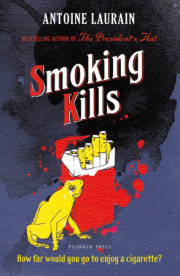
Smoking Kills

Paperback
$17.95 US
| $23.95 CAN
On sale May 05, 2026 | 240 Pages | 9781805333630

See Additional Formats
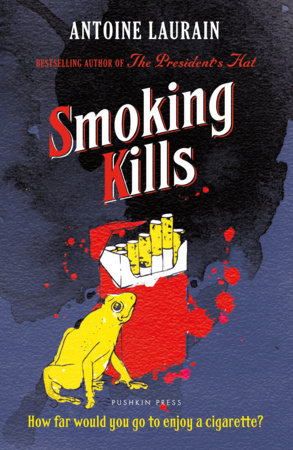
In this cozy crime novel with a witty, Parisian black-comedy twist, anti-hero Fabrice can only make smoking pleasurable by committing the ultimate crime

“Hilarious, formidable―and essential packing for any French Summer holiday”  — The Daily Mail

“A brisk black comedy . . . makes cigarettes seem seductive again, even to committed non-smokers”  — The Guardian


How far would you go to enjoy a cigarette?

When headhunter Fabrice Valantine faces a smoking ban at work, he decides to undertake a course of hypnotherapy to rid himself of the habit. At first the treatment works, but his stress levels begin to rise when he is passed over for an important promotion and he finds himself lighting up again—but with none of his previous enjoyment. 

Then he discovers something terrible: he accidentally causes a man’s death, and, needing a cigarette to calm his nerves, he enjoys it more than any other previous smoke. What if he now needs to kill someone every time he wants to properly appreciate his next Benson and Hedges? 

Unwilling to return to the numbness of a life without pleasurable smoking, Fabrice launches into a life of crime, finding ever more original murder methods—including the use of a poisonous Ecuadorean frog. 

A blackly comic story of addiction and transgression, this is also an exploration of the human need for fulfillment, and the lengths we will go to in order to find it. In the end the book provokes us to question the limits we place on ourselves, and the true definition of joy.
If I were to look back over my life – at the risk of experiencing a degree of vertigo – I should say that prior to the events that turned it upside down, I was an unremarkable man, bordering on the extremely ordinary. I had a wife, a daughter, a profession in which I was known and appreciated, and a criminal record as white and clean as a sheet of Canson paper bought from an art supplies store. Subsequently, an attempt was made to unseat me at work, my wife left me, and I had four murders to my name. An unusual trajectory which, if I had to sum it up in a simple, universally accessible phrase, I would say was ‘all down to the cigarettes.’

It was in 2007 that the heinous law took effect. The law that drove smokers to colonise any available outdoor space within their office complexes, “authorised areas” that didn’t remain authorised for long. The maintenance teams or cleaning operatives soon made it known that the sudden increase in their workload, occasioned by the proliferation of cigarette butts, would quickly become unmanageable without an equally consequent re- evaluation of the fruits of their labour. Businesses ignored their demands, and smokers were thrown out on to the street.

“These heinous laws will have everyone doing it in the road.” I suggested the shock phrase to my lawyer, with a subtle nod to Marthe Richard’s law of April 1946 that ordered – with not a trace of irony – the shutting down of the maisons closes: luxurious, legal brothels across France, where champagne and other delights had been liberally dispensed for decades. Proprietors and Madams suffered the torments of nervous depression, previously known only to bourgeois ladies of leisure and their over-worked husbands. As for the girls, they found themselves out on the street. Self- employed, until they fell into the clutches of merciless, often violent, pimps.

Our sweetest vices – stockings and suspenders, champagne, curls of smoke, cigars, blondes in bustiers (or packs of twenty) – have ended up out on the street with the refuse, and the State as sanitizer-in-chief. The dreams of our elected representatives are the nightmares of science fiction: a world where no one smokes and no one drinks, where the men are all thrusting executives with dazzling teeth and careers to match, and the women are all smiling, professionally fulfilled mothers of two- point-five children. Sanctimonious laws for the good of one and all are the building blocks, brick by brick, of a sad, uniform world that reeks of bleach.

My lawyer was unconvinced by my reasoning, and still less so by its application to my case. Obviously, he would cite my nicotine dependency, but “without making too much of that side of things”, as he put it. I wasn’t standing before him for having smoked in a public place – it was ‘a little more serious than that, Monsieur Valantine.’

There are various ways to embark on a criminal career. The first is to discover a compelling vocation of sorts. Serial killers are an excellent, precocious example: from an early age they feel different, and experience strong animosity to the world around them, coupled with a highly questionable determination to shape it to their own ends. Psychopathic, schizophrenic, paranoiac: medical terminology abounds for those who choose to dispatch their neighbour, often with elaborately staged savagery. And yet, by reproducing the same scenario from one crime to the next, they are quickly identified and generally end up behind bars, where they keep their psychiatrists happily occupied and, more recently, secure fortunes for their chroniclers in fiction.

Above all, it’s important to distinguish the murderer – an occasional killer – from the assassin, who has made murder his profession. The murderer may be the unhappy, cheated husband who, discovering his misfortune, seizes his hunting rifle or his lobster-knife: if his career ends there, he will retain the title of ‘murderer’. But the assassin carries it forward, from crime to crime. The number of lives forfeited, and the resulting criminal record, are central to this choice of terminology. A murderer may be a bank robber who finds himself cornered by the forces of law and order, uses his weapon and kills two or three police officers. He is a dangerous animal, but blood was never his primary motive, only money. That said, the attempt to secure bags of someone else’s cash regularly leads to violent misunderstandings with bank cashiers the world over.

Where among these examples would I situate myself? I’m a little of each at once. From the initial forced mishap, to a profound degree of premeditation.

At the beginning of his career, the smoker is generally intent on killing no one but himself. But forces beyond my control drove me to become a killer of others. And not through passive smoking. When it came to murder, I played an active role. A very active role.

The mechanism that drove me to break first the eleventh commandment – Thou Shalt Not Smoke – and after that, the sixth, Thou Shalt Not Kill, was set in motion one winter, that grey-white season, the colour of ashes and smoke, in my fiftieth year.

As a hardened, confirmed smoker, two packs of blondes a day, who had exercised the regal prerogative of smoking in my office for fifteen years and more, the first blow came with the proclamation of the law that banned smoking on business premises, other than in areas specially designated for the purpose. Initially, at HBC Consulting – Europe’s biggest firm of head- hunters – we chose to ignore the ruling. The department heads were untouchable: no one would dare ask Véronique Beauffancourt, Jean Gold or myself to extinguish what was, for each of us, an extension of our anatomy. We were smokers of power. Nothing could bring us down. But dare they did.

The French Revolution must have had its roots in some rustic inn, one afternoon, where a man with a bigger mouth than everyone else slammed his tankard of wine down on the table and hollered ‘Death to the King!’, to the applause of the small assembled company. The man’s name, the names of the men who cheered him on, and the inn where the scene took place are forgotten now.

Precisely the same thing happened in business premises across France, in the early years of the new millennium. At HBC Consulting, the rebellion was sparked in the canteen, whose gruff team-mates found their Saint-Just in the person of a highly attractive young blonde who fuelled many a conversation during the month she worked for us. This long-legged creature, as open and inviting as the prison doors I would come to know, loathed cigarette smoke with a vengeance. Her beauty was matched only by her intolerance to our poison of choice. And yet my male colleagues, who were in the habit of lunching in the nearby cafés, had all made a hasty return to the canteen. With its sub-standard food and pointless view over the rooftops of Paris, overheated in summer and freezing in winter, the HBC canteen had suddenly acquired the allure of a changing-room backstage at a Fashion Week runway show. None of the men paid the least attention to their food – indeed, many ate nothing at all – but all were mesmerised by the new arrival’s figure.

‘She’s temping. She’s a model really,’ breathed the frightful Jean Verider – Search Director for Marketing – at lunch one day.

‘Did you ask her?’ I said.

Nose down in his grated carrot salad, he flushed a deep red. ‘No, Françoise in Human Resources told me.’

The girl’s beauty was plain to see; and her loathing of us all, with our grey suits and grey hair, was plain to see, too. Her loathing of us, and her distaste for the canteen job she was forced to take while waiting for glory on the covers of the glossy magazines, constituted – I’m quite certain – the ingredients for the Molotov cocktail that shook our bastion of privilege.

Our exterminating angel managed to convince the refectory harpies that they were entirely within their rights to insist on the smoking ban at their place of work. One lunchtime, as we were all arriving to eat, Véronique Beauffancourt asked for an ashtray and was refused. The large woman dishing out the cooked vegetables and sliced meat pointed to a small sticker she had doubtless affixed to the wall with her fat, pudgy-fingered hands, experiencing the same heady excitement and anticipation she had known on her wedding night, and at no time since. A cigarette inside a red circle, the latter scored through with an oblique line of the same colour. Véronique, suffering the pressures of a late divorce, declared it was a scandal, and was immediately joined by Jean Gold with his collector’s Dunhill pipe (‘Impression Caviar’). It so happened that Gold had set his sights on Véronique. For him, the incident was timely indeed. The events that ensued led to their joyful union, and they still write even now, always with the same (to me) slightly irritating opening address: ‘Poor, dear Fabrice [comma]…’

I remember asking, that lunchtime, if this was some sort of joke. And the fat lady replying that indeed it was not, it was the law, and high time it was respected, or prosecutions would ensue. We were left speechless at the woman’s nerve. Immediately, a committee was formed to draft a stinging riposte and a direct appeal to Hubert Beauchamps-Charellier himself. Stirred by the small flurry of excitement on the smokers’ tables, even Jean Verider – who was extremely reserved as a rule – was moved to speak, asking the whereabouts of the blonde canteen girl, who was nowhere to be seen.

A small, thin, short-haired woman, whom we all strongly suspected of belonging to Lutte Ouvrière or some other sect-like crucible of workers’ revolt, at first pretended not to know who we were talking about, the better to stoke the mounting exasperation at our table. Jean Verider could bear it no longer:

‘The blond bombshell, who do you think?’ he burst out. ‘This place isn’t exactly over-run with them, as far as I can see!’

The woman glared back.

‘You’re referring to Magalie, I suppose.’ ‘No doubt.’ Verider recovered himself.

‘Magalie left yesterday at lunchtime. We organised a small farewell drinks for her.’

‘And we weren’t invited?’ choked Verider.

‘Canteen staff don’t fraternise with the office workers,’ she retorted, and turned on her heels.
The superb creature had come, sown the seeds of our destruction, and flown. In less than two weeks, she had converted the canteen harpies with the zeal of a jungle missionary. It was a masterstroke, a tour de force that gave us all, head-hunters that we were, significant pause for thought. Some people have a strange power of domination over others: a magical gift, capable of opening a thousand doors, to heaven or to hell. Beauty is often a factor. Not always, I admit: Hitler, who stirred multitudes by preaching the superiority of the Aryan race, was diminutive, dark- haired and ugly. A whole other question.


‘It’s the law.’
Hubert Beauchamps-Charellier, sixty-two, founder of the business that bore his initials, pronounced the words while drawing deep on his Montecristo no.1.

‘Nothing I can do,’ he sent on, ‘that’s just how it is. Soon, it will be the norm. Look at me, puffing on my Havana cigar, I’m an outlaw. But I’m also the head man. I’m all alone in my office, and I shall do as I please.’

‘We all have offices of our own, too!’ we chorused, plaintively. We three smokers were united in our indignation, like children kept indoors at playtime by their teacher.

Hubert Beauchamps-Charellier got thoroughly bogged down in articles of the law, smoking bans and floutings thereof, which could end up costing him dearly and causing problems he neither wanted nor needed. He had to put a call through straightaway to a Secretary of State, he said, finally. It was early afternoon. We returned to our respective offices, set the incident aside, and carried on smoking. Bensons for me; Capstan tobacco in a Dunhill pipe for Gold; Vogue menthols for Véronique.

That evening, I told my wife what had happened. She replied straightaway that I’d have to get used to it, it was the law. As a non-smoker, and far from sharing my dismay, she was an insidious supporter of the putsch plotted by others of her kind. After a red Martini each and (in my case) two cigarettes smoked in the sitting-room, we headed out to the City Museum of Modern Art, for a private view: an exhibition entitled Inflammatory art: Fluxus and beyond.

‘Is this an anti-smoking show?’ I asked her.

‘No, Fabrice,’ she sighed. ‘It’s conceptual art. About the Fluxus group. I’ve explained it all before.’

My wife is editor-in-chief of Moderna, the iconic contemporary art review. An expert on three or four artists whose names I can never remember, and the official archivist of a fourth, who has his own museum in the States. I say ‘is’ because we are still married. I have stubbornly refused all her petitions for divorce since my incarceration, and continue to think of myself as the husband of the famous Sidonie Gravier.


Having no opinions whatsoever in common with the person whose life you share is a risky business. Even, I would say with hindsight, impossible. I have always, I admit, been impervious to contemporary art. I would pay a heavy price for our aesthetic differences, after many years together. One contemporary artist would suffer the consequences, too, and achieve greater fame dead than alive. He didn’t even have to ask.
Antoine Laurain was born in Paris and is a journalist, antiques collector and award-winning author of ten novels, including The Red Notebook and The President's Hat. His books have been translated into 25 languages and sold more than 200,000 copies in English. He lives in Paris, France.

Louise Rogers Lalaurie is a writer and literary translator from French.

About

In this cozy crime novel with a witty, Parisian black-comedy twist, anti-hero Fabrice can only make smoking pleasurable by committing the ultimate crime

“Hilarious, formidable―and essential packing for any French Summer holiday”  — The Daily Mail

“A brisk black comedy . . . makes cigarettes seem seductive again, even to committed non-smokers”  — The Guardian


How far would you go to enjoy a cigarette?

When headhunter Fabrice Valantine faces a smoking ban at work, he decides to undertake a course of hypnotherapy to rid himself of the habit. At first the treatment works, but his stress levels begin to rise when he is passed over for an important promotion and he finds himself lighting up again—but with none of his previous enjoyment. 

Then he discovers something terrible: he accidentally causes a man’s death, and, needing a cigarette to calm his nerves, he enjoys it more than any other previous smoke. What if he now needs to kill someone every time he wants to properly appreciate his next Benson and Hedges? 

Unwilling to return to the numbness of a life without pleasurable smoking, Fabrice launches into a life of crime, finding ever more original murder methods—including the use of a poisonous Ecuadorean frog. 

A blackly comic story of addiction and transgression, this is also an exploration of the human need for fulfillment, and the lengths we will go to in order to find it. In the end the book provokes us to question the limits we place on ourselves, and the true definition of joy.

Excerpt

If I were to look back over my life – at the risk of experiencing a degree of vertigo – I should say that prior to the events that turned it upside down, I was an unremarkable man, bordering on the extremely ordinary. I had a wife, a daughter, a profession in which I was known and appreciated, and a criminal record as white and clean as a sheet of Canson paper bought from an art supplies store. Subsequently, an attempt was made to unseat me at work, my wife left me, and I had four murders to my name. An unusual trajectory which, if I had to sum it up in a simple, universally accessible phrase, I would say was ‘all down to the cigarettes.’

It was in 2007 that the heinous law took effect. The law that drove smokers to colonise any available outdoor space within their office complexes, “authorised areas” that didn’t remain authorised for long. The maintenance teams or cleaning operatives soon made it known that the sudden increase in their workload, occasioned by the proliferation of cigarette butts, would quickly become unmanageable without an equally consequent re- evaluation of the fruits of their labour. Businesses ignored their demands, and smokers were thrown out on to the street.

“These heinous laws will have everyone doing it in the road.” I suggested the shock phrase to my lawyer, with a subtle nod to Marthe Richard’s law of April 1946 that ordered – with not a trace of irony – the shutting down of the maisons closes: luxurious, legal brothels across France, where champagne and other delights had been liberally dispensed for decades. Proprietors and Madams suffered the torments of nervous depression, previously known only to bourgeois ladies of leisure and their over-worked husbands. As for the girls, they found themselves out on the street. Self- employed, until they fell into the clutches of merciless, often violent, pimps.

Our sweetest vices – stockings and suspenders, champagne, curls of smoke, cigars, blondes in bustiers (or packs of twenty) – have ended up out on the street with the refuse, and the State as sanitizer-in-chief. The dreams of our elected representatives are the nightmares of science fiction: a world where no one smokes and no one drinks, where the men are all thrusting executives with dazzling teeth and careers to match, and the women are all smiling, professionally fulfilled mothers of two- point-five children. Sanctimonious laws for the good of one and all are the building blocks, brick by brick, of a sad, uniform world that reeks of bleach.

My lawyer was unconvinced by my reasoning, and still less so by its application to my case. Obviously, he would cite my nicotine dependency, but “without making too much of that side of things”, as he put it. I wasn’t standing before him for having smoked in a public place – it was ‘a little more serious than that, Monsieur Valantine.’

There are various ways to embark on a criminal career. The first is to discover a compelling vocation of sorts. Serial killers are an excellent, precocious example: from an early age they feel different, and experience strong animosity to the world around them, coupled with a highly questionable determination to shape it to their own ends. Psychopathic, schizophrenic, paranoiac: medical terminology abounds for those who choose to dispatch their neighbour, often with elaborately staged savagery. And yet, by reproducing the same scenario from one crime to the next, they are quickly identified and generally end up behind bars, where they keep their psychiatrists happily occupied and, more recently, secure fortunes for their chroniclers in fiction.

Above all, it’s important to distinguish the murderer – an occasional killer – from the assassin, who has made murder his profession. The murderer may be the unhappy, cheated husband who, discovering his misfortune, seizes his hunting rifle or his lobster-knife: if his career ends there, he will retain the title of ‘murderer’. But the assassin carries it forward, from crime to crime. The number of lives forfeited, and the resulting criminal record, are central to this choice of terminology. A murderer may be a bank robber who finds himself cornered by the forces of law and order, uses his weapon and kills two or three police officers. He is a dangerous animal, but blood was never his primary motive, only money. That said, the attempt to secure bags of someone else’s cash regularly leads to violent misunderstandings with bank cashiers the world over.

Where among these examples would I situate myself? I’m a little of each at once. From the initial forced mishap, to a profound degree of premeditation.

At the beginning of his career, the smoker is generally intent on killing no one but himself. But forces beyond my control drove me to become a killer of others. And not through passive smoking. When it came to murder, I played an active role. A very active role.

The mechanism that drove me to break first the eleventh commandment – Thou Shalt Not Smoke – and after that, the sixth, Thou Shalt Not Kill, was set in motion one winter, that grey-white season, the colour of ashes and smoke, in my fiftieth year.

As a hardened, confirmed smoker, two packs of blondes a day, who had exercised the regal prerogative of smoking in my office for fifteen years and more, the first blow came with the proclamation of the law that banned smoking on business premises, other than in areas specially designated for the purpose. Initially, at HBC Consulting – Europe’s biggest firm of head- hunters – we chose to ignore the ruling. The department heads were untouchable: no one would dare ask Véronique Beauffancourt, Jean Gold or myself to extinguish what was, for each of us, an extension of our anatomy. We were smokers of power. Nothing could bring us down. But dare they did.

The French Revolution must have had its roots in some rustic inn, one afternoon, where a man with a bigger mouth than everyone else slammed his tankard of wine down on the table and hollered ‘Death to the King!’, to the applause of the small assembled company. The man’s name, the names of the men who cheered him on, and the inn where the scene took place are forgotten now.

Precisely the same thing happened in business premises across France, in the early years of the new millennium. At HBC Consulting, the rebellion was sparked in the canteen, whose gruff team-mates found their Saint-Just in the person of a highly attractive young blonde who fuelled many a conversation during the month she worked for us. This long-legged creature, as open and inviting as the prison doors I would come to know, loathed cigarette smoke with a vengeance. Her beauty was matched only by her intolerance to our poison of choice. And yet my male colleagues, who were in the habit of lunching in the nearby cafés, had all made a hasty return to the canteen. With its sub-standard food and pointless view over the rooftops of Paris, overheated in summer and freezing in winter, the HBC canteen had suddenly acquired the allure of a changing-room backstage at a Fashion Week runway show. None of the men paid the least attention to their food – indeed, many ate nothing at all – but all were mesmerised by the new arrival’s figure.

‘She’s temping. She’s a model really,’ breathed the frightful Jean Verider – Search Director for Marketing – at lunch one day.

‘Did you ask her?’ I said.

Nose down in his grated carrot salad, he flushed a deep red. ‘No, Françoise in Human Resources told me.’

The girl’s beauty was plain to see; and her loathing of us all, with our grey suits and grey hair, was plain to see, too. Her loathing of us, and her distaste for the canteen job she was forced to take while waiting for glory on the covers of the glossy magazines, constituted – I’m quite certain – the ingredients for the Molotov cocktail that shook our bastion of privilege.

Our exterminating angel managed to convince the refectory harpies that they were entirely within their rights to insist on the smoking ban at their place of work. One lunchtime, as we were all arriving to eat, Véronique Beauffancourt asked for an ashtray and was refused. The large woman dishing out the cooked vegetables and sliced meat pointed to a small sticker she had doubtless affixed to the wall with her fat, pudgy-fingered hands, experiencing the same heady excitement and anticipation she had known on her wedding night, and at no time since. A cigarette inside a red circle, the latter scored through with an oblique line of the same colour. Véronique, suffering the pressures of a late divorce, declared it was a scandal, and was immediately joined by Jean Gold with his collector’s Dunhill pipe (‘Impression Caviar’). It so happened that Gold had set his sights on Véronique. For him, the incident was timely indeed. The events that ensued led to their joyful union, and they still write even now, always with the same (to me) slightly irritating opening address: ‘Poor, dear Fabrice [comma]…’

I remember asking, that lunchtime, if this was some sort of joke. And the fat lady replying that indeed it was not, it was the law, and high time it was respected, or prosecutions would ensue. We were left speechless at the woman’s nerve. Immediately, a committee was formed to draft a stinging riposte and a direct appeal to Hubert Beauchamps-Charellier himself. Stirred by the small flurry of excitement on the smokers’ tables, even Jean Verider – who was extremely reserved as a rule – was moved to speak, asking the whereabouts of the blonde canteen girl, who was nowhere to be seen.

A small, thin, short-haired woman, whom we all strongly suspected of belonging to Lutte Ouvrière or some other sect-like crucible of workers’ revolt, at first pretended not to know who we were talking about, the better to stoke the mounting exasperation at our table. Jean Verider could bear it no longer:

‘The blond bombshell, who do you think?’ he burst out. ‘This place isn’t exactly over-run with them, as far as I can see!’

The woman glared back.

‘You’re referring to Magalie, I suppose.’ ‘No doubt.’ Verider recovered himself.

‘Magalie left yesterday at lunchtime. We organised a small farewell drinks for her.’

‘And we weren’t invited?’ choked Verider.

‘Canteen staff don’t fraternise with the office workers,’ she retorted, and turned on her heels.
The superb creature had come, sown the seeds of our destruction, and flown. In less than two weeks, she had converted the canteen harpies with the zeal of a jungle missionary. It was a masterstroke, a tour de force that gave us all, head-hunters that we were, significant pause for thought. Some people have a strange power of domination over others: a magical gift, capable of opening a thousand doors, to heaven or to hell. Beauty is often a factor. Not always, I admit: Hitler, who stirred multitudes by preaching the superiority of the Aryan race, was diminutive, dark- haired and ugly. A whole other question.


‘It’s the law.’
Hubert Beauchamps-Charellier, sixty-two, founder of the business that bore his initials, pronounced the words while drawing deep on his Montecristo no.1.

‘Nothing I can do,’ he sent on, ‘that’s just how it is. Soon, it will be the norm. Look at me, puffing on my Havana cigar, I’m an outlaw. But I’m also the head man. I’m all alone in my office, and I shall do as I please.’

‘We all have offices of our own, too!’ we chorused, plaintively. We three smokers were united in our indignation, like children kept indoors at playtime by their teacher.

Hubert Beauchamps-Charellier got thoroughly bogged down in articles of the law, smoking bans and floutings thereof, which could end up costing him dearly and causing problems he neither wanted nor needed. He had to put a call through straightaway to a Secretary of State, he said, finally. It was early afternoon. We returned to our respective offices, set the incident aside, and carried on smoking. Bensons for me; Capstan tobacco in a Dunhill pipe for Gold; Vogue menthols for Véronique.

That evening, I told my wife what had happened. She replied straightaway that I’d have to get used to it, it was the law. As a non-smoker, and far from sharing my dismay, she was an insidious supporter of the putsch plotted by others of her kind. After a red Martini each and (in my case) two cigarettes smoked in the sitting-room, we headed out to the City Museum of Modern Art, for a private view: an exhibition entitled Inflammatory art: Fluxus and beyond.

‘Is this an anti-smoking show?’ I asked her.

‘No, Fabrice,’ she sighed. ‘It’s conceptual art. About the Fluxus group. I’ve explained it all before.’

My wife is editor-in-chief of Moderna, the iconic contemporary art review. An expert on three or four artists whose names I can never remember, and the official archivist of a fourth, who has his own museum in the States. I say ‘is’ because we are still married. I have stubbornly refused all her petitions for divorce since my incarceration, and continue to think of myself as the husband of the famous Sidonie Gravier.


Having no opinions whatsoever in common with the person whose life you share is a risky business. Even, I would say with hindsight, impossible. I have always, I admit, been impervious to contemporary art. I would pay a heavy price for our aesthetic differences, after many years together. One contemporary artist would suffer the consequences, too, and achieve greater fame dead than alive. He didn’t even have to ask.

Author

Antoine Laurain was born in Paris and is a journalist, antiques collector and award-winning author of ten novels, including The Red Notebook and The President's Hat. His books have been translated into 25 languages and sold more than 200,000 copies in English. He lives in Paris, France.

Louise Rogers Lalaurie is a writer and literary translator from French.
  • More Websites from
    Penguin Random House
  • Common Reads
  • Library Marketing