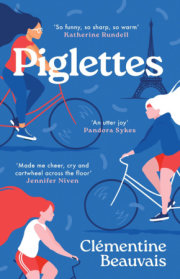
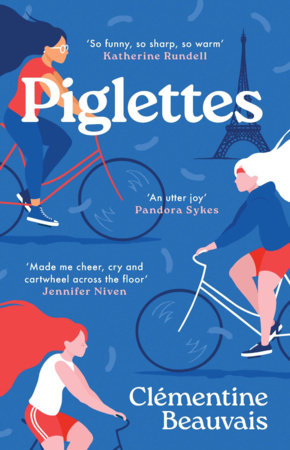
A wickedly funny and uplifting coming-of-age road trip story of friendship, fun and setting yourself free— winner of France's biggest prize for teen and YA fiction

“One of my favourite YAs of recent years... Very funny and totally original, idiosyncratic and generous, sardonic and that kind of intelligent that makes you relax immediately” — Katherine Rundell, author of Impossible Creatures

Mireille, Astrid and Hakima have just been voted the three ugliest girls in school by their classmates online. But are they going to sit around crying about it?

…Well, yes. But not for long! Climbing onto their bikes, the friends set off on a summer road trip to Paris. Their final destination? The president’s summer garden party. Because at this party there is something that each of the girls has been dreaming of – a secretly estranged parent, a much-beloved music sensation, and a long awaited chance for revenge!

There’s only one problem – road trips like this don’t come cheap! So, to fund their adventure, the three friends come up with a plan. At each stop along the way, they’ll set up shop and sell mouth-wateringly delicious sausages to the locals they meet. But it’s not long before this strange quest captures the attention of the nation. With the press on their heels, and the country in a frenzy to discover the real reason for their journey, can the three friends reach Paris in time?

With luck, they’ll find fame, adventure and happiness on their journey, and still have time to scoff plenty of delicious food (and drink the odd glass of wine) along the way in this hilarious, beautiful and life-affirming story of friendship, fun and setting yourself free.
Rheumy: adj. Full of rheum.
A rheumy eye.
A rheumy eye is an eye full of that white and glutinous substance that eyes secrete. It’s an eye that is kind of glued shut with its own ocular diarrhoea.
Such an eye is staring at me through the night-brown kitchen window.
“What the hell is that?”
That knocks on the window; I drop the kitchen roll, which unrolls all the way to the French window leading from the kitchen to the garden, like a red carpet (except it’s white). I walk along it to open the French window.
The visitor is the Pig Pageant’s gold-medal winner: Astrid Blomvall. Swaying from one foot to the other, in the dark garden, she fixes me with her eyes, her extremely rheumy eyes (especially the left one). She’s wearing dark- blue jeans, much too tight, and a black T-shirt that says INDOCHINE at the top with a faded picture underneath showing a bunch of grumpy-looking men, and she’s got two chunky arms sticking out of her T-shirt, arms that are pink and soft and pimply, and above all that, a fat pink face, framed with thick blonde hair like the string around a joint of meat, tied into a ponytail, and there’s a dimple on her left cheek, a dimple that is the redemption of this flabby face, a dimple which, as Astrid Blomvall smiles, seems to invite all the tenderness of the world to come and nestle in it.
Just after smiling, as if hyper-aware of her braces, Astrid Blomvall looks down at her feet (which are securely strapped into a pair of hiking sandals).
“Hi,” she mutters. “Sorry, hi, sorry, but I was wondering if maybe you were Mireille Laplanche by any chance, sorry for bothering you, I know it’s late, I found your address on WhitePages.fr.”
“Look, Astrid, let’s make things very clear here,” I say, letting her into my kitchen and onto the red carpet that is white. “You don’t need to be sorry about anything. You stole my gold medal, sure! But I don’t resent you. I think a bit of competition is a healthy thing in life. I think everyone should get their chance.”
She stares at me fixedly (well, with one eye; the second one is hidden inside her eyelid). Hmm. Apparently, she doesn’t get that I’m joking; people don’t often get it when I’m joking. And now she’s crying. Flood alert! Get the sandbags out, build the defences!
“Don’t cry, Astrid Blomvall. Do you hear me, gentle damsel? Don’t cry, or you’ll get morbidly dehydrated. There, there, blow your nose.”
I kneel down to tear a few squares off the white red carpet, and I offer them to her like you would an engagement ring. She blows her nose emphatically. I sit her down onto an Ikea stool that creaks rudely under her weight. The cat Fluffles, thinking I’m the one sitting down (since the stool is just as rude when I sit down on it), runs into the kitchen and jumps onto Astrid Blomvall’s lap. Mindlessly, she starts stroking his back, which makes Fluffles lift his tail and show her his tiny little light-brown arsehole. Then he turns around to lick the tears running down Astrid’s face. It’s a kind gesture, but a slightly unpleasant one too, because his tongue is like a little strip of Velcro.
I introduce them to each other. “My cat Fluffles. Astrid Blomvall. Why are you crying, Astrid?”
“I’ve won the Pig Pageant,” Astrid cries. “Is that not a good enough reason to cry? I’ve been in France barely a year; I’ve only been in Bourg-en-Bresse a little while, and I’ve already been voted top pig of my school!”
“Where were you before?”
“In Switzerland, with the sisters.” “What sisters?”
“Sisters, you know: nuns. In a Catholic school.” “Blimey!” I wince, shaking my hands to express how
unconvinced I am by her parents’ educational choices. What do her parents do, by the way? I enquire.
“My mum’s an artisanal potter, my dad’s a Swede.” “Does that offer good career prospects, being a Swede?” “I mean he’s Swedish and lives in Sweden and every-
thing. He does things, I’m not sure what.”
“I hope he’s not the Swede who designed this Ikea stool,” I reply, pointing sternly at the object in question. “It’s too small for even one of my bum cheeks, and loudly lets me know about it every bloody time I sit on it.”
“You’re funny,” says Astrid thoughtfully.
Since I’m not just funny but also generous, I give her some Fanta. Then a bit of leftover cooked ham. Then a slice of home-made tiramisu—I tell her I made it myself with my little hands; she says I’m a good cook.
“It’s because my grandparents have a restaurant. I fell into it when I was a child, like Obelix. Which might explain the comparable BMI.”
“I’m not a good cook,” says Astrid, “but I make good apple purée.”
Then, “How do you deal with it, winning the Pig Pageant at Marie Darrieussecq? It’s hard… It’s really hard, seriously.”
“Oh, I’m amazingly good at not taking things seri- ously. I know that my life will be much better when I’m twenty-five; in the meantime, I can wait. I have a lot of patience.”
“It’s sad to have to wait so long for things to get better.” I want to say, Oh, only the first three years. Then you get used to it. But clearly poor Astrid, at her Catholic school, hasn’t had the same training as me; it’s unlikely she got told often enough that she’s fatandugly. Whereas it’s happened to me so many times that I quite simply laugh
it off. It runs off me like water from a lotus leaf.
Except sometimes when I’m a bit tired, or on my period, or if I have a cold; then, all right, sometimes I get slightly less watertight. But not tonight. Tonight I’m fine, and the Pig Pageant winner needs me.
Astrid fiddles with her T-shirt. The sad little men on the picture crumble away even more. Me: “You might not like what I’m going to say, but I think your T-shirt is on its last legs.”
“It’s because I wear it all the time.”
Funny, that passionate voice, all of a sudden… and that now-legendary dimple, scooped out of her doughy face, as if by a teaspoon…
“Why?”
“Because Indochine are my whole life… My whole life. Tonight, I listened to them again before coming over here. They’re the ones who gave me the strength to come and see you.”
“Right. And supposing I don’t know who Indochine are?”
She looks at me like I’ve just said I don’t know who Barack Obamette is. I suggest: “Are they a boy band?”
“No! No, they’re a rock group, they… You really don’t know? They’re… they’re the best band in the whole history of the world!” She starts singing: “And three nights every week, it’s her skin against my skin… No?”
“No, sorry. My mother doesn’t listen to music and Philippe Dumont doesn’t either, and I only listen to… well, not much, really.”
I don’t have a musical ear. My ears are too small, ugly and complicated to catch melodies—I think that, in order to enjoy music, you must need very long sideburns that flap in the wind and funnel notes all the way down a vast, oyster-shaped ear.
“Who’s Philippe Dumont?”
“A makeshift father and a synthetic husband; a hand- some man with greying temples, well known to the local middle class, and fond of trips to Venice, from which he comes back with Murano vases that look like multicoloured glass vomit.”
I point at one of them on the windowsill, which currently hosts a long arum lily sticking out its tongue. “Cool,” says Astrid, unconvinced. “But tell me, Mireille, what did you do, the first time you won the Pig Pageant?
Did you close your Facebook account?”
“God no! Are you crazy? I just ordered a Hawaiian pizza, which I ate while reading Kafka’s Metamorphosis because we had a test on it the next day.”
That’s a lie; I’m not the kind to leave book-reading to the night before a test. But I can’t tell poor Astrid the truth, which is that, that night, three years ago, after discovering I’d been awarded the gold medal in the Pig Pageant, I ate a Hawaiian pizza topped with tears and snot, and spent three hours watching videos of cats riding Roombas on YouTube.
"Witty, empowering and irresistibly bonkers, this is a treat for those dreading secondary school, or puberty"
—Amanda Craig, New Statesman, Best Children's Books for Summer

“This beautiful and funny book explores the troubles and triumphs of being a teen through the eyes of a witty, philosophical, and slightly awkward teen. Beauvais goes above and beyond to appeal to readers while addressing many relevant issues in society including cyber-bullying, racism, and self-image. Mireille’s voice and character are wonderfully authentic with unflappable confidence and inelegant missteps mixed together for a potent storyteller on a journey of self-discovery. . . Love laughing and cringing? This book is for you!” —Melissa McCleary, Pembroke Public Library, via Youth Services Book Review

“The Piglettes keep trucking... Readers will rejoice in their sass, their celebrity, and their appreciation of French delectables . . . A wonderfully irreverent alternative to earnest claims about real beauty.” —Bulletin of the Center for Children's Books

“A unique voice—mordant, uncompromising and sophisticated . . . a superbly original reimagining of the road-trip novel, skewering societal obsessions with appearance.” —Guardian

“Stands out for its humorous style, ridiculing cruelty, malice and obsession with physical appearance. The most beautiful novel of the season.” —Elle

“Crammed with acerbic, affectionate, full‐blooded reflections on family, food, the glamorous toxicity of media attention and the difficulty of being an intelligent, outspoken teenage girl without the licence conferred by conventional attractiveness, Beauvais’s novel is a strikingly satirical, outrageous tour de force.” —Imogen Russell Williams, TLS

“The story of Mireille, Astrid, and Hakima made me cheer, cry, and cartwheel across the floor… One of the loveliest reading experiences I’ve had in years.” —Jennifer Niven, author of All the Bright Places and Holding Up the Universe

“Warm-hearted, uplifting and an excellent lesson in handling online bullies.” —Sunday Express

“This book is a treasure—a tale about true friendship and standing up for yourself narrated by one of the wittiest, sharpest teen girl voices I have ever had the pleasure of reading. It made me want to pull my bike out of the garage and ride through the streets yelling about lady power. I absolutely adored this story.” —Jennifer Mathieu, author of Moxie

“A triumph of a book; so funny, so original, so sharp, so warm.” —Katherine Rundell, author of Rooftoppers

“Pithy, powerful, laugh-out-loud funny.” —Cathy Cassidy, author of Chocolate Box Girls

“A jubilant novel that will make you smile. A true joy.” —Le Monde
Clémentine Beauvais (born 1989) is a French children's author living in the UK. She started reading children's books early, and somehow never stopped. Now she writes her own, in both French and English, for a variety of ages, and is a lecturer in English and Education at the University of York. Piglettes won four prizes in France, including the biggest children's book prize, the Prix Sorcières. It has already been adapted for the stage, and a film version is also in prodiction. Now Clémentine has translated her book into English!

About

A wickedly funny and uplifting coming-of-age road trip story of friendship, fun and setting yourself free— winner of France's biggest prize for teen and YA fiction

“One of my favourite YAs of recent years... Very funny and totally original, idiosyncratic and generous, sardonic and that kind of intelligent that makes you relax immediately” — Katherine Rundell, author of Impossible Creatures

Mireille, Astrid and Hakima have just been voted the three ugliest girls in school by their classmates online. But are they going to sit around crying about it?

…Well, yes. But not for long! Climbing onto their bikes, the friends set off on a summer road trip to Paris. Their final destination? The president’s summer garden party. Because at this party there is something that each of the girls has been dreaming of – a secretly estranged parent, a much-beloved music sensation, and a long awaited chance for revenge!

There’s only one problem – road trips like this don’t come cheap! So, to fund their adventure, the three friends come up with a plan. At each stop along the way, they’ll set up shop and sell mouth-wateringly delicious sausages to the locals they meet. But it’s not long before this strange quest captures the attention of the nation. With the press on their heels, and the country in a frenzy to discover the real reason for their journey, can the three friends reach Paris in time?

With luck, they’ll find fame, adventure and happiness on their journey, and still have time to scoff plenty of delicious food (and drink the odd glass of wine) along the way in this hilarious, beautiful and life-affirming story of friendship, fun and setting yourself free.

Excerpt

Rheumy: adj. Full of rheum.
A rheumy eye.
A rheumy eye is an eye full of that white and glutinous substance that eyes secrete. It’s an eye that is kind of glued shut with its own ocular diarrhoea.
Such an eye is staring at me through the night-brown kitchen window.
“What the hell is that?”
That knocks on the window; I drop the kitchen roll, which unrolls all the way to the French window leading from the kitchen to the garden, like a red carpet (except it’s white). I walk along it to open the French window.
The visitor is the Pig Pageant’s gold-medal winner: Astrid Blomvall. Swaying from one foot to the other, in the dark garden, she fixes me with her eyes, her extremely rheumy eyes (especially the left one). She’s wearing dark- blue jeans, much too tight, and a black T-shirt that says INDOCHINE at the top with a faded picture underneath showing a bunch of grumpy-looking men, and she’s got two chunky arms sticking out of her T-shirt, arms that are pink and soft and pimply, and above all that, a fat pink face, framed with thick blonde hair like the string around a joint of meat, tied into a ponytail, and there’s a dimple on her left cheek, a dimple that is the redemption of this flabby face, a dimple which, as Astrid Blomvall smiles, seems to invite all the tenderness of the world to come and nestle in it.
Just after smiling, as if hyper-aware of her braces, Astrid Blomvall looks down at her feet (which are securely strapped into a pair of hiking sandals).
“Hi,” she mutters. “Sorry, hi, sorry, but I was wondering if maybe you were Mireille Laplanche by any chance, sorry for bothering you, I know it’s late, I found your address on WhitePages.fr.”
“Look, Astrid, let’s make things very clear here,” I say, letting her into my kitchen and onto the red carpet that is white. “You don’t need to be sorry about anything. You stole my gold medal, sure! But I don’t resent you. I think a bit of competition is a healthy thing in life. I think everyone should get their chance.”
She stares at me fixedly (well, with one eye; the second one is hidden inside her eyelid). Hmm. Apparently, she doesn’t get that I’m joking; people don’t often get it when I’m joking. And now she’s crying. Flood alert! Get the sandbags out, build the defences!
“Don’t cry, Astrid Blomvall. Do you hear me, gentle damsel? Don’t cry, or you’ll get morbidly dehydrated. There, there, blow your nose.”
I kneel down to tear a few squares off the white red carpet, and I offer them to her like you would an engagement ring. She blows her nose emphatically. I sit her down onto an Ikea stool that creaks rudely under her weight. The cat Fluffles, thinking I’m the one sitting down (since the stool is just as rude when I sit down on it), runs into the kitchen and jumps onto Astrid Blomvall’s lap. Mindlessly, she starts stroking his back, which makes Fluffles lift his tail and show her his tiny little light-brown arsehole. Then he turns around to lick the tears running down Astrid’s face. It’s a kind gesture, but a slightly unpleasant one too, because his tongue is like a little strip of Velcro.
I introduce them to each other. “My cat Fluffles. Astrid Blomvall. Why are you crying, Astrid?”
“I’ve won the Pig Pageant,” Astrid cries. “Is that not a good enough reason to cry? I’ve been in France barely a year; I’ve only been in Bourg-en-Bresse a little while, and I’ve already been voted top pig of my school!”
“Where were you before?”
“In Switzerland, with the sisters.” “What sisters?”
“Sisters, you know: nuns. In a Catholic school.” “Blimey!” I wince, shaking my hands to express how
unconvinced I am by her parents’ educational choices. What do her parents do, by the way? I enquire.
“My mum’s an artisanal potter, my dad’s a Swede.” “Does that offer good career prospects, being a Swede?” “I mean he’s Swedish and lives in Sweden and every-
thing. He does things, I’m not sure what.”
“I hope he’s not the Swede who designed this Ikea stool,” I reply, pointing sternly at the object in question. “It’s too small for even one of my bum cheeks, and loudly lets me know about it every bloody time I sit on it.”
“You’re funny,” says Astrid thoughtfully.
Since I’m not just funny but also generous, I give her some Fanta. Then a bit of leftover cooked ham. Then a slice of home-made tiramisu—I tell her I made it myself with my little hands; she says I’m a good cook.
“It’s because my grandparents have a restaurant. I fell into it when I was a child, like Obelix. Which might explain the comparable BMI.”
“I’m not a good cook,” says Astrid, “but I make good apple purée.”
Then, “How do you deal with it, winning the Pig Pageant at Marie Darrieussecq? It’s hard… It’s really hard, seriously.”
“Oh, I’m amazingly good at not taking things seri- ously. I know that my life will be much better when I’m twenty-five; in the meantime, I can wait. I have a lot of patience.”
“It’s sad to have to wait so long for things to get better.” I want to say, Oh, only the first three years. Then you get used to it. But clearly poor Astrid, at her Catholic school, hasn’t had the same training as me; it’s unlikely she got told often enough that she’s fatandugly. Whereas it’s happened to me so many times that I quite simply laugh
it off. It runs off me like water from a lotus leaf.
Except sometimes when I’m a bit tired, or on my period, or if I have a cold; then, all right, sometimes I get slightly less watertight. But not tonight. Tonight I’m fine, and the Pig Pageant winner needs me.
Astrid fiddles with her T-shirt. The sad little men on the picture crumble away even more. Me: “You might not like what I’m going to say, but I think your T-shirt is on its last legs.”
“It’s because I wear it all the time.”
Funny, that passionate voice, all of a sudden… and that now-legendary dimple, scooped out of her doughy face, as if by a teaspoon…
“Why?”
“Because Indochine are my whole life… My whole life. Tonight, I listened to them again before coming over here. They’re the ones who gave me the strength to come and see you.”
“Right. And supposing I don’t know who Indochine are?”
She looks at me like I’ve just said I don’t know who Barack Obamette is. I suggest: “Are they a boy band?”
“No! No, they’re a rock group, they… You really don’t know? They’re… they’re the best band in the whole history of the world!” She starts singing: “And three nights every week, it’s her skin against my skin… No?”
“No, sorry. My mother doesn’t listen to music and Philippe Dumont doesn’t either, and I only listen to… well, not much, really.”
I don’t have a musical ear. My ears are too small, ugly and complicated to catch melodies—I think that, in order to enjoy music, you must need very long sideburns that flap in the wind and funnel notes all the way down a vast, oyster-shaped ear.
“Who’s Philippe Dumont?”
“A makeshift father and a synthetic husband; a hand- some man with greying temples, well known to the local middle class, and fond of trips to Venice, from which he comes back with Murano vases that look like multicoloured glass vomit.”
I point at one of them on the windowsill, which currently hosts a long arum lily sticking out its tongue. “Cool,” says Astrid, unconvinced. “But tell me, Mireille, what did you do, the first time you won the Pig Pageant?
Did you close your Facebook account?”
“God no! Are you crazy? I just ordered a Hawaiian pizza, which I ate while reading Kafka’s Metamorphosis because we had a test on it the next day.”
That’s a lie; I’m not the kind to leave book-reading to the night before a test. But I can’t tell poor Astrid the truth, which is that, that night, three years ago, after discovering I’d been awarded the gold medal in the Pig Pageant, I ate a Hawaiian pizza topped with tears and snot, and spent three hours watching videos of cats riding Roombas on YouTube.

Reviews

"Witty, empowering and irresistibly bonkers, this is a treat for those dreading secondary school, or puberty"
—Amanda Craig, New Statesman, Best Children's Books for Summer

“This beautiful and funny book explores the troubles and triumphs of being a teen through the eyes of a witty, philosophical, and slightly awkward teen. Beauvais goes above and beyond to appeal to readers while addressing many relevant issues in society including cyber-bullying, racism, and self-image. Mireille’s voice and character are wonderfully authentic with unflappable confidence and inelegant missteps mixed together for a potent storyteller on a journey of self-discovery. . . Love laughing and cringing? This book is for you!” —Melissa McCleary, Pembroke Public Library, via Youth Services Book Review

“The Piglettes keep trucking... Readers will rejoice in their sass, their celebrity, and their appreciation of French delectables . . . A wonderfully irreverent alternative to earnest claims about real beauty.” —Bulletin of the Center for Children's Books

“A unique voice—mordant, uncompromising and sophisticated . . . a superbly original reimagining of the road-trip novel, skewering societal obsessions with appearance.” —Guardian

“Stands out for its humorous style, ridiculing cruelty, malice and obsession with physical appearance. The most beautiful novel of the season.” —Elle

“Crammed with acerbic, affectionate, full‐blooded reflections on family, food, the glamorous toxicity of media attention and the difficulty of being an intelligent, outspoken teenage girl without the licence conferred by conventional attractiveness, Beauvais’s novel is a strikingly satirical, outrageous tour de force.” —Imogen Russell Williams, TLS

“The story of Mireille, Astrid, and Hakima made me cheer, cry, and cartwheel across the floor… One of the loveliest reading experiences I’ve had in years.” —Jennifer Niven, author of All the Bright Places and Holding Up the Universe

“Warm-hearted, uplifting and an excellent lesson in handling online bullies.” —Sunday Express

“This book is a treasure—a tale about true friendship and standing up for yourself narrated by one of the wittiest, sharpest teen girl voices I have ever had the pleasure of reading. It made me want to pull my bike out of the garage and ride through the streets yelling about lady power. I absolutely adored this story.” —Jennifer Mathieu, author of Moxie

“A triumph of a book; so funny, so original, so sharp, so warm.” —Katherine Rundell, author of Rooftoppers

“Pithy, powerful, laugh-out-loud funny.” —Cathy Cassidy, author of Chocolate Box Girls

“A jubilant novel that will make you smile. A true joy.” —Le Monde

Author

Clémentine Beauvais (born 1989) is a French children's author living in the UK. She started reading children's books early, and somehow never stopped. Now she writes her own, in both French and English, for a variety of ages, and is a lecturer in English and Education at the University of York. Piglettes won four prizes in France, including the biggest children's book prize, the Prix Sorcières. It has already been adapted for the stage, and a film version is also in prodiction. Now Clémentine has translated her book into English!
  • More Websites from
    Penguin Random House
  • Common Reads
  • Library Marketing