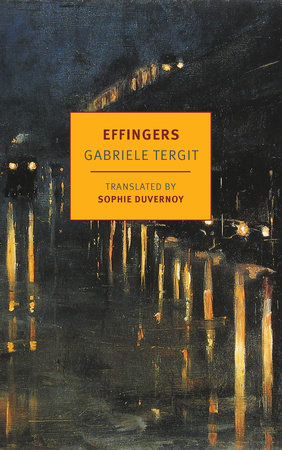
Effingers

Translated by Sophie Duvernoy
Look inside
Paperback
$29.95 US
| $39.95 CAN
On sale Nov 11, 2025 | 864 Pages | 9781681379791

See Additional Formats
Three generations of German Jewish family undergo the tumult, upheaval, and brutality of nineteenth- and twentieth-century history in this panoramic and skillfully nuanced family drama, rich with gossip and incident, capturing a Germany now lost to time.

Gabriele Tergit’s Effingers is a novel, at once epic and intimate, about the lives and fates of three generations of a German Jewish family. Beginning in 1878 and ending in 1948, we follow the Effingers, a family of modest craftsmen from southern Germany, who are joined through marriage to two families of high-society financiers in Berlin, the Goldschmidts and the Oppners. The Effingers soon rise to prominence as one of the most important German industrialist families in Berlin, but with the outbreak of World War I, they fall on hard times and must navigate the tumultuous changes of the Weimar Republic.

Full of parties and drama and delicious gossip, and featuring a kaleidoscopic cast of characters, Effingers is a keenly observed account of German Jewish life in all its richness and complexity. Tergit's precise and limpid prose dazzles in Sophie Duvernoy's elegant translation.

Woefully underrated when it first appeared in 1951, and only recently rediscovered in Germany, Effingers is a meditation on identity and nationality that establishes Tergit as one of the most significant writers of the twentieth century.
"Thomas Mann once said that if he were Jewish, Buddenbrooks would be read quite differently. Of course, if he'd been Jewish, well, who knows what kind of story he would have written? Maybe something more like Gabriele Tergit's multigenerational family saga Effingers, which, with its epic sweep, psychological depth, and linguistic brilliance, recalls Mann's novel, but which trains its sights on the heady, fraught world of the German-Jewish haute bourgeoisie. It's a remarkable book, full of insights and characters that make a lasting impression, and, happily, Sophie Duvernoy's sustained sensitivity as a writer matches Tergit's." —Paul Reitter

"If any novel deserves to be called epic, it’s Effingers. Inspired by Tergit’s own family history, this account of the rise and fall of a German Jewish clan has an addictive immediacy that will make you reluctant to put it down, despite its intimidating bulk — and despite the historical storm clouds you know will be looming." —Alida Becker, The New York Times

"Sometimes the term ‘lost masterpiece’ proves to be little more than a publisher’s puff. At other times, however, a long-buried book that is dug up, dusted down and branded a classic is worthy of the accolade. That applies to Gabriele Tergit’s Effingers . . . It is thoroughly immersive and unfolds in precise, often stark prose, expertly translated by Sophie Duvernoy. It is packed with well drawn scenes of individual struggles and family dramas . . . The novel constitutes not only a sweeping panorama but also a series of captivating portraits." —Malcolm Forbes, The Spectator

"Tergit’s novel, hitherto unavailable in English, is in part a roman à clef, narrated in unadorned, matter-of-fact prose. The Effinger family is a blend of urban and rural, secular and religious, socialist and capitalist . . . [each] striving to find their places in the world as the 20th century nears . . . The book, published in 1951, predated Germany’s full 'postwar reckoning with the Holocaust.' A masterwork of modern German literature." —Kirkus Reviews, starred review

"A blend of page-turner and the highest literary quality." ―Der Tagesspiegel

"No other novel rescues the lost Berlin and the world of Jewish Berliners like this one. It is a work of disturbing truthfulness." ―Süddeutsche Zeitung

"Anyone who reads it will accompany the characters for many decades and take some of them very much to their hearts." ―Berliner Zeitung

Gabriele Tergit (1894–1982), born Elise Hirschmann, was a German novelist and reporter. She began writing newspaper articles in the early 1920s under her pseudonym and eventually rose to prominence at the Berliner Tageblatt as one of Berlin's best-known court reporters. Her first novel, Käsebier Takes Berlin (available from NYRB Classics) cemented her reputation as a brilliant social satirist of the Weimar Republic. In 1933 she narrowly evaded arrest by the Nazis, fleeing to Prague and Palestine before settling in London with her husband and son. Alongside essays and articles, she wrote a number of books of fiction and nonfiction, including two novels, unpublished in Tergit’s lifetime, that were recently published in Germany to critical acclaim: So war’s eben (That’s How It Was) and Der erste Zug nach Berlin (The First Train to Berlin).

Sophie Duvernoy is a literary translator and scholar focusing on the literature and aesthetic theory of the Weimar Republic. Her translation of Gabriele Tergit’s Käsebier Takes Berlin was published by New York Review Books in 2019 and shortlisted for the 2021 Schlegel-Tieck translation prize. She is co-editor of Representing Social Precarity in German Literature and Film, and her writing and translations have appeared in Modern Language Notes, The Paris Review Online, Los Angeles Review of Books, No Man’s Land, and The Offing.

About

Three generations of German Jewish family undergo the tumult, upheaval, and brutality of nineteenth- and twentieth-century history in this panoramic and skillfully nuanced family drama, rich with gossip and incident, capturing a Germany now lost to time.

Gabriele Tergit’s Effingers is a novel, at once epic and intimate, about the lives and fates of three generations of a German Jewish family. Beginning in 1878 and ending in 1948, we follow the Effingers, a family of modest craftsmen from southern Germany, who are joined through marriage to two families of high-society financiers in Berlin, the Goldschmidts and the Oppners. The Effingers soon rise to prominence as one of the most important German industrialist families in Berlin, but with the outbreak of World War I, they fall on hard times and must navigate the tumultuous changes of the Weimar Republic.

Full of parties and drama and delicious gossip, and featuring a kaleidoscopic cast of characters, Effingers is a keenly observed account of German Jewish life in all its richness and complexity. Tergit's precise and limpid prose dazzles in Sophie Duvernoy's elegant translation.

Woefully underrated when it first appeared in 1951, and only recently rediscovered in Germany, Effingers is a meditation on identity and nationality that establishes Tergit as one of the most significant writers of the twentieth century.

Reviews

"Thomas Mann once said that if he were Jewish, Buddenbrooks would be read quite differently. Of course, if he'd been Jewish, well, who knows what kind of story he would have written? Maybe something more like Gabriele Tergit's multigenerational family saga Effingers, which, with its epic sweep, psychological depth, and linguistic brilliance, recalls Mann's novel, but which trains its sights on the heady, fraught world of the German-Jewish haute bourgeoisie. It's a remarkable book, full of insights and characters that make a lasting impression, and, happily, Sophie Duvernoy's sustained sensitivity as a writer matches Tergit's." —Paul Reitter

"If any novel deserves to be called epic, it’s Effingers. Inspired by Tergit’s own family history, this account of the rise and fall of a German Jewish clan has an addictive immediacy that will make you reluctant to put it down, despite its intimidating bulk — and despite the historical storm clouds you know will be looming." —Alida Becker, The New York Times

"Sometimes the term ‘lost masterpiece’ proves to be little more than a publisher’s puff. At other times, however, a long-buried book that is dug up, dusted down and branded a classic is worthy of the accolade. That applies to Gabriele Tergit’s Effingers . . . It is thoroughly immersive and unfolds in precise, often stark prose, expertly translated by Sophie Duvernoy. It is packed with well drawn scenes of individual struggles and family dramas . . . The novel constitutes not only a sweeping panorama but also a series of captivating portraits." —Malcolm Forbes, The Spectator

"Tergit’s novel, hitherto unavailable in English, is in part a roman à clef, narrated in unadorned, matter-of-fact prose. The Effinger family is a blend of urban and rural, secular and religious, socialist and capitalist . . . [each] striving to find their places in the world as the 20th century nears . . . The book, published in 1951, predated Germany’s full 'postwar reckoning with the Holocaust.' A masterwork of modern German literature." —Kirkus Reviews, starred review

"A blend of page-turner and the highest literary quality." ―Der Tagesspiegel

"No other novel rescues the lost Berlin and the world of Jewish Berliners like this one. It is a work of disturbing truthfulness." ―Süddeutsche Zeitung

"Anyone who reads it will accompany the characters for many decades and take some of them very much to their hearts." ―Berliner Zeitung

Author

Gabriele Tergit (1894–1982), born Elise Hirschmann, was a German novelist and reporter. She began writing newspaper articles in the early 1920s under her pseudonym and eventually rose to prominence at the Berliner Tageblatt as one of Berlin's best-known court reporters. Her first novel, Käsebier Takes Berlin (available from NYRB Classics) cemented her reputation as a brilliant social satirist of the Weimar Republic. In 1933 she narrowly evaded arrest by the Nazis, fleeing to Prague and Palestine before settling in London with her husband and son. Alongside essays and articles, she wrote a number of books of fiction and nonfiction, including two novels, unpublished in Tergit’s lifetime, that were recently published in Germany to critical acclaim: So war’s eben (That’s How It Was) and Der erste Zug nach Berlin (The First Train to Berlin).

Sophie Duvernoy is a literary translator and scholar focusing on the literature and aesthetic theory of the Weimar Republic. Her translation of Gabriele Tergit’s Käsebier Takes Berlin was published by New York Review Books in 2019 and shortlisted for the 2021 Schlegel-Tieck translation prize. She is co-editor of Representing Social Precarity in German Literature and Film, and her writing and translations have appeared in Modern Language Notes, The Paris Review Online, Los Angeles Review of Books, No Man’s Land, and The Offing.
  • More Websites from
    Penguin Random House
  • Common Reads
  • Library Marketing