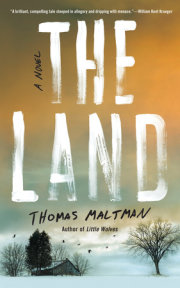
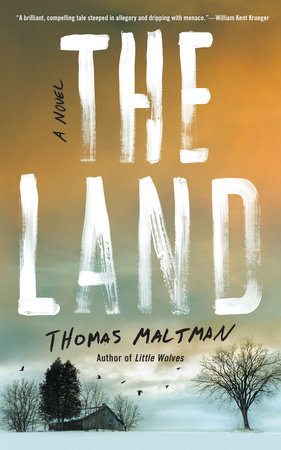
The Land

Paperback
$16.00 US
| $20.00 CAN
On sale Sep 21, 2021 | 336 Pages | 9781641293143

See Additional Formats
A story of violence at the heart of a pastoral landscape, from the author of Indie Next pick and All Iowa Reads selection Little Wolves

Recovering from a terrible auto accident just before the turn of the millennium, college dropout and hobbyist computer-game programmer Lucien Swenson becomes the caretaker of a house in northern Minnesota. Shortly after moving in, Lucien sets out to find a woman with whom he had an affair, who vanished along with money stolen from the bank where they had worked together.

His search will take him to Rose of Sharon, a white supremacist church deep in the wilderness, where a cabal of outcasts awaits the end of the world at a place they call The Land. Lucien is visited at the house by a mysterious guest, who may not be who she claims, as well as a vast flock of violent ravens out of an apocalyptic vision. At once a mystery and spiritual noir, The Land explores the dark side of belief, entrenched white supremacy in the Heartland, the uniquely American obsession with end times, and the sacrifices we make for those we love.
Chapter 1
A Dead Man Casts His Shadow  

Above all, Mr. Kroll told me, take care of the dog.
     We were standing together in the foyer, next to the last suitcases Mr. Kroll needed to lug to
his Audi, and he lingered here as if he had something else important to tell me. Mrs. Kroll already had the Audi running in the driveway, where it huffed clouds of exhaust in the icy November air as she sat rigid, her arms crossed and her body tilted forward in the seatbelt of the passenger side, the posture of a snowbird who might grow wings and fly to South Padre Island for the winter by herself if he didn’t hurry. When she gave a toot on the horn, Mr. Kroll grimaced. “Just between you and me, Lucien, I don’t put much stock in this Y2K business,” he said, “but if the world really does go to hell, I don’t want to be stuck someplace cold.”
     I didn’t say anything, but I couldn’t have disagreed more. If the world ended at the turn of the millennium, the last place I wanted to be was surrounded by busloads of old folks greased up in Coppertone and singing along to Jimmy Buffett. I couldn’t wait to be alone, longed for what I hoped would be a winter of solitude.
     Mr. Kroll handed me a schedule with his tight, military printing listing watering days for the ferns and spider plants, the exact temperature to set the thermostat (62 degrees), and a food and exercise program for a geriatric German shepherd named Kaiser.
     “No parties,” he said, taking hold of my other hand.
     “I don’t drink.”
     “You will clear the driveway of snow, just in case.”
     He didn’t explain what he meant. His palm felt scaly and lizard-like. He tugged me closer to him as though he were about to confide a secret. “Harry said you were good. He said he was sorry he had to let you go.”
     If it wasn’t for Harry Larkin, I’d be homeless as well as jobless. The Krolls were longtime customers at Bay City Mutual where I had worked before the accident. The place they were leaving behind was called “The Gingerbread House” by locals—a stone house set back in the pines with a red-tiled roof that curved like an elf’s shoe, twin turrets on either side, and topiary bearding the lower windows—like some vision from the Brothers Grimm. The property sprawled over eighty acres of boreal forest above a deep canyon carved by the Wind River, which ran swift and silver far below, spilling down to Cauldron Falls before pouring into Aurora Bay, miles and miles away, where I attended Northern Minnesota State University. The Krolls needed someone to maintain the property and I needed a place to stay. Get some rest, Harry Larkin had advised me before explaining the arrangement, then get your shit together.
     I told friends and family that I planned to use the time to finish coding an open-ended computer game called The Land, a post-apocalyptic fantasy world I’d been programming since my freshman year with the little free time I had between work and school. I planned to release the game as shareware and dreamed of it becoming a cult classic. Already on academic probation, I was about to be thrown out of college, so I hoped the game might get me in the door at some place like BioWare up in Canada, where I could work on the next Baldur’s Gate.
     Mr. Kroll had a thin crop of oily hair, nicotine-stained teeth, his breath smelling of ashes and Listerine. “Do you know your way around guns?” He asked this in the same tone as someone might say, Do you know the Lord?
     “Guns?” I was the only child of two overly protective parents who hadn’t even let me own a toy gun as a boy.
     “I keep a .30-06 fully loaded in the gun cabinet. You have the keys. We’ve discussed the things that are not yours to touch, but the rifle you may use when the situation calls for it. If wolves come around—and they will—let them have it.”
     “You want me to give them the gun, sir?”
     Mr. Kroll had finally let go of my hand. “Lucien,” he said, his mouth crimping at the corners, as though speaking my name aloud a second time pained him. I regretted my attempt at humor, just a little, knowing how much these old-timers hated a wiseass. When Mr. Kroll had visited the bank on business he preferred to be waited on by the pretty, young female tellers, especially Maura. Maura had been everyone’s favorite. “Harry said you were smart before your time in the hospital, so I think you know what I mean.” How much had Harry told him? And surely he knew that wolves were on the endangered species list. Mr. Kroll lowered his voice, though it was just the two of us in the foyer. “Wolves are vermin and you are on private property. Won’t anyone know what you do out here. Got it? Also, it’s okay if some of my wife’s plants die, but not the dog.”
 
 
After they left, I spent hours wandering the maze of rooms, at first careful of the old couple’s privacy. My bare feet sank into lush, Berber carpets the color of burgundy, and the floors seemed to slope downhill  as if this entire house was drifting toward the volcanic ridge above the river, a quarter mile away. A spiral staircase led to a walkout on the lower level. Here a bearskin rug splayed before a towering stone fireplace. Bay windows looked out over a grove of birches already filling up with snow. In November of 1999, a wolfish cold had settled early over the woods, shaggy with snow. It was so quiet I swore I could hear the hush of each flake touching the ground. I could hear the thump of my heart in my ears, strong and insistent and traitorous. I only wanted to be alone, but I could feel something padding toward me in the snow, and I knew I would have to go out to meet it. I didn’t know enough to be afraid yet.
 
 
My mother had cam paigned for me to come home to Chicago and enroll in Oakton Community College for the spring semester instead of housesitting this place over the winter. “You’ll be so far from everything,” she said over the phone.
     “That’s the whole point.”
     “But how will you keep up with your classes?”
     “It’s not a bad commute. Now that I’m not working thirty hours a week, I can focus better.” I paused, mentally counting how many lies I’d packed in those sentences. My focus had been shattered. I missed two weeks of classes in the hospital and I should have withdrawn rather than take Fs, but I let the deadline pass without doing anything. Yet, I still attended. Some days I went to classes I hadn’t even enrolled in, choosing random lectures on meteorology, the philosophy of Eastern religions, or astronomy, and sitting in the back taking notes. Once the registrar’s office caught up with me, my time at Northern was done, but I couldn’t wrap my head around why any of it was supposed to matter anymore.
     “You are coming home for Thanksgiving.”
     Home? I wasn’t sure where that was anymore since my parents had divorced. “We’ll see, Mom.”
     I heard her swallow on the other end of the phone line. I hated talking on the phone, the way disembodied voices floated out of the ether. She knew I wasn’t coming home. I couldn’t. Not yet. There was something I had to do first. I was afraid she was going to start crying again. “I gotta go, Mom.”
 
 
The first day of the storm I took Kaiser out for a walk, trussing my hiking boots in antique snowshoes I’d found hanging beside the French doors in the lower level and grabbing a set of poles from an umbrella stand. I didn’t bother with a leash, knowing the old dog would stay close. In the sandy, acidic soil of the property, the white pines grew immense, their trunks gnarled and gigantic, the upper reaches soughing in the wind. Grandfather trees with white frock coats and mossy, dripping beards.
     Kaiser ambled along beside me. Released from his side yard pen, the dog appeared ready to bound through the snow, if only his body would allow it. He wheezed and struggled in the deeper drifts, his back legs stiff and arthritic. Balanced on my balsa wood poles, I commiserated. Under my skin I could sense the alien piece of ceramic prosthetic the surgeon had grafted to my hip bone.
     Kaiser and I discovered a pond at the edge of the birch grove. Beneath the glazed surface of the ice, koi swam in sluggish circles, mottled blurs of flame. I cracked the ice with the hard plastic end of my pole and the koi squirmed away. Kaiser snorted beside me, a questioning bark, before using his paws to break more ice so he could slurp the cold water. Soon the small pond would freeze solid around those fish, leaving them trapped and breathless. Already a new skin of ice was forming around the holes we had made. The Krolls hadn’t left any instructions about tending the koi and I felt certain they were going to die but didn’t know how to save them. We were gazing down into their icy tomb, our shadows blocking out their light. Yet, it didn’t seem like a bad way to go, all things considered. “The parable of this world is like your shadow,” I told Kaiser, one of my notes from the religion class that got stuck in my head, though I couldn’t recall who said it. Kaiser sat on his haunches, slobbery icicles dangling from his muzzle. “If you stop, your shadow stands still. If you chase it, it distances itself from you.” Tomorrow was Sunday. I had a shadow to chase.
Praise for The Land

"A spiritual quest for meaning, a lamentation on loneliness, and a tense tale of the infectious nature of 'paranoia and fear.' If you ask me, it’s a parable for our time."
Carole Barrowman, Minneapolis Star Tribune

"A dark and disturbing novel that is beautifully and fearfully told . . . The Land is a marvelous novel, and there is no good place to stop reading it." 
Bookreporter.com

"Illuminates the way religious fanaticism can be a refuge for the lost, often with devastating consequences . . . Maltman’s character development is superb."
Los Angeles Review of Books

"The tale of a broken man seeking a way to wholeness in body and spirit, The Land is a multi-layered journey through a bleak landscape filled with visions and ruminations on the nature of man and God. What Maltman offers readers is nothing less than a brilliant, compelling tale steeped in allegory and dripping with menace. Suspenseful, thought-provoking, and utterly unputdownable, The Land explores those frightening moments when every human being confronts both the devil outside and the devil within. Once again, Thomas Maltman proves himself to be among the finest writers publishing today."
—William Kent Krueger, author of This Tender Land

"Thomas Maltman’s The Land is a gift to readers longing for a tale of lost love, fringe prophets, souls in cold suspension, and ravens that darken the skies of a Northern winter. Set against looming apocalypse and the clicking of a projector showing classic films, The Land is generous, intricate, and propulsive. It has a kind heart and a tear in its eye, and I enjoyed it completely."
—Leif Enger, author of Peace Like a River

"The Land gives us an unflinching look at the sad, strained logic of modern white supremacy. By turns lyrical and hallucinatory, it is also an angry, lonely love letter to the most isolated corners of the rural Midwest at the turn of the millennium, a mystery where the man trying to solve it is also increasingly a mystery to himself."
—Chris Dennis, author of Here Is What You Do

"Maltman’s very dark novel deals dramatically with considerations of good and evil, of angels and demons, creating a visceral sense of danger . . . Metaphysics and mystery merge in this haunting, thought-provoking story." 
Booklist

"An enjoyably slippery narrator." 
Publishers Weekly 

"The Land is a fine coming of age story, told in the convincing and thoroughly likable voice of Lucien Swenson, a young man in the throes of forbidden love as he recovers from a terrible accident. But where is Maura? . . . [A] well-built mystery, with unexpected guests, elements of horror, and hints of the supernatural, as Lucien’s migraines and other effects of his injuries have him seeing signs in the raw winter and questioning what’s real. I enjoyed every bit of this story and its conflicted cast of characters. An exceptional novel!" 
Tim McCarthy, Boswell Book Company (Milwaukee, WI)

"This timely novel will appeal to readers who enjoy noir fiction as well as book clubs looking for a meaty, satisfying, and eloquent read . . . The Land is a book that begs to be read in one sitting and contemplated for eternity."
—Pamela Klinger-Horn, Excelsior Bay Books (Excelsior, MN)

Praise for Little Wolves


“Took my breath away . . . as rich in myth and metaphors as Cormac McCarthy's The Road.”
Milwaukee Journal-Sentinel

“Part allegory, part mystery and pure poetry, layered with Norse mythology and Anglo-Saxon narratives, Maltman's second novel is dark, redemptive and very beautiful.”
—Minneapolis Star-Tribune

"A complicated portrait of a prairie town, a meditation on violence, a fantasia of myth and folklore, and a knockout murder mystery . . . I loved this book."
—Benjamin Percy, author of Red Moon
Thomas Maltman has an MFA from Minnesota State University, Mankato. His first novel, The Night Birds, won an Alex Award, a Spur Award, and the Friends of American Writers Literary Award. His second novel, Little Wolves, was an Indie Next pick and an All Iowa Reads selection. He teaches at Normandale Community College and lives in the Twin Cities area.

About

A story of violence at the heart of a pastoral landscape, from the author of Indie Next pick and All Iowa Reads selection Little Wolves

Recovering from a terrible auto accident just before the turn of the millennium, college dropout and hobbyist computer-game programmer Lucien Swenson becomes the caretaker of a house in northern Minnesota. Shortly after moving in, Lucien sets out to find a woman with whom he had an affair, who vanished along with money stolen from the bank where they had worked together.

His search will take him to Rose of Sharon, a white supremacist church deep in the wilderness, where a cabal of outcasts awaits the end of the world at a place they call The Land. Lucien is visited at the house by a mysterious guest, who may not be who she claims, as well as a vast flock of violent ravens out of an apocalyptic vision. At once a mystery and spiritual noir, The Land explores the dark side of belief, entrenched white supremacy in the Heartland, the uniquely American obsession with end times, and the sacrifices we make for those we love.

Excerpt

Chapter 1
A Dead Man Casts His Shadow  

Above all, Mr. Kroll told me, take care of the dog.
     We were standing together in the foyer, next to the last suitcases Mr. Kroll needed to lug to
his Audi, and he lingered here as if he had something else important to tell me. Mrs. Kroll already had the Audi running in the driveway, where it huffed clouds of exhaust in the icy November air as she sat rigid, her arms crossed and her body tilted forward in the seatbelt of the passenger side, the posture of a snowbird who might grow wings and fly to South Padre Island for the winter by herself if he didn’t hurry. When she gave a toot on the horn, Mr. Kroll grimaced. “Just between you and me, Lucien, I don’t put much stock in this Y2K business,” he said, “but if the world really does go to hell, I don’t want to be stuck someplace cold.”
     I didn’t say anything, but I couldn’t have disagreed more. If the world ended at the turn of the millennium, the last place I wanted to be was surrounded by busloads of old folks greased up in Coppertone and singing along to Jimmy Buffett. I couldn’t wait to be alone, longed for what I hoped would be a winter of solitude.
     Mr. Kroll handed me a schedule with his tight, military printing listing watering days for the ferns and spider plants, the exact temperature to set the thermostat (62 degrees), and a food and exercise program for a geriatric German shepherd named Kaiser.
     “No parties,” he said, taking hold of my other hand.
     “I don’t drink.”
     “You will clear the driveway of snow, just in case.”
     He didn’t explain what he meant. His palm felt scaly and lizard-like. He tugged me closer to him as though he were about to confide a secret. “Harry said you were good. He said he was sorry he had to let you go.”
     If it wasn’t for Harry Larkin, I’d be homeless as well as jobless. The Krolls were longtime customers at Bay City Mutual where I had worked before the accident. The place they were leaving behind was called “The Gingerbread House” by locals—a stone house set back in the pines with a red-tiled roof that curved like an elf’s shoe, twin turrets on either side, and topiary bearding the lower windows—like some vision from the Brothers Grimm. The property sprawled over eighty acres of boreal forest above a deep canyon carved by the Wind River, which ran swift and silver far below, spilling down to Cauldron Falls before pouring into Aurora Bay, miles and miles away, where I attended Northern Minnesota State University. The Krolls needed someone to maintain the property and I needed a place to stay. Get some rest, Harry Larkin had advised me before explaining the arrangement, then get your shit together.
     I told friends and family that I planned to use the time to finish coding an open-ended computer game called The Land, a post-apocalyptic fantasy world I’d been programming since my freshman year with the little free time I had between work and school. I planned to release the game as shareware and dreamed of it becoming a cult classic. Already on academic probation, I was about to be thrown out of college, so I hoped the game might get me in the door at some place like BioWare up in Canada, where I could work on the next Baldur’s Gate.
     Mr. Kroll had a thin crop of oily hair, nicotine-stained teeth, his breath smelling of ashes and Listerine. “Do you know your way around guns?” He asked this in the same tone as someone might say, Do you know the Lord?
     “Guns?” I was the only child of two overly protective parents who hadn’t even let me own a toy gun as a boy.
     “I keep a .30-06 fully loaded in the gun cabinet. You have the keys. We’ve discussed the things that are not yours to touch, but the rifle you may use when the situation calls for it. If wolves come around—and they will—let them have it.”
     “You want me to give them the gun, sir?”
     Mr. Kroll had finally let go of my hand. “Lucien,” he said, his mouth crimping at the corners, as though speaking my name aloud a second time pained him. I regretted my attempt at humor, just a little, knowing how much these old-timers hated a wiseass. When Mr. Kroll had visited the bank on business he preferred to be waited on by the pretty, young female tellers, especially Maura. Maura had been everyone’s favorite. “Harry said you were smart before your time in the hospital, so I think you know what I mean.” How much had Harry told him? And surely he knew that wolves were on the endangered species list. Mr. Kroll lowered his voice, though it was just the two of us in the foyer. “Wolves are vermin and you are on private property. Won’t anyone know what you do out here. Got it? Also, it’s okay if some of my wife’s plants die, but not the dog.”
 
 
After they left, I spent hours wandering the maze of rooms, at first careful of the old couple’s privacy. My bare feet sank into lush, Berber carpets the color of burgundy, and the floors seemed to slope downhill  as if this entire house was drifting toward the volcanic ridge above the river, a quarter mile away. A spiral staircase led to a walkout on the lower level. Here a bearskin rug splayed before a towering stone fireplace. Bay windows looked out over a grove of birches already filling up with snow. In November of 1999, a wolfish cold had settled early over the woods, shaggy with snow. It was so quiet I swore I could hear the hush of each flake touching the ground. I could hear the thump of my heart in my ears, strong and insistent and traitorous. I only wanted to be alone, but I could feel something padding toward me in the snow, and I knew I would have to go out to meet it. I didn’t know enough to be afraid yet.
 
 
My mother had cam paigned for me to come home to Chicago and enroll in Oakton Community College for the spring semester instead of housesitting this place over the winter. “You’ll be so far from everything,” she said over the phone.
     “That’s the whole point.”
     “But how will you keep up with your classes?”
     “It’s not a bad commute. Now that I’m not working thirty hours a week, I can focus better.” I paused, mentally counting how many lies I’d packed in those sentences. My focus had been shattered. I missed two weeks of classes in the hospital and I should have withdrawn rather than take Fs, but I let the deadline pass without doing anything. Yet, I still attended. Some days I went to classes I hadn’t even enrolled in, choosing random lectures on meteorology, the philosophy of Eastern religions, or astronomy, and sitting in the back taking notes. Once the registrar’s office caught up with me, my time at Northern was done, but I couldn’t wrap my head around why any of it was supposed to matter anymore.
     “You are coming home for Thanksgiving.”
     Home? I wasn’t sure where that was anymore since my parents had divorced. “We’ll see, Mom.”
     I heard her swallow on the other end of the phone line. I hated talking on the phone, the way disembodied voices floated out of the ether. She knew I wasn’t coming home. I couldn’t. Not yet. There was something I had to do first. I was afraid she was going to start crying again. “I gotta go, Mom.”
 
 
The first day of the storm I took Kaiser out for a walk, trussing my hiking boots in antique snowshoes I’d found hanging beside the French doors in the lower level and grabbing a set of poles from an umbrella stand. I didn’t bother with a leash, knowing the old dog would stay close. In the sandy, acidic soil of the property, the white pines grew immense, their trunks gnarled and gigantic, the upper reaches soughing in the wind. Grandfather trees with white frock coats and mossy, dripping beards.
     Kaiser ambled along beside me. Released from his side yard pen, the dog appeared ready to bound through the snow, if only his body would allow it. He wheezed and struggled in the deeper drifts, his back legs stiff and arthritic. Balanced on my balsa wood poles, I commiserated. Under my skin I could sense the alien piece of ceramic prosthetic the surgeon had grafted to my hip bone.
     Kaiser and I discovered a pond at the edge of the birch grove. Beneath the glazed surface of the ice, koi swam in sluggish circles, mottled blurs of flame. I cracked the ice with the hard plastic end of my pole and the koi squirmed away. Kaiser snorted beside me, a questioning bark, before using his paws to break more ice so he could slurp the cold water. Soon the small pond would freeze solid around those fish, leaving them trapped and breathless. Already a new skin of ice was forming around the holes we had made. The Krolls hadn’t left any instructions about tending the koi and I felt certain they were going to die but didn’t know how to save them. We were gazing down into their icy tomb, our shadows blocking out their light. Yet, it didn’t seem like a bad way to go, all things considered. “The parable of this world is like your shadow,” I told Kaiser, one of my notes from the religion class that got stuck in my head, though I couldn’t recall who said it. Kaiser sat on his haunches, slobbery icicles dangling from his muzzle. “If you stop, your shadow stands still. If you chase it, it distances itself from you.” Tomorrow was Sunday. I had a shadow to chase.

Reviews

Praise for The Land

"A spiritual quest for meaning, a lamentation on loneliness, and a tense tale of the infectious nature of 'paranoia and fear.' If you ask me, it’s a parable for our time."
Carole Barrowman, Minneapolis Star Tribune

"A dark and disturbing novel that is beautifully and fearfully told . . . The Land is a marvelous novel, and there is no good place to stop reading it." 
Bookreporter.com

"Illuminates the way religious fanaticism can be a refuge for the lost, often with devastating consequences . . . Maltman’s character development is superb."
Los Angeles Review of Books

"The tale of a broken man seeking a way to wholeness in body and spirit, The Land is a multi-layered journey through a bleak landscape filled with visions and ruminations on the nature of man and God. What Maltman offers readers is nothing less than a brilliant, compelling tale steeped in allegory and dripping with menace. Suspenseful, thought-provoking, and utterly unputdownable, The Land explores those frightening moments when every human being confronts both the devil outside and the devil within. Once again, Thomas Maltman proves himself to be among the finest writers publishing today."
—William Kent Krueger, author of This Tender Land

"Thomas Maltman’s The Land is a gift to readers longing for a tale of lost love, fringe prophets, souls in cold suspension, and ravens that darken the skies of a Northern winter. Set against looming apocalypse and the clicking of a projector showing classic films, The Land is generous, intricate, and propulsive. It has a kind heart and a tear in its eye, and I enjoyed it completely."
—Leif Enger, author of Peace Like a River

"The Land gives us an unflinching look at the sad, strained logic of modern white supremacy. By turns lyrical and hallucinatory, it is also an angry, lonely love letter to the most isolated corners of the rural Midwest at the turn of the millennium, a mystery where the man trying to solve it is also increasingly a mystery to himself."
—Chris Dennis, author of Here Is What You Do

"Maltman’s very dark novel deals dramatically with considerations of good and evil, of angels and demons, creating a visceral sense of danger . . . Metaphysics and mystery merge in this haunting, thought-provoking story." 
Booklist

"An enjoyably slippery narrator." 
Publishers Weekly 

"The Land is a fine coming of age story, told in the convincing and thoroughly likable voice of Lucien Swenson, a young man in the throes of forbidden love as he recovers from a terrible accident. But where is Maura? . . . [A] well-built mystery, with unexpected guests, elements of horror, and hints of the supernatural, as Lucien’s migraines and other effects of his injuries have him seeing signs in the raw winter and questioning what’s real. I enjoyed every bit of this story and its conflicted cast of characters. An exceptional novel!" 
Tim McCarthy, Boswell Book Company (Milwaukee, WI)

"This timely novel will appeal to readers who enjoy noir fiction as well as book clubs looking for a meaty, satisfying, and eloquent read . . . The Land is a book that begs to be read in one sitting and contemplated for eternity."
—Pamela Klinger-Horn, Excelsior Bay Books (Excelsior, MN)

Praise for Little Wolves


“Took my breath away . . . as rich in myth and metaphors as Cormac McCarthy's The Road.”
Milwaukee Journal-Sentinel

“Part allegory, part mystery and pure poetry, layered with Norse mythology and Anglo-Saxon narratives, Maltman's second novel is dark, redemptive and very beautiful.”
—Minneapolis Star-Tribune

"A complicated portrait of a prairie town, a meditation on violence, a fantasia of myth and folklore, and a knockout murder mystery . . . I loved this book."
—Benjamin Percy, author of Red Moon

Author

Thomas Maltman has an MFA from Minnesota State University, Mankato. His first novel, The Night Birds, won an Alex Award, a Spur Award, and the Friends of American Writers Literary Award. His second novel, Little Wolves, was an Indie Next pick and an All Iowa Reads selection. He teaches at Normandale Community College and lives in the Twin Cities area.
  • More Websites from
    Penguin Random House
  • Common Reads
  • Library Marketing