Eww! Who smells like rotten eggs and smelly feet? Yuck! Whose burps smell like cow poop?
Find out which animals stink (and why) in this reeky, cheeky guessing game for ages 3-7.
Animals make all sorts of smells for all sorts of reasons! Can you guess the stinker from its stink? Simple clues and laugh-out-loud art make this guessing game perfect for rowdy read-alouds. Fun facts from a world-class zoologist reveal the science behind the stink.
Readers are introduced to:
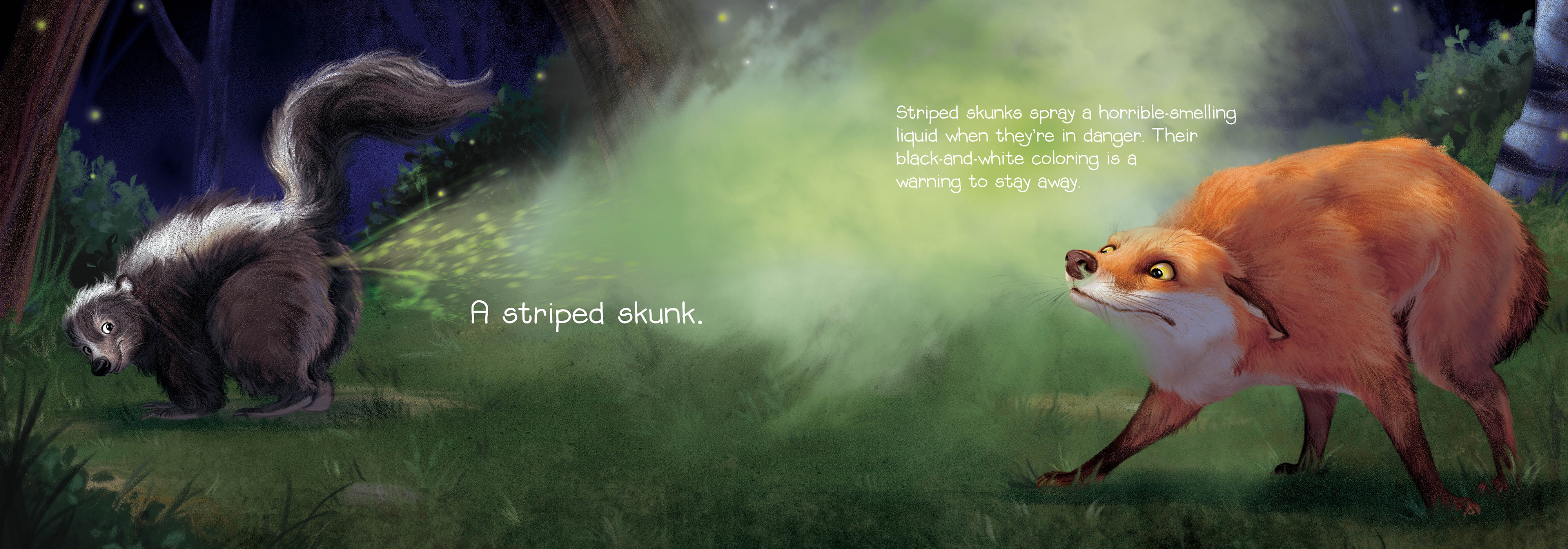
Striped skunk
Stink bird
Musk ox
Corpse flower
Bombardier beetle
Sea hare
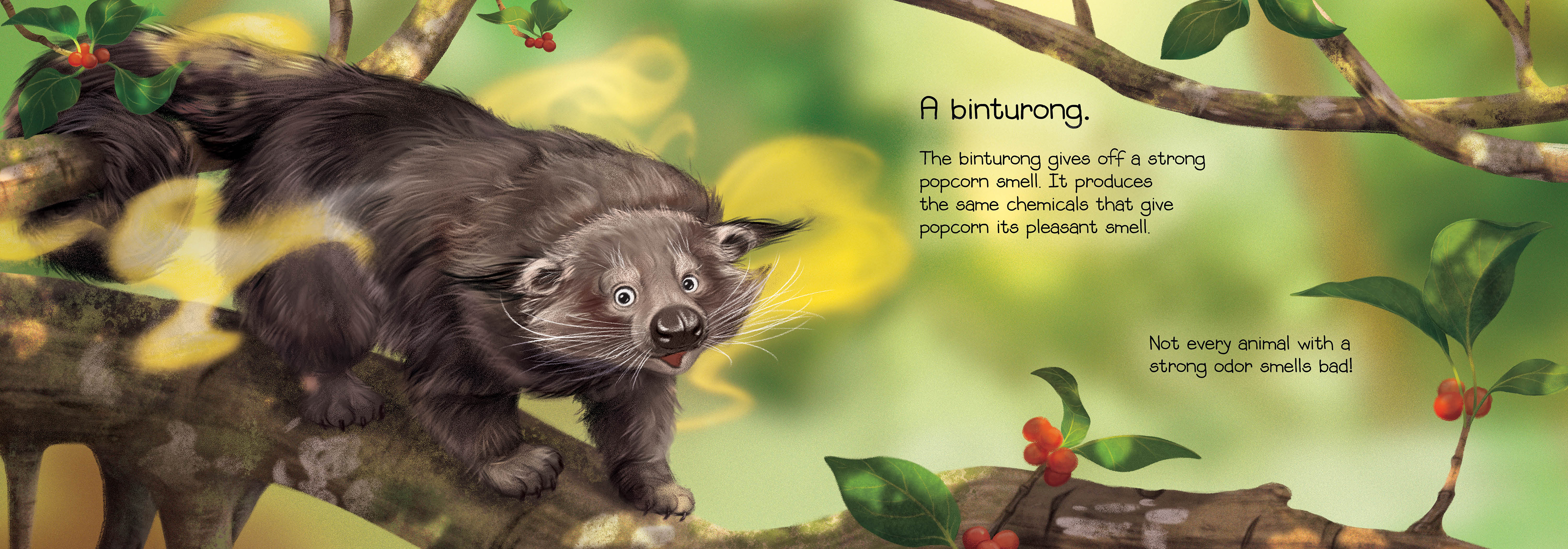
Binturong
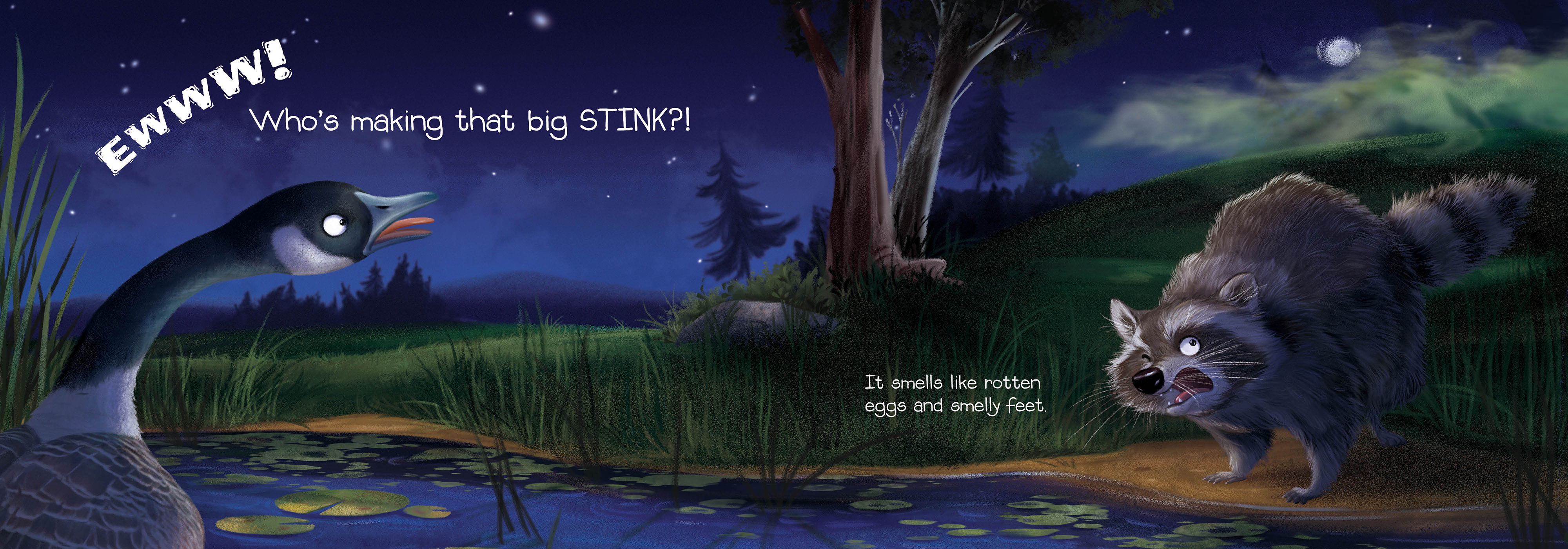
A celebratory pinch of the nostrils to 13 particularly aromatic members of the plant and animal kingdoms. Chen’s animated images depict comically paw-waving or otherwise disturbed-looking wild bystanders asking some variation on the titular question. Lunde begins by highlighting odiferous overachievers—from the fabulously feculent striped skunk to the bombardier beetle (which sprays an irritant from its rear when disturbed) to—representing the plant kingdom—the evocatively named corpse flower. From there he moves on to strong but less offensive tangs such as the binturong’s popcorn smell, the beaver’s vanilla-scented “goo,” and the flowery oil that male ring-tailed lemurs rub on their tails to attract mates. The author admits that the purple clouds emitted by sea hares may or may not carry a smell but do somehow distract predatory spiny lobsters. In the same crowd-pleasing vein, he brings his redolent revue to a close with an appropriately waggish salute to the hippo, who flings poop with its whirling tail and so makes the dung hit the fan. Though otherwise naturalistically placed and posed, Chen’s creatures bear almost human expressions, and many are wreathed in visible swirls of funk. A gleeful gallery for any reader with a nose for nature. —Kirkus Reviews
Calling all nature lovers, amateurs, and masters, big and small, this book is well worth a look. With bright colors and smooth illustrations, Lunde offers a fun, detailed book that teaches children about the scents of various animals and plants. Through funny descriptions and detailed images, this story does a phenomenal job of giving readers a chance to learn about the different scents nature holds and explains their purposes. From skunks, the smell of popcorn, bombardier beetles, and the scent of poop, the audience travels the world to meet common and uncommon creatures. Lunde helps his young readers correlate the wonders of the world with items and smells found at home and in everyday locations, making it easier for them to distinguish and connect. This book is a perfect tool for preschool and elementary teachers to get their students excited about animals while also providing a good laugh. Highly recommended. —Children's Literature
Darrin Lunde has worked as a mammalogist at the American Museum of Natural History and at the Smithsonian Institute. His work has brought him into contact with all kinds of animals, big and small, throughout the remote forests of South America, Africa, and Asia where he camped for months at a time to survey species diversity and to discover new species. He is the author of Hello, Bumblebee Bat, a Theodor Seuss Geisel Award Honor Book, After the Kill, and other books about animals. He lives in Washington, DC.
View titles by Darrin Lunde
Eww! Who smells like rotten eggs and smelly feet? Yuck! Whose burps smell like cow poop?
Find out which animals stink (and why) in this reeky, cheeky guessing game for ages 3-7.
Animals make all sorts of smells for all sorts of reasons! Can you guess the stinker from its stink? Simple clues and laugh-out-loud art make this guessing game perfect for rowdy read-alouds. Fun facts from a world-class zoologist reveal the science behind the stink.
Readers are introduced to:
Striped skunk
Stink bird
Musk ox
Corpse flower
Bombardier beetle
Sea hare
Binturong
Reviews
A celebratory pinch of the nostrils to 13 particularly aromatic members of the plant and animal kingdoms. Chen’s animated images depict comically paw-waving or otherwise disturbed-looking wild bystanders asking some variation on the titular question. Lunde begins by highlighting odiferous overachievers—from the fabulously feculent striped skunk to the bombardier beetle (which sprays an irritant from its rear when disturbed) to—representing the plant kingdom—the evocatively named corpse flower. From there he moves on to strong but less offensive tangs such as the binturong’s popcorn smell, the beaver’s vanilla-scented “goo,” and the flowery oil that male ring-tailed lemurs rub on their tails to attract mates. The author admits that the purple clouds emitted by sea hares may or may not carry a smell but do somehow distract predatory spiny lobsters. In the same crowd-pleasing vein, he brings his redolent revue to a close with an appropriately waggish salute to the hippo, who flings poop with its whirling tail and so makes the dung hit the fan. Though otherwise naturalistically placed and posed, Chen’s creatures bear almost human expressions, and many are wreathed in visible swirls of funk. A gleeful gallery for any reader with a nose for nature. —Kirkus Reviews
Calling all nature lovers, amateurs, and masters, big and small, this book is well worth a look. With bright colors and smooth illustrations, Lunde offers a fun, detailed book that teaches children about the scents of various animals and plants. Through funny descriptions and detailed images, this story does a phenomenal job of giving readers a chance to learn about the different scents nature holds and explains their purposes. From skunks, the smell of popcorn, bombardier beetles, and the scent of poop, the audience travels the world to meet common and uncommon creatures. Lunde helps his young readers correlate the wonders of the world with items and smells found at home and in everyday locations, making it easier for them to distinguish and connect. This book is a perfect tool for preschool and elementary teachers to get their students excited about animals while also providing a good laugh. Highly recommended. —Children's Literature
Author
Darrin Lunde has worked as a mammalogist at the American Museum of Natural History and at the Smithsonian Institute. His work has brought him into contact with all kinds of animals, big and small, throughout the remote forests of South America, Africa, and Asia where he camped for months at a time to survey species diversity and to discover new species. He is the author of Hello, Bumblebee Bat, a Theodor Seuss Geisel Award Honor Book, After the Kill, and other books about animals. He lives in Washington, DC.
View titles by Darrin Lunde